
Ever finish a Google Meet sales call and immediately feel like you've forgotten 30% of what was discussed? Or do you struggle with organizing all your post-call notes and follow-ups? You're not alone. Sales professionals everywhere are searching for that "little assistant to take notes and remind me of details" while managing their busy schedules.
The good news? With the rise of powerful AI tools that integrate seamlessly with Google Meet, implementing a sophisticated call scoring system is no longer reserved for enterprise teams with massive budgets. It's now accessible to sales teams of all sizes.
This guide will walk you through exactly how to add call scoring to your Google Meet sales calls, covering the essential metrics, the right tools, and best practices to transform your sales coaching and drive consistent performance.
Call scoring is the process of rating sales representatives' performance on calls using qualitative and quantitative metrics relevant to your sales process. It transforms subjective feedback into structured, data-driven insights.
Qualitative Scoring focuses on the how of the conversation. This includes assessing the quality of the interaction, such as how well reps build rapport, demonstrate active listening, and manage the conversation flow.
Quantitative Scoring focuses on data-driven, measurable aspects of the call. This includes metrics like talk time distribution, the speed of responses to questions, and the number of interruptions.
To score calls effectively, you need a robust scorecard. Here are the critical metrics to track:
.png)
The ideal ratio is often cited as 40% salesperson talk and 60% customer talk. A high salesperson talk time might indicate a one-sided monologue rather than an engaged conversation.
Did the salesperson repeat customer concerns or acknowledge their statements? This demonstrates understanding and builds trust.
The type and frequency of questions matter. The focus should be on asking open-ended questions that encourage the client to share detailed information.
This is crucial. As one sales professional aptly noted, "If you're only doing analysis on the transcript, you're going to have an inaccurate call sentiment." Modern tools use AI to analyze vocal patterns and word choice to detect emotional cues like enthusiasm or frustration, providing a much deeper level of insight.
Score how well the representative follows established frameworks like BANT or MEDDPICC, ensuring a structured and effective approach to qualification.
Assess performance on critical sales behaviors like discovery depth, objection handling, and empathy.
The foundation of any call scoring program is the recording. Google Meet has built-in recording capabilities. Ensure you have the proper permissions and inform participants that the call is being recorded for quality and training purposes.
While manual scoring is possible, it's subjective and time-consuming. The modern approach is to use an AI-powered conversation intelligence platform that integrates directly with your Google Workspace.
Tool Examples:

Once a tool is integrated, define what success looks like.
After each call, the AI platform will automatically generate a completed scorecard, a full transcription, and an AI Summary.
Use the performance dashboards to review trends across the team. Are multiple reps struggling with objection handling? Is the talk-to-listen ratio consistently off?
Use these data points to facilitate coaching sessions that are objective, evidence-based, and focused on specific, improvable behaviors.
Many sales professionals report that "customers don't want to be recorded" or that clients might feel "super sketched by it."
Best Practice: Be transparent. A simple and effective approach recommended by sales professionals is to frame it as a benefit to the client: "I'm going to record this call so I don't miss any details and can send you a summary of our discussion afterward. Is that alright with you?" This turns it from a compliance check into a value-add.
Some team members may worry that "AI is going to monitor our conversation voice tones... you have to have a Ned Flanders tone of voice... to get a good grade."
Best Practice: Frame call scoring as a developmental tool, not a punitive one. The goal is not micromanagement but empowerment. Focus on objective evaluations of the call's content and structure, not personal criticism.
Call scoring on Google Meet is no longer a complex, manual process. By integrating AI-powered tools, you can systematically analyze every sales call, uncover powerful insights, and provide your team with the targeted coaching they need to succeed.
You'll move from subjective feedback to data-driven coaching, improve sales consistency, and build a culture where every call is a learning opportunity.
Ready to stop letting valuable insights slip through the cracks? Explore how Hyperbound's AI-powered platform can transform your sales process. Book a demo to see firsthand how automated call scoring and AI coaching can integrate with your Google Meet workflow and elevate your team's performance.
Sales call scoring is the process of evaluating a sales representative's performance on a call using a set of predefined qualitative and quantitative metrics. It provides structured, data-driven feedback to identify areas for improvement and ensure consistency across the sales team.
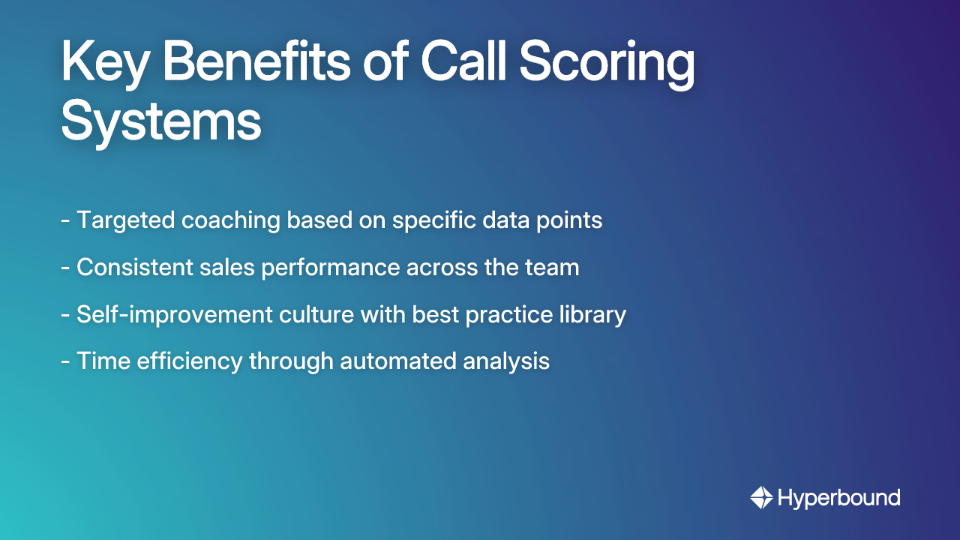
Your sales team should use call scoring to drive significant improvements in performance and consistency. The key benefits include providing targeted, data-backed coaching, identifying and correcting weaknesses early, fostering a culture of self-improvement by creating a library of best practices, and increasing time efficiency for managers through automation.
To implement call scoring for Google Meet, you should follow four main steps. First, ensure you are recording your calls. Second, choose an AI-powered conversation intelligence tool that integrates with Google Meet. Third, customize your scorecards and set up trackers for key topics. Finally, analyze the automated results to provide targeted coaching to your team.
A robust sales call scorecard should include a mix of metrics to provide a complete picture of performance. Key metrics include the talk-to-listen ratio (ideally 40:60), active listening indicators, the quality of questioning (open-ended vs. closed), sentiment and tone analysis, adherence to your specific sales methodology (like BANT or MEDDPICC), and evaluation of core skills like objection handling.
You can convince clients to allow call recording by framing it as a benefit to them. Instead of simply asking for permission, explain the purpose positively. For example, say: "I'm going to record this call so I don't miss any important details and can send you a complete summary afterward. Is that okay?" This approach positions the recording as a value-add that ensures accuracy and thorough follow-up.
Yes, modern AI tools can score sales calls with a high degree of accuracy by analyzing multiple data points beyond just keywords. These platforms evaluate talk-to-listen ratios, sentiment and tone through vocal patterns, adherence to sales methodologies, and other key behaviors. This provides an objective, consistent, and data-driven evaluation that minimizes the human bias often present in manual scoring.










Use Cases
Legal