You've just dialed your prospect's number. They answer. Your heart races slightly as you prepare to launch into your carefully crafted opening line—but wait. There's that awkward disclosure you're supposed to include: "This call is being recorded."
A sales leader once confided, "Having to open a cold call by saying you're recording is a guaranteed way to make sure that call is unsuccessful." Many frontline reps silently nod in agreement. After all, anytime you add friction to a process, your job gets harder.
"Nobody actually says it," whispers the voice of temptation in your ear. But should you really skip this seemingly conversion-killing disclosure?
This article cuts through the confusion surrounding call recording disclosures. We'll explore the legal realities behind wire tapping laws, analyze the actual enforcement landscape, and provide a realistic risk-reward analysis. Most importantly, we'll share practical strategies from sales leaders and reps who've mastered the art of disclosure without derailing their calls.
To understand your obligations, you first need to navigate the complex web of recording laws in the United States.
Call recording laws in the U.S. fall into two main categories:
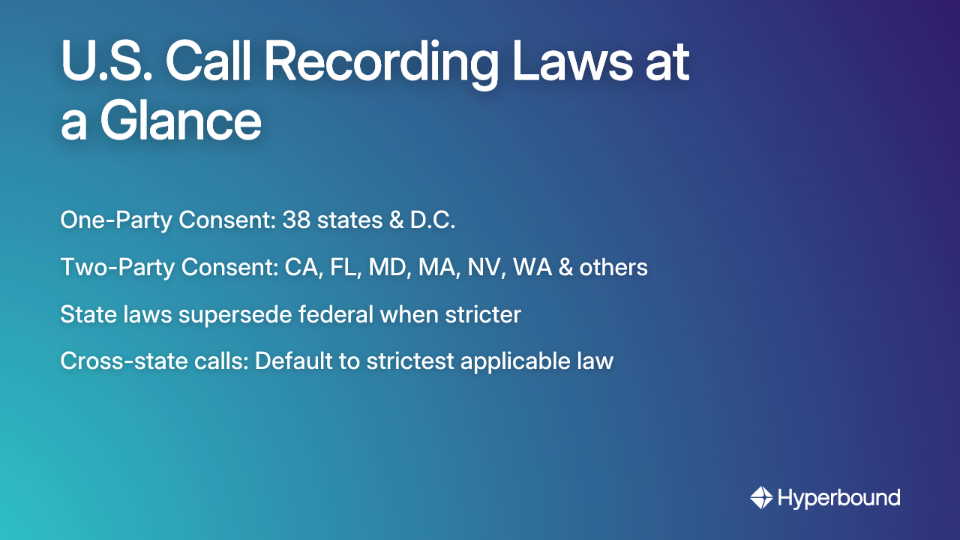
One-Party Consent: In these jurisdictions, only one person on the call needs to be aware of and consent to the recording. As the person initiating the recording, your consent is sufficient.
According to a 2021 analysis by Vonage, approximately 38 states and Washington D.C. follow one-party consent laws.
Two-Party Consent (or All-Party Consent): Every single person on the call must be notified and must consent to the recording.
Key states requiring all-party consent include California, Florida, Maryland, Massachusetts, Nevada (for phone calls), and Washington, among others, as detailed by legal resource site Justia.
The federal law, 18 U.S. Code Section 2511, is a one-party consent statute. However—and this is crucial—state laws supersede federal law when they are stricter.
This means if you're calling someone in a two-party consent state, you MUST abide by the two-party rule, regardless of where you're located. This creates a significant compliance challenge for sales teams conducting prospecting across multiple states.
What happens when you're calling from New York (one-party) to California (two-party)? The safest and most legally sound practice is to default to the strictest law applicable. If any party is in a two-party consent state, you must get consent from everyone.
For global sales teams, it's worth noting that in the European Union, the General Data Protection Regulation (GDPR) requires explicit consent for call recording. Non-compliance can lead to massive fines—up to €20 million or 4% of global annual turnover, whichever is higher.
"The chances of anything actually happening are pretty low, but there is a risk..." This sentiment, expressed by a sales rep on Reddit, reflects a common view. But what exactly is that risk?
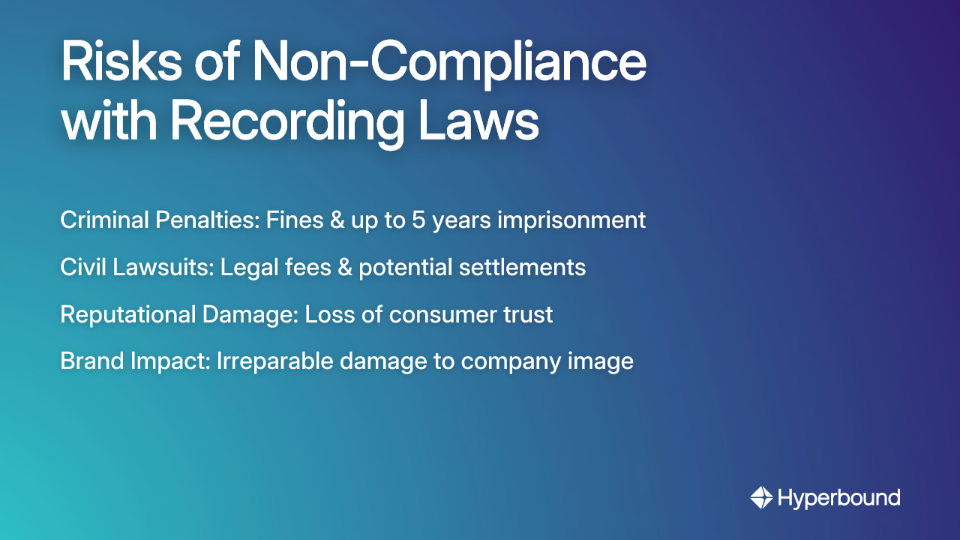
Criminal Penalties: Violating federal wiretapping laws can result in fines and imprisonment for up to five years. Some states, like Florida, classify illegal recording as a felony. This isn't just a slap on the wrist—it's a serious criminal offense.
Civil Lawsuits: A person recorded without their consent can file a civil lawsuit for damages. These lawsuits can be costly in terms of legal fees and potential settlements, even if you ultimately prevail.
Reputational Damage: Beyond legal fees, getting caught can lead to a significant loss of consumer trust. In an age where brand reputation is paramount, the damage from being labeled as a company that deceptively records calls can be irreparable.
The Reward: A potentially smoother call opening, avoiding immediate hang-ups, and a less "censored" prospect.
The Risk: Felony charges, massive fines, civil litigation, and irreversible brand damage.
The Verdict: The potential upside of a single successful call does not outweigh the catastrophic downside of legal and reputational ruin.
Let's look at how successful sales professionals manage this requirement without tanking their calls.
Many successful reps don't see the disclosure as a hurdle but incorporate it confidently into their approach.
"Just say it confidently and quickly then move on. Most people will not make it a big deal," advises one experienced sales rep on Reddit.
The key is to deliver it not as a legal formality but as a standard part of your professional process. As another rep puts it, "Just straight up own it, tone is everything in sales anyways."
For reps who don't follow strict scripts, integrating the disclosure can feel especially awkward. As one salesperson noted, "I'm actually dialing the number and not really working with any sort of script," making it challenging to smoothly incorporate the disclosure.
When prospects do question the recording, having a ready explanation can turn a potential objection into a trust-building moment. One rep shared, "I've had people get up in arms about it and just explain it's a safety measure for both us and them." This shifts the frame from intrusive surveillance to mutual protection.
Now let's get tactical with specific approaches that maintain compliance without killing your connection.
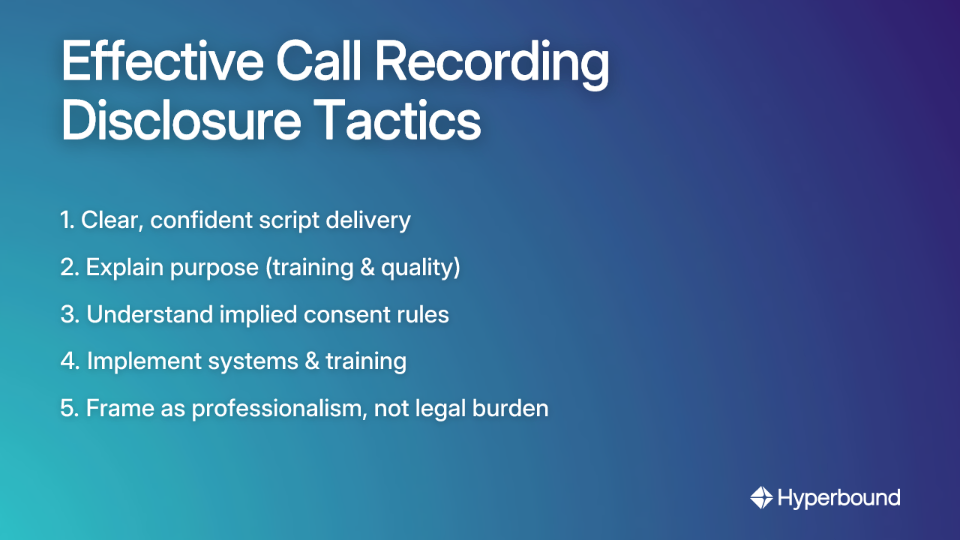
Here are some effective disclosure phrases that real sales reps use:
Pro-Tip: A/B testing different versions of the disclosure can help you find what feels most natural and gets the best response from your prospects.
The Federal Communications Commission (FCC) emphasizes transparent communication. A simple phrase like, "Just so you know, this call may be recorded for quality and training purposes" is widely accepted and builds trust rather than eroding it.
Explaining the purpose of the recording—typically for training and quality assurance—helps prospects understand there's a legitimate reason beyond surveillance.
In many states, consent can be legally implied if a person is clearly notified that the call is being recorded and chooses to continue with the conversation. According to legal experts at Justia, acceptable FCC notification methods include:
Once notified, if the prospect continues the conversation, they've typically provided the necessary implied consent.
Implement Systems: Use a VoIP system or CRM with features that automate disclosures or allow for easy consent management. This protects the company from compliance issues while reducing the burden on individual reps.
Mandate Training: One of the biggest pitfalls is a lack of training on disclosure requirements. This is where AI coaching platforms like Hyperbound become invaluable. By using AI-powered roleplays, reps can practice their disclosure statements in a safe, repeatable environment until they sound natural and confident. Regular training on compliance and best practices is essential for any team making cold calls, and using a platform to scale this training ensures consistency.
The tension between legal compliance and sales effectiveness is real. But the path of least resistance—skipping the disclosure—carries risks that no commission check can justify.
Mastering the disclosure is a non-negotiable skill in modern sales. It's not about adding friction; it's about demonstrating professionalism and transparency from the very first interaction. When delivered with confidence, it builds trust and sets a professional tone for the entire conversation.
Don't view the recorded line disclosure as a barrier. View it as your first opportunity to control the call with integrity, protecting yourself, your company, and the relationship you're about to build.
After all, if a prospect is going to hang up because you're recording the call, they were likely going to hang up anyway. As one sales veteran put it: "If they hang up, they were hanging up regardless of having a call recording disclosure or not."

The best reps don't hide from compliance—they use it to demonstrate the transparency and professionalism that ultimately wins deals.
The difference is how many people must consent to the recording. One-party consent requires only one person on the call to agree (typically the one recording), while two-party consent requires everyone on the call to be notified and give their consent. It is critical to know which law applies to your prospect's location before recording.
The strictest law applies, meaning you must follow the two-party consent rule. Whenever any party to a conversation is in a state with stricter regulations (e.g., California, Florida), you must obtain consent from all participants to be legally compliant. The safest approach for any national sales team is to disclose all recorded calls.
Explain that calls are recorded for quality and training purposes. This is a standard business practice that demonstrates transparency. Saying something like, "We record calls for quality assurance and to help train our team," frames the recording as a tool for improving service, which can build trust.
Yes, the penalties for illegal call recording are severe. Violations can lead to criminal charges (including felonies), significant fines, and civil lawsuits. Beyond the legal and financial risks, the damage to your company's reputation and customer trust can be immense and long-lasting.
Deliver the disclosure confidently as a standard part of your opening. Integrating it smoothly, such as saying "Hi, this is [Name] from [Company] on a recorded line. The reason I'm calling is...", makes it feel routine. The key is practicing your delivery so that your tone is confident and professional, not hesitant.
Implied consent is when someone continues a conversation after being clearly told it is being recorded. Yes, in most jurisdictions, this is legally sufficient. As long as you provide an unambiguous verbal notification at the beginning of the call, the other person's choice to stay on the line and talk is generally considered consent.
Yes, call recording laws apply to conversations with individuals, whether in a B2B or B2C context. Privacy laws protect people, not just private citizens. When you call someone at their business, you must still follow the consent regulations for their specific location.








Use Cases
Legal