
You just wrapped a great discovery call. The prospect mentioned a critical pain point, hinted at a competitor they're evaluating, and signaled they're ready to move fast. Then the call ends — and within 48 hours, that nuance is gone. Your rep's notes say "interested, follow up next week." The insight is dead.
This is the core problem that call intelligence software was built to solve. At its most basic, call intelligence (CI) software records, transcribes, and analyzes sales conversations — surfacing patterns, keywords, talk ratios, and sentiment to give revenue leaders visibility into what's actually happening in customer conversations.
But here's the gap that most reviews don't address: the majority of tools are exceptional at creating data and terrible at creating change.
Sales ops teams on forums like Reddit describe the problem clearly: "AI summaries or call scores which are very generic and completely random at times," and "manager coaching layers are pretty thin." The real complaint isn't that these tools don't capture information — it's that the information doesn't make reps better. "When insights stay in a rep's head or get buried in call notes, coaching and forecasting both suffer."
The next generation of call intelligence software needs to close the loop — not just show you what happened on a call, but change what happens on the next one.
Here are the 7 best call intelligence software tools for sales teams, along with a buyer's guide to help you make the right choice.
Hyperbound is positioned as a Revenue Activation Platform — a category it coined to describe what happens when teams stop just analyzing call data and start using it to change outcomes.
What it does well:
Hyperbound Perform deploys AI scorecards on 100% of real customer conversations, automatically scoring calls against your custom methodology (MEDDIC, BANT, Challenger — whatever your team runs). But unlike tools that stop at a scorecard, Perform connects those scores to action.
Its standout feature is the connection between call analysis and rep practice. When Perform identifies a skill gap — say, a rep struggling with multi-threading or economic buyer conversations — it automatically recommends targeted Bitesized Roleplays from Hyperbound Practice. This creates a continuous improvement loop: Score Real Calls → Identify Skill Gaps → Practice Roleplays → Score Again.
Perform also goes beyond single-call analysis. Its AI Deal Coaching rolls up insights across every touchpoint in a deal's lifecycle — from cold call to closing conversation — surfacing early risk signals and recommending deal-winning actions while opportunities are still winnable.
Above it all, Kota Activate acts as an AI Revenue Analyst that orchestrates the entire system, recommending personalized coaching interventions based on combined Practice and Perform data.
Best for: Sales enablement leaders who need to tie training ROI to live pipeline outcomes. Frontline managers who need scalable deal inspection without listening to every call. CROs scaling teams quickly — Hyperbound customers like Vanta report 60% ramp reduction (from 210 to 72 days) and 5x pipeline growth, while Nivoda saw a 150% demo rate increase and 2x revenue YoY.
What it lacks: Hyperbound Perform is not a forecasting tool. While deal health insights can improve forecast inputs, predicting quarterly numbers is not its purpose. Teams looking purely for pipeline forecasting should layer in a dedicated tool.
Gong is the most recognized name in call intelligence software — and for good reason.
What it does well:
Gong excels at deep call analytics: talk-time ratios, customer sentiment, topic trends, and competitor mention tracking. Its Deal Boards give revenue leaders a real-time view of pipeline health grounded in actual conversation data. Smart Trackers can be configured to flag objections, buying signals, and methodology adherence across every rep's calls. At scale, it's a powerful visibility engine.
Best for: Large revenue organizations (20+ reps) that need comprehensive pipeline analytics. As noted in user research, "Gong is great but you will need serious funds behind you to afford it" — it's a premium tool built for mature, well-funded teams.
What it lacks: Gong has no native AI roleplay or structured practice environment. It can identify that a rep is struggling with objection handling, but it can't give that rep a safe place to practice. It analyzes — it doesn't activate. Teams using Gong for coaching often find they still need a separate solution to close the behavior-change loop.
Chorus is a well-established CI platform, now part of the ZoomInfo ecosystem.
What it does well:
Chorus captures and analyzes conversations to surface winning behaviors, coaching opportunities, and pipeline risks. Its deepest advantage is integration with ZoomInfo's data — call analysis can be enriched with contact and company intelligence, giving context to conversation patterns. It's a solid platform for organizations already embedded in ZoomInfo's suite.
Best for: Large organizations that are heavily invested in the ZoomInfo ecosystem and want a stable, established solution for conversation analytics and pattern recognition.
What it lacks: Like Gong, it lacks a direct mechanism for rep behavior change. Reviews note limited real-time guidance during calls and limited pricing transparency, which makes it difficult for smaller teams to evaluate. If you want insights to translate directly into rep improvement, you'll need to build that bridge yourself.
Salesloft integrates conversation intelligence directly into its broader sales engagement platform.
What it does well:
The primary benefit of Salesloft is consolidation. Call recording, CI analysis, email sequencing, and dialer capabilities live inside one platform. For RevOps teams fighting tool sprawl, that's genuinely appealing. Insights from conversation analysis can feed directly into engagement workflows without switching contexts.
Best for: Sales teams that prioritize a unified workflow experience over specialized CI depth. If your team runs high-volume outbound sequences and wants call analysis baked into the same platform, Salesloft is worth evaluating.
What it lacks: The CI features are not as analytically deep as dedicated tools like Gong or Chorus, and there's no AI-driven practice environment. Teams that need rigorous call scoring, methodology adherence tracking, or a behavior-change loop will find the platform's CI layer falls short.
Jiminny differentiates itself through a focus on structured, manager-led coaching workflows.
What it does well:
Jiminny's standout feature is live coaching support — managers can listen in via "incognito coaching" and provide real-time feedback to reps during live calls. On the post-call side, it uses structured scorecards and thematic analysis to help managers deliver consistent, data-backed coaching. Teams using Jiminny have reported up to a 15% increase in win rates.
Best for: Sales managers who want to be actively involved in call coaching and need a platform that structures their feedback process. Works best for teams where manager bandwidth is available and coaching culture is already strong.
What it lacks: The model is manager-dependent, which limits scale. There's no AI-driven practice environment for reps to work on skills independently. Reviews note a lack of real-time objection handling guidance for reps themselves — the coaching flows to the manager, not back to the rep in a structured way.
Fathom is the lightest-weight option on this list — and intentionally so.
What it does well:
Fathom automates the meeting documentation problem. It records, transcribes, generates AI summaries, and syncs notes directly to your CRM — eliminating the "rely mostly on notes and CRM updates" pain that sales reps experience daily. It's fast to set up, has a generous free tier, and is beloved by individuals and small teams who simply need a reliable automated note-taker.
Best for: Individual contributors or small teams whose primary need is capturing meeting insights and reducing manual CRM data entry. If you're just starting to explore call intelligence software and need a low-friction entry point, Fathom is worth a look.
What it lacks: Fathom is a productivity tool, not a performance platform. It doesn't offer deep conversation analytics, call scoring against sales methodologies, deal risk identification, or any form of rep coaching. For teams that need systematic behavior change, Fathom will quickly hit its ceiling.
Avoma delivers a solid suite of meeting intelligence features at a competitive price point — making it a popular choice for growing teams.
What it does well:
Avoma covers the core CI bases: AI summaries, agenda templates, topic intelligence, customizable scorecards, and smart trackers for deal risks. Its coaching automation features help managers scale feedback beyond what they can deliver manually. For small to mid-sized teams, it punches above its weight relative to cost, as noted in multiple comparisons.
Best for: Small to mid-sized, meeting-heavy teams that need a budget-friendly solution covering the essentials of conversation intelligence without enterprise-level complexity or pricing.
What it lacks: At the enterprise level, Avoma has "limited in-depth integration capabilities for complex workflows." It lacks the analytical depth of Gong and the active practice loop of a platform like Hyperbound. For teams with complex tech stacks or serious performance-gap issues, it may not be enough.
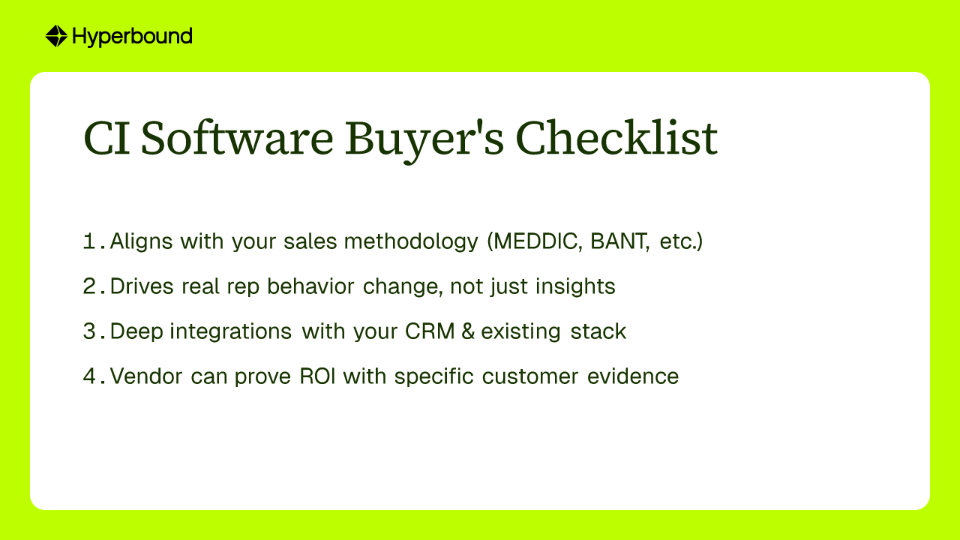
Before you sign a contract, move beyond the feature checklist. Here are four criteria that matter more than most vendors will tell you.
Generic scorecards produce generic insights. Your call intelligence software should allow you to build custom scorecards and trackers based on your specific methodology — whether that's MEDDIC, BANT, Challenger, or something proprietary. If the tool can't measure what you're already training reps on, it's creating noise, not signal.
This is the question most buyers forget to ask. A dashboard full of data is worthless if it doesn't lead to action. Ask vendors specifically: What happens after a gap is identified? Look for a platform that creates a clear feedback loop — where identifying a weakness in a real call automatically connects to a mechanism for the rep to practice and improve that specific skill. Tools that close this loop (like Hyperbound) are built to solve the root problem. Tools that stop at insights are selling you half a solution.
Surface-level integrations create more work than they save. One Sales Ops practitioner put it plainly: look for "tools that best integrate with your existing stack, specifically your CRM data." Evaluate native integrations across:
The goal: a seamless data flow that autofills CRM properties, enriches deal records, and slots into your existing workflows — not another silo.
Your vendor should be able to show you — with customer evidence — how their platform impacts the metrics that matter: ramp time, win rate, deal velocity, coaching hours saved. When evaluating proof points, look for specificity. For example, Hyperbound customers report 50% faster ramp time, a 150% increase in demo conversion rates, and 3.5 workweeks of coaching saved. Demand the same specificity from every vendor you evaluate.
Call intelligence (CI) software is a tool that records, transcribes, and analyzes customer conversations to provide insights into sales performance. It helps sales leaders understand what's happening in calls by tracking keywords, talk-to-listen ratios, competitor mentions, and sentiment. The primary goal is to move beyond anecdotal notes and base coaching and strategy on real conversation data.
Call intelligence is important because it provides objective visibility into what works and what doesn't in customer conversations, preventing critical insights from being lost after a call ends. Without it, managers rely on rep self-reporting and incomplete notes. CI software surfaces coachable moments, identifies deal risks, and helps standardize winning behaviors across the entire team.
Call intelligence software improves sales coaching by replacing guesswork with data, allowing managers to pinpoint specific skill gaps based on real call performance. Instead of generic feedback, managers can use CI tools to review specific moments in a call and use data-backed scorecards. Advanced platforms like Hyperbound take this further by automatically recommending targeted practice exercises, like AI roleplays, to help reps actively improve on identified weaknesses.
Call intelligence focuses on analyzing past conversations to generate insights, while Revenue Activation focuses on using those insights to actively change future sales outcomes. Most CI tools show you what happened on a call. A Revenue Activation Platform closes the loop by connecting those insights to action, ensuring that identified gaps are addressed with targeted practice and coaching to drive measurable behavior change.
For small teams or individual users, Fathom and Avoma are often the best starting points due to their focus on core features and budget-friendly pricing. Fathom excels at automated note-taking and syncing meeting summaries to your CRM. Avoma provides a more comprehensive suite of conversation intelligence features, including scorecards and coaching workflows, at a price point that is accessible for growing teams.
When choosing call intelligence software, you should look for four key things: alignment with your sales methodology, a clear mechanism to drive rep behavior change, deep integrations with your existing tech stack (especially your CRM), and proven customer ROI. The best tool is one that can measure what you train on (e.g., MEDDIC, BANT), connects insights to practice, and can demonstrate its impact on key metrics like ramp time and win rates.
The first generation of call intelligence software gave revenue teams visibility. The next generation has to give them results.
Recording and transcribing calls is table stakes. The tools that will define the next era of sales performance are the ones that don't just surface what happened — but change what happens next. That means connecting real call performance to targeted practice, closing the loop between insight and action, and making rep behavior change systematic rather than accidental.
That's the idea behind Revenue Activation — and it's why the gap between "we have call data" and "we're winning more deals because of it" is the most important distance to close in your tech stack.









Use Cases
Legal