
Here's a number that should make every sales rep uncomfortable: most reps spend 90% of their preparation time building slides and only 10% — or zero — actually rehearsing their delivery.
And yet, C-suite buyers can detect unpolished delivery within the first two minutes of a presentation. One executive put it bluntly in a Reddit thread on C-suite presenting: "If you haven't got me interested in 60 seconds, I'll ask you to leave my office."
That's the real stakes of a C-suite sales presentation. It doesn't matter how polished your deck is if your delivery is shaky, your answers to tough questions are fumbled, or your opening hook falls flat. Executives aren't grading your slides — they're evaluating you: your confidence, your command of the room, your ability to tell a compelling story about value generation in their specific context.
The good news? Delivery is a skill. And like every skill, it improves with structured, deliberate practice — not just slide-building.
This guide gives you a five-step rehearsal framework to walk into your next C-suite sales presentation with confidence, composure, and a message that lands.
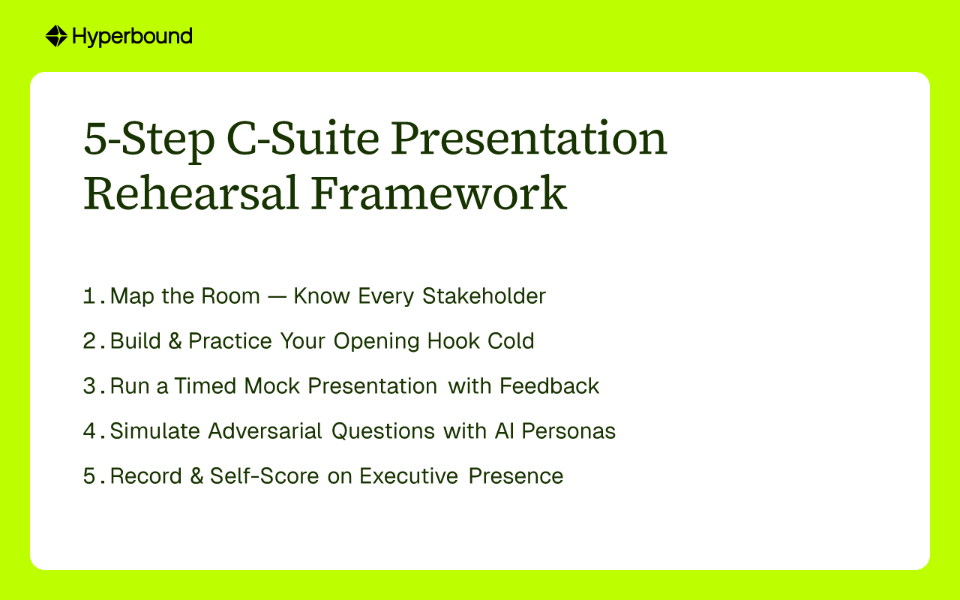
Before you practice a single word, you need to know who you're presenting to and what each person in the room actually cares about.
C-suite executives are not a monolith. As one practitioner noted, they want to know "what benefits the project is going to bring to the business, how much it will cost, and how you will manage change." But how that breaks down depends entirely on which executive is asking.
How to build your stakeholder map:
Create a simple four-column table for each person expected in the room:
.png)
Research each attendee on LinkedIn before you rehearse. What do they post about? What are their stated priorities? What does their team care about? Tailoring your message to each executive's lens isn't optional — it's the baseline for C-suite sales presentation practice.
Your opening 60 seconds will determine whether the rest of your presentation gets a fair hearing. Executives have short windows of genuine attention — and as one practitioner noted on Reddit, "They are thinking about golf" if you haven't captured them immediately.
Your opening hook should not be about you or your product. It should be about their problem, elevated to the strategic level they operate at.
A strong hook structure:
"In conversations with [Role] leaders in [Industry], we consistently hear that [specific pain] is costing [metric]. Today, I want to show you exactly how [Company] can eliminate that drag — and what that's worth over the next 12 months."
This immediately demonstrates you understand their world and that you're there to generate value, not just present features.
Now practice it cold — without notes, without warm-up.
That means standing up, not looking at your screen, and delivering it as if you just walked into the room. Record yourself on your phone. Watch it back. Does it sound natural or recited? Are you making eye contact with an imaginary audience? Are you starting with confidence, or do the first five seconds feel tentative?
Repeat until the words feel like yours, not like a script.
A solo rehearsal in front of your bathroom mirror will only take you so far. Real preparation means simulating the actual dynamics of the room — multiple stakeholders, competing agendas, and the time pressure of a C-suite calendar slot.
The rule here is simple: find out how much time you have with them, then plan to spend at most half of it presenting. The rest should be dialogue. That means your timed rehearsal should be practiced at that compressed length, not the full slot.
This is where Hyperbound Practice transforms the rehearsal process. Instead of relying on a peer who may not push back realistically — or a manager who's too busy for a full run-through — Hyperbound lets you run scalable, consistent, and genuinely challenging simulations.
The feature that matters most here: Multiparty Roleplays.
C-suite meetings are almost never one-on-one. Hyperbound's Multiparty Roleplay feature lets you simulate a room full of AI buyer personas simultaneously — a skeptical CFO pressing on ROI, an enthusiastic Champion trying to stay aligned, and a quiet CTO who hasn't been sold yet. This mirrors the stakeholder map you built in Step 1 and forces you to manage the room dynamically, not just recite a prepared script.
After each run, Hyperbound's AI Scorecards give you immediate, objective feedback on:
Peer feedback has its place, but it's often subjective and incomplete. Scorecard data gives you a quantitative baseline to improve against across multiple rehearsal runs — which is exactly how you track real progress in your c-suite sales presentation practice.
The worst moment to hear a deal-breaking objection is in the actual meeting. The best moment is in rehearsal, repeated until you have a composed, credible, and practiced response ready.
This step is about intentionally putting yourself under pressure — seeking out the hardest questions and roleplaying through them until the answers are automatic.
Common adversarial C-suite objections include:
Hyperbound Practice is purpose-built for this kind of pressure testing. Its AI buyer personas are trained on 2 million+ hours of real B2B sales conversations — not generic chatbot scripts — so the pushback feels realistic, not formulaic.
How to customize the simulation for C-suite adversarial practice:
The goal isn't to memorize perfect answers — it's to build the composure to handle unexpected pressure with confidence. Executives are watching how you respond under stress as much as they're evaluating your answer content.
"Executive presence" sounds abstract — but it's actually measurable. Research from ASLAN Training found that gravitas accounts for 67% of executive presence perception, followed by communication style and appearance. If you can't see yourself the way executives see you, you can't improve.
Recording your rehearsals — and watching them critically — is one of the highest-leverage things you can do to sharpen your delivery.
Two ways to watch your recording:
Use the AI Scorecard data from your Hyperbound Practice sessions as the quantitative foundation — talk ratios, methodology adherence, pacing — and layer on your own qualitative assessment from the recording.
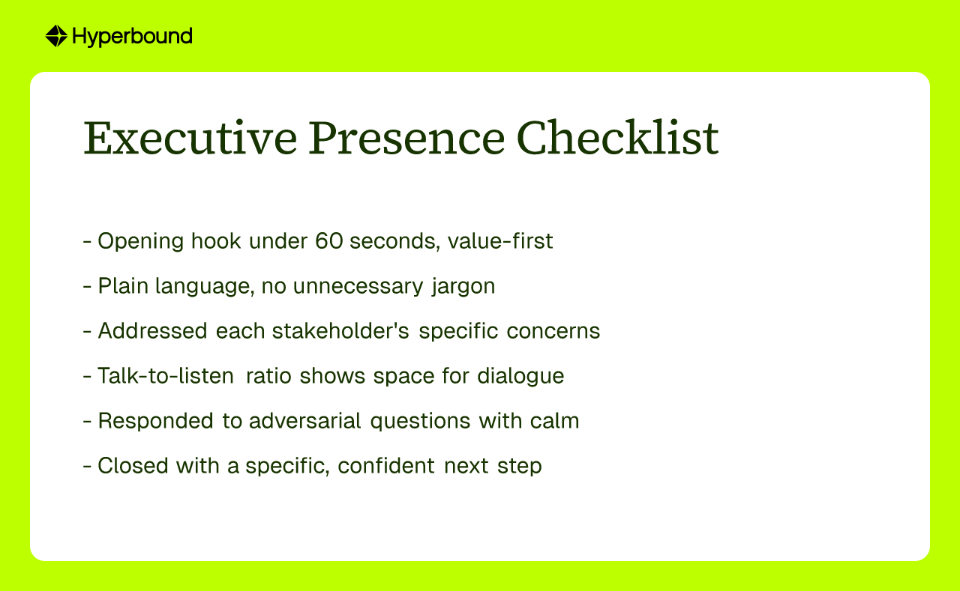
Use this after every practice run to score yourself and identify your #1 focus area for the next rehearsal.
Clarity & Brevity
Audience Engagement
Confidence & Gravitas
Storytelling & Message Clarity
Overall Self-Assessment
The path to winning in the C-suite is not paved with more polished decks. It's built through deliberate, structured rehearsal that sharpens your delivery, tightens your message, and builds the composure to handle whatever the room throws at you.
Map your stakeholders. Practice your hook cold. Run multiparty simulations with real-time feedback. Pressure-test with adversarial AI personas. Record yourself and score honestly.
Each step in this framework closes the gap between the rep who prepared a presentation and the one who commanded the room.
Tools like Hyperbound provide the AI roleplays, multiparty simulations, and data-driven scorecards to make every rehearsal count — not just for one high-stakes meeting, but as an ongoing practice that compounds over time. Across 250,000+ simulations and 1.1M+ minutes of practice delivered, the reps who win are the ones who treat rehearsal as a competitive advantage, not an afterthought.

Prepare. Practice. Perform. That's how you activate revenue at the top of the org chart.
Rehearsal is crucial because C-suite executives evaluate the presenter's delivery and confidence, not just the slide deck. Most sales reps spend too much time on slides and not enough on practice, yet executives can spot an unpolished delivery within the first two minutes. Deliberate practice builds the confidence and composure needed to command the room and handle tough questions effectively.
The best way to open is with a strong, 60-second hook that focuses on the executive's strategic problems, not your product. A powerful opening structure demonstrates that you understand their industry and challenges, immediately framing the conversation around value generation. It's critical to practice this opening "cold"—without notes and while recording yourself—until it sounds confident and natural.
You should prepare by creating a stakeholder map for every executive in the room. C-suite leaders are not a monolith; a CFO cares about ROI, a CTO focuses on technical integration, and a CRO is concerned with revenue impact. By mapping each stakeholder's primary goals, likely objections, and your proactive response, you can tailor your message to address their specific concerns directly during the presentation.
The best way to handle tough questions is to prepare for them in advance through adversarial simulation. Intentionally practice answering the hardest, most common objections (e.g., regarding cost, competitors, or ROI) until your response is calm, credible, and automatic. Using AI role-playing tools with skeptical personas can help you build the composure to handle unexpected pressure with confidence in the live meeting.
Executive presence is the combination of gravitas, communication style, and composure that conveys credibility and confidence to senior leaders. You can develop it by recording your rehearsals and critically evaluating your performance. Watch your recordings with the sound off to analyze body language and with the screen off to assess your vocal tone and clarity. Using a checklist to self-score on factors like brevity, audience engagement, and response to pressure helps make a seemingly abstract concept measurable and improvable.
AI tools can significantly enhance C-suite presentation practice by providing scalable, realistic, and data-driven simulations. Tools like Hyperbound allow you to run multiparty roleplays with different AI buyer personas (like a skeptical CFO and an eager Champion) simultaneously. After each session, AI scorecards provide objective feedback on metrics like talk-to-listen ratio, pacing, and filler word usage, giving you a quantitative baseline for improvement.










Use Cases
Legal