
You've invested in sales coaching sessions, but your team's performance remains frustratingly stagnant. The expensive consultant offered generic advice that didn't align with your B2B reality, and now you're left wondering if you've wasted valuable resources on yet another failed improvement attempt.
This scenario plays out in businesses everywhere. As one frustrated business owner shared, "I ended up canceling the last 2 sessions because it was a waste of time. I really wanted help with laying the framework for my business, but I didn't get that." Another lamented paying "$2000/mo for 2 years" only to eventually outgrow the advice they received.
The problem isn't that coaching doesn't work – it's that traditional coaching often lacks the structure, data, and accountability needed to drive measurable results. According to Gartner research, companies with effective coaching can increase their sales performance by as much as 8%. Yet despite this potential, only 26% of sales reps report receiving weekly one-on-one coaching, according to Salesforce's State of Sales report.
The missing link? Technology. The right coaching tools provide the framework and insights that turn generic advice into transformative action. Let's explore how these tools can revolutionize your sales coaching efforts and deliver the ROI you've been searching for.
Effective business coaching isn't just about dispensing advice – it's a "collaborative relationship aimed at developing a successful company," according to EMyth. A great coach (or coaching system) provides a clear roadmap, fosters empowerment, and acts as a trusted accountability partner.
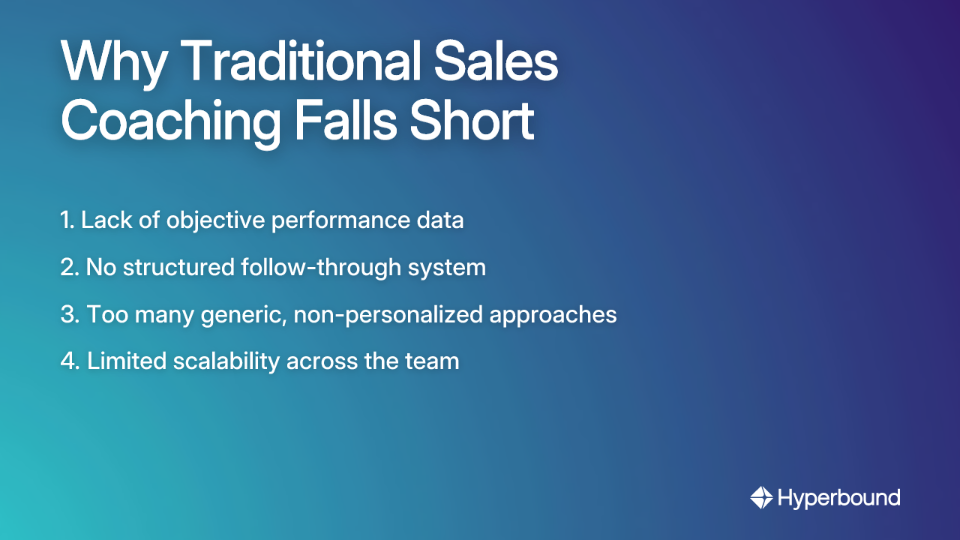
Yet many coaching relationships fall short because they lack:
Modern coaching tools address these shortcomings by creating systematic approaches built on four core principles:
Before diving into specific tools, it's helpful to understand that sales coaching software generally falls into two categories:
Now, let's explore the 10 tools that can transform your sales coaching efforts:
Overview: An AI Sales Coaching platform that uses your own call data to create hyper-realistic practice scenarios.
Key Features: Hyperbound analyzes your team's actual sales conversations to identify winning behaviors, then builds AI-powered roleplays for reps to practice everything from cold calls to objection handling. It provides instant, objective feedback and AI Real Call Scoring, helping to reduce new hire ramp time, scale best practices, and ensure the entire team is sales-ready.
This system moves coaching from subjective advice to a data-driven practice ground, ensuring reps can master new playbooks before they talk to a single customer.
Overview: An AI-powered platform that analyzes sales calls to provide deep insights for coaching.
Key Features: Uses machine learning to surface key moments in calls, tracks talk-to-listen ratios, and helps managers reverse-engineer what top performers do differently. This creates a data-driven approach to identifying best practices that can be replicated across the team.
Outreach enables managers to move beyond "I think you should try this approach" to "Here's what our top performers are saying that's working."
Overview: A real-time, in-call coaching tool powered by AI.
Key Features: Provides live alerts and cue cards during calls to help reps with talking points, objection handling, and competitive intelligence. It acts like a coach whispering in their ear, offering guidance at the moment it's most needed.
This eliminates the "I wish I had remembered to say that" problem that plagues even experienced sales professionals.
Overview: A revenue intelligence platform that enables managers to listen to and provide feedback on calls.
Key Features: Allows managers to save "teachable moments" from calls and build a library of best practices for training the entire team. This creates a continuous learning environment where every call contributes to the team's collective knowledge.
Overview: A sales readiness platform with an AI-powered virtual coach.
Key Features: Reps can practice their pitch and receive instant feedback on message adherence, use of filler words, rate of speech, and conveyed emotion. Perfect for building confidence before a critical meeting.
This tool solves the problem of reps feeling unprepared or uncertain before important client interactions.
Overview: A metrics-driven platform that uses gamification to motivate sales teams.
Key Features: Features customizable dashboards, goal-tracking scorecards, and leaderboards to create a high-energy, competitive environment. Ambition turns sales KPIs into engaging contests that drive behavior change through healthy competition and recognition.
This approach is particularly effective for motivating teams that thrive on competition and public recognition.
Overview: A mobile-first training platform designed for modern sales teams.
Key Features: Specializes in microlearning—delivering short, bite-sized lessons that improve knowledge retention. It's offline-capable and uses AI-enhanced search so reps can find answers in the moment of need.
This solves the problem of traditional training that overwhelms reps with information they can't remember when they actually need it.
Overview: A Salesforce-native tool focused on providing crystal-clear visibility into the sales pipeline.
Key Features: While not a direct coaching tool, it's foundational. Weflow offers multiple pipeline views, activity tracking, and deal signals. This data allows managers to see exactly where reps are struggling and where coaching is needed most.
The platform helps answer the critical question: "Which deals need coaching attention right now?"
Overview: A comprehensive sales readiness platform that connects training directly to performance outcomes.
Key Features: Combines training modules, conversation intelligence, and performance analytics to show the direct impact and ROI of coaching efforts on quota attainment. This creates a closed-loop system where coaching directly ties to business results.
Overview: A performance management platform that helps leaders build structured coaching programs within their CRM.
Key Features: Enables managers to create consistent coaching cadences, track key sales activities and behaviors, and keep the team focused on the leading indicators that drive results.
This addresses the common issue of inconsistent coaching that varies widely from manager to manager.
Before investing in any tool, address the user pain of mismatched coaching by starting with your "why." Define your primary goal: Is it improving discovery calls, increasing motivation, or streamlining training for new hires?
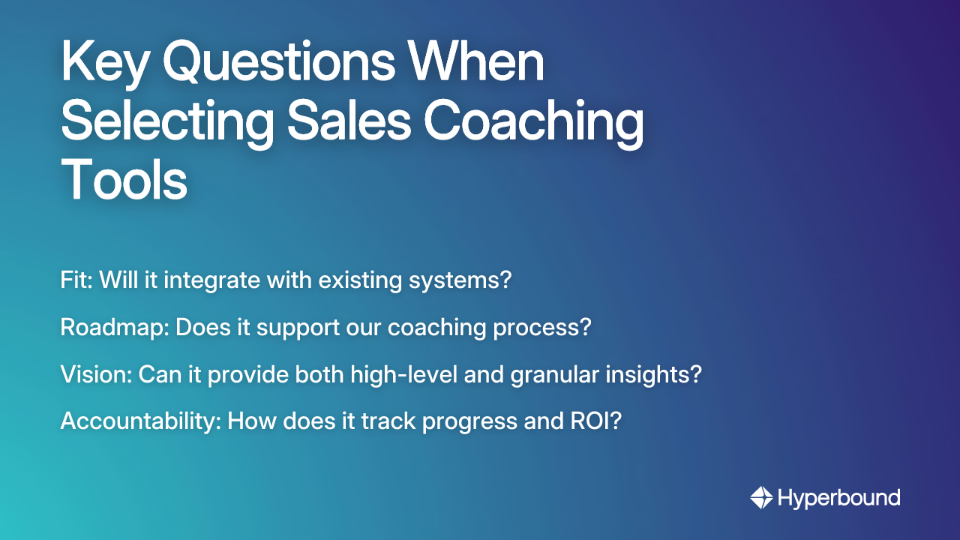
Ask these critical questions (adapted from EMyth's approach to coach selection):
Also consider your team's well-being. With 70% of salespeople reporting struggles with mental health according to the Sales Health Alliance, choose tools that foster a supportive, feedback-rich environment rather than a purely judgmental one.
A smart approach is to pilot a tool with a small, coachable group before a company-wide rollout to ensure it meets your specific needs.
Stop blaming stagnation on a lack of effort. Empower your team with systems that make improvement inevitable. Modern coaching tools provide the structure, data, and accountability that generic consulting often fails to deliver.
These tools don't replace managers; they turn them into better, more effective coaches. They empower reps to take ownership of their development, creating a culture of excellence where everyone is constantly improving.
Stop hoping for better results. Pick one area of improvement, explore a tool from this list that aligns with your goal, and start building a high-performance sales engine today. The transformation from stagnation to acceleration is just one tool away.
A sales coaching tool is a software platform designed to improve sales team performance through data analysis, skill development, and structured feedback. These tools help managers and reps by analyzing sales calls, providing AI-powered practice scenarios, tracking key performance indicators (KPIs), and offering structured training modules. They replace subjective feedback with objective, data-driven insights to make coaching more effective and scalable.
Traditional sales coaching often fails because it lacks objective data, structured follow-through, personalization, and scalability. Without concrete metrics, feedback can be subjective and inconsistent. One-off sessions are easily forgotten without a system for implementation, generic advice doesn't solve specific challenges, and it's difficult to scale individual coaching across an entire team. Modern coaching tools are designed to solve these specific problems.
AI sales coaching platforms work by analyzing large volumes of sales conversation data to identify winning patterns and create personalized training experiences. For example, platforms like Hyperbound analyze your team's best calls to understand what works. The AI then creates hyper-realistic roleplay scenarios for reps to practice those specific skills, providing instant, objective feedback. Other tools use AI to transcribe calls and pinpoint key moments or provide real-time suggestions during a live call.
To choose the right sales coaching tool, start by defining your primary goal, then evaluate tools based on their fit with your existing systems, their ability to support your coaching process, and how they track progress and ROI. First, identify what you want to improve—is it cold calling, demo quality, or new hire ramp time? Then, ask critical questions: Does it integrate with your CRM? Will your team use it? Can it provide both high-level and granular insights? A pilot program with a small group is an excellent way to test a tool before a full rollout.
Conversation intelligence tools focus on analyzing sales calls to provide feedback on what was said, while performance management tools focus on tracking sales activities and managing the overall coaching program. Conversation intelligence platforms (like Outreach or Wingman) record and analyze calls to help reps refine their pitch and objection handling. Performance management platforms (like Ambition or LevelEleven) provide the infrastructure for goal tracking, gamification, and creating consistent coaching cadences.
You can measure the ROI of sales coaching software by tracking improvements in key sales metrics such as quota attainment, win rates, deal size, and sales cycle length. Before implementing a tool, benchmark your team's current performance on these metrics. After implementation, monitor these same KPIs to see the impact. Many platforms have built-in analytics to directly connect training activities to sales outcomes, making it easier to demonstrate a clear return on your investment.
No, sales coaching tools are designed to augment, not replace, sales managers. These platforms empower managers by handling the time-consuming tasks of data collection and analysis. This frees up managers to focus on high-impact, human-centric coaching. The tools provide the objective data and structure, turning a good manager into a great, data-driven coach who can focus on strategy, motivation, and career development.









Use Cases
Legal