You've set up an intricate prospecting workflow in Clay to fuel your sales pipeline. The platform promised to revolutionize your lead generation process with powerful automation. But when you check your credit usage dashboard, your stomach drops—you've burned through 75% of your monthly credits in just one week. At this rate, you'll either need to upgrade to a pricier plan or pause your critical prospecting activities until next month.
Sound familiar? You're not alone. Growth teams everywhere are discovering that while Clay offers impressive automation capabilities, its credit-based pricing can become a significant drain on resources, especially when it comes to data enrichment.
"My company has 75k credits, and between Clay and ZoomInfo, we're flying through them," shared one RevOps professional on Reddit. Another lamented receiving "a $30k/year offer from ClearBit... that's too much in today's world when data is everywhere."
There's a better way. What if you could keep using Clay's powerful automation features while dramatically reducing your data enrichment costs? The secret lies in understanding Clay for what it truly excels at—being a "supercharged spreadsheet" for orchestrating workflows—while leveraging direct APIs for your data enrichment needs.
Clay's pricing model is straightforward but potentially expensive. Every action in Clay—from enriching a company profile to finding someone's email—consumes credits from your monthly allowance. Here's the breakdown:
.png)
This structure reveals a critical insight: lower-tier users pay a significant premium for the same actions. On the Starter plan, enriching 1,000 companies could consume your entire monthly credit allowance, effectively costing you $149. On the Pro plan, the same action costs just $16 worth of credits.
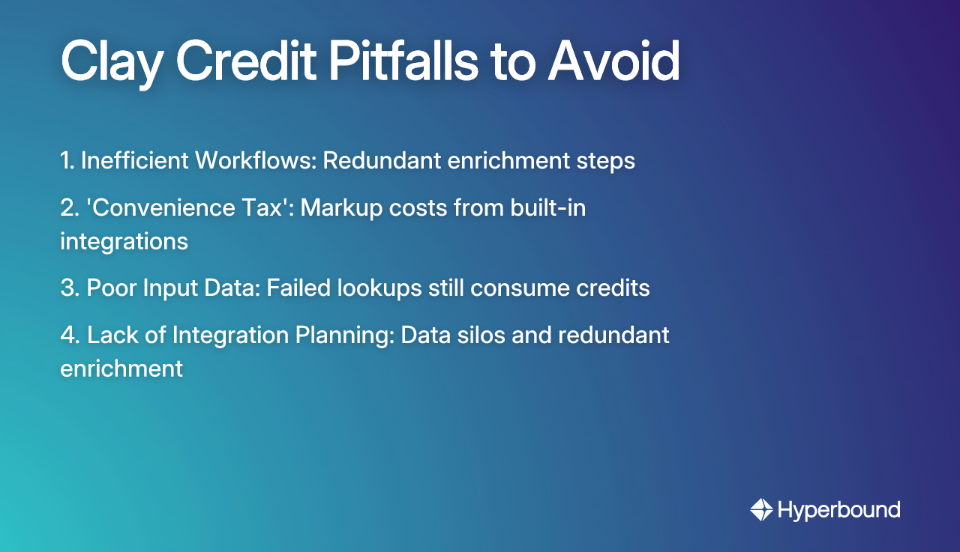
Several credit-burning pitfalls plague even experienced Clay users:
As one user put it, it becomes "too expensive to set up workflows per credit," limiting the platform's potential for sophisticated sales prospecting and lead generation activities.
Here's where things get interesting. Clay offers a powerful but often overlooked feature: native HTTP API integration. This allows you to call any external API directly from your Clay table, bypassing the credit system for data enrichment tasks.
Instead of using Clay's built-in integrations that consume credits, you connect directly to third-party data providers through their APIs. Clay then serves as your workflow orchestrator—the "supercharged spreadsheet" that manages your lists, runs logic, and sequences operations—while the actual data enrichment happens through more cost-effective channels.
Let's look at a real-world example:
Task: Find employee counts, industries, and technologies used for 1,000 companies.
The Clay Way: Using Clay's built-in "Enrich Company" feature might consume 2-3 credits per company = 2,000-3,000 credits. On the Starter Plan, this single step costs your entire month's subscription of $149, with potentially additional costs if you exceed your limit.
The API Way: Using Clearbit's Enrichment API ($99/month for 1,000 enrichments) or Apollo.io ($49/month plan), you could perform the same task while saving 33-67% on this step alone. Plus, you still have your Clay credits available for other automation tasks.
This approach is particularly valuable for AI tools and sales prospecting teams that need to enrich large datasets with real-time LinkedIn data for personalized outreach campaigns.
.png)
Setting up direct API connections in Clay is surprisingly straightforward. Here's how to do it:
GET: To retrieve data (most common for enrichment)POST: To create a new record in another systemPUT: To update an existing recordhttps://api.example.com/enrich?domain={{Company Domain}}
Authorization: Often formatted as Bearer YOUR_API_KEYContent-Type: Typically application/jsondata.employees, data.industry).
Once you've mastered the API approach, it's time to build a comprehensive, cost-effective data enrichment stack with Clay as the central orchestrator. Here's how to structure it for maximum efficiency in your lead gen efforts:
Position Clay as your central workflow hub—it manages your prospect lists, runs conditional logic, sequences API calls, and pushes the final, enriched data to your CRM or sales engagement platform. This leverages Clay's strengths in automation without relying on its more expensive data enrichment credits.
For B2B contact and company data:
For high-accuracy firmographics:
A world-class data stack gets you to the conversation, but it doesn't win the deal. To complete your prospecting engine, you need to ensure your reps can convert these data-enriched leads into revenue. This is where AI sales coaching platforms like Hyperbound come in. By creating realistic AI roleplays based on your winning talk tracks, Hyperbound lets reps practice handling objections and articulating value, turning your investment in data into more closed deals.
A mid-sized SaaS company was spending $800/month on Clay's Pro plan (50,000 credits) but consistently running out of credits by mid-month due to heavy enrichment needs for their ICP targeting. By implementing the direct API strategy:
Clay is an exceptional automation platform, but its credit system can quickly become a budget killer for data-hungry growth teams. By pairing Clay's orchestration capabilities with the cost-efficiency of direct APIs, you get the best of both worlds: powerful automation and affordable data enrichment.
Here's your action plan:

Stop letting a credit system dictate your prospecting budget. By adopting this hybrid API strategy, you can build a more powerful, flexible, and dramatically more affordable growth engine for your sales prospecting and lead generation efforts.
The main problem with Clay's credit-based pricing is that data enrichment tasks can quickly consume your monthly credit allowance, making it expensive, especially on lower-tier plans. Every action, from finding an email to enriching a company profile, uses credits. This "pay-per-action" model, combined with a markup on integrated data services, means costs can escalate rapidly, forcing users to either upgrade their plan or pause crucial prospecting activities.
You can significantly reduce your Clay credit usage by using its native HTTP API integration to connect directly with third-party data providers for enrichment tasks. Instead of using Clay's credit-consuming built-in integrations, you make API calls to services like Apollo.io or Hunter.io. This bypasses the credit system for data enrichment, allowing you to pay the provider's direct, often much lower, price while still using Clay for workflow automation.
Using a direct API is cheaper because you avoid Clay's markup, often referred to as a "convenience tax," on data from third-party providers. When you use a built-in integration, Clay acts as a reseller for that data and charges a premium in credits. By connecting directly to the source, you pay the provider's base rate, which is typically designed for bulk usage and is far more cost-effective.
Some of the most cost-effective API alternatives for B2B data enrichment include Apollo.io, Hunter.io, and Kaspr. Apollo.io is excellent for company and contact data, Hunter.io specializes in finding and verifying email addresses, and Kaspr offers plans with unlimited B2B email credits. For high-accuracy firmographic data, Clearbit and People Data Labs are also strong options to access directly.
While it requires more technical knowledge than using pre-built integrations, connecting an external API to Clay is a straightforward process for those comfortable with basic API concepts. The process involves selecting the "Use an API" integration, defining the endpoint URL, and configuring authentication headers with your API key. Clay's visual mapper also simplifies pulling the specific data you need from the API response into your table.
In an API-first approach, Clay's primary role shifts from being an all-in-one data provider to a powerful central command center or workflow orchestrator. You leverage Clay for what it does best: managing prospect lists, running conditional logic, sequencing direct API calls, and pushing the final enriched data to your CRM or sales engagement platform. This maximizes Clay's automation strengths without incurring high data costs.









Use Cases
Legal