
You've heard it before: "Sales certifications? Nobody cares about those. Just show me you can sell."
If you work in SaaS, you've probably never been asked for your CPSP or CMSP credentials. You might even struggle to remember what those acronyms stand for. The skepticism is warranted—traditional sales certifications often feel disconnected from what actually drives revenue in the real world.
But here's the thing: while generic external certifications might not move the needle, internal certification programs can be transformative when designed correctly. The difference lies in what you test, how you score it, and whether your certification actually validates a rep's ability to execute your sales playbook with your customers.
This guide will walk you through building a sales certification program that goes beyond theoretical knowledge to ensure your team can consistently deliver results where it matters—in actual sales conversations.
A comprehensive certification must test both knowledge and—more importantly—the application of that knowledge. Here's what to include:
These elements form the baseline understanding your reps need:
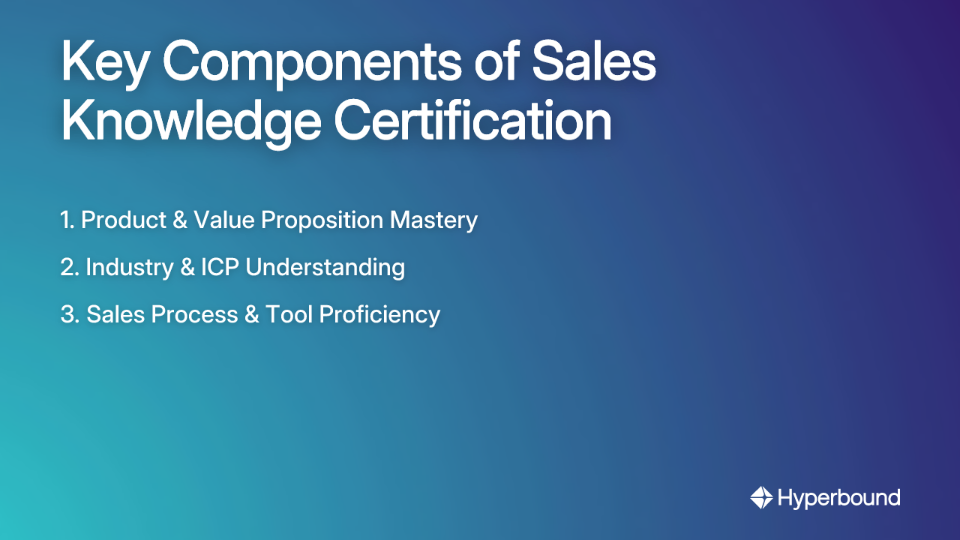
For these knowledge components, testing formats like multiple-choice assessments, written explanations, and matching exercises work well.
This is where certifications prove their worth. Reps must demonstrate they can apply knowledge in real conversations:
These applied skills require simulation and role-play to properly evaluate. Static quizzes simply can't measure a rep's ability to adapt and respond in real time.
Traditional assessment methods like manager ride-alongs and peer reviews are valuable but inherently subjective, inconsistent, and difficult to scale. Here's how to build a more reliable evaluation system:
Create clear, quantitative scorecards for evaluating skills. For example, an objection handling scenario might include:
This transforms vague feedback like "good job handling that pricing objection" into specific, actionable data points.
According to industry research, 62% of sales enablement teams are now using AI to improve training effectiveness, and 58% of organizations saw revenue increase after adopting AI solutions. Here's how to implement this approach:
The best way to test applied skills is through realistic simulations that mimic actual customer interactions. Traditional role-plays are effective but challenging to scale across large teams.
AI-powered platforms can address this limitation. For example, Hyperbound's AI Sales Roleplays allow reps to practice critical conversations—from cold calls to renewals—against dynamic AI buyer personas that respond naturally to different approaches. The platform provides instant, objective feedback based on your custom methodology, allowing reps to practice endlessly in a safe environment.
The ultimate certification is proving skills on actual customer calls. This is where tools like AI Real Call Scoring become valuable. Such solutions automatically analyze and score real sales conversations against your playbook, providing:
This approach saves managers countless hours of manual review while ensuring every rep is evaluated consistently, regardless of who their manager is or when their calls occur.
A certification score isn't just a grade; it's a data point. The true value comes from how you use certification results to drive ongoing performance improvement:
Use the results from certification scorecards to identify both team-wide and individual skill gaps:
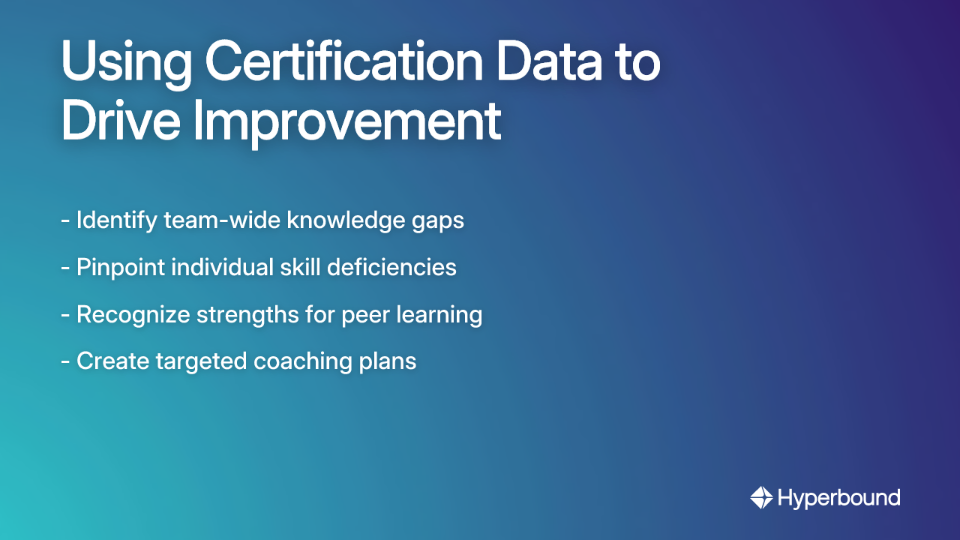
This data allows managers to move from generic advice to targeted, evidence-based coaching. For maximum impact, consider how to reinforce learning and drive continuous improvement.
AI coaching solutions can help here too. Platforms like Hyperbound's AI Coaching deliver instant, personalized feedback after every call (both role-plays and real ones). This empowers reps to self-correct and accelerates their learning curve without waiting for their next manager 1:1.
A certification program must prove its ROI. Track the performance of certified reps against their non-certified peers on metrics including:
Organizations that implement effective certification programs tied to their sales methodologies see measurable improvements across these key performance indicators.
Connecting certification to these metrics proves its value and justifies the investment in your program.
The skepticism toward generic certifications is warranted. A piece of paper that says "Certified Professional Sales Person" won't impress buyers or automatically boost your numbers.
However, a well-designed internal certification program focused on applied skills and scored objectively can be a powerful lever for performance. The modern framework looks like this:
The goal isn't to hand out badges. It's to build a predictable system for creating elite sellers who can consistently execute your strategy and drive revenue. When you focus on certifying what actually matters—the ability to have effective sales conversations with your customers—you'll find that certification becomes not just another box to check, but a genuine business driver.
Your quota history will always matter most, as many sales professionals rightly point out. But a thoughtfully constructed certification program can help ensure that history consistently shows success.
An internal sales certification is a program created by a company to validate that its sales reps can execute its specific sales playbook, use its tools, and sell its products effectively. In contrast, external certifications are offered by third-party organizations and cover general sales methodologies, which may not be directly applicable to a company's unique selling environment.
A modern sales certification program should test both foundational knowledge and applied skills. Foundational knowledge includes product mastery, industry acumen, and process proficiency. More importantly, it must test applied skills like sales methodology execution (e.g., MEDDIC, Challenger), discovery, objection handling, and closing through realistic simulations and role-plays.
To make scoring less subjective, you should create a detailed, objective scoring rubric with clear, quantitative criteria for evaluating specific skills. For example, instead of a manager simply saying a rep did a "good job," a rubric would award points for specific actions like "used a clarifying question" or "pivoted to a relevant value prop." Leveraging AI tools for call scoring can also ensure every rep is evaluated against the same criteria consistently and at scale.
AI plays a crucial role in making sales certifications more scalable, objective, and effective. AI-powered platforms can provide realistic role-play simulations for reps to practice in a safe environment, offering instant feedback. AI can also automatically score real customer calls against a company's playbook, providing unbiased data on rep performance and highlighting specific areas for coaching without manual review from managers.
You can prove the business value (ROI) of a sales certification program by tracking the performance of certified reps against their non-certified peers on key business metrics. These metrics include win rates, average deal size, sales cycle length, and quota attainment. A successful program will show that certified reps consistently outperform others in these areas.
No, an effective sales certification should not be a one-time event but part of a continuous improvement cycle. The data gathered from certifications should be used as a diagnostic tool to identify individual and team-wide skill gaps. This information then fuels targeted, personalized coaching plans, ensuring that reps are always refining their skills and adapting to new challenges.
Looking to implement AI-powered sales certification and continuous coaching for your team? Hyperbound's AI Sales Coaching platform helps sales organizations analyze winning behaviors, create realistic practice environments, and deliver objective, data-driven feedback at scale.






Use Cases
Legal