
You built the wiki. You ran the workshop. You created the content library. And then — almost none of it got used.
If that lands, you're not alone. Sales practitioners on Reddit describe the same reality: critical knowledge "just lives in people's heads and Slack threads," reps spend 3–11 hours a week searching for internal information they never find, and training materials collect digital dust while deals slip through the cracks.
Here's the hard truth: most revenue enablement programs are built around content delivery, not behavior change. And those are two fundamentally different things.
This guide gives you an exact, four-stage playbook to build a revenue enablement program that actually changes what reps do on calls — and connects that change to the metrics that matter: win rates, ramp time, and deal velocity.
The four stages:
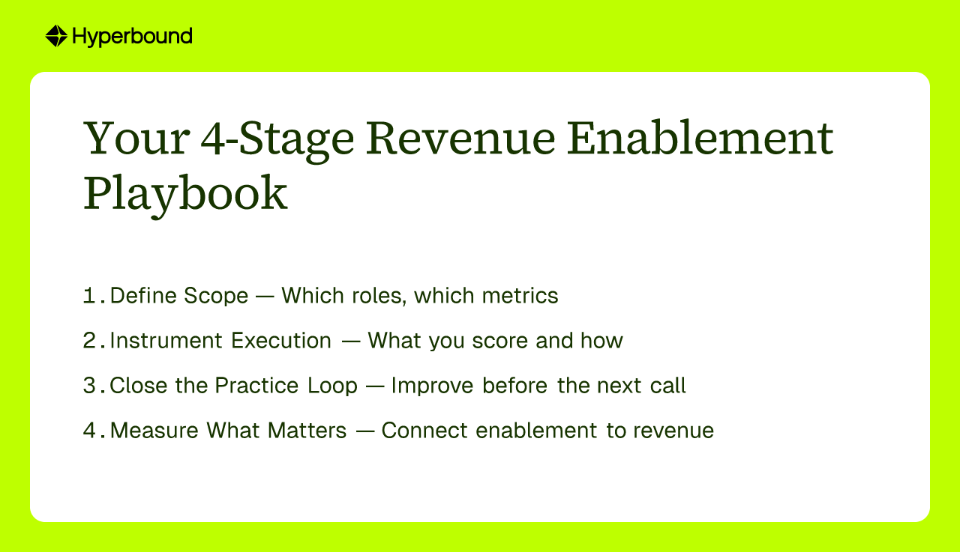
Let's build it.
Most revenue enablement programs fail before they start. They're scoped too narrowly (just AEs), too vaguely ("improve sales performance"), or without the cross-functional buy-in needed to actually execute.
Before you write a single training module, you need a clear blueprint.
Revenue enablement isn't a synonym for sales training. It means equipping every customer-facing role — SDRs, AEs, Account Managers, and CSMs — with the behaviors, tools, and coaching needed for consistent execution across the full customer lifecycle. Research from Forrester shows companies that align their go-to-market (GTM) teams see 38% higher sales win rates and 36% higher customer retention.
If your enablement program stops at the point of sale, you're leaving NRR on the table.
You need two types of metrics working together:
Lagging indicators (revenue outcomes): Win rate, quota attainment, average deal size, ramp time, customer lifetime value (CLV), and sales cycle length. These are the results you're ultimately trying to move.
Leading indicators (behaviors): These are the actions that predict those outcomes — discovery calls scored above a threshold, pipeline progression rates between stages, meeting-to-demo conversion rates. If your leading indicators are healthy and your lagging indicators aren't moving, you have an execution problem. If both are lagging, you have a behavior problem.
Before you build anything, document your program's mission, target outcomes, stakeholder responsibilities, and scope in a one-page charter. This creates accountability and gives leadership something concrete to align behind. Without it, your program becomes whatever anyone asks you to do that week.
You can't change behavior you can't see. Stage 2 is about making execution visible — defining what "good" looks like in concrete, observable terms, and building the infrastructure to measure it consistently at scale.
Vague goals like "do better discovery" don't change behavior. Specific, observable behaviors do. Work with your top performers and analyze their call recordings to identify exactly what they say and do that drives outcomes. Examples:
These become the building blocks of your scorecards. The highest-performing enablement programs define which selling behaviors reps should repeat, then build systems to reinforce them consistently.
Start with one high-impact call type — typically the Stage 1 discovery call. Build a scorecard around 5–7 non-negotiable behaviors. Keep it focused. A scorecard with 20 criteria gets ignored; one with 7 gets used.
Sales coaches spend enormous time reviewing repetitive call recordings, identifying patterns, and writing feedback — work that is exhausting, doesn't scale, and still only covers a fraction of calls. Manual scoring is a bottleneck that limits the coaches listening to less than 1% of recorded conversations.
This is exactly the problem Hyperbound Perform is built to solve. It deploys AI scorecards across real calls automatically, routing the right scorecard based on meeting type and content. Unlike tools that analyze individual calls in isolation, Perform connects insights across every touchpoint in a deal — calls, emails, and stakeholder interactions — to give you a complete picture of execution quality. It's the raw data engine that makes Stage 3 possible.
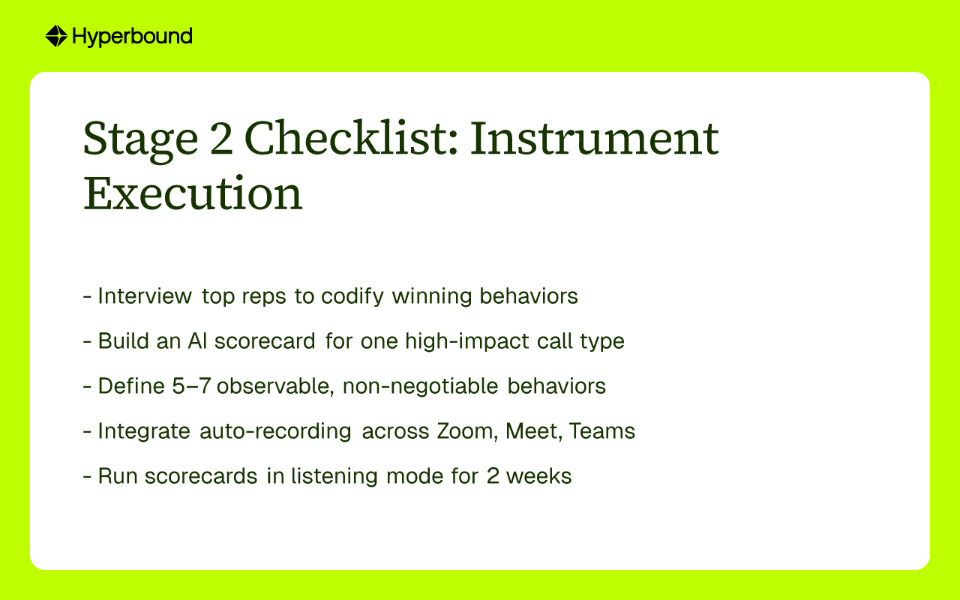
Scorecards tell you what is broken. The practice loop is how you fix it — before the next call, not after the next lost deal.
This is the stage most revenue enablement programs skip entirely. They surface the data. They share the report. They wait for behavior to change. It doesn't.
Traditional coaching happens after the deal is lost. A manager reviews a recording weeks later, delivers feedback that's already disconnected from context, and the rep files it away. Research consistently shows that 80% of training content is forgotten within 30 days without reinforcement. And frontline managers only spend 5–8% of their time coaching — and it's often inconsistent, with each manager coaching differently.
The solution is a continuous operational loop that connects real call data to targeted practice in near real-time.
This is the engine of the whole program, and it is a subject deep enough to warrant its own frame. The full model — what breaks at each handoff between practice, real calls, and coaching, plus how to diagnose and fix each one — is laid out in our guide to closed-loop enablement. For the purposes of this playbook, here is the loop at the level you need to run it:
The proof that this loop works is well established. It is the same closed loop behind the 60% ramp reduction at Vanta, Nivoda's 2x revenue growth, and the 50% faster ramp times and 3.5 workweeks of coaching saved per manager per year we see across deployments. Read the closed-loop enablement guide for the detail on each handoff; the rest of this stage assumes the loop and focuses on standing it up.
This isn't theoretical. The operational loop connecting real call scoring to targeted practice delivers:
The difference between these outcomes and what most programs produce isn't the content. It's the loop. Score the real call. Find the gap. Practice before the next one. Score again.
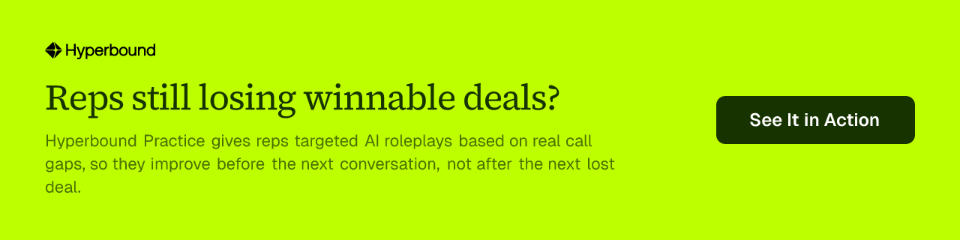
1. No stakeholder buy-in from leadership. Without executive sponsorship, revenue enablement programs don't get the resources, rep time, or org-wide engagement they need to produce results. Build the business case before you build the program.
2. Training without reinforcement. One-off workshops and launch-day certifications don't change behavior. Without a continuous practice loop, skills decay within weeks. The program needs a reinforcement cadence built in from the start.
3. Tools before strategy. Buying technology before defining the behaviors you want to change is one of the most common mistakes teams make. The framework — what behaviors, for which roles, measured how — has to come first.
4. Measuring activity instead of outcomes. "Training completion rate" is a vanity metric. The only metrics that matter are the ones that connect behavioral improvement to revenue — win rates, ramp time, deal velocity. If you can't draw that line, you can't defend the budget.
5. Siloed execution. When Sales, Marketing, and CS aren't aligned on messaging and goals, the customer experience is fragmented and deals are lost. Revenue enablement only works when the entire GTM motion is pulling in the same direction.
The most common question revenue enablement leaders get from leadership isn't "what are you working on?" It's "how are you measuring impact?" And for too long, the honest answer has been ramp time and training completion — metrics that rarely satisfy a CRO reviewing budget.
Stage 4 is about drawing a direct, credible line between enablement activity and revenue outcomes.
Pull your scorecard data and your CRM data together. Segment reps by average scorecard performance and look at how that correlates with win rates, average deal size, and sales cycle length. You'll almost certainly find that reps who consistently execute the key behaviors you've defined close more deals, faster.
That correlation is your business case. It's also your north star for where to focus next — if discovery call scores correlate strongly with win rates, you know where your coaching budget should go.
Shared visibility changes behavior at the team level, not just the individual level. Publish a simple dashboard in your weekly team meeting — scorecard performance by rep, skill gap trends, and the movement in leading indicators week-over-week. When reps can see their own data relative to their peers, they self-correct faster. When managers can see team trends, they coach more precisely.
Knowing which rep needs coaching on which skill at which moment is the hardest part of scaling a revenue enablement program. With a team of 50 or more reps, manual tracking breaks down fast.
This is the role of Kota Activate, Hyperbound's AI assistant that sits above Practice and Perform, connecting all the data points across the coaching system. Instead of waiting for a manager to notice a rep's scores declining, Kota proactively identifies the pattern and recommends a specific intervention — automatically. A manager can ask in Slack, "Which of my new hires are struggling most with discovery right now?" and get an answer grounded in real call data, along with a recommended roleplay assignment they can deploy in one click.
That's the essence of Revenue Activation: not just surfacing what happened, but taking action to change what happens next.
Your enablement program should be a living system, not a static curriculum. Quarterly, review your behavioral metrics against your revenue outcomes and reallocate your coaching focus accordingly. If reps are mastering discovery but struggling with negotiation, shift. If a new competitor is changing the objection landscape, update your roleplays.
The program that changes behavior is the one that keeps changing itself.
Most revenue enablement programs produce content. The best ones produce habits — repeatable, measurable, revenue-generating behaviors that become how your team sells.
The difference is the loop. Define the behaviors that win deals. Instrument execution so every call is scored against them. Close the practice gap by giving reps targeted repetitions before the next call. And measure the correlation between behavioral improvement and the outcomes leadership cares about.
For too long, revenue teams have been drowning in data about what already happened. Conversation intelligence made execution visible for the first time — that was real progress. But visibility was never the same as improvement. The moment a call ends up in a summary, the moment to change it is already gone.
The next era is about intervention. Using real call data to change the next conversation, not just analyze the last one.
Revenue enablement is the strategic process of equipping all customer-facing teams (SDRs, AEs, CSMs) with the skills, tools, and coaching needed to maximize revenue across the full customer lifecycle. Unlike traditional sales training, it covers the entire go-to-market motion and is built to systematically change rep behavior and connect those changes to business outcomes.
Most revenue enablement programs fail because they focus on one-off content delivery instead of creating a continuous system for measurable behavior change. The most common issues are a lack of executive buy-in, no reinforcement cadence for training, and measuring vanity metrics like "course completions" instead of revenue impact.
You measure the success of revenue enablement by proving a direct correlation between the behaviors you teach (leading indicators) and the revenue outcomes you drive (lagging indicators). This means tracking improvements in specific skills—like discovery call performance—and showing how reps who master them achieve higher win rates, shorter sales cycles, or faster ramp times.
A "practice loop" is a proactive, data-driven cycle of improvement that happens before a high-stakes call; traditional coaching is a reactive review that happens long after a deal is lost. The loop uses AI to score real calls, identify skill gaps, and assign targeted practice, making coaching scalable, timely, and directly relevant to a rep's next conversation.
AI improves revenue enablement by automating and scaling its most critical tasks: performance analysis, skill gap identification, and targeted practice. AI tools can score 100% of conversations to surface insights, identify coaching opportunities, and deliver personalized practice via realistic roleplays, shifting the focus from analyzing the past to actively improving the future.
You get buy-in from experienced reps by making coaching and practice immediately relevant to winning their active deals. Instead of generic training, use data from their own calls to assign "bitesized," deal-specific roleplays focused on an upcoming call. When practice is personalized and clearly helps them win, adoption follows.
That's Revenue Activation. Stop watching. Start winning. See how Hyperbound helps you build and scale the program.










Use Cases
Legal