
You've just signed up for yet another AI sales tool promising to revolutionize your outreach. Your credit card is on file with more SaaS platforms than you can count. And somehow, your team is still struggling to consistently hit quota.
Sound familiar?
In today's hyper-competitive B2B landscape, it feels like there's a new "game-changing" AI tool launching every week. As one frustrated founder put it on Reddit, "There are just way too many tools popping up every week," and "most AI tools promise the world but fall short."
The global sales tech market is exploding—projected to grow from $36.65 billion in 2023 to $104.47 billion by 2030. With thousands of data brokers saturating the market, it's no wonder many SaaS founders and sales leaders feel overwhelmed.
But here's the truth: You don't need a dozen different tools to build an effective AI sales stack. What you need is a strategic framework that cuts through the noise and focuses on what actually works.
In this guide, we'll walk you through:

Let's cut through the hype and build a sales stack that actually delivers results.
Every successful sales operation starts with a solid foundation: accurate contact information for your Ideal Customer Profile (ICP). Your database is where it all begins, and the two main contenders in this space are LinkedIn Sales Navigator and Apollo.io.
Best for: Startups and teams needing a more comprehensive, multi-channel outreach tool with built-in CRM and automation features at a competitive price.
Pros:
Cons:
The Verdict:
Choose Sales Navigator if your strategy is relationship-driven, you live on LinkedIn, and you prioritize networking insights over sheer volume.
Choose Apollo if you need an all-in-one, cost-effective platform for multi-channel outreach and want to build automated workflows from a single tool.
A raw lead list is just the start. Enrichment tools add layers of data—verified emails, phone numbers, company technographics, funding data—to make your outreach relevant and personal. The right enrichment tool transforms a cold contact into a warm conversation.
Best for: Tech-savvy teams who want to build complex, multi-source enrichment "waterfalls" and test creative personalization angles.
Pros:
Cons:
Best for: Teams that prioritize verified data, compliance, and an easy-to-use interface for enriching existing contact lists.
Pros:
Cons:
The Verdict:
Choose Clay if you're a power user who wants to orchestrate data from multiple providers to create unique personalization hooks.
Choose Airscale if your priority is clean, compliant, and verified data for your existing lists with a straightforward workflow.
You have your list, it's enriched. Now you need to reach out. This is where automation platforms come in, but the key is to avoid being one of the "spam machines" that give cold outreach a bad name.
Best for: Teams and individuals just starting with cold outreach who need a cost-effective tool with excellent email warmup and deliverability features.
Pros:
Cons:
Best for: Growing teams that need more sophisticated automation, A/B testing, and AI-powered personalization to optimize large-scale campaigns.
Pros:
Cons:
The Verdict:
Choose Instantly if your main goals are high email volume and deliverability on a tight budget.
Choose Smartlead if you're ready to move beyond basic automation and want AI-driven tools to optimize campaign performance.
You've built a world-class engine to book meetings, but the best tech in the world is useless if your reps can't convert those hard-won conversations into revenue. This is where the fourth and most critical pillar of your stack comes in: the performance layer.
As one sales leader put it, "From my experience, the ones that actually stick are the ones that cut down on repeat work instead of just blasting out more volume."
The most advanced stacks don't just focus on generating leads; they ensure the sales team is equipped to handle them. This is where you close the loop between automation and human skill with AI-powered coaching and practice.
Instead of guessing what works in sales conversations, Hyperbound's AI analyzes your team's actual sales calls to identify the talk tracks and behaviors of your top performers.
It then turns these winning playbooks into hyper-realistic AI Sales Roleplays. Your reps can practice the exact conversations your stack is generating—from cold calls to objection handling—in a safe, repeatable environment.
This bridges the critical gap: your outreach tool gets the meeting, and Hyperbound ensures your reps have the skills to win it. The platform helps you:

To complete the feedback loop, AI Real Call Scoring provides objective, data-driven feedback on both roleplays and real customer calls, ensuring that the skills practiced are being applied effectively.
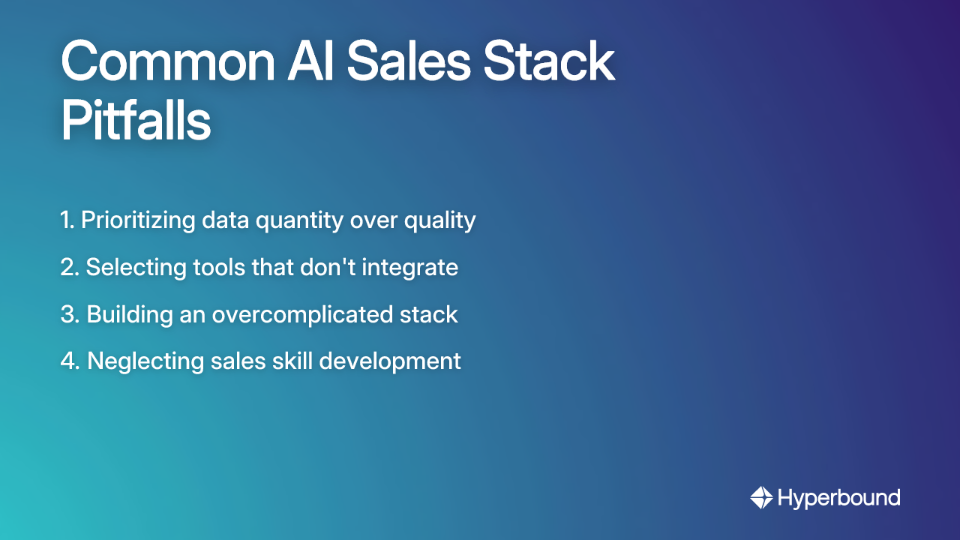
Let's address the common pitfalls that lead to wasted budgets and frustrated teams:
Business Size:
Industry Considerations:As one Redditor wisely noted, "The differentiator now has become which of them suit your industry the best." If you're in a niche B2B industry, you may need specialized data sources that integrate with tools like Clay.
Budget Reality Check:
✅ Database Tool: Selected and integrated with your CRM
✅ Enrichment Process: Established with verification protocols
✅ Outreach Platform: Configured with compliance measures
✅ Performance Layer: Implemented to ensure skill development
✅ Integration Testing: Completed across all platforms
✅ Compliance Check: Verified for data protection regulations
✅ Team Training: Conducted for all relevant team members
The perfect AI sales stack isn't about having the most tools—it's about having the right tools that work together seamlessly across four key pillars: Database, Enrichment, Outreach, and Performance. This strategic framework moves you beyond simple automation to genuine revenue generation.
As the market continues to evolve, remember the wisdom from our community research: "From my experience, the ones that actually stick are the ones that cut down on repeat work instead of just blasting out more volume."
The best AI tools don't replace human connection—they enhance it by freeing your team from repetitive tasks and providing insights that make every conversation more meaningful. With the right stack, your sales team can focus on what they do best: building relationships and solving problems for your customers.
By following this framework, you'll avoid getting burned by shiny new tools that promise the world but fall short on delivery. Instead, you'll build a strategic stack that drives real results for your business—more qualified meetings, shorter sales cycles, and ultimately, more revenue.
The four essential pillars are the Lead Database, Data Enrichment, Outreach Platforms, and the Performance Layer. The Database provides your initial contacts (e.g., Sales Navigator, Apollo), Enrichment adds crucial context (e.g., Clay, Airscale), Outreach automates communication (e.g., Instantly, Smartlead), and the Performance Layer (e.g., Hyperbound) ensures your team has the skills to convert the meetings you generate.
Your budget for an AI sales stack can range from around $137 per month for a basic startup setup to over $300 per month for a more advanced stack. A cost-effective stack for a small team might combine Apollo and Instantly. A more sophisticated stack for a growing company could include Sales Navigator, Clay, Smartlead, and a performance tool like Hyperbound, which provides ROI through shorter ramp times and better conversion rates.
The performance layer is critical because it closes the gap between generating meetings and winning deals. While the first three pillars (database, enrichment, outreach) automate the process of booking meetings, the performance layer ensures your sales reps have the skills to convert those conversations into revenue. Tools like Hyperbound use AI to provide realistic sales practice and coaching, directly impacting your stack's overall ROI.
Yes, you can start with an all-in-one tool like Apollo, which is a great option for startups and small teams needing a cost-effective solution for database, enrichment, and outreach. However, as your team grows and your needs become more sophisticated, building a dedicated stack with best-in-class tools for each pillar often provides greater flexibility, higher data quality, and better overall performance.
To avoid common mistakes, focus on four key areas: 1) Prioritize data quality over quantity to protect your reputation. 2) Ensure all tools integrate with each other and your CRM. 3) Start simple with the four core pillars before adding complexity. 4) Never neglect the human element—invest in sales skill development alongside your technology.
A lead database like Apollo provides the initial list of contacts based on your ideal customer profile. A data enrichment tool like Clay takes that raw list and adds multiple layers of information—such as verified emails, company technographics, or recent funding news—from various sources. This enriched data allows you to create highly personalized and relevant outreach messages.
Have you implemented an AI sales stack in your organization? What tools have worked best for you? Share your experiences in the comments below.









Use Cases
Legal