
On a sales call, rambling doesn't just lose your audience's attention — it loses you the deal. Reps who can't communicate with clarity and focus signal to buyers that they lack confidence, don't understand the product, and frankly, don't respect anyone's time.
That's why sales training tools that sharpen communication skills are having a moment. Two names that come up often in this space are Brevity and Hyperbound. Both use AI roleplay. Both promise to improve rep performance. But they are built for fundamentally different jobs.
Brevity is a presentation and pitch practice tool. Hyperbound is a Revenue Activation platform designed to shorten your sales cycle. This guide gives you an honest, head-to-head look at each — so you can make the right call for your team.
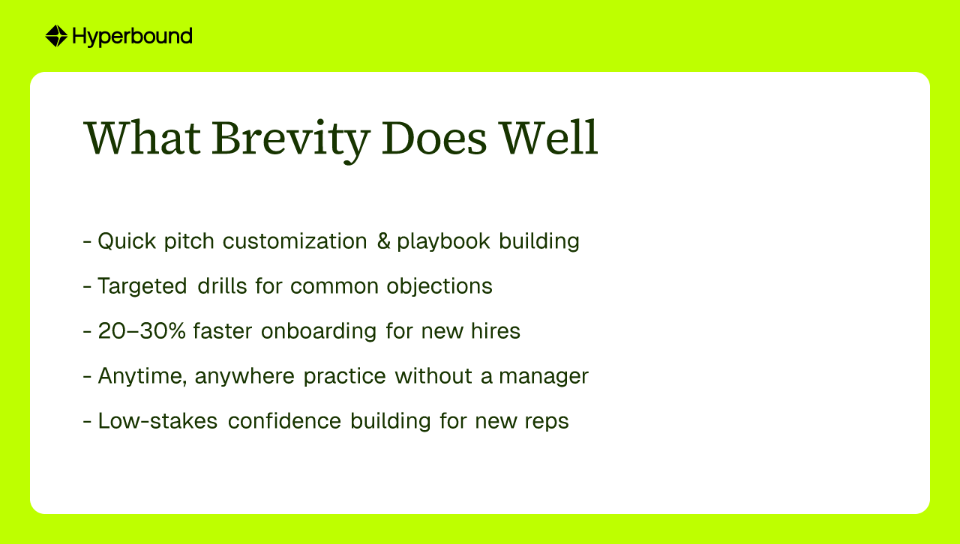
Let's start with what Brevity genuinely does well, because there's real value here.
Brevity is built around the idea that reps need a low-stakes environment to practice pitching — over and over — without requiring a manager to sit in. Its AI-powered roleplays simulate basic prospect conversations, and its automated feedback gives reps instant scoring on their responses without any manual review.
A few standout strengths:
And there's truth in that. Jerry Ruland, a Sales Manager, summed it up well: "My team resisted live role-plays. With Brevity, they can practice anytime, anywhere, without fear."
For teams that need reps comfortable with the basics of a pitch, Brevity delivers.
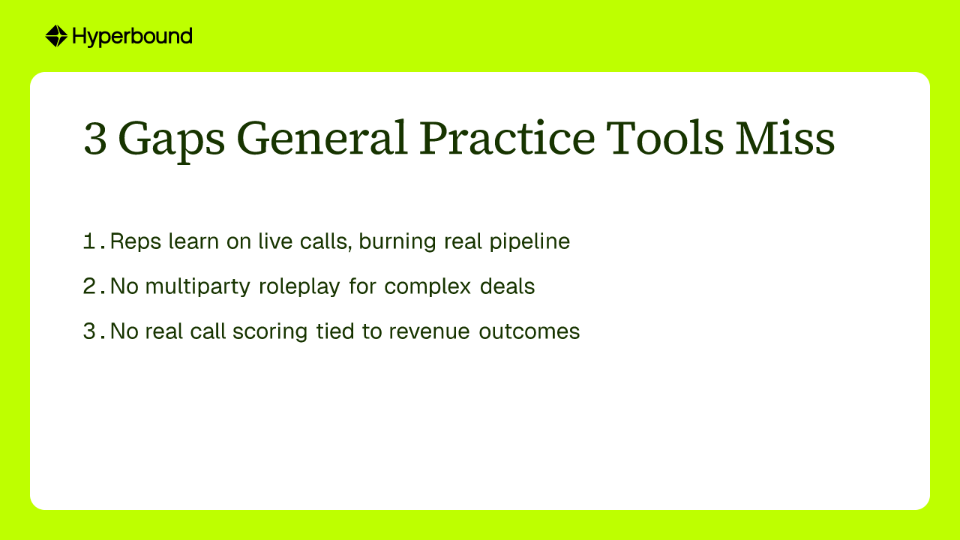
Here's the problem: winning complex B2B deals requires more than a polished pitch. And once you move past the basics, general practice tools reveal some significant gaps.
Job #1: Accelerating Rep Ramp Speed
The real challenge with ramp time isn't that reps don't know the product. As sales practitioners on Reddit have noted, most onboarding is product-focused — the ICP, the real problems the solution solves, and practical field examples are left to be learned on live calls. That means reps are burning real pipeline while still learning.
Practice tools that simulate generic conversations help with boredom — but they don't prepare reps for the unpredictability of a real buyer. And if the feedback isn't grounded in what your actual top performers do on winning calls, you're not shortening ramp time in any meaningful, measurable way.
Job #2: Advanced Conversation Skill Development
Enterprise and mid-market sales cycles often involve multiple stakeholders — a champion, an economic buyer, a skeptical IT leader. Practicing with a single, generic AI persona doesn't replicate that complexity. Brevity lacks features like multiparty roleplays, which limits its usefulness for reps working complex deals.
Job #3: Driving Consistent Deal Execution
The most important gap: practice that isn't tied to your real calls is disconnected from your actual revenue outcomes. If your training tool doesn't score what reps are doing in live conversations, you can't identify what skills are actually missing, and you can't prove the training is working. Brevity offers no real call scoring. Its analytics remain surface-level — general metrics like tone and pace that don't connect to deal momentum or win rates.
To be fair — and credibility requires fairness — there are genuine scenarios where Brevity makes sense:
If you're a 3-person startup and you just need your new SDR to stop fumbling the value prop, Brevity can get the job done. There's no shame in using the right tool for the right stage.
If your team is past the basics — if you're scaling, dealing with long ramp times, or watching win rates stagnate — Brevity alternatives like Hyperbound exist precisely because general practice tools weren't built for these problems.
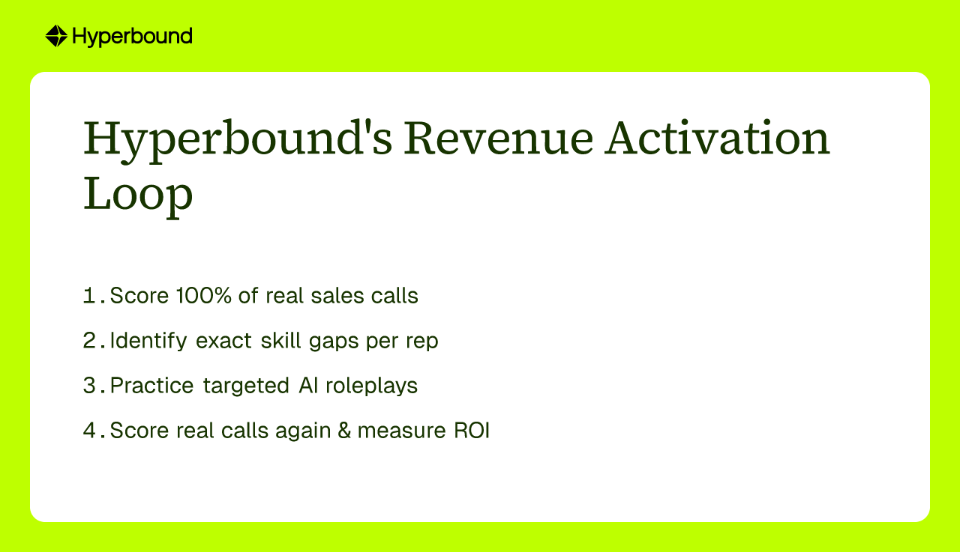
Hyperbound is the Revenue Activation Platform — a category it created to describe what happens when teams stop just analyzing call data and start using it to change outcomes. Here's how the model works:
The operational loop is simple but powerful: Score Real Calls → Identify Skill Gaps → Practice Roleplays → Score Real Calls Again. It's a closed-loop system designed for one outcome: faster revenue.
These aren't vanity metrics. They're the outcomes of closing the loop between practice and performance.
Not sure which tool fits your situation? Answer these three questions honestly:
1. Do you need to measurably reduce new hire ramp time — and prove the ROI of your training program to leadership?
2. Are reps struggling to consistently apply your sales methodology in live customer conversations, not just in practice?
3. Are you looking for a platform that scores 100% of real calls to surface deal-level coaching — not just generic roleplay feedback?
If you answered yes to 2 of 3, Hyperbound is built for your team.
Basic pitch practice has its place. But if you're chasing faster ramp, stronger deal execution, and a training program you can actually tie to revenue — you need a platform that connects what reps practice to what they do on real calls.
The main difference is that Brevity is a tool for practicing sales pitches, while Hyperbound is a complete Revenue Activation Platform that connects practice to real-world performance. Brevity helps reps build confidence with basic scripts in a low-stakes environment. In contrast, Hyperbound scores 100% of your team's real sales calls to identify skill gaps, provides targeted AI roleplays based on those gaps, and measures the impact on revenue outcomes, creating a closed-loop system for improvement.
Brevity is best suited for very small teams or those with simple, transactional sales motions who need a basic, low-cost tool for pitch practice. If your primary goal is to help new reps get comfortable with a single value proposition or a few common objections, Brevity is a solid starting point. Teams facing challenges with long ramp times, inconsistent deal execution, or complex B2B sales cycles will find more value in a comprehensive platform like Hyperbound.
A Revenue Activation Platform is a system that directly connects sales training and practice with real-world sales performance to accelerate revenue. Unlike traditional training tools that operate in a silo, a Revenue Activation Platform like Hyperbound analyzes actual sales calls to identify skill gaps, delivers targeted AI-powered practice to fix them, and then measures the impact on key metrics like ramp time, conversion rates, and win rates. It closes the loop between practice and pipeline.
Hyperbound reduces sales ramp time by training new reps on what actually works in your real-world sales conversations, not just on product knowledge. The platform scores calls from your top performers to identify winning behaviors and then builds AI roleplay scenarios that simulate your specific buyers and challenges. This allows new hires to practice the exact skills they need to succeed on live calls, shortening the learning curve and enabling them to contribute to the pipeline faster. Companies like Vanta have used Hyperbound to slash ramp time by 60%.
Yes, Hyperbound is designed for continuous skill development across your entire sales team, from new hires to seasoned veterans. By scoring 100% of live calls, the platform identifies coaching opportunities for all reps, helps enforce sales methodology consistently, and prepares the team for new product launches or messaging changes. It serves as an ongoing performance engine, not just a one-time onboarding tool.
Hyperbound integrates seamlessly into your existing sales workflow to ensure high adoption and minimal disruption. It offers deep integrations with leading CRMs like Salesforce, HubSpot, and Pipedrive, automatically filling call notes and updating records. This ensures that the insights and coaching from Hyperbound are embedded directly where your reps and managers already work.
See how Hyperbound works → Book a Demo










Use Cases
Legal
.png)
.png)