You've set up your call list, practiced your pitch, and mentally prepared for rejection. But when you finally connect with a prospect, the conversation falls flat. They respond with terse "yes" or "no" answers, and before you know it, you're back to awkward silence—or worse, hearing the dreaded click of them hanging up.
Cold calling doesn't have to be this painful. The difference between a stilted sales pitch and a productive conversation often comes down to one simple technique: asking the right types of questions.
Most salespeople dread cold calling for good reason. As one sales professional candidly shared on Reddit, "Most people do not answer, most people will not let you through, and most people will say no or not interested, most of the time." This constant rejection can be demoralizing, leading to frustration and diminished performance.
The root of this problem often lies in how we structure our conversations. When we rely on closed-ended questions—those that can be answered with a simple "yes" or "no"—we're essentially creating conversational dead ends.
Consider this common scenario: "Do you have a few minutes to talk about our product?" The prospect says "no," and you're instantly shut down. Or: "Are you happy with your current provider?" They say "yes," and you're back at square one.
The solution? Shift your focus from closed-ended questions to open-ended ones that invite dialogue, engagement, and discovery—transforming your approach from an interrogation to a consultation.
Before diving into specific questions, it's essential to understand why open-ended questions are so powerful in sales conversations.
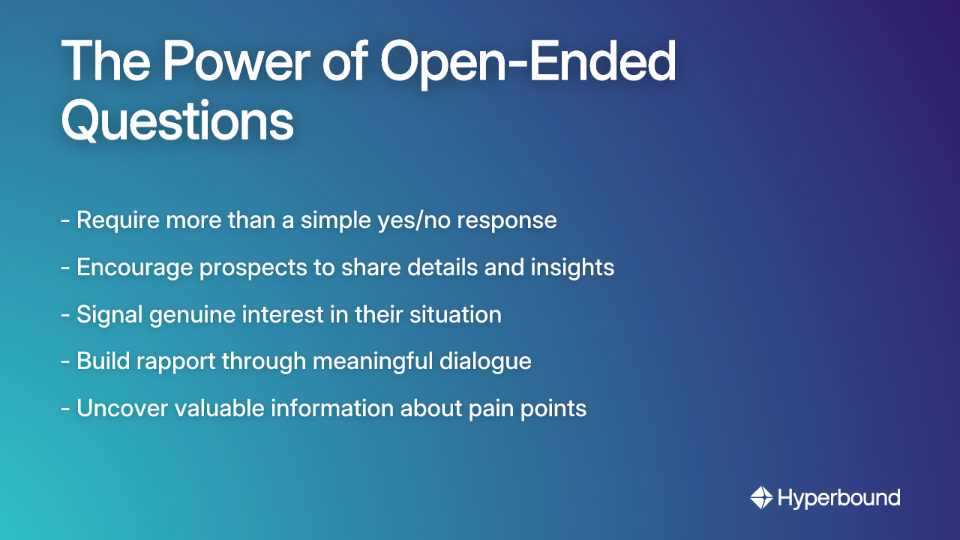
Open-ended questions:
As one sales expert noted on a discussion forum, "Any question that forces the other party to talk about stuff they're passionate about is great." This insight captures a fundamental truth: people enjoy talking about themselves and their experiences when they feel genuinely heard.
When you replace "Do you need help with your marketing?" with "What's your biggest marketing challenge right now?", you're not just changing your words—you're changing the entire dynamic of the conversation. You're shifting from pitching to problem-solving, from selling to consulting.
The first 30 seconds of your call are crucial. Research shows that starting with a simple, human question like "How have you been?" can increase your chances of booking a meeting by 6.6 times compared to launching straight into a pitch.
This technique, known as the "pattern interrupt," breaks through the typical cold call script that prospects are conditioned to reject. Instead of sounding like every other salesperson, you sound like a human being interested in a conversation.
Try these powerful openers to set the right tone:
These questions signal respect for the prospect's time while inviting them to engage in a way that feels comfortable and non-threatening.
Once you've established initial rapport, the real work begins: uncovering the prospect's pain points through strategic questioning. This is where open-ended questions truly shine.
According to Aventi Group, effective pain point discovery requires exploring three dimensions:
Real-World Example: A security software company identified that their prospects were struggling with statements like: "Our security operations staff is already stretched thin. How do we streamline cloud services incidents investigation?" By asking probing questions about this pain point, they developed a compelling benefit statement: "Our solution reduces cloud services risks and speeds up incident response by working with your existing Security Operation systems."
This demonstrates the power of using open-ended questions to transform customer pain into a compelling value proposition.

Not every lead deserves your time and resources. Effective open-ended questions help you qualify prospects efficiently while maintaining engagement. Here's how to structure these questions:
As your call progresses, you'll need techniques to handle objections, clarify information, and guide the conversation toward a productive conclusion.
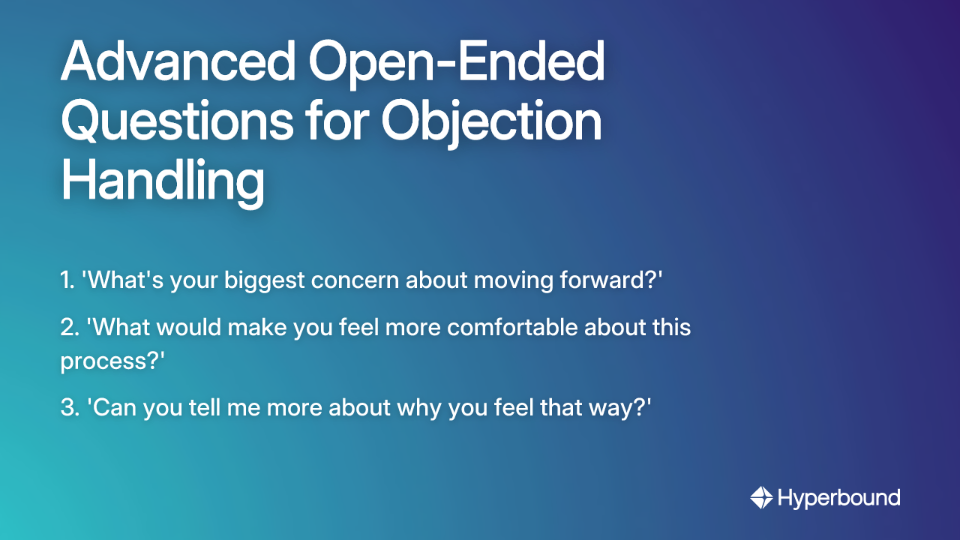
When faced with resistance, don't get defensive. Instead, use open-ended questions to explore the objection:
This approach shows empathy and transforms objections from conversation stoppers into opportunities for deeper engagement.
Instead of the traditional close—"Can I book 15 minutes on your calendar?"—try the "Interest CTA" approach:
This soft approach converts verbal interest into a concrete appointment without feeling pushy.

Mastering open-ended questions transforms you from a salesperson pushing a product to a trusted advisor solving problems. The fear of rejection diminishes when your goal becomes understanding and helping, not just selling.
As one sales professional wisely noted, "It's not possible to sell immediately anyway; you're focusing on building relationships first." Open-ended questions are your most powerful tool for building those relationships.
Ready to transform your cold calling approach? Choose 3-5 questions from this guide that resonate with you. Write them down and make it your goal to use them in your next five cold calls. To accelerate your learning and master these techniques, you can practice them in realistic scenarios using Hyperbound's AI Sales Roleplays. Track how the conversations change, and you'll likely find that both your results and your enjoyment of the process improve dramatically.
Remember, the goal isn't just to close a sale—it's to open a conversation that leads to a lasting, mutually beneficial relationship.
Open-ended questions are queries that cannot be answered with a simple "yes" or "no." In a sales context, they are designed to encourage prospects to share detailed information, insights, and feelings about their business challenges, needs, and objectives. This approach helps build rapport and uncovers valuable information for a more productive conversation.
Open-ended questions are more effective because they transform a one-sided pitch into a genuine, two-way conversation. Unlike closed-ended questions that often lead to conversational dead ends, they invite prospects to elaborate on their experiences and pain points. This signals genuine interest and helps build a relationship based on understanding and problem-solving rather than just selling.
Start your cold call with a "pattern interrupt" question that is human-centric and respectful of the prospect's time to avoid an immediate shutdown. Instead of a direct pitch, try an opener like, "How have you been?" or "I know I'm interrupting, would it be helpful if I shared why I'm calling in about 30 seconds, and you can decide if it makes sense to continue?" This breaks the typical sales script and increases engagement.
Effective questions for uncovering pain points explore the logical, emotional, and political dimensions of a prospect's challenges. For example:
Handle objections by using open-ended questions to explore the root cause of the concern, rather than immediately defending your position. When a prospect objects, ask clarifying questions like, "What's your biggest concern about moving forward with something like this?" or "Can you tell me more about why you feel that way?" This approach demonstrates empathy and turns objections into opportunities for deeper understanding.
The biggest mistake to avoid is asking too many questions in rapid succession, which can make the prospect feel interrogated. It is crucial to listen more than you speak (aim for an 80/20 split where the prospect does most of the talking), show genuine curiosity, and use silence strategically to give the prospect ample space to think and provide a thoughtful response.








Use Cases
Legal