
Your account manager knows the product inside and out. They've memorized the upsell playbook and can recite expansion value props in their sleep. But when a long-time customer says, "I'm not sure we're even getting full value from what we have now," the conversation stalls. The AM stumbles, over-explains, and the moment passes.
Why does this keep happening? Because theory doesn't survive contact with reality.
Most CSMs and AMs have never had a safe place to practice the actual conversation — the live, messy, emotionally charged moment when a customer pushes back on pricing, questions the ROI, or hints at churn. They've read the playbook, but they haven't drilled it. And research backs this up: reps consistently say they want more "at-bats" but feel that most AI simulations are too robotic to be worth their time.
That's a fair criticism — and it's also a solvable problem.
The best upsell conversation practice software tools have closed the gap between "feels fake" and "feels like a real customer." They give CSMs and AMs a flight simulator for high-stakes expansion conversations: a place to fail safely, get scored objectively, and build the muscle memory that makes the live version feel natural.
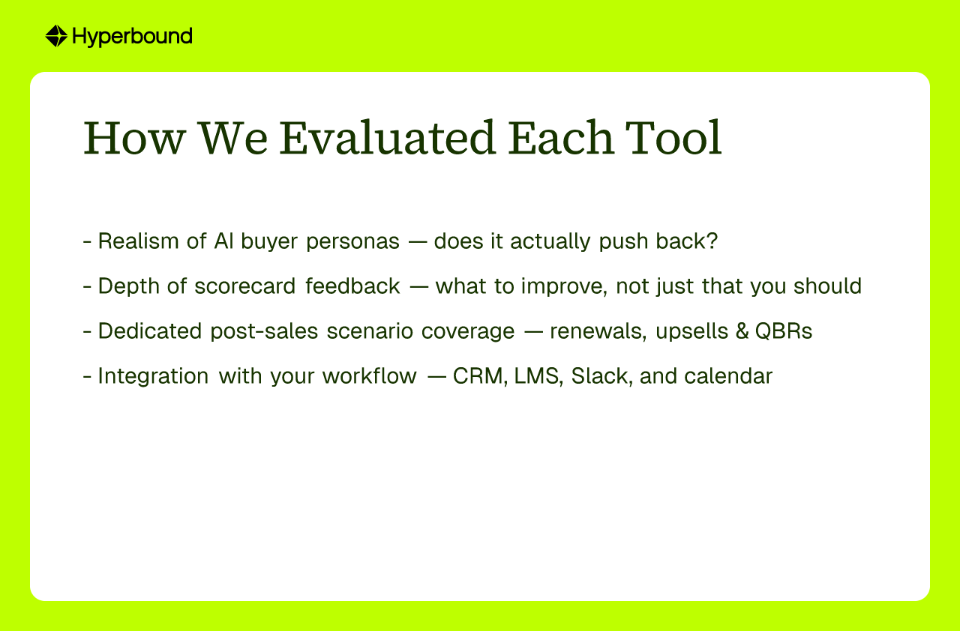
Here's what we evaluated each tool on:
Let's get into it.
Best for: CSMs and AMs who need purpose-built upsell and renewal practice grounded in real call data.
Hyperbound sits at the top of this list for one reason above all others: it's the only platform with a dedicated post-sales roleplay module and AI buyer personas trained on over 2 million hours of real B2B sales conversations. That's not a generic script library. That's the difference between practicing against a punching bag and practicing against a sparring partner who actually knows your moves.
The AI Post-Sales Roleplays feature is purpose-built for exactly the conversations that drive net revenue retention (NRR): renewal negotiations, upsell discovery, QBR value positioning, and de-escalation with at-risk accounts. You can practice against an "expansion-ready" customer, a frustrated churning account, or an executive stakeholder in a QBR — all with AI personas that counter objections the way real customers do.
Key features for upselling:
What makes Hyperbound uniquely powerful is the closed-loop system. Hyperbound Perform analyzes live calls and surfaces skill gaps at the deal level. Then Kota Activate connects those gaps back to targeted Practice roleplays — automatically. It's not just practice; it's practice on the right things, informed by what's actually hurting your deals.
The proof: 250,000+ simulations delivered, 45,000+ active users across 7,000+ companies, 4.9/5 on G2. Customers like Vanta cut ramp time by 60% (from 210 to 72 days), while Nivoda saw a 150% increase in demo conversion rates and 2x revenue YoY.
Best for: Teams that want a visually immersive AI roleplay experience with flexible scenario building.
Second Nature is a well-regarded AI roleplay platform that uses lifelike AI avatars to create immersive practice simulations. Reps practice conversations with on-screen personas that respond dynamically, making it feel closer to a real interaction than text-based tools.
For upsell practice, Second Nature lets managers load their own training materials — upsell playbooks, battlecards, pricing objection guides — to create customized simulations relevant to specific customer segments. It also includes templates for customer success scenarios that can be adapted for expansion conversations.
Why it makes the list: Second Nature is a strong pick for teams that prioritize the visual and emotional realism of practice. The 3D avatar format can help reps who are specifically working on presence and delivery — not just what they say, but how they say it.
Best for: Large enterprise teams already invested in a full-suite enablement platform.
Mindtickle is an enterprise-grade sales readiness platform where AI roleplay is one component of a broader suite that includes onboarding, content management, and coaching. For large organizations with complex enablement stacks, that breadth can be a major advantage.
Their AI roleplay module supports customizable scenarios, multi-lingual practice (useful for global CSM teams), and detailed completion tracking — so managers can verify that reps have actually practiced, not just watched a training video.
Why it makes the list: If your organization needs AI roleplay tightly integrated into a larger LMS and formal certification workflow, Mindtickle fits that structure well, particularly for enterprises rolling out new product lines or updated pricing structures across large CSM teams.
Best for: Teams that want to combine video-based coaching with AI-analyzed pitch practice.
Brainshark takes a video-first approach to sales readiness. Reps record themselves practicing an upsell pitch or renewal conversation, then submit it for AI-based analysis or manager review. The platform scores for clarity, pace, keyword usage, and energy — surfacing the delivery elements that pure text or voice practice tools often miss.
Why it makes the list: Brainshark is a good fit for teams where how a rep presents matters as much as what they say. If your CSMs regularly do camera-on QBRs or executive business reviews, the video practice format mirrors the real experience more directly than audio-only simulation.
Best for: Teams that want to build a practice foundation from real-life conversation analysis.
Salesloft is primarily a sales engagement platform, but its Conversation Intelligence features reframe how teams think about "practice." Rather than simulating conversations, Salesloft lets you record, transcribe, and analyze real customer calls — then build playlists of top-performing upsell and renewal calls for the team to study.
Why it makes the list: Salesloft is powerful for answering the question, "What should we be practicing?" Managers can clip the exact moments where top reps turned a pricing objection or uncovered an expansion opportunity and turn those into learning assets.
Best for: Teams that want data-driven insight into what their best upsell calls actually look like.
Chorus.ai captures and analyzes customer interactions to surface the patterns behind successful conversations. For upselling, teams can filter past calls by topic (expansion, pricing, add-on features) and study what objection-handling techniques and talk tracks correlated with positive outcomes.
Why it makes the list: Chorus excels at building a team-wide understanding of what "good" looks like in an upsell conversation. It's an excellent complement to simulation tools — use Chorus to identify the scenarios worth practicing, then use a roleplay platform to drill them.
Best for: Revenue teams that want deep deal intelligence to inform and prioritize their practice.
Gong is the market leader in Revenue Intelligence, and for good reason. It provides comprehensive call recording, analysis, and deal tracking — giving teams an unparalleled view of their conversation data across the entire account lifecycle.
For upsell preparation specifically, Gong can flag accounts showing expansion signals, track sentiment shifts over time, and identify the talk tracks that top performers use when moving a customer from renewal to upsell.
Why it makes the list: Gong is, in Hyperbound's own framing, "a giant library of data." It tells you what happened and what patterns matter. The gap Gong doesn't fill is the practice layer — it can show a rep exactly what a great upsell conversation looks like, but it can't put them inside one to practice it. That's where a tool like Hyperbound picks up.
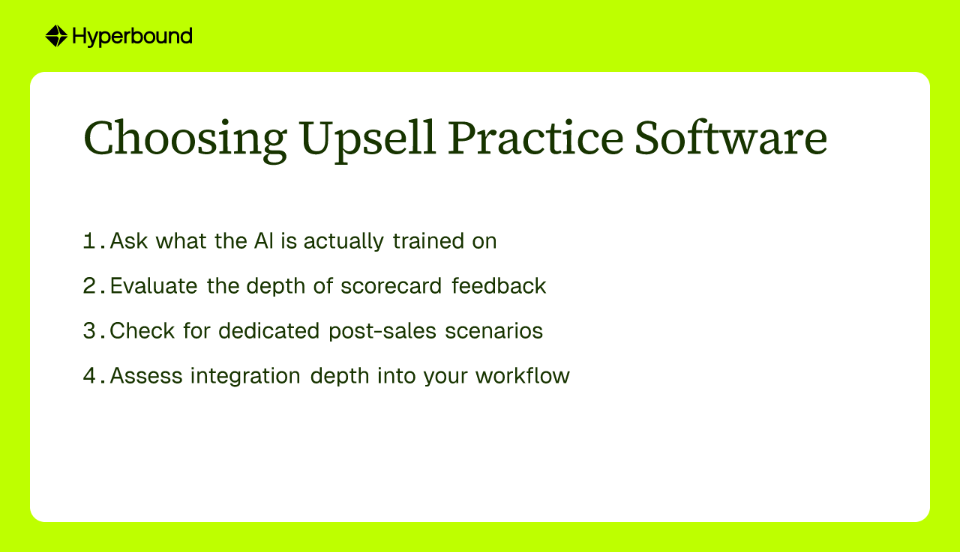
Not all tools are built the same. Here's the framework to evaluate them honestly:
If your CSMs and AMs are walking into expansion conversations cold — relying on instinct, hoping the playbook they read three months ago will surface under pressure — that's not a sign you have the wrong people. It's a sign they haven't had a safe place to fail.
The gap between knowing the upsell motion and executing it under real customer pressure is a practice gap. And practice gaps are solvable.
The tools on this list exist to close that gap — by giving your post-sales team the at-bats they need before the ones that count. Whether you're evaluating upsell conversation practice software for a 10-person CS team or a 200-person revenue organization, the core question is the same: are your reps going into high-stakes customer conversations having practiced them, or just having thought about them?
There's a difference. And it shows up in your NRR.
Practicing upsell conversations is crucial because it builds the muscle memory needed to handle real-time customer objections and high-stakes negotiations effectively. While playbooks provide theoretical knowledge, only deliberate practice in a safe environment prepares CSMs and AMs for the messy, unpredictable nature of live customer interactions, turning theory into confident execution.
AI roleplay software is a training tool that simulates realistic customer conversations, allowing sales reps, CSMs, and AMs to practice their skills against an AI buyer persona. The best platforms, like Hyperbound, use AI trained on real call data to create dynamic, responsive "sparring partners" that can push back, raise objections, and mimic the behavior of actual customers in scenarios like renewals, QBRs, and upsell discovery.
Upsell practice software directly improves NRR by making your post-sales team more effective at identifying and closing expansion opportunities. By repeatedly drilling renewal negotiations, pricing discussions, and value positioning in a simulated environment, CSMs and AMs become more skilled at preventing churn and increasing customer lifetime value, which are the core components of a healthy NRR.
Conversation intelligence tools analyze past calls to show you what happened, while AI practice platforms let you actively drill and prepare for future calls. Tools like Gong and Chorus are excellent for identifying winning talk tracks and skill gaps from your historical call data. Practice platforms like Hyperbound then take those insights and turn them into interactive roleplay scenarios where reps can build the skills needed to replicate success.
The most essential features are a realistic AI, in-depth feedback, and relevant scenarios. Look for AI buyer personas trained on real conversation data, not just scripts. The tool should provide objective scorecards that offer specific, actionable feedback beyond a simple pass/fail. Finally, ensure the platform has a dedicated library of post-sales scenarios, including renewal negotiations, QBRs, and pricing objections.
Yes, the best AI personas can feel remarkably like real customers when they are trained on the right data. Early AI simulations were often robotic, but modern tools like Hyperbound train their AI on millions of hours of real B2B sales calls. This allows the AI to understand context, push back with relevant objections, and respond dynamically, closing the gap between a fake-feeling simulation and a challenging, realistic practice session.










Use Cases
Legal