
You've spent months grinding through B2B sales roles, researching the medical device space, and finally decided to make the leap into clinical sales. So you sign up for a training program, learn the terminology, and walk into your first physician conversation — only to realize that nothing in your training prepared you for a skeptical surgeon who has three minutes between cases and zero patience for a standard discovery call.
That's the reality of clinical sales. Generic B2B sales training — even great B2B sales training — doesn't equip reps for physician conversations, hospital committee buying cycles, or the gatekeepers of large Integrated Delivery Networks (IDNs). Selling to a value analysis committee (VAC) is a fundamentally different skill than selling SaaS to a VP of Engineering.
And if you've spent any time in online communities researching your options, you've probably encountered the skepticism firsthand. Reddit threads on the topic are full of warnings like "I would think it's nothing but a grift like most for profit schools" and "You'll be unemployed and in debt." That level of distrust isn't unfounded — some programs overpromise and underdeliver, especially for career-switchers who are betting big on a single credential.
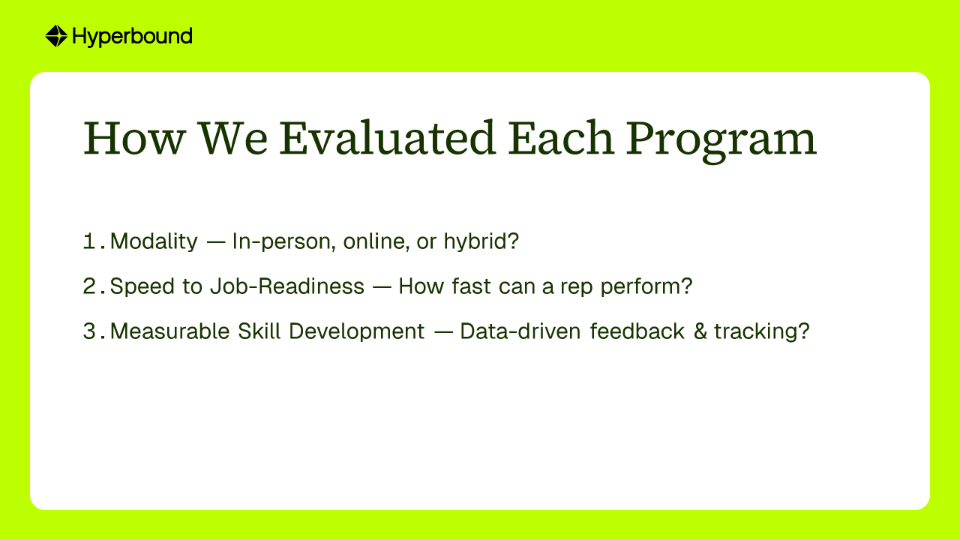
So this guide cuts through the noise. We've evaluated 7 clinical sales training programs across three criteria:
Whether you're a career-switcher looking for your first medical sales rep role or a sales leader trying to upskill a team of 50 reps, this breakdown will help you find the right fit.
Modality: Online (integrates with Salesforce, HubSpot, Seismic, Highspot, Slack, Zoom, Google Meet) Speed to Job-Readiness: Fast — customers see up to 50% faster ramp times Best For: Teams and individuals who need to close the gap between knowing the clinical pitch and actually delivering it under pressure
Every clinical sales training program teaches you what to say. Almost none of them give you enough practice actually saying it. That's the gap Hyperbound Practice was built to close.
Hyperbound's AI buyer personas are trained on over 2 million hours of real B2B sales conversations — not generic scripts. That means when you practice a discovery call with a resistant hospital supply chain director or a time-crunched oncologist, the simulation pushes back the way a real decision-maker would. You get instant AI scorecards after every session tracking talk ratios, missed opportunities, messaging adherence, and methodology alignment.
For medical device sales specifically, the Multiparty Roleplay feature is a standout — it lets reps practice navigating conversations with multiple stakeholders at once, like a surgeon, a nurse manager, and a supply chain director in the same room. That's exactly the dynamic you'll face in front of a hospital buying committee.
Hyperbound is also HIPAA compliant (alongside SOC 2 Type II, GDPR, and ISO 27001), which matters when you're deploying a training tool across a healthcare sales org.
The proof points are real: Vanta cut its ramp time by 60% — from 210 days to 72 — while scaling its BDR team 4x and growing pipeline 5x after implementing Hyperbound.
What It Does Well:
Where It Falls Short:
Modality: In-person, accelerated campus-based programs Speed to Job-Readiness: Fast — specialized programs run 8 to 12 weeks Best For: Career-switchers with no medical sales background who want a structured, credential-driven entry point
Medical Sales College is one of the most recognized names in clinical sales training, offering specialized programs in high-earning fields like orthopedics, biologics, and sports medicine. Their flagship TotalOrtho+ course is 10 weeks of intensive, hands-on instruction designed to make graduates credible in operating room settings. MSC claims an 82% job placement rate with over 5,100 graduates placed, backed by a network of 2,160+ registered hiring managers.
That said, the community sentiment around MSC is genuinely divided. As one sales professional put it on Reddit, "Med sales College isn't a bad way to go but it's just a secondhand niche school to collect loan $$." Another noted that graduates often get funneled into demanding Ortho roles that mean "being on call 24/7 if your trauma Ortho." Even advocates of the program tend to have "mixed opinions."
What It Does Well:
Where It Falls Short:
Modality: Primarily in-person with some remote flexibility Speed to Job-Readiness: Slow — this is a 12–14 month immersive corporate program Best For: Early-career candidates who want a blue-chip foundation and are willing to invest time over speed
The J&J MedTech Sales Training Representative Program is arguably the gold standard for corporate clinical sales training. Trainees are paid employees — eliminating the debt risk of private programs — and coached by experienced mentors across diverse medical departments with the goal of graduating into a full-time J&J sales role.
The credibility this program carries in the industry is unmatched. If you complete it, you have a recognizable brand behind your name and a clear career track inside one of the world's leading MedTech companies.
What It Does Well:
Where It Falls Short:
Modality: Blended — virtual and in-person instructor-led Speed to Job-Readiness: Moderate — modules can be customized for faster rollout Best For: Sales organizations that want to install a proven consultative methodology across their clinical team
Richardson Sales Performance specializes in equipping healthcare sales professionals with structured methodologies for navigating complex, multi-stakeholder buying groups. Their programs — including Consultative Selling and partnerships with The Challenger Sale framework — are specifically designed for the realities of selling into hospital systems: value-based care models, shifting stakeholder groups, and time-constrained HCPs.
For sales leaders who need their team to speak the same framework language in front of an IDN, Richardson is a strong choice. Their programs are highly customizable to an organization's specific products and market challenges.
What It Does Well:
Where It Falls Short:
Modality: Hybrid — in-person (Dallas, TX) and virtual Speed to Job-Readiness: N/A — this is continuing education, not a foundational training program Best For: Sales enablement leaders and senior MedTech professionals seeking strategic insights and peer networking
The MedTech Sales Training & Education Conference is less a training program and more a concentrated dose of industry intelligence. Sessions cover the future of MedTech learning, AI in sales enablement, measuring training impact, and leadership alignment — with peers from companies like Hologic, Philips, and Medtronic in the room.
What It Does Well:
Where It Falls Short:
Modality: In-person and online Speed to Job-Readiness: Slow — Sandler is built for long-term behavioral reinforcement, not rapid ramp Best For: Experienced reps and sales organizations who want to overhaul their selling mindset over time
Sandler is one of the most established methodologies in professional sales, built around creating an equal power dynamic between buyer and seller, rigorous qualification, and psychological selling principles. For reps who have picked up bad habits from pushy, feature-dump approaches, Sandler can be genuinely transformative.
What It Does Well:
Where It Falls Short:
Modality: In-person and virtual Speed to Job-Readiness: Moderate — offers structured programs with "quick-start" options for new reps Best For: Organizations wanting a structured, measurable sales process with built-in accountability
The Brooks Group builds its training around adaptable sales strategies and a clear, step-by-step process for structured selling. The emphasis on measurement and skill tracking makes it a reasonable choice for sales leaders who want to be able to see progress on paper.
What It Does Well:
Where It Falls Short:
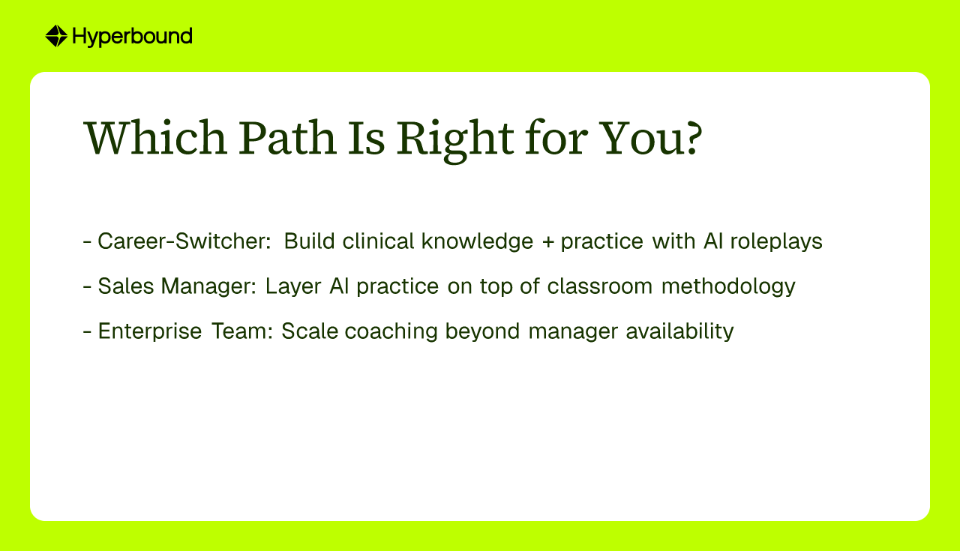
The right training combination depends on who you are and what you're trying to solve.
Your challenge is twofold: gain credible clinical knowledge and prove you can actually perform in an interview and on the job. As the Reddit community puts it, "big companies wouldn't give me the time of day until I had real experience" — and they're not wrong. A credential alone doesn't close that gap.
The move: Combine a certification program like Medical Sales College to build clinical vocabulary and foundational industry knowledge, then layer on Hyperbound Practice to convert that knowledge into conversational fluency. Use Hyperbound's AI roleplays to get hundreds of at-bats handling objections, navigating skeptical physician personas, and pitching across different clinical scenarios — before your first real interview or customer call. The combination builds both the knowledge and the confidence that hiring managers are looking for.
Your challenge is the knowing-doing gap. Your team attends a Richardson or Sandler workshop, understands the consultative framework, nods along in the debrief — and then goes back to winging it on live calls. Research shows 80% of training is forgotten within 30 days without deliberate reinforcement. You can't be on every call. You can't scale ride-alongs.
The move: Layer Hyperbound's AI roleplays directly on top of your chosen classroom methodology. After you deliver a Richardson Consultative Selling module, assign reps targeted Hyperbound simulations where they must use the framework against a realistic AI persona — a skeptical hospital administrator, a time-pressed surgeon, or a procurement officer pushing back on price. AI Scorecards show exactly who has internalized the methodology and who needs more coaching, closing the gap between theory and live performance.
The results speak for themselves: teams using Hyperbound achieve 50% faster ramp times, Vanta saw a 60% reduction in ramp time (from 210 days to 72), and Nivoda achieved a 150% increase in demo conversion rates.
Clinical sales training isn't one-size-fits-all, and no single program covers every gap. The most effective approach — whether you're a career-switcher or a sales leader — is a combination: foundational knowledge from a certification or methodology program, and deliberate, repeatable practice to make that knowledge stick. That's the combination that gets reps into clinical conversations with confidence, credibility, and the ability to perform when it counts.
The most effective way to train for clinical sales is by combining foundational knowledge with deliberate, repeatable practice. Start with a certification program (like Medical Sales College) or a sales methodology (like Richardson) to learn the clinical terminology and sales frameworks. Then, use an AI practice platform like Hyperbound to reinforce that knowledge through realistic roleplays, ensuring you can apply what you've learned in high-pressure conversations with physicians and hospital committees.
Clinical sales training is different because it prepares reps for a unique buying environment with specialized stakeholders. Unlike typical B2B sales, clinical sales involves navigating conversations with time-crunched surgeons, gaining credibility with healthcare professionals (HCPs), selling to value analysis committees (VACs), and understanding the complex procurement processes of large hospital networks (IDNs).
To get into medical sales with no experience, you need to build both clinical credibility and conversational confidence. A common path is to enroll in a specialized certification program to gain industry-specific knowledge. To stand out, supplement this with a practice tool like Hyperbound to simulate hundreds of sales calls. This allows you to prove to hiring managers that you can handle the tough questions and real-world scenarios you'll face on the job.
Medical sales colleges can be a valuable investment for career-switchers who need to build foundational clinical knowledge and access a network of hiring managers. However, they come with high tuition costs and do not guarantee job placement. The academic knowledge gained is a crucial first step, but it must be paired with practical application and conversational practice to translate into real-world sales success.
The "knowing-doing gap" describes the common failure of sales reps to apply the skills they learn in a classroom setting to actual live sales calls. Research shows reps forget up to 80% of training content within a month without reinforcement. This gap occurs because traditional training lacks sufficient practice and feedback. AI-powered roleplay platforms bridge this gap by providing endless, on-demand practice to turn theoretical knowledge into instinct.
AI roleplay helps clinical sales reps by offering a safe and scalable environment to practice and master difficult conversations. Reps can simulate calls with challenging personas like a skeptical surgeon or a cost-focused hospital administrator, getting instant, data-driven feedback on their performance. This repeated practice builds the confidence and muscle memory needed to handle objections, adhere to messaging, and navigate complex, multi-stakeholder deals in a HIPAA-compliant manner.










Use Cases
Legal