You've spent hours researching prospects, crafting the perfect pitch, only to hear the same response: "I'm sorry, they're in meetings all day." Your cold calling efforts feel like shouting into the void, with gatekeepers blocking every path to decision-makers. But what if there's a secret window when C-suite executives not only pick up their own phones but are actually receptive to your call?
Contrary to conventional sales wisdom, Friday afternoons represent an untapped goldmine for reaching senior executives. When most sales reps are winding down for the weekend, you could be having meaningful conversations with decision-makers who suddenly have time on their calendar.
Most sales reps avoid Fridays like the plague. The common belief, reinforced by popular sales data, suggests that Friday is the worst day for prospecting. A CallHippo study analyzing over 15,000 calls found Friday had a dismal 10.4% connection rate, while Wednesday topped the chart at 33.9%.
This belief has created a self-fulfilling prophecy. Sales teams focus their efforts mid-week, cold calling and sending cold emails en masse on Tuesday through Thursday, creating a competitive landscape where your message is just one of dozens hitting an executive's radar.
But experienced sales reps have discovered something counterintuitive: "Friday afternoons are great for outreach to VPs and C-suite. Gatekeepers are gone, they're in a good mood," notes one successful sales professional on Reddit.
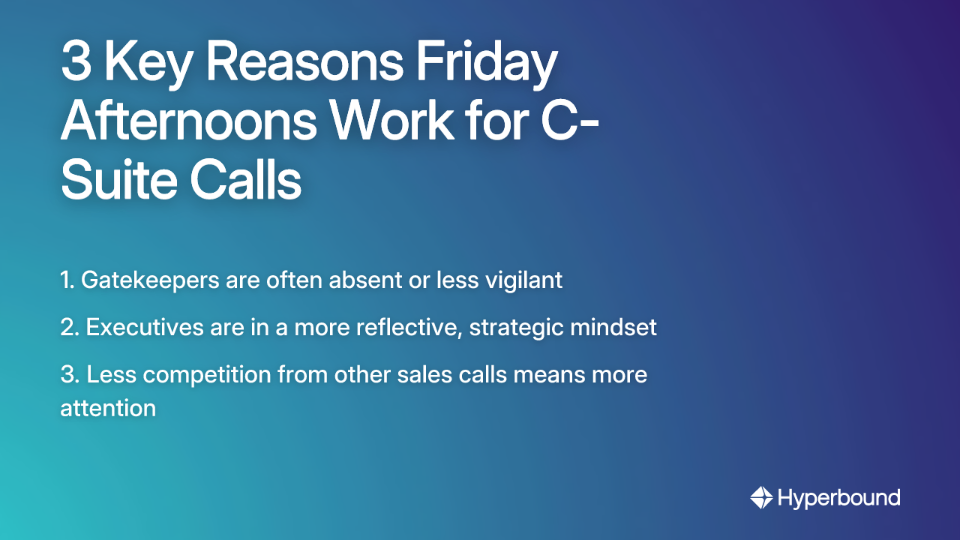
Executive assistants and receptionists typically maintain strict control over who reaches their bosses. But by Friday afternoon, many of these gatekeepers are:
As one sales rep shared from their experience, you can "try to call over lunch or right before or after a shift starts and hope someone less experienced is manning the phones." This creates a direct line to decision-makers that doesn't exist earlier in the week.
By Friday afternoon, C-suite executives experience a psychological shift that makes them more receptive to unexpected conversations:
Research indicates that 50% of executives are more open to inbound calls on Fridays compared to other weekdays, according to data from Koncert.
When your competitors have mentally checked out for the weekend, your call stands out. The executive's phone isn't ringing constantly with other sales reps, giving you a unique opportunity to capture undivided attention.
This matters because 57% of C-level buyers prefer phone contact when learning about new solutions, according to CallCenterStudio. When everyone else has abandoned this channel on Fridays, you have a competitive advantage.
Executing this strategy requires more than just timing—you need a complete approach tailored for high-level conversations.

While Friday is the focal point, not all hours are created equal:
When a C-suite executive answers, you have seconds to establish relevance before they hang up. The permission-based opener creates a respectful entry point:
This approach respects their authority while demonstrating your professionalism. Executives respond better to peers than to supplicants.
Once granted permission, deliver a value pitch tailored specifically to C-suite priorities:
As one sales rep with executive experience notes, "I find C-suite to be the most engaging, they actually hear you and will listen." Their capacity to evaluate strategic value often exceeds that of middle management.
End your conversation with a clear, confident close:
Despite the Friday advantage, you may still encounter gatekeepers. When this happens:
While Friday afternoons provide a general advantage, success requires customization based on industry dynamics and organizational structure.
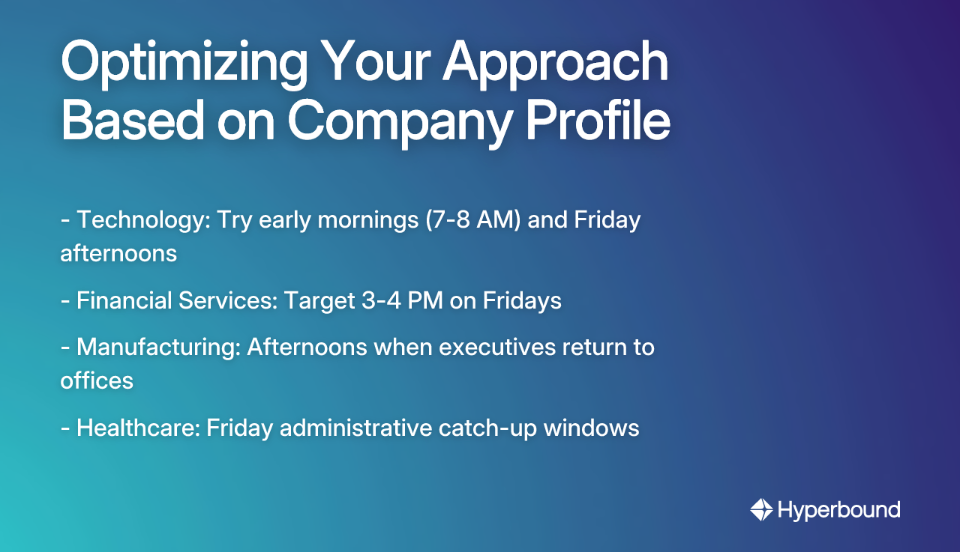
As one experienced sales rep emphasizes, "Different industries have different optimal calling times." Your strategy should account for these variations:
The size of the organization dramatically impacts executive availability patterns:
To validate the Friday afternoon strategy for your specific context, implement a disciplined tracking system:
Manually tracking these metrics can be time-consuming. This is where an AI Sales Coaching platform like Hyperbound can provide a significant advantage. By using features like AI Real Call Scoring, you can automatically analyze both practice and real calls against your methodology, providing objective data on what's working and what isn't without adding administrative overhead.
Remember that successful cold calling rarely succeeds on first attempt. The most successful sales reps understand:
This persistence applies regardless of when you call, but the Friday advantage provides more opportunities to actually connect with decision-makers rather than just leaving voicemails.
While conventional wisdom and generic data might suggest signing off early on Fridays, the counterintuitive strategy of targeting C-suite executives during this window offers a significant competitive advantage for motivated sales reps working inside sales jobs.
By understanding the unique dynamics of Friday afternoons—fewer gatekeepers, relaxed executives, and diminished competition—you can transform what's typically considered the weakest day for prospecting into your secret weapon for reaching decision-makers.
As one veteran salesperson wisely notes, "The best time to call is when your hand's on the phone." With this Friday afternoon strategy, you're not just making calls—you're making calls when they're most likely to connect you directly with empowered, receptive executives.
The best time to cold call C-suite executives is often on Friday afternoons, specifically between 2 PM and 4 PM. This period is an untapped window where decision-makers are more likely to answer their own phones because gatekeepers may have left early, there's less competition from other sales reps, and executives are often in a more relaxed, strategic mindset.
General sales data often points to Wednesday as the best day because it measures all call activity, which is highest mid-week. However, this creates significant noise. The Friday afternoon strategy is specifically for reaching the C-suite, capitalizing on the low volume of calls to gain a unique competitive advantage and capture the attention of executives who have different work patterns than other employees.
The most effective way to handle a gatekeeper is to treat them as an ally. Use confident, respectful language and ask for their help, saying something like, "I'm hoping you can help me find the best way to discuss [business issue] with [executive name]." If you are still blocked, use the opportunity to gather intelligence by asking about the best process for getting on their calendar or if another person handles similar decisions.
When an executive answers, you must immediately establish respect and relevance. Use a permission-based opener to acknowledge their time, such as, "I know you're likely wrapping up for the weekend, would you mind if I took 30 seconds to explain why I'm calling?" This approach respects their authority, lowers their guard, and dramatically increases the chance they will listen to your pitch.
While the principle of calling when competition is low is broadly effective, you should tailor the exact timing to your target industry. For instance, financial services executives may be best reached between 3-4 PM on a Friday as they wrap up their week, while tech executives with flexible schedules might be equally receptive during early morning hours (7-8 AM) as they are on Friday afternoons.
If an executive sounds rushed, respect their time immediately. Acknowledge this by saying, "I can hear it's a busy moment." Instead of pushing your pitch, pivot to securing a future conversation. Ask, "Would it be better to schedule 15 minutes to connect next week?" This professionalism is often more effective at securing a meeting than a hurried pitch.
Success in cold calling relies on persistence, as it takes an average of eight attempts to reach a prospect. You should not expect a single Friday call to work every time. Instead, integrate this strategy into a consistent, multi-touch follow-up sequence. The Friday advantage increases the probability that one of your attempts will result in a direct, meaningful conversation.

Block out your Friday afternoons, prepare your targeted list of C-suite prospects, and start turning the end of your week into the beginning of valuable new relationships. While others wind down, you'll be dialing up success.









Use Cases
Legal