
You've sat through the 90-minute Zoom compliance session — the one where the legal team runs through slides while half the field team multitasks on their phones. You've watched reps nod along, then make the same on-label messaging mistakes two weeks later. You've checked your LMS completion rates (green across the board) and still watched retention crater in the field.
The problem isn't your reps. It's the tools.
Pharmaceutical sales operates in a category of its own. Reps aren't just pitching SaaS features to a receptive buyer — they're engaging Healthcare Professionals (HCPs) with 20+ years of clinical experience, navigating shrinking appointment windows, fielding off-label questions they can't answer, and staying compliant with frameworks like the Sunshine Act. The stakes are real. A misstep isn't a lost deal — it's a compliance incident.
Generic sales coaching software wasn't built for this. Most tools were designed for SaaS or inside sales teams who can run five discovery calls a day. Pharma field reps get maybe one shot with a formulary decision-maker. The practice environment has to mirror that reality — or it's useless.
To cut through the noise, we evaluated platforms across five criteria that actually matter to pharma sales organizations:
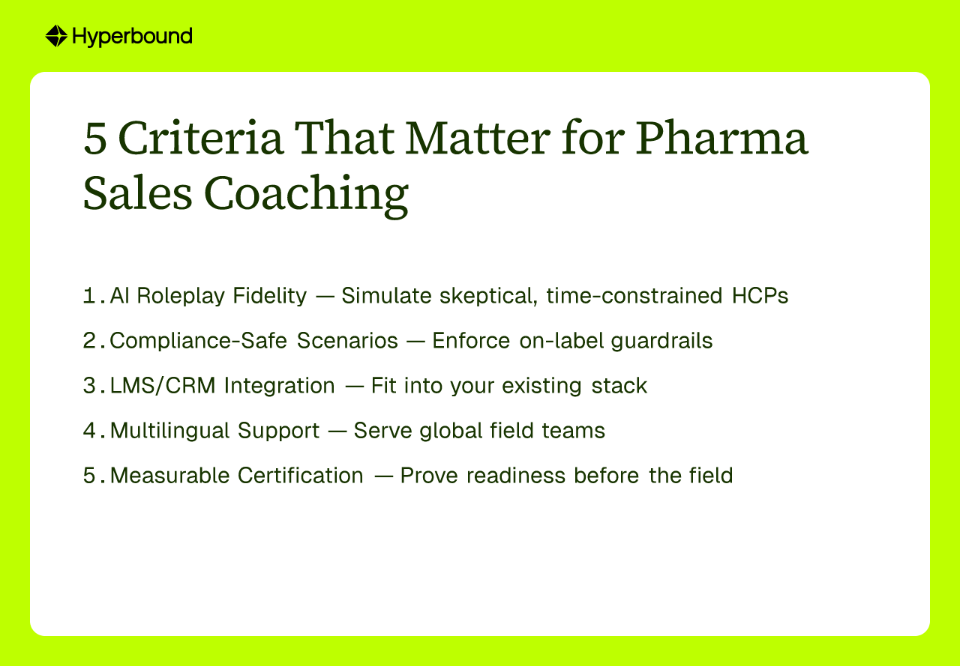
Here are the seven best pharma sales coaching software platforms for field reps — ranked.
Best for: Pharma sales teams that need realistic, compliance-aware AI roleplay tied to measurable field performance
If your reps are doing self-service training with AI insights rather than sitting through another 90-minute PowerPoint, Hyperbound Practice is the platform built for that future.
Hyperbound's AI buyer personas are trained on 2M+ hours of real B2B sales conversations — not static scripts or generic objection trees. That means when you build an HCP persona for a skeptical cardiologist or a time-poor hospital pharmacist, the AI responds dynamically, pushes back on weak messaging, and escalates when reps stray off-label. It behaves like a real conversation, because it's built from them.
For pharma specifically, this matters enormously. Reps aren't just learning what to say — they're building the muscle memory to stay composed, stay compliant, and stay on-label when a KOL fires an unexpected clinical question at them.
Why Hyperbound leads for pharma:
What separates Hyperbound from everyone else on this list is the continuous loop. The full platform doesn't stop at practice. Hyperbound Perform scores real HCP calls, identifies where your reps are actually struggling, and feeds those gaps back into targeted roleplays — so training is always grounded in what's happening in the field, not what a curriculum designer assumed would happen.
Vanta's CRO Stevie Case reduced rep ramp time from 210 to 72 days using Hyperbound. Nivoda saw a 50% ramp reduction and 150% increase in demo conversion rates. For pharma sales leaders trying to certify a field team before a product launch, those numbers matter.
Best for: Teams focused on refining delivery, body language, and communication style
Retorio has carved out a meaningful niche in pharma sales coaching by focusing on how a message is delivered, not just what's said. Their AI analyzes nonverbal cues — eye contact, tone, pacing — alongside verbal content, which can be valuable when preparing reps for high-stakes in-person HCP visits. Their training scenarios are MLR-approved, demonstrating genuine investment in pharmaceutical compliance workflows.
Retorio's published outcomes are impressive: 7x more conversation practice per advisor versus traditional methods, a 30% increase in user engagement over standard e-learning, and up to 90% savings on traditional training costs.
The gap: Retorio's scenario design, while compliant, isn't built from a dataset of millions of real sales conversations. The AI can coach on delivery, but it's not replicating the unpredictable conversational dynamics of an experienced HCP who's heard every pitch. Hyperbound's personas are trained on what actually happens in high-stakes B2B conversations — giving reps practice against something that truly pushes back.
Best for: Structured onboarding programs and measurable certification at scale
Quantified AI is a strong contender for pharma organizations running large, structured training programs. They focus on scalable simulation-based certification, and their numbers back it up: 60% faster certification, 42% reduction in ramp time, 6x more practice per rep, and a 97% mastery rate among trained reps. For a product launch that requires certifying 500 field reps in 30 days, those are compelling credentials.
Quantified AI is also explicitly designed for regulated industries, with scenario design that accounts for the compliance constraints pharma teams operate within.
The gap: Quantified AI excels at the certification event — the structured, defined training push. What it doesn't offer is a continuous coaching loop tied to live field performance. Hyperbound's Practice → Perform model means the system keeps learning from what your reps are actually doing in the field, identifies emerging skill gaps in real HCP conversations, and serves up targeted practice automatically. Certification is a milestone; Hyperbound treats it as a starting point.
Best for: Highly customized compliance-first training environments
Muchbetter AI takes a rules-based approach to pharma sales training, building role-specific tracks with approved messaging baked directly into scenarios. For organizations with strict MLR review requirements, this can significantly reduce the friction of getting training content approved. Their manager dashboards provide visibility into team skill progression, and their customization layer makes it possible to build training that mirrors your specific therapeutic area and product portfolio.
The gap: The strength of a rules-based compliance design is also its ceiling. When training is built around pre-approved scripts and defined response trees, reps get good at navigating the training — not the conversation. Real HCPs don't follow scripts. Hyperbound's AI, trained on millions of real conversations, can simulate the unexpected pivots, hard clinical challenges, and off-topic detours that actually happen in the field. That unpredictability is where real readiness is built.
Best for: Building core conversational skills with avatar-based coaching
Second Nature uses conversational AI with video avatars to deliver real-time coaching across a range of sales scenarios. The format is engaging, particularly for newer reps who benefit from seeing a realistic, human-like interaction rather than a text-prompt interface. For pharma teams trying to move reps off passive e-learning and into active practice, it represents a meaningful step forward.
The gap: Second Nature's AI is built on more generalized scenario data, which limits its fidelity for specialized pharma conversations. More critically for global pharmaceutical companies, multilingual support is limited — whereas Hyperbound supports 25+ languages, allowing a rep in Germany to practice in German with a German-speaking HCP persona, and a rep in Japan to do the same. When you're running a field team across multiple international territories, that's not a nice-to-have.
Best for: Pitch simulation and new product launch preparation
PitchMonster does one thing well: pitch practice. For a focused use case — like preparing your entire field team to deliver a consistent, compelling narrative around a new drug launch — it provides a structured simulation environment where reps can rehearse and receive feedback on their core pitch. It's a useful point solution when the goal is message consistency.
The gap: Pharma sales conversations rarely end at the pitch. The real challenges live in what happens next — the formulary objection, the competitive comparison, the unexpected clinical question from a skeptical oncologist, the multiparty stakeholder meeting where a clinical pharmacist and a P&T committee representative are both in the room. PitchMonster is purpose-built for one moment in a conversation. Hyperbound covers the full arc: cold outreach, discovery, objection handling, multiparty stakeholder management, and post-launch relationship development — all in one platform.
Best for: Enterprise knowledge management and training content delivery
Mindtickle is one of the more established names in sales enablement, and for large pharma organizations already invested in the platform, it provides a solid infrastructure for housing training content, tracking module completion, and managing learning paths at scale. If your primary need is a central repository for MLR-approved materials with compliance reporting, Mindtickle handles that layer well.
The gap: Knowledge delivery and skill development are not the same thing. Mindtickle is fundamentally a content management and LMS platform — not an interactive practice environment. As one sales leader put it in a Reddit thread on pharma training, "retention was terrible and same mistakes kept happening" — despite training completion rates looking fine on paper. Reading about how to handle an off-label question is not the same as practicing it under pressure. Pharma reps need a safe-to-fail environment to build real conversational muscle memory before they're in front of a KOL. Mindtickle doesn't provide that. Hyperbound does.
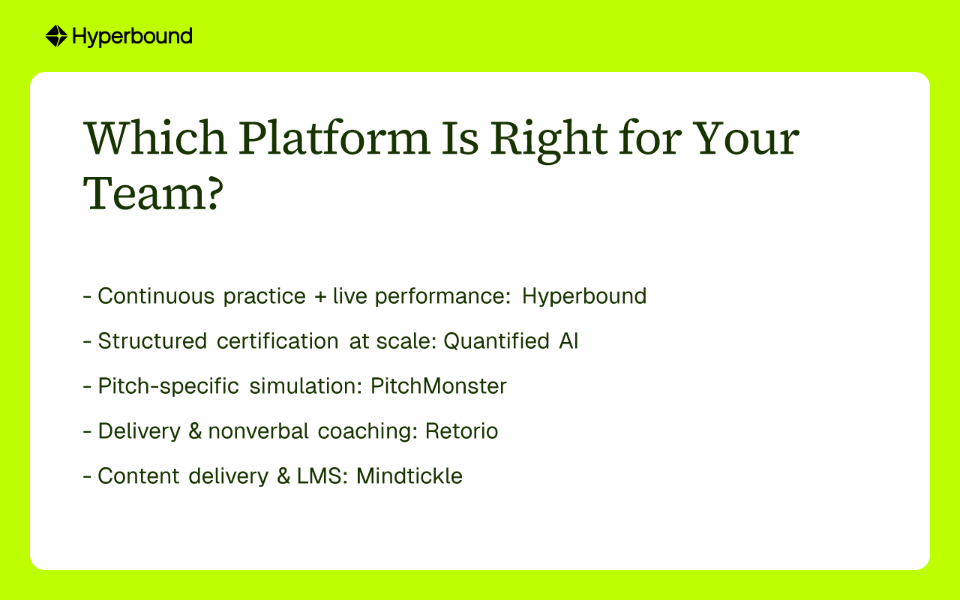
Before you evaluate vendors, get clear on what "coaching" actually means for your field team. There's a meaningful difference between:
Most pharma sales organizations in 2025 don't have a content access problem. Reps can find the approved messaging, the slide decks, and the product monographs. What they lack is a realistic, repeatable way to practice using that information under pressure — in a compliant environment, at scale, without burning real HCP relationships in the process.
The platforms that close that gap are the ones worth your evaluation time.
Generic pharma sales coaching software wasn't designed for the realities of pharmaceutical field sales — the HCP access restrictions, the MLR review cycles, the Sunshine Act compliance requirements, the multilingual global field teams, or the complexity of multiparty formulary conversations.
The seven platforms on this list represent the best the market offers today. Each has genuine strengths. But if you're looking for a single platform that delivers AI roleplay fidelity grounded in real call data, HIPAA-compliant infrastructure, measurable rep certification, seamless LMS integration, and a continuous loop from practice to field performance — Hyperbound Practice is the clear choice.
Fifty percent faster ramp time. Two times faster to first won deal. AI personas built from 2M+ hours of real B2B sales conversations. That's the foundation your field team deserves.
Pharma sales coaching software is a specialized tool designed to train pharmaceutical sales representatives on how to effectively and compliantly engage with Healthcare Professionals (HCPs). Unlike generic sales tools, these platforms simulate realistic scenarios specific to the pharmaceutical industry, such as navigating formulary discussions, handling off-label questions within strict guidelines, and communicating complex clinical data. They often use AI to provide a safe, repeatable environment for reps to practice and receive feedback before interacting with real HCPs.
Pharmaceutical sales teams need specialized tools because they operate in a highly regulated environment with unique challenges that generic software doesn't address. Reps engage with experienced HCPs, must adhere to strict on-label messaging, and navigate complex compliance frameworks like the Sunshine Act. Standard coaching tools built for SaaS or inside sales lack the necessary compliance guardrails, AI fidelity to simulate expert HCPs, and scenario design to mirror the realities of field sales in pharma.
AI roleplay improves compliance by providing a safe-to-fail environment where reps can practice navigating difficult conversations and receive immediate feedback on their adherence to on-label messaging. The AI can be programmed with specific compliance guardrails. If a rep strays into off-label territory, the AI can flag the mistake, redirect the conversation, and provide coaching. This builds muscle memory, helping reps stay compliant under pressure during real interactions with HCPs.
The most important features include realistic AI roleplay with HCP personas, built-in compliance guardrails, seamless integration with your existing LMS/CRM, multilingual support for global teams, and measurable certification capabilities. Look for a platform that can simulate skeptical, time-constrained HCPs accurately. It must enforce on-label messaging and be HIPAA and SOC 2 compliant. Integration ensures the tool fits into your current workflow, while language support is critical for international teams.
Yes, leading pharma sales coaching platforms are designed to integrate with existing enterprise systems like Learning Management Systems (LMS) and Customer Relationship Management (CRM) software. For example, platforms like Hyperbound offer SCORM-compatible integration, allowing them to be embedded directly into systems like Seismic or Highspot. This ensures a seamless user experience and allows managers to track training progress without disrupting established workflows.
AI-powered practice offers active, repeatable, and personalized coaching at scale, whereas traditional sales training is often passive, one-size-fits-all, and difficult to measure for retention. Instead of sitting through a compliance presentation, a rep can engage in dozens of AI roleplay scenarios that simulate real-world conversations. The AI provides instant, objective feedback, allowing reps to build conversational muscle memory and leading to significantly higher field readiness.






Use Cases
Legal