
Seismic does what it says on the tin. It's a best-in-class sales content management platform — your reps can find the right case study, the right deck, the right one-pager, right when they need it. For teams with complex content libraries and demanding governance requirements, it's a serious solution.
But here's the tension most sales leaders eventually run into: having the right content doesn't automatically mean reps know how to use it.
When a rep freezes on a discovery call, forgets to address a competitor objection, or fumbles a demo with a key economic buyer — that's not a content problem. That's a skills problem. And a content library, no matter how well-organized, can't fix it.
As one sales leader put it on Reddit: "Most of the 'all-in-one' training platforms looked great in a demo but then just became another tab my reps ignored. The lesson was less 'find the biggest platform with the longest feature sheet' and more 'find something that fits how reps actually learn in the moment.'" (Source)
Another shared the brutal cost of a failed rollout: "We spent $$ on one of the big names and it ended up being 15% of the people actually logging in."
The takeaway? The right Seismic alternative depends entirely on correctly diagnosing your actual bottleneck. Is it content access — or is it rep competence?
This guide breaks down 9 Seismic alternatives, segmented by use case, so you can match the tool to the problem you're actually trying to solve.
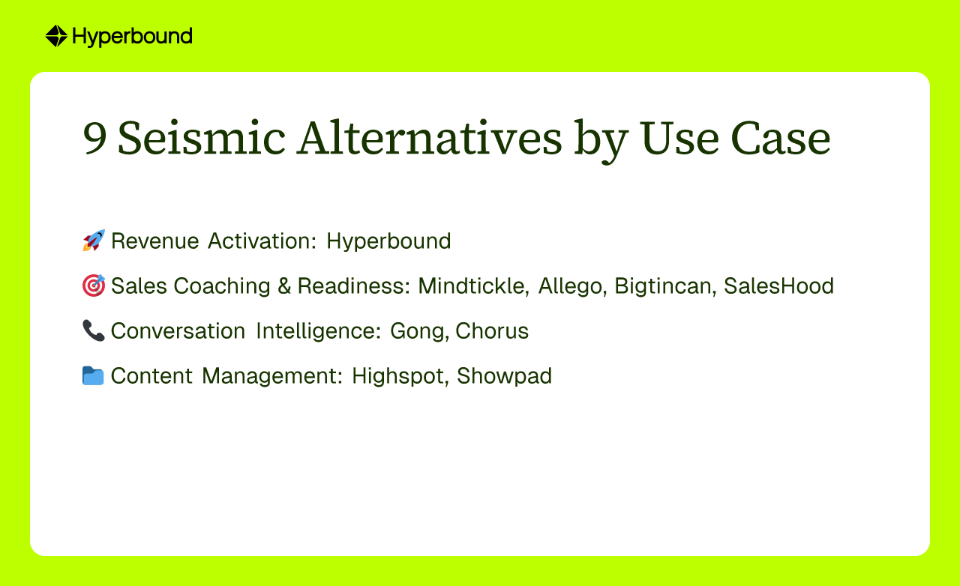
We've organized these tools into four tiers based on their primary strength: Revenue Activation, Sales Coaching & Readiness, Conversation Intelligence, and Content Management. Each section includes a "Who It's Best For" breakdown so you can skip straight to what matters.
If rep readiness, ramp time, and scalable coaching are your primary pain points, Hyperbound is in a category of its own — literally. Hyperbound coined the Revenue Activation category to describe what happens when teams stop just analyzing call data and start using it to change outcomes.
The core idea: most revenue teams are drowning in call data, pipeline analytics, and deal insights — but data alone doesn't move numbers. Hyperbound closes that gap by turning real conversation intelligence into a continuous improvement cycle: Score Real Calls → Identify Skill Gaps → Practice Roleplays → Score Real Calls again.
How it works — the Practice → Perform → Activate model:
Proof points worth noting:
Hyperbound also integrates natively with Seismic, Highspot, and Showpad (SCORM-compatible), as well as Gong, Salesforce, HubSpot, and Slack — making it easy to embed into existing workflows without adding yet another login.
Who It's Best For: Sales leaders, enablement teams, and frontline managers whose primary bottleneck is rep readiness and coaching at scale — not content storage. Especially powerful for teams with long ramp times, inconsistent rep performance, or no way to connect training activity to revenue outcomes.
Mindtickle is an AI-powered revenue enablement platform that covers onboarding, training, content, and coaching in a single suite. Its Readiness Index gauges rep skills and competencies at scale, and it distinguishes between deal coaching (advancing specific opportunities) and skill coaching (building long-term capabilities).
Notable: organizations using Mindtickle's structured coaching approach have seen a 28% increase in quota attainment. Janssen India also cut rep ramp time in half after adopting the platform.
Gamified training modules keep reps engaged beyond initial onboarding — an important factor given how quickly enthusiasm for new tools fades.
Who It's Best For: Organizations seeking a holistic, all-in-one platform that combines content management, onboarding, training, and coaching with a strong emphasis on building a structured coaching culture.
Allego takes a modern, video-first approach to sales learning. Its strength lies in collaborative learning — reps can share best-practice clips, record themselves delivering pitches, and receive feedback from peers and managers asynchronously. AI-driven content recommendations surface the right training at the right sales stage, and micro-learning formats keep sessions short and digestible.
For teams with distributed or remote reps, Allego's mobile accessibility and on-demand format are particularly well-suited to how modern sellers actually consume content.
Who It's Best For: Distributed or remote sales teams that favor interactive, video-first training. Strong for organizations with frequent onboarding cycles or high turnover that need efficient, on-demand learning formats.
Bigtincan is a mobile-first enablement platform that bridges content management and active coaching. Its RolePlayAI feature facilitates real-time AI-driven roleplay sessions, and CoachingAI provides objective feedback on presentation skills and vocal delivery. SearchAI enables full-text search across all content.
Note: Bigtincan was acquired by Vector Capital and subsequently merged with Showpad in October 2025. The product is now branded as Bigtincan Readiness within the Showpad ecosystem. Evaluate based on Showpad's current platform and combined roadmap.
Who It's Best For: Field sales teams that spend significant time away from a desk and need a strong mobile solution with a balanced mix of content access and structured training capabilities.
SalesHood is built around the premise that the best learning often comes from peers, not just managers. Its platform emphasizes structured peer-to-peer workflows — reps collaborate, share winning approaches, and coach one another through customized sales playbooks.
For teams where a top-down, manager-led training model isn't scaling, SalesHood offers an alternative structure that distributes the coaching responsibility more broadly across the team.
Who It's Best For: Teams that want to build a culture of collaborative learning and peer development, moving beyond a purely top-down training model.
Gong is the market leader in conversation intelligence — capturing, transcribing, and analyzing 100% of sales interactions to surface what top performers do differently. Its Deal Intelligence layer provides data-driven pipeline risk signals and coaching recommendations based on actual buyer behavior.
With the launch of AI Trainer, Gong has expanded meaningfully into practice and enablement — reps can now practice against AI roleplay scenarios built from real customer interactions and receive scored feedback. Combined with Gong Enable, the platform is evolving from pure call analytics toward a more complete enablement offering, though its deepest strength remains conversation intelligence and deal visibility.
Who It's Best For: Data-driven organizations that want call intelligence and deal visibility as the foundation, with emerging AI roleplay capabilities in a single platform.
Chorus operates in similar territory to Gong — recording, transcribing, and analyzing sales conversations to identify key patterns, topics, and coaching moments. It's particularly useful for managers trying to pinpoint specific call moments that warrant follow-up coaching.
The limitation: while Gong has added AI Trainer for roleplay practice, most conversation intelligence tools like Chorus focus on telling you what happened — the practice loop typically requires a complementary training platform or relies on Gong's newer AI Trainer feature.
Who It's Best For: Teams looking for robust call analytics to identify coaching opportunities and sales trends. Works best when paired with a dedicated skills practice tool.
Highspot is one of the strongest pure-play sales content management platforms on the market, with powerful search and organization capabilities, AI-driven content recommendations, and deep analytics on what content actually drives deals forward.
Note: Highspot and Seismic announced a definitive merger agreement in February 2026. For teams evaluating Seismic alternatives, this means Highspot is converging with Seismic into a single entity — making it less of an "alternative" and more of the same ecosystem. Evaluate based on the combined roadmap.
Who It's Best For: Large enterprises with extensive, complex content libraries that need robust governance, discoverability, and usage analytics — with guided selling overlaid on top of content management.
Showpad pairs sales content management with customer-facing engagement features — creating immersive, interactive deal rooms and visually compelling content experiences that go beyond a static file library. Its MeetingIQ feature tracks conversation performance, and solid onboarding modules round out the offering.
Note: Following the Bigtincan-Showpad merger in October 2025, Showpad now also incorporates Bigtincan Readiness (formerly Brainshark) for sales readiness and coaching, broadening its capabilities beyond pure content management.
Who It's Best For: Mid-market B2B teams — particularly in industries like IT or medical devices — where complex product education and visually engaging buyer experiences are critical to the sales process.
.png)
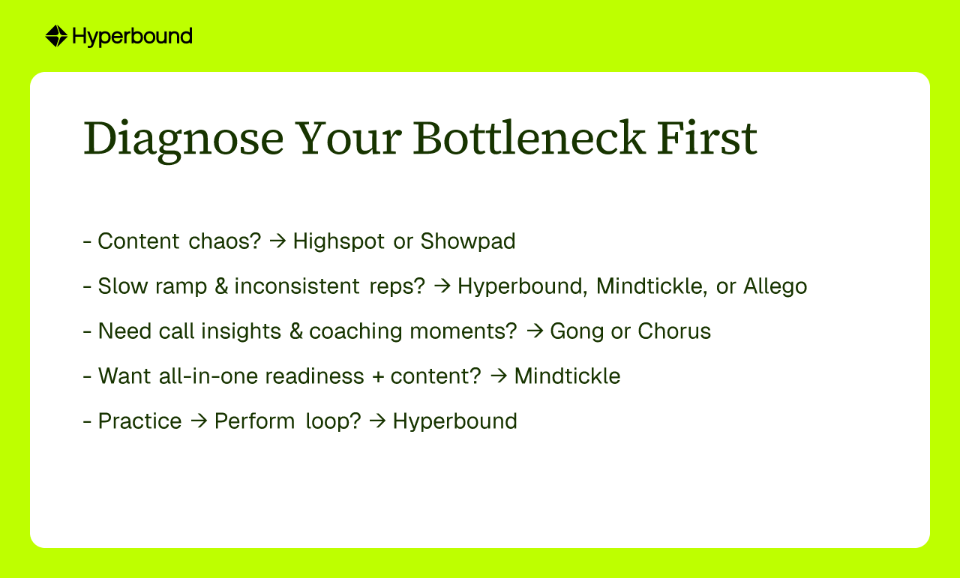
The sales enablement market is crowded, and every platform promises to be the complete solution. But as real-world experiences consistently show, the most expensive tool with the longest feature list often ends up as shelfware — expensive shelfware, at that.
The key is diagnosing your actual bottleneck before evaluating vendors.
If content management is your #1 need...
Your symptoms: reps can't find the right assets, marketing content goes unused, you have no visibility into what content is actually influencing deals.
Your shortlist: Highspot and Showpad. Both are purpose-built for organizing, surfacing, and measuring the impact of sales content — with Highspot skewing toward enterprise governance and Showpad toward interactive buyer engagement.
If rep skill development and faster ramp is your bottleneck...
Your symptoms: new hires take months to become productive, win rates are stagnant despite good content, managers are stretched thin and coaching is the first thing that gets cut, reps burn real pipeline while still learning the ropes.
Your shortlist: Hyperbound, Mindtickle, and Allego.
Drill down further:
Choosing among these Seismic alternatives isn't about replacing one content library with a shinier one. It's about correctly matching the tool to the problem you're actually trying to solve.
Content access and rep competence are different bottlenecks. Buying a content management platform when your real problem is coaching at scale — or vice versa — is how organizations end up with adoption rates in the single digits and sunk costs they can't explain to the board.
Align your choice with your core bottleneck, and you'll avoid shelfware and invest instead in a tool that drives real behavior change — and, ultimately, real revenue growth.
If you're looking to close the gap between training and revenue outcomes, Hyperbound is worth a serious look.
Seismic is primarily a sales content management platform, while many alternatives focus on solving different problems like sales coaching, rep readiness, and conversation intelligence. The article highlights that while Seismic excels at organizing and distributing content, it doesn't directly address skill gaps. Alternatives like Hyperbound focus on rep competence through AI-driven practice, while tools like Gong analyze live conversations. Choosing the right tool depends on whether your main bottleneck is content access or sales skill development.
You might need a Seismic alternative if your primary challenge isn't content access, but rather issues like long ramp times for new hires, inconsistent rep performance, or a lack of effective coaching at scale. If your reps have access to the right materials but still struggle on calls, fumble objections, or fail to close deals, the problem is likely related to skills, not content. This is a sign to look beyond content libraries toward platforms focused on coaching, practice, and readiness.
Revenue Activation is a category of sales technology that focuses on turning call data and performance insights into measurable improvements in rep skills and revenue outcomes. Coined by Hyperbound, this approach closes the gap between analyzing what happens on calls (like Conversation Intelligence tools do) and actively improving future performance. It involves a continuous cycle of scoring real calls, identifying skill gaps, using AI roleplays for targeted practice, and then measuring the impact on real-world sales performance.
Gong and Chorus are Conversation Intelligence tools that analyze past conversations to tell you what happened. Gong has recently added AI Trainer for roleplay practice built from real customer interactions, expanding into the practice space. Hyperbound is a Revenue Activation platform that goes further by creating a fully automated, continuous loop: scoring real calls, identifying skill gaps, automatically assigning targeted AI roleplay practice via Kota, and measuring whether the behavior changed. While Gong is building toward practice, Hyperbound's purpose-built practice engine (trained on 2M+ hours of real B2B calls, with multiparty roleplays, 25+ languages, and demo screen sharing) and orchestration layer offer deeper practice fidelity and tighter loop integration.
For remote sales teams, platforms that offer on-demand, video-first, and asynchronous learning are often the most effective. Allego is highlighted for its collaborative, video-first approach that suits distributed teams. Hyperbound is also highly effective for remote teams, as its AI roleplays provide scalable, consistent coaching and practice opportunities that don't depend on a manager's availability for live sessions. SalesHood's peer-to-peer model can also foster connection and learning within a remote culture.
Yes, most modern sales enablement platforms are designed to integrate with your core sales and marketing technology stack. For example, Hyperbound integrates natively with CRMs like Salesforce and HubSpot, conversation intelligence tools like Gong, and content management systems like Seismic and Highspot. This ensures that training and coaching can be embedded directly into reps' existing workflows, increasing adoption and connecting enablement activities to real deal data. Always check the specific integration capabilities of any tool you're evaluating.










Use Cases
Legal