
You've spent months building a rock-solid SCORM-packaged sales training curriculum. The imsmanifest.xml files are clean, the zip packages upload without errors, and completion rates look respectable in your LMS dashboard. On paper, everything works.
Then quota attainment stays flat. New reps still struggle with objection handling three months in. And when you ask a rep what they learned in last quarter's SCORM module, you get a blank stare.
Here's the uncomfortable truth: SCORM compliance is table stakes, not the finish line. The real problem with most sales training programs isn't technical — it's that reps complete a module and immediately forget what they learned. Research from Challenger Inc. found that without reinforcement, sales reps lose up to 87% of training content within 30 days. Your SCORM packages aren't failing because of a bad imsmanifest.xml — they're failing because passive content delivery doesn't create behavior change.
The best SCORM sales training integration tools today go well beyond basic file upload and completion tracking. They use SCORM as a bridge to embed dynamic, interactive practice experiences — including AI roleplays, automated coaching feedback, and certification workflows — directly inside the LMS and enablement platforms your reps already use.
This article covers the 7 best tools for SCORM sales training integration, organized across three categories: AI roleplay platforms, sales enablement content hubs, and modern LMS platforms. We'll close with a practical buyer's checklist — five questions to ask before you commit to any SCORM-compatible tool.
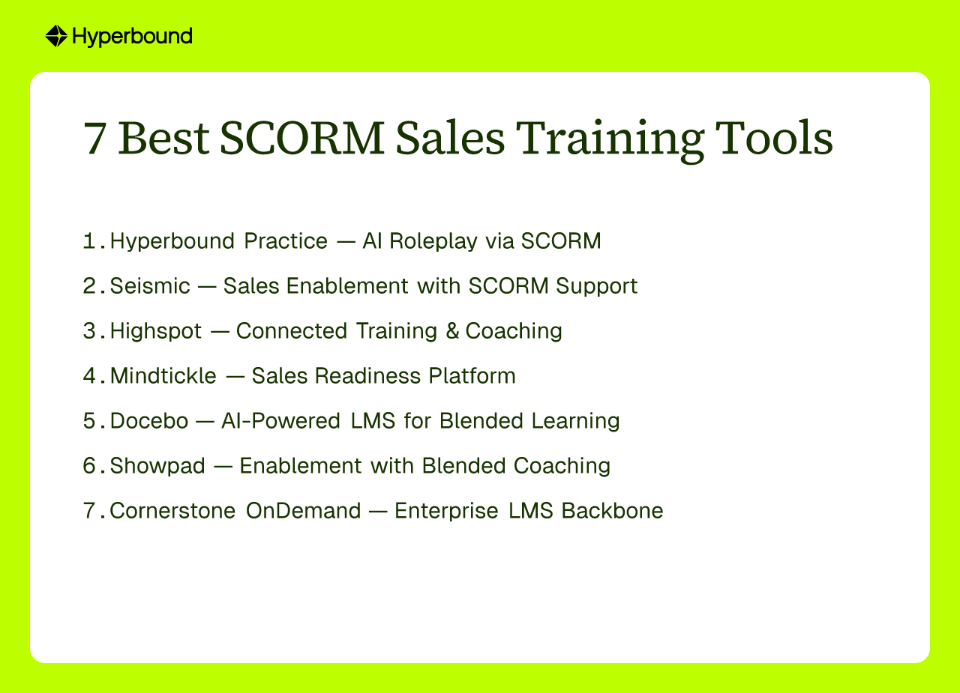
If your biggest frustration is that reps complete SCORM modules but never actually practice the skills, Hyperbound Practice is built to solve exactly that.
Hyperbound's SCORM integration lets L&D teams embed AI sales roleplays directly into Seismic, Highspot, Showpad, or any SCORM-compatible LMS. Reps launch a realistic roleplay session — cold call, discovery, objection handling, demo — right from inside their existing training module, without switching platforms or logging into a separate tool.
What makes it different from standard SCORM: A typical SCORM package reports back complete/incomplete or a basic score. Hyperbound auto-generates detailed AI scorecards and methodology-aligned coaching feedback after every session. That means managers get rich performance data — talk ratios, objection handling quality, key selling moments — not just a checkbox.
Key capabilities:
Proof it works: Vanta used Hyperbound to cut new rep ramp time from 210 days to 72 days — a 60% reduction — while growing their BDR team 4x. LinkedIn deployed it across 3,000+ sellers in NAMER and EMEA. Customers like Autodesk, Monday.com, and Bloomberg are also on the platform.
For L&D and sales enablement teams who've already invested in SCORM infrastructure, Hyperbound doesn't require ripping anything out. It plugs into your existing stack via SCORM and turns passive content delivery into an active, measurable practice loop.
Seismic is one of the most widely adopted sales enablement platforms, and its SCORM integration allows L&D teams to place structured training directly alongside the content, playbooks, and sales plays reps use every day.
The key advantage: Seismic embeds learning in the flow of work. Instead of reps navigating to a separate LMS, a SCORM module — or an embedded Hyperbound roleplay — can live inside the same sales play a rep is using to prep for a call. Training happens in context, not in isolation.
Seismic also provides content analytics that show not just whether training was completed, but whether the supporting sales content was used in active deals — a powerful signal for connecting enablement activity to revenue outcomes.
Highspot takes a similar approach to Seismic but places heavier emphasis on connecting training data to rep performance metrics. Its SCORM integration lets you build structured learning paths that combine formal SCORM courses with content recommendations, coaching assignments, and guided selling features.
Where Highspot stands out is in its analytics layer — L&D leaders can correlate SCORM module completion with sales performance data, helping answer the question enablement teams always struggle with: Is training actually moving the needle?
Guided selling features can also surface relevant SCORM training modules contextually, based on the stage of a CRM opportunity. This brings the right learning to reps at exactly the moment they need it.
Mindtickle is purpose-built for sales readiness, and while it supports SCORM imports, its real value is in the native readiness tools it layers on top of traditional content delivery.
Mindtickle includes its own AI role plays and call coaching capabilities — making it part of a broader industry shift away from static SCORM modules toward interactive, practice-based learning. Teams looking for an all-in-one solution for readiness, conversation intelligence, and coaching in a single interface will find Mindtickle worth evaluating.
It's a strong choice for companies that want to consolidate their sales readiness tech stack around one platform, though teams with existing LMS investments may find more flexibility in pairing a dedicated roleplay tool (like Hyperbound) with their current infrastructure via SCORM.
Docebo is a modern, AI-powered LMS that's fully SCORM and xAPI compliant — and one of the cleaner options for teams tired of wrestling with legacy LMS platforms that make SCORM uploads a technical undertaking.
But Docebo's real differentiator is what surrounds the SCORM content. It incorporates social and experiential learning features — peer-to-peer coaching sessions, expert-led webinars, user-generated content — that help combat the "check-the-box" behavior that plagues traditional SCORM-only programs.
As community practitioners on Reddit have noted, SCORM can be limiting when you want deeper insight into learner behavior. Docebo addresses this by letting teams pair SCORM modules with richer learning activities, creating formal learning paths that feel less like compliance checkboxes and more like genuine development programs.
Showpad occupies a similar space to Seismic and Highspot, but with a stronger emphasis on coaching workflows. Its integration with LMS platforms allows SCORM content to be delivered as part of a blended learning experience — where completing a module is only the first step.
Managers can create assignments that require reps to complete a SCORM course and then record a video pitch or objection-handling response for review. This pairing of knowledge acquisition (SCORM) with skill application and manager feedback is a meaningful step beyond passive completion tracking.
For teams where manager coaching bandwidth is already stretched thin, Showpad's structured coaching workflows help standardize the feedback loop without adding significant overhead.
Cornerstone OnDemand is a reliable, enterprise-grade LMS built for organizations running large-scale, compliance-driven training programs. Its SCORM compliance is deep and thoroughly tested, and its reporting capabilities make it a strong foundation for structured learning initiatives.
Where Cornerstone shines is in blended learning path construction — a SCORM e-learning module can be one step in a broader program that includes virtual instructor-led training (vILT), assessments, and on-the-job tasks. For large sales organizations with complex onboarding programs, this structured approach provides consistency and auditability.
The watch-out: Cornerstone's native experience can feel heavyweight for sales reps who need quick, focused practice. Teams using Cornerstone often get the most value by integrating a tool like Hyperbound via SCORM to add an active practice layer to otherwise static training paths.
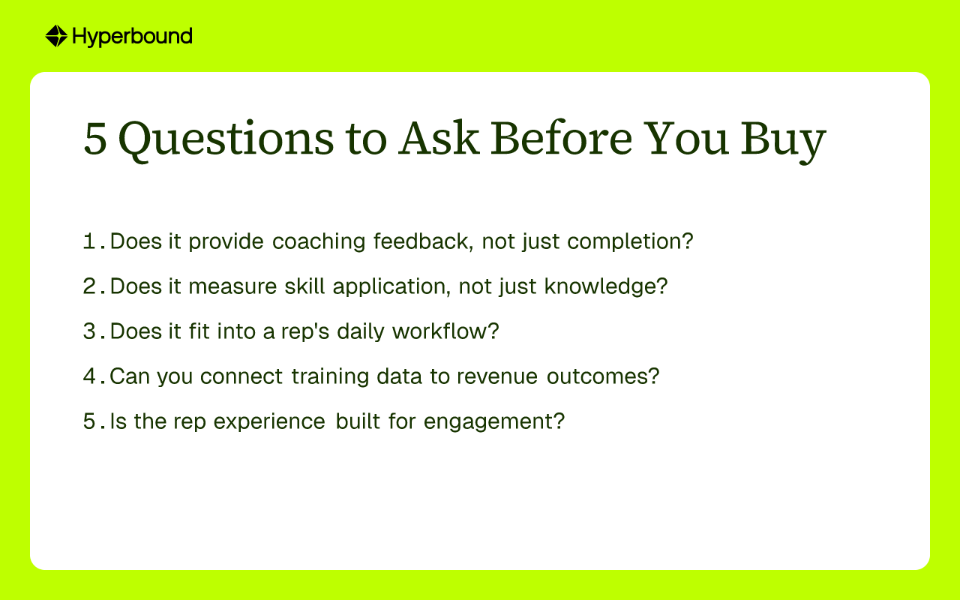
SCORM compliance is binary — a tool either supports it or it doesn't. The questions that actually separate good tools from great ones are about what happens after the file uploads.
1. Does it provide coaching feedback, or just track completion? A standard SCORM package reports pass/fail and complete/incomplete. That tells you a rep clicked through the module — it tells you nothing about whether they can actually handle a discovery call. Look for tools that generate automated, actionable coaching feedback: scorecards, objection-by-objection breakdowns, methodology adherence scoring. If a tool only tracks completion, it's a filing cabinet, not a training system.
2. Does it measure skill application or just knowledge consumption? The goal of sales training isn't for reps to know how to handle an objection — it's for them to do it under pressure. Ask whether the platform supports certifications based on demonstrated performance in realistic scenarios, not just quiz scores. Can you certify a rep on their ability to run a discovery call? That's a fundamentally different bar than "completed module."
3. Does it integrate into a rep's daily workflow — or create another login? As Challenger's research highlights, CRM integration and embedding training in the platforms reps already use is critical for adoption. A tool that requires reps to navigate to a separate system will be avoided. Look for SCORM-based integrations that surface practice opportunities inside Seismic, Highspot, Showpad, Slack, or the CRM — where reps actually spend their time.
4. Can you connect training data to revenue outcomes? This is the question most L&D leaders wish they could answer confidently. Does the platform offer analytics that link training activity to sales performance metrics — pipeline created, win rate, ramp time? Look for tools with robust reporting APIs, CRM connectors, or native analytics that move beyond learning metrics into business outcomes.
5. Is the rep experience built to drive engagement, not just compliance? A clunky, mandatory experience trains reps to click through as fast as possible. Look for tools with intuitive UX, mobile accessibility, and engagement features like gamification and leaderboards. Tenured reps in particular need short, focused practice options (like Bitesized Roleplays) rather than another full-length certification course they'll tune out.
SCORM is essential infrastructure — but it's not a training strategy. The L&D teams seeing real results aren't just uploading packages and tracking completion. They're using SCORM as a delivery mechanism to embed active practice — AI roleplays, coaching assignments, video reviews — directly inside the platforms their reps already live in.
The shift from passive SCORM content delivery to dynamic, feedback-rich practice environments is where scorm sales training integration is heading. Tools like Hyperbound Practice are leading that charge by turning a simple SCORM embed into a full coaching loop: reps complete a roleplay, receive an AI scorecard, and build the muscle memory that static modules never could.
Before your next training rollout, don't justask "Is this SCORM-compatible?" Ask whether it will actually change how your reps sell. That's the question that separates a training investment from a training outcome.
SCORM (Sharable Content Object Reference Model) is a technical standard that allows online learning content and Learning Management Systems (LMS) to communicate with each other. It's important because it ensures that training courses created by different authors can be easily uploaded and tracked across various LMS platforms, making it a foundational element for delivering scalable digital training programs.
SCORM compliance alone is not enough because it primarily tracks simple metrics like completion or a basic quiz score, not actual skill application or behavior change. Sales reps can complete a module without retaining the information or being able to apply it in a real-world scenario. As research shows, reps forget up to 87% of training content within a month without active reinforcement, meaning a "completed" SCORM module often has little impact on sales performance.
You can make SCORM training more engaging by embedding interactive and practical experiences directly within your SCORM-compatible platform. Instead of relying on passive content, integrate tools that allow for active practice, such as AI roleplays, video coaching assignments, and interactive simulations. This shifts the focus from simple content consumption to active skill development and application.
The best tools for SCORM integration fall into three main categories: AI roleplay platforms (like Hyperbound) that embed practice into your LMS, sales enablement hubs (like Seismic and Highspot) that place training in the flow of work, and modern LMS platforms (like Docebo) that support blended learning paths beyond basic SCORM tracking. The right tool depends on whether your primary goal is skill practice, content integration, or building comprehensive learning programs.
AI roleplay tools like Hyperbound integrate with SCORM by packaging an interactive roleplay session as a SCORM object. This allows L&D teams to upload the AI practice module into any SCORM-compliant LMS or sales enablement platform. When a sales rep launches the module, they enter a realistic AI conversation. Upon completion, the tool sends back rich data—far beyond a simple pass/fail—including detailed performance scorecards and coaching feedback, all while tracking completion status in the LMS.
Yes, you can measure the ROI of SCORM-based training, but it requires using tools that go beyond basic completion metrics. Look for platforms that can connect training data with performance outcomes from your CRM. By tracking metrics like skill improvement in practice sessions and correlating them with win rates, ramp time, and pipeline generation, you can draw a clear line between your training investment and tangible revenue results.
When choosing a tool, look beyond simple SCORM compliance. Prioritize platforms that provide automated coaching feedback, measure skill application (not just knowledge), integrate seamlessly into a rep's daily workflow, connect training data to revenue outcomes, and offer an engaging user experience. The goal is to find a tool that facilitates behavior change, not just one that tracks content completion.

Want to see how Hyperbound Practice embeds into your existing LMS or enablement platform via SCORM? Explore Hyperbound Practice →










Use Cases
Legal