
Your new hire starts Monday. By Friday, they've sat through four hours of product slides, clicked through an LMS course, and shadowed two calls. By week three, they're on their own — and still burning live pipeline while they figure out how to handle pricing objections.
Sound familiar?
The dirty truth about sales onboarding is that most of it is infrastructure theater. It looks like training. It feels like structure. But it doesn't produce ramped reps. As one sales manager put it bluntly in a Reddit thread on onboarding: "Sales onboarding falls apart when it's just a dump of docs and one long LMS course."
The problem isn't effort — it's tool selection. The tools you choose to support new hire sales ramp acceleration aren't just a nice-to-have; they're your infrastructure. They determine whether reps practice in a safe environment or burn real pipeline, whether managers coach from data or gut feel, and whether training sticks or disappears within 30 days (which, per research on the Ebbinghaus Forgetting Curve, is exactly what happens to 80% of training content).
In 2026, the fastest-ramping sales teams are making deliberate infrastructure decisions across five tool categories. This article breaks them down — with honest takes on what each category can and can't do — and closes with a sequenced 90-day rollout plan and an Implementation Complexity vs. Ramp Impact matrix to help you prioritize.
.png)
Why this category wins on ramp impact: New hires don't need more information. They need more reps. User research confirms that "less documenting, more reps" is the mentality that actually cuts ramp time — and AI roleplay platforms are the scalable mechanism for delivering that safely, before live pipeline is at risk.
🥇 Hyperbound — The Standout
Hyperbound is the clear leader in this category, and the proof points aren't marketing fluff. Teams using Hyperbound see 50% faster ramp, a 2x faster time to first won deal, and a 150% increase in DM → demo conversion rates. Vanta's CRO, Stevie Case, reported a 60% reduction in ramp time — from 210 days down to 72 — while simultaneously scaling their BDR team 4x and growing pipeline 5x.
What makes Hyperbound different isn't just the roleplays — it's the closed loop. The platform operates on a Practice → Perform → Activate triangle that competitors simply can't replicate:
The operational loop — Score Real Calls → Identify Skill Gaps → Practice Roleplays → Score Real Calls — means onboarding never really ends. It evolves into a continuous improvement system.
Integrations: Embeds directly into Seismic, Highspot, and Showpad (SCORM-compatible), Gong, Salesforce, HubSpot, Slack, Zoom, and Google Meet.
Limitation: Requires a mindset shift from passive content delivery to active skill practice. Teams used to "assign and forget" LMS courses will need to commit to a new cadence. Hyperbound mitigates this with white-glove implementation support and a structured rollout playbook.
Runner-up: Second Nature
Second Nature offers life-like AI simulations with customizable templates aligned to methodologies like SPIN, MEDDPICC, and BANT. It's a solid standalone practice environment for teams newer to AI roleplay.
Limitation: There's no closed loop. Practice scenarios aren't informed by what's actually happening on live calls, meaning skill gaps identified in the field don't automatically become targeted roleplays. The practice-to-performance connection requires manual coaching work.
Why it matters: With frontline managers hearing as little as 2–5% of their reps' calls, call intelligence tools provide the visibility necessary to understand what "good" actually looks like — and where new hires are struggling in the real world.
Top Tool: Hyperbound Perform
Hyperbound Perform is the leader in AI deal coaching. It automatically scores 100% of real calls against your custom methodology scorecards, surfaces deal-level insights, and flags where deals are at risk — while they're still winnable. For onboarding, it's invaluable for identifying precisely where new hires are struggling in their real-world conversations.
Limitation of Legacy Tools: Traditional call intelligence platforms tell you what is broken, but they don't fix it. A manager can see that a new hire fumbles pricing objections on 80% of their calls, but legacy tools don't give that rep anywhere to practice before the next live call.
The bridge: Hyperbound's platform closes this loop. Hyperbound Perform scores the real call and surfaces the skill gap; Hyperbound Practice closes it with a targeted roleplay. It's an integrated system for continuous improvement.
Why it matters: New hires need a single source of truth for product knowledge, playbooks, battlecards, and competitive intel. Scattered information across Google Docs, Notion, Slack, and shared drives creates the exact confusion that sales onboarding research consistently flags — "fragmented information spread across platforms leads to inefficiency and frustration."
Top Tools: Seismic and Highspot
Both are the gold standard for sales content management. They ensure reps always have the latest messaging, case studies, and playbooks. Seismic and Highspot also provide analytics on content engagement, so enablement teams can see what reps actually use versus what they ignore.
Limitation: These platforms are fundamentally about content delivery — and content delivery is passive. Reading a competitive battlecard doesn't mean a rep can use that intel in a live objection. Research on knowledge retention shows that it requires application, not just consumption.
The fix: Hyperbound is SCORM-compatible and embeds directly into both Seismic and Highspot. A rep can finish reading a battlecard and immediately launch a Hyperbound roleplay to practice handling objections against that competitor — turning static content into active skill-building without leaving the platform.
Why it matters: The CRM is the operational center of every sales team. New hires who don't learn it properly from day one will log incomplete data, lose deal context, and create downstream problems for RevOps and leadership. Onboarding that ignores the CRM creates a split reality between what training says and what reps actually do.
Top Tools: Salesforce and HubSpot native onboarding features
Both platforms offer built-in workflow automation, activity tracking, and pipeline visibility that — when configured correctly — guide new hires through the mechanics of deal management. Native onboarding workflows, for example, can automate task assignments, track activity milestones, and surface coaching prompts tied to real deal stages.
Limitation: CRMs track outcomes (calls logged, deals moved, stages updated) but not the quality of the conversations driving those outcomes. A new hire can log 30 calls and still be losing every single one for the same preventable reason. The CRM won't tell you why.
The bridge: Hyperbound Perform's Auto-CRM Fill automatically updates CRM fields from conversation data — reducing manual admin for new hires and ensuring deal records are accurate from the start. This creates a tight link between conversation behavior and pipeline outcomes, giving managers real signal instead of data-entry compliance.
Why it matters: Even the best tools fail if managers don't have a structured way to act on the data. With frontline managers spending only a fraction of their time on coaching, it's typically the first thing that gets cut when a quarter gets busy. Coaching cadence tools help managers turn sporadic, gut-feel conversations into structured, data-driven sessions.
Top Tool: Kota Activate by Hyperbound
Kota Activate is Hyperbound's AI Revenue Analyst. It sits above the Practice and Perform products, connecting practice performance with real-world results to orchestrate personalized coaching interventions at the right time. For example, Kota can surface an alert in Slack when a new hire's call scores dip, recommending a specific roleplay to close the skill gap before it impacts their pipeline.
Limitation of Broad Platforms: All-in-one readiness platforms often include coaching features, but they are a secondary focus. Their roleplay simulations don't match the fidelity of purpose-built platforms, and because they aren't deeply connected to real call performance data in the same way Hyperbound is, coaching recommendations can still rely on manager judgment rather than behavioral evidence.
Use this framework to prioritize which tools to adopt first based on the effort required versus the direct impact on getting reps to productivity faster.
.png)
The takeaway: AI roleplay and practice platforms sit in the "quick win" zone — high ramp impact with relatively manageable implementation. Call intelligence and CRM integrations require more investment (data pipelines, change management, admin configuration) but pay off significantly once established. LMS/content platforms and manager coaching tools form the foundational layer — necessary for organization and structure, but insufficient on their own to drive conversational skill.
Start with the tools that move reps fastest. Layer in complexity as the program matures.
Buying the right tools isn't enough. The order in which you activate them matters. Here's how to sequence your stack to maximize new hire sales ramp acceleration across a 90-day program.
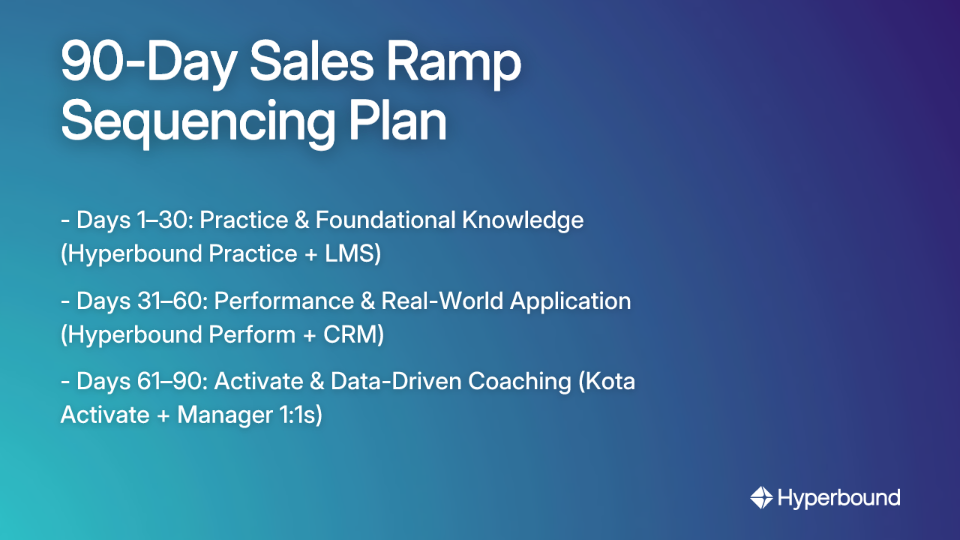
Goal: Certify reps on core messaging, your value proposition, and the top 3–5 objections they'll face in the first 60 days.
Lead tool: Hyperbound Practice. Get reps into daily Bitesized Roleplays from day one. Focus on cold call openers, discovery question frameworks, and objection handling for the most common early-stage pushbacks. Build the muscle memory before they ever dial a live prospect.
Supporting tool: LMS/Content Platform. Deliver product documentation and playbooks in structured modules — but embed Hyperbound roleplays at the end of each module. Instead of a knowledge check that tests memorization, test application. Can the rep actually use what they just read in a simulated conversation? That's the bar that predicts real-world performance.
The approach mirrors what high-performing enablement practitioners recommend: "Break it into small daily reps, short knowledge checks, objection handling prompts, quick product refreshers, delivered over a couple of weeks instead of all at once."
Goal: Move from practice to live calls. Start capturing real-world performance data to inform the next phase of coaching.
Lead tool: Hyperbound Perform (or your call intelligence platform of choice). Automatically record and score 100% of the new hire's early calls against your methodology scorecard. You'll quickly surface whether what reps practiced in Phase 1 is showing up in their real conversations — or where the gap still exists.
Supporting tool: CRM. Ensure all call activity is tied to the correct opportunities. Use Hyperbound's Auto-CRM Fill to automate this so reps aren't spending their first live selling weeks on manual data entry. The cleaner the CRM data from day 31 forward, the more useful the pipeline coaching insights will be in Phase 3.
Goal: Close the loop. Use the performance data from Phase 2 to deliver hyper-personalized coaching that's specific, evidence-based, and actionable.
Lead tool: Kota Activate. Hyperbound's AI Revenue Analyst connects the dots between roleplay scores from Phase 1 and real-call performance from Phase 2. Kota can surface insights like: "This rep scores 88% on discovery roleplays but asks only 1 of 5 key discovery questions in live calls." That's a coaching signal you can act on immediately.
Supporting tool: Manager coaching cadence tools. Use the specific, data-driven insights Kota surfaces to structure manager 1:1s. The conversation shifts from "How's pipeline looking?" to "I can see you're struggling to uncover budget. Let's run through that scenario in Hyperbound right now." Coaching becomes targeted, consistent, and tied to real outcomes — not manager intuition.
The fastest-ramping sales teams in 2026 aren't working harder on onboarding — they're building better infrastructure.
Passive content delivery, generic LMS courses, and sporadic manager ride-alongs are not a ramp strategy. They're a ramp delay. The teams cutting ramp time in half are building systems that give reps safe, deliberate practice from day one, then scoring real performance, then closing the loop with data-driven coaching at scale.
The tool categories in this article aren't optional add-ons — they're the architecture of a modern new hire ramp program. Each one plays a distinct role. Together, they create the Practice → Perform → Activate loop that turns raw new hires into confident, quota-carrying reps in weeks, not months.
If you're ready to see what that looks like in practice, Hyperbound's Revenue Activation Platform is where most teams start — because the fastest path to ramp acceleration is giving reps a place to practice that sounds like the real thing.
The most critical tools for modern sales onboarding fall into five categories: AI Roleplay & Practice Platforms, Call Intelligence & Scoring Tools, LMS & Content Delivery Platforms, CRM Onboarding Integrations, and Manager Coaching Cadence Tools. While all are important, AI Roleplay platforms like Hyperbound often provide the highest immediate impact on ramp time by allowing reps to practice safely before engaging with real prospects.
AI roleplay is more effective because it allows for scalable, consistent, and safe practice of real-world sales conversations. Unlike traditional methods like shadowing or passive content review, AI roleplay builds muscle memory and confidence through active participation, which is proven to overcome the Ebbinghaus Forgetting Curve where 80% of information is lost if not applied.
You can measure the ROI of a new onboarding tool by tracking key metrics like time to first deal, time to full quota attainment, new hire conversion rates (e.g., demo-to-close), and overall pipeline generation in their first 90 days. For example, teams using Hyperbound have seen a 50% faster ramp time and a 2x faster time to the first won deal, providing clear, quantifiable returns.
The "Practice → Perform → Activate" loop is a continuous improvement model for sales teams. It works by having reps Practice skills in a safe environment (like AI roleplays), analyzing their Performance on real customer calls with AI scoring, and using that data to Activate targeted, data-driven coaching interventions. This ensures that training is directly linked to real-world performance gaps.
Implementing an AI roleplay and practice platform like Hyperbound is typically fast, with many teams getting set up in a matter of days or weeks, not months. The process involves integrating with your existing CRM and call recording tools, customizing buyer personas and scorecards, and a structured rollout playbook supported by the vendor. This places it in the "Low-to-Medium" complexity category with a very high impact on ramp time.
The best place to start is by introducing a dedicated practice environment. According to the Implementation Complexity vs. Ramp Impact matrix, AI Roleplay & Practice platforms offer the highest impact for the lowest implementation effort. This allows you to address the biggest gap in most onboarding programs—the lack of safe, scalable practice—and generate quick wins in reducing ramp time.
A Call Intelligence tool analyzes what happened on past calls, while an AI Roleplay platform prepares reps for future calls. Call intelligence tools (like Gong or Hyperbound Perform) record and score real conversations to identify skill gaps. AI Roleplay platforms (like Hyperbound Practice) provide a safe environment for reps to close those gaps through simulated conversations. The most effective systems, like Hyperbound's platform, integrate both to create a closed loop of analysis and improvement.










Use Cases
Legal