
You've just wrapped your Monday pipeline review. The CRM shows 14 deals in "Proposal Sent," your forecast looks healthy, and your Commit number is dialed in. Then the quarter ends and half those deals ghost you. Sound familiar?
The problem isn't your reps. It's that your pipeline visibility is built on a lie — specifically, the lie that CRM stage updates tell the whole story.
As sales teams on Reddit have put it bluntly: "CRM reports don't have all the context" — which is exactly why spreadsheets still exist in 2025, why SWAG (Shit, We All Guessing) forecasting is still the norm, and why reps develop a CYA mentality just to survive pipeline reviews. Without real visibility, the best pipeline isn't the most accurate one — it's just the most optimistic one.
This is the gap that true deal inspection tools are built to close.
Before diving into the list, it's worth drawing a clear line:
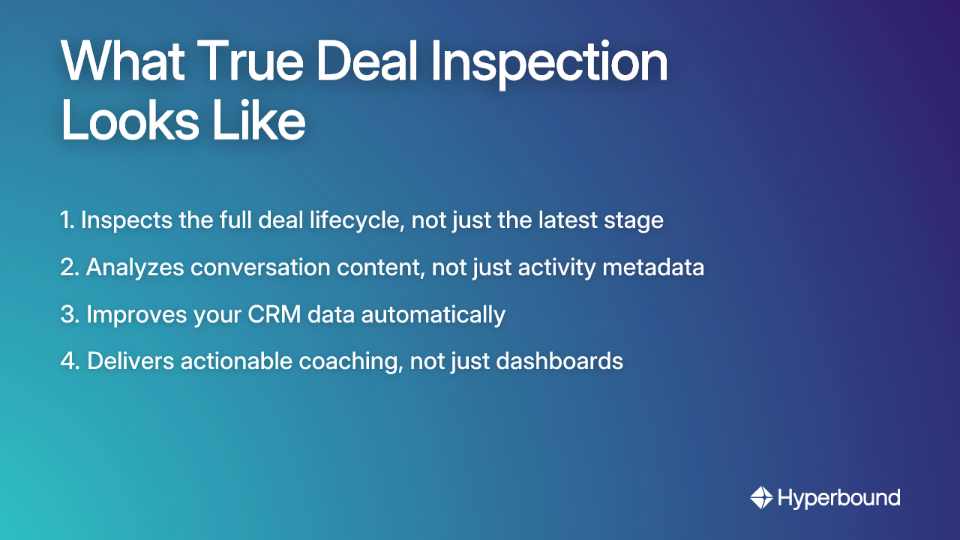
The best deal inspection tools should deliver on four criteria:
With that framework in place, here are the 7 best tools for true pipeline visibility.
Best for: Teams who want deal inspection grounded in real buyer conversation data — not CRM field updates.
Most deal inspection tools tell you that a deal is at risk. Hyperbound Perform tells you why — and what to do about it.
Perform is purpose-built as the missing layer between call-level intelligence and pipeline outcomes. It connects real call behavior across the entire deal lifecycle — from the first cold call to the final negotiation — to surface deal-level insights and recommend deal-winning actions. Importantly, it's not a forecasting tool. It's the signal layer that gives your forecasts actual ground truth.
Depth of Inspection: Rather than flagging a deal because it hasn't moved stages in 30 days, Hyperbound Perform scores 100% of real customer conversations against your custom methodology scorecard (think MEDDICC, MEDDPICC, or your own framework). It builds a behavioral picture of the deal across every touchpoint — not just the most recent one.
Conversation-Level Signals: This is where Perform separates itself from the pack. Its AI Real Call Scoring automatically analyzes every call in a deal and surfaces what's helping or hurting momentum. Did your rep miss the economic buyer? Is the champion going cold? Did the last demo call fail to address the core pain? Perform catches it — while the deal is still winnable.
CRM Integration: Perform's Auto-CRM Fill feature directly eliminates the double data entry problem that plagues most sales teams. It automatically populates CRM fields — objections raised, stakeholders identified, MEDDICC criteria — directly from conversations. No manual input. No stale data. Your CRM reflects reality. Integrates with Salesforce, HubSpot, and connects to call recording tools like Gong, Salesloft, and Chorus.
Coaching Output: Perform's AI Deal Coaching looks across all calls in a deal to deliver specific, guided next actions for both reps and managers. It can even trigger Bitesized Roleplays through Hyperbound Practice — so if a rep keeps fumbling a procurement objection, they get targeted practice before the next call, not a generic training module weeks later.
The result: deal health grounded in actual buyer behavior, not rep intuition or pipeline hygiene scores. Vanta's CRO Stevie Case saw a 60% ramp reduction and 5x pipeline growth after deploying Hyperbound — and that starts with deals being coached from real conversation data.
Best for: Manager-led call review and conversation intelligence at scale.
Gong is the pioneer of conversation intelligence and remains one of the most widely deployed tools in enterprise sales stacks. It records, transcribes, and analyzes sales conversations to provide deal insights across the pipeline.
Depth of Inspection: Gong claims to capture 99% of customer interactions, including calls and emails, to give a comprehensive view of deal activity. It can flag engagement drop-offs and identify at-risk deals based on communication patterns.
Conversation-Level Signals: Its AI identifies keywords, topics, competitor mentions, and sentiment shifts — and can alert managers when a deal shows warning signs like a sudden lack of engagement or a negative tone shift.
CRM Integration: Gong integrates seamlessly with Salesforce and other CRMs, enriching opportunity records with conversation data and reducing some of the manual logging burden.
Coaching Output: Gong is excellent for managers who want to review call recordings and give feedback. However, the coaching workflow tends to be manager-driven and manual — Gong surfaces the data, but a human still needs to synthesize it into a coaching action. It doesn't automatically close the loop from insight to rep behavior change.
Best for: RevOps and leadership teams focused on forecast accuracy and revenue orchestration.
Clari is a revenue orchestration platform built to give leadership end-to-end pipeline visibility and more reliable forecasts. It's a strong choice for teams whose primary pain is forecast accuracy rather than rep-level coaching.
Depth of Inspection: Clari uses AI to analyze CRM data and sales activity — meetings, emails, stage history — to generate predictive deal health scores. It's particularly good at flagging deals that have stalled or regressed.
Conversation-Level Signals: This is where Clari shows its limits as a pure deal inspection tool. It leans more on activity metadata (a meeting occurred, an email was sent) than on analyzing the actual content of those conversations. It tells you engagement happened — not what that engagement revealed about buyer intent.
CRM Integration: A core strength. Clari pulls from CRMs and sales tools to create a unified view, making it easy for RevOps teams to work within existing data structures.
Coaching Output: Primarily designed for leadership's forecasting confidence. Less suited for frontline coaching — it won't tell your rep what to say differently in the next discovery call.
Best for: Enterprise teams needing B2B intelligence layered on top of conversation analysis.
ZoomInfo expanded its platform into conversation intelligence through its acquisition of Chorus.ai, combining rich contact and company data with call analysis capabilities.
Depth of Inspection: ZoomInfo's combination of firmographic intelligence and automated activity capture creates a fairly comprehensive picture of deal engagement. Its Copilot feature surfaces AI-driven next-step recommendations.
Conversation-Level Signals: Chorus brings legitimate conversation analysis — key topics, objection patterns, competitor mentions — to the ZoomInfo stack. Buyer intent signals from ZoomInfo's data layer add an outside-in perspective on deal health.
CRM Integration: Integrates with major CRMs to sync contact and deal data, with good bi-directional data flow.
Coaching Output: Provides managers with call-level insights and AI-recommended next actions for reps. More robust than Clari on the coaching side, but still lacks the deal-lifecycle-wide behavioral analysis that separates top-tier deal inspection tools from the rest.
Best for: Organizations prioritizing CRM data hygiene and stakeholder engagement mapping.
People.ai focuses on automatically logging all customer-facing activity and mapping engagement across every stakeholder in a deal — a critical capability when deals involve multiple decision-makers.
Depth of Inspection: People.ai's strength is capturing the existence of interactions and mapping who is (and isn't) engaged. If your economic buyer has gone dark for three weeks, People.ai will surface that.
Conversation-Level Signals: The platform focuses more on engagement patterns than conversation content. It tells you that communication happened; it doesn't deeply analyze what was said and what it means for deal health.
CRM Integration: Automatic activity capture and CRM population is People.ai's core value prop. It dramatically reduces manual data entry and keeps CRM records accurate.
Coaching Output: Helps managers prioritize which accounts need attention, but doesn't provide behavioral coaching recommendations based on call content. Better suited to RevOps than frontline sales managers.
Best for: Teams focused on AI-driven forecasting and guided selling workflows.
Aviso uses machine learning to deliver predictive forecasting, deal intelligence, and guided selling — with a strong focus on helping revenue teams execute with more precision.
Depth of Inspection: Aviso provides AI-driven deal health scores and risk assessments, helping teams prioritize where to focus their energy. Its WinScore gives a probabilistic view of each deal's likelihood to close.
Conversation-Level Signals: Aviso analyzes conversational and engagement data to feed its predictive models, though its primary output is forward-looking (will this deal close?) rather than behavioral (what specifically needs to change in how the rep is engaging?).
CRM Integration: Connects to CRMs to pull the activity and pipeline data its AI engine needs. The integration is solid, particularly for Salesforce-heavy environments.
Coaching Output: Offers "Guided Selling" recommendations that are more process- and prediction-oriented than deep behavioral coaching. Good for deal prioritization; less detailed in terms of rep-level skill development.
Best for: Teams looking to standardize and track engagement sequences across the pipeline.
Outreach is a leading sales engagement platform that has built out pipeline management and forecasting features to complement its core engagement sequencing capabilities.
Depth of Inspection: Outreach provides visibility into which deals are receiving active engagement and which are falling through the cracks. It excels at top-of-funnel process standardization.
Conversation-Level Signals: Tracks engagement signals — email opens, replies, meeting acceptance — as indicators of deal health. While it has conversation intelligence features, it's not primarily designed as a deep deal inspection tool.
CRM Integration: Deep, bi-directional sync with major CRMs ensures that rep activities and deal stage updates stay current.
Coaching Output: Automated performance feedback based on engagement activity helps managers track process adherence. Better at diagnosing whether reps are following process than how well they're executing conversations.
.png)
.png)
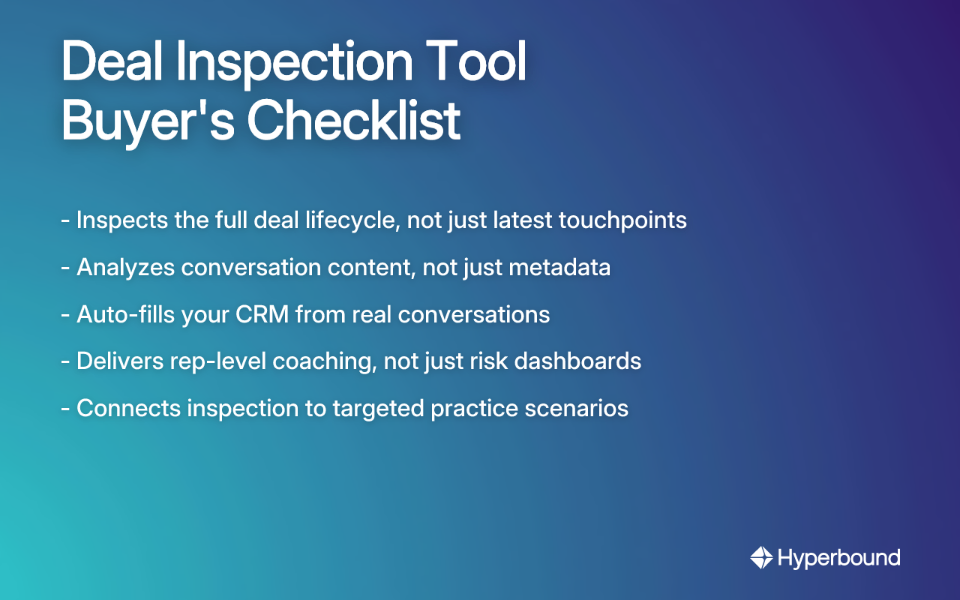
Not all tools marketed as "pipeline intelligence" are true deal inspection tools. Before you buy, run every option through this checklist:
✅ Does it inspect across the full deal lifecycle — not just the latest touchpoint? A single call review won't tell you where a deal went wrong. Look for a tool that stitches together every interaction from first contact to close, so you can see behavioral patterns that span the whole engagement.
✅ Does it analyze conversation content — not just that a conversation happened? Metadata tells you a meeting occurred. True deal inspection tools analyze what was said — objections raised, questions asked, stakeholders engaged, methodology adherence — and surface what that means for deal health.
✅ Does it actively improve your CRM data, not just pull from it? The best tools reduce rep admin burden. Look for Auto-CRM Fill or similar features that write intelligence back to your CRM automatically, so the data your managers and RevOps team rely on actually reflects reality.
✅ Does it deliver actionable coaching — not just dashboards? Dashboards showing a deal is "at risk" don't move the needle. The right sales deal inspection tool tells your rep what to do differently in the next call and gives managers a scalable way to coach based on real evidence.
✅ Does it connect inspection to practice? The most powerful deal inspection tools don't just identify skill gaps — they close them. Look for a tool that can trigger targeted practice scenarios based on what the coaching data surfaces, so reps improve in real time across active deals.
If your weekly pipeline review still feels like "vibes deals sitting there forever" — to borrow a phrase from a frustrated RevOps manager on Reddit — it's time to upgrade what you're using to inspect them.
The difference between teams that hit their number and teams that miss it isn't the size of their pipeline. It's the quality of their visibility into deal health and the speed at which they can act when something is off.
True deal inspection requires going deeper than stage changes and activity logs. It requires understanding what your buyers are actually saying, how your reps are responding, and what coaching needs to happen before the next call — not after the quarter ends.
A sales deal inspection tool is a software platform that analyzes actual buyer interactions, like calls and emails, to provide deep insights into the health of a sales deal. Unlike traditional pipeline management tools that only track deal stages, deal inspection tools investigate the why behind deal momentum by focusing on conversation-level signals, helping teams identify risks and opportunities while deals are still winnable.
The key difference is depth: pipeline management tracks the what (deal stage, value, close date), while deal inspection investigates the why (buyer sentiment, objections raised, champion engagement). Pipeline management relies on manual CRM updates from reps, which can be subjective. Deal inspection automates the analysis of real conversations to provide an objective, evidence-based view of deal health.
Your CRM isn't enough for accurate pipeline visibility because it relies on manually updated fields that lack context. A deal marked as "Proposal Sent" in the CRM might hide the fact that the last call went poorly or the economic buyer has gone silent. CRMs track activity but don't analyze the quality or content of those interactions, which is where the real truth about a deal's health resides.
The most important features in a deal inspection tool are conversation-level analysis, full deal lifecycle tracking, automated CRM data enrichment, and actionable coaching outputs. Look for a tool that goes beyond metadata to analyze what's actually said in calls, stitches together insights from every touchpoint, reduces manual data entry for reps, and provides specific, behavior-based recommendations for what to do next.
Deal inspection tools improve sales coaching by grounding it in objective data from real customer conversations instead of manager intuition. They automatically surface moments where a rep struggled with an objection, missed a buying signal, or failed to adhere to a sales methodology. This allows managers to provide targeted, evidence-based feedback and can even trigger automated practice scenarios to close skill gaps in real time.
Yes, the best deal inspection tools can automate CRM data entry. Features like "Auto-CRM Fill" listen to sales conversations and automatically populate relevant CRM fields, such as identified stakeholders, key objections, MEDDICC criteria, and competitive mentions. This not only saves reps significant time but also dramatically improves the accuracy and richness of your CRM data.
Hyperbound Perform is built for exactly that. It scores 100% of your real customer calls, connects the behavioral dots across the full deal lifecycle, automatically fills your CRM with conversation intelligence, and delivers deal-level coaching that tells your reps and managers what to do next.
Ready to see what's really happening in your pipeline? Book a demo of Hyperbound Perform today.









Use Cases
Legal