
If you've ever heard a rep say, "The info is just... all over the place" — scattered across Google Docs, CRM notes, and random Slack threads — you already know the core problem with most sales enablement software today.
Sales teams have more tools than ever, yet the sentiment on the ground hasn't changed much: most "sales enablement platforms" are just fancy content dumping grounds. They solve the storage problem, but not the actual problem — getting your reps the right information at the exact moment they need it, and more importantly, helping them execute with it.
Legacy sales enablement platforms were game-changers when they launched. They centralized content, structured onboarding, and made training scalable. But there's a gap they haven't closed: the distance between delivering training and actually improving deal outcomes. With 80% of training forgotten within 30 days, content libraries and LMS modules alone aren't moving the needle on win rates.
The sales enablement software market has evolved. Today, the most effective revenue teams don't just need a content hub — they need a closed-loop system that connects training to performance to results.
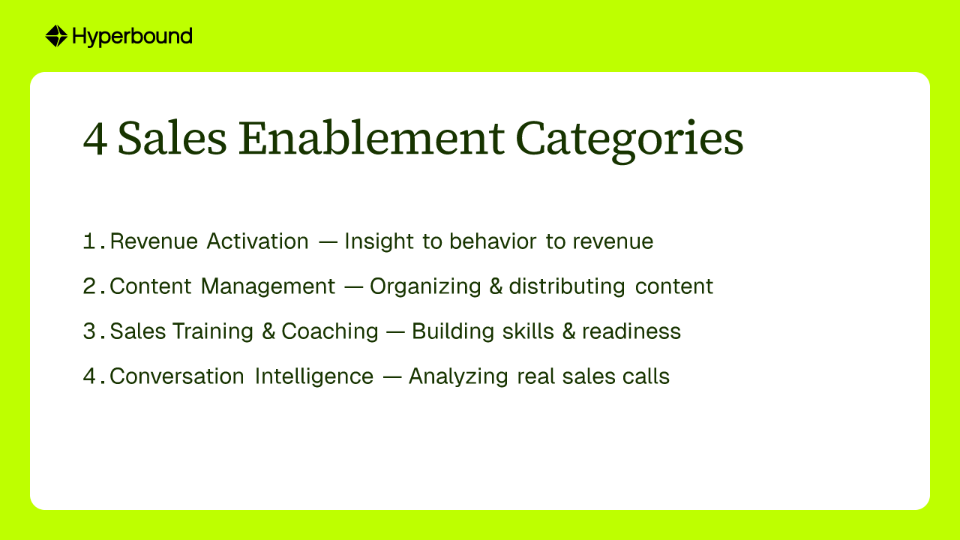
To help you navigate the landscape, we've organized the 12 best tools into four categories so you can self-select based on your biggest need:
Let's get into it.
Revenue Activation is the emerging category for teams that already have data — from their CRM, their call recordings, their training completions — but can't translate it into better rep performance. These tools close the loop between insight and outcome.
Best for: Closing the gap between training and revenue outcomes
Hyperbound coined the Revenue Activation category, and for good reason. Where most sales enablement platforms stop at content delivery or call analysis, Hyperbound runs a continuous improvement loop: Score Real Calls → Identify Skill Gaps → Practice with AI Roleplays → Perform Better on Real Calls.
It's the only platform that does all three in one place — and connects them to actual deal outcomes.
The platform is built around three core products:
Proof it works:
Hyperbound integrates with Seismic, Highspot, Salesforce, HubSpot, Gong, Zoom, and more — so it fits into your existing stack rather than replacing it.
G2 Rating: 4.9/5 | SOC 2 Type II | GDPR | ISO 27001 | HIPAA Compliant
These platforms are the foundation of most enablement programs. They centralize your playbooks, case studies, one-pagers, and competitive intel — so reps stop hunting through Slack and Google Drive for the right asset.
Best for: Enterprise content governance and buyer engagement
Seismic is one of the most established names in sales enablement software. Its AI-powered "Enablement Cloud" unifies content management, training, and buyer engagement — making it a strong choice for large organizations in regulated industries where content compliance and version control matter.
Key features include Aura AI for generative content personalization, digital sales rooms for buyers, and structured learning paths for reps. Seismic customers like Aerogen have reported a 56% reduction in sales cycle length. Trusted by over 2,000 organizations including IBM.
Best for: Large enterprises needing tight content governance and marketing-sales content alignment.
Best for: AI-powered content discovery and sales play execution
Highspot is a unified sales enablement platform that combines intelligent content management, training, coaching, and analytics. Its standout capability is AI-powered search — reps can find the most relevant content for a deal without digging through folder structures.
Highspot also tracks how content performs in actual deals, closing some of the loop between content delivery and revenue impact. For teams that have invested heavily in content but struggle with discoverability and adoption, Highspot is a top-tier choice.
Best for: Mid-market to enterprise teams that need smart content discovery and sales play tracking.
Best for: Buyer-facing content experiences and coaching
Showpad integrates content management with coaching tools and buyer experience features. Reps can create immersive, personalized presentations for prospects, and managers get deep analytics on buyer engagement with shared content.
It's a strong choice for teams that prioritize buyer-facing experience alongside internal training, and it offers SCORM-compatible integrations for existing LMS setups.
Best for: Teams wanting a polished buyer content experience alongside basic coaching capabilities.
These platforms are purpose-built for onboarding, skill development, and scaling coaching workflows — especially across distributed or fast-growing sales teams.
Best for: Structured onboarding and sales readiness programs
Mindtickle is a comprehensive sales readiness platform focused on improving rep knowledge, skills, and behaviors through structured, on-the-job learning. Its gamified training paths drive higher completion rates, and it includes AI-powered roleplays and coaching tools.
It's a go-to for enterprises that need formal certification programs, strong content management, and structured coaching workflows. Where it differs from Hyperbound is in simulation fidelity — Hyperbound's AI personas are trained on real B2B sales conversations, while Mindtickle's roleplay is more generalized.
Best for: Large sales organizations that need structured curricula, certification workflows, and gamified onboarding.
Best for: Video-based learning and mobile-first coaching
Allego is a sales enablement platform built around video and mobile-first learning — making it a natural fit for field sales teams or organizations that rely on peer-to-peer learning through video practice and sharing. Managers can capture and distribute winning call snippets across the team.
Its conversation intelligence layer provides call analysis, though the practice and coaching capabilities are less deeply integrated than dedicated Revenue Activation platforms.
Best for: Field sales and geographically distributed teams that learn well through video and peer modeling.
Best for: Collaborative, team-based learning and peer coaching
SalesHood is designed around the idea that reps learn best from each other. Its platform enables collaborative learning modules, peer video coaching, and sales content creation — with a strong emphasis on replicating what's working across the team.
It's particularly effective for smaller enablement teams that want to scale through crowdsourced best practices rather than top-down training programs.
Best for: SMB and mid-market teams that want to leverage peer learning and manager-led coaching workflows.
These tools record, transcribe, and analyze sales conversations to give managers and reps visibility into what's actually happening on the front lines. They generate the insights that should inform coaching — but often don't get actioned.
Best for: Deep conversation analytics and pipeline visibility
Gong is the market leader in conversation intelligence. It automatically captures and analyzes customer-facing interactions across phone, email, and video calls — surfacing deal risk signals, talk pattern trends, and topic tracking at scale.
The key limitation: Gong is exceptional at telling you what happened on a call. But it doesn't give reps a structured way to practice based on those insights. That's the gap that Revenue Activation platforms like Hyperbound are built to fill — and notably, Hyperbound integrates directly with Gong so you don't have to choose.
Best for: Teams that want deep call analytics and pipeline intelligence as their primary use case.
Best for: Intelligent virtual meetings and AI-assisted demo coaching
Demodesk is an intelligent meeting platform built specifically for remote sales teams. It auto-summarizes meetings, fills CRM notes, and provides coaching feedback based on call analysis — all within a purpose-built meeting interface.
Pre-loaded playbooks and battle cards surface in the meeting window in real time, helping reps stay on track during live demos.
Best for: Remote-first sales teams that run high volumes of virtual demos and want in-call guidance.
These aren't pure-play sales enablement software tools, but they serve as the system of record that everything else plugs into — and they've added enough native enablement features to warrant inclusion.
Best for: Enterprise CRM with native enablement capabilities
Salesforce is the world's #1 CRM and increasingly a platform that bundles enablement capabilities — including its own LMS, content delivery tools, and AI-powered deal health insights. For large enterprises already standardized on Salesforce, its native enablement features can reduce tool sprawl.
That said, the candid take from sales reps in the field is telling: Salesforce is often viewed as less for the user's benefit and more for employer metrics and record keeping. The most effective teams pair Salesforce as their system of record with user-friendly tools layered on top — like Hyperbound, Highspot, or Gong.
Best for: Enterprises already on Salesforce that want to minimize additional vendors.
Best for: SMB and mid-market teams that want CRM + enablement in one place
HubSpot Sales Hub is an all-in-one CRM and sales platform known for its approachable interface and tight marketing-sales integration. It includes conversation intelligence for call analysis, interactive sales playbooks, and email/sequence automation.
The honest trade-off: HubSpot's reporting is widely praised, but users often find it less effective for deal tracking compared to managing relationships and marketing workflows. Hyperbound integrates directly with HubSpot for teams that want to layer in AI-driven coaching on top.
Best for: SMB and scaling teams that want an easy-to-use, all-in-one hub without enterprise complexity.
Best for: Sales engagement and multi-channel outreach at scale
Salesloft and Outreach are the leaders in the sales engagement category — helping SDRs and AEs execute multi-channel outreach sequences across email, phone, and LinkedIn at scale. Both platforms include call recording, basic analytics, and integrations with major CRMs.
They're not full-stack sales enablement platforms, but they're indispensable for pipeline generation and are often the first tool an SDR touches in their workflow.
Best for: SDR and outbound-heavy teams running high-volume prospecting motions.
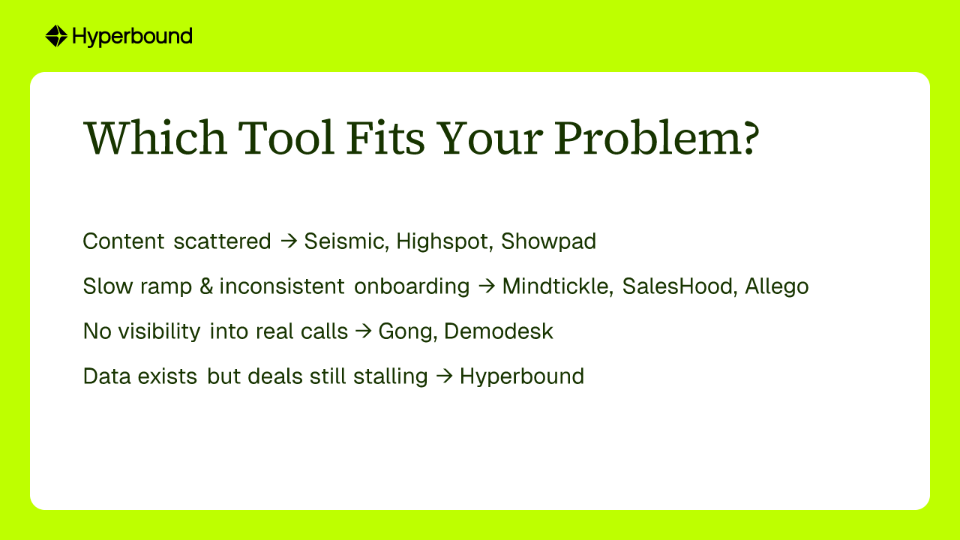
Here's a simple framework based on your biggest problem:
.png)
That last row is the one most teams overlook. If your reps already have access to call recordings, a content library, and a training platform — but your win rates aren't improving and ramp is still slow — you don't have a content problem or a data problem. You have an activation problem.
Content that isn't practiced doesn't change behavior. Insights that aren't acted on don't change outcomes. The missing piece is a closed-loop system that takes what's happening in real deals, identifies the specific skill gaps driving losses, and gives reps a realistic, low-stakes environment to practice and correct — before the next real call.
That's what Revenue Activation is. And it's what Hyperbound was built to do.
If your reps already have content but deals are still stalling, you need a platform that activates, not just delivers.
Vanta reduced ramp time by 60% — from 210 days to 72 — while growing their BDR team 4x. Nivoda increased their demo rate by 150% and doubled revenue year-over-year. LinkedIn deployed Hyperbound across 3,000+ sellers in NAMER and EMEA.
The pattern is consistent: when you connect real call data to targeted practice, performance follows.
Book a demo of Hyperbound today and see how your team can turn every insight into a closed-won outcome.
Sales enablement software is a set of tools designed to help sales teams sell more effectively by providing them with the right content, training, and coaching at the right time. These platforms centralize resources, streamline onboarding, and provide insights into sales performance to improve win rates and reduce ramp time.
The four main categories of sales enablement tools are Revenue Activation, Content Management & Delivery, Sales Training & Coaching, and Conversation Intelligence. Each category addresses a specific problem, from organizing content (Seismic, Highspot) and building skills (Mindtickle) to analyzing calls (Gong) and directly connecting training to revenue outcomes (Hyperbound).
To choose the right sales enablement platform, first identify your team's biggest bottleneck. If your content is scattered, look at Content Management tools like Highspot. If ramp time is too slow, consider Training & Coaching platforms like Mindtickle. If you have data but performance isn't improving, a Revenue Activation platform like Hyperbound is likely the best fit to close the gap between insight and action.
The key difference is that Revenue Activation platforms close the loop between training, performance, and revenue, while traditional sales enablement tools often focus on just one piece, like content storage or call analysis. Platforms like Hyperbound actively connect insights from real calls to targeted practice (like AI roleplays), ensuring that training translates directly into better deal outcomes.
Yes, most modern sales enablement platforms are designed to integrate seamlessly with major CRMs like Salesforce and HubSpot. This integration is crucial for pulling in deal data, tracking content engagement against opportunities, and ensuring that training activities are aligned with real-world sales performance recorded in your system of record.
AI significantly enhances sales enablement by automating call analysis, personalizing content recommendations, and providing scalable practice opportunities. For example, AI can score 100% of sales calls against a methodology, surface coaching moments for managers, and power realistic AI roleplays (like in Hyperbound) that allow reps to practice handling objections or delivering a new pitch in a safe environment.
Conversation Intelligence tools like Gong are excellent at telling you what happened on past calls by recording and analyzing them. Revenue Activation platforms like Hyperbound take it a step further by telling you what to do next. They use the insights from call analysis to identify specific skill gaps and then provide a structured way for reps to practice and improve before their next real customer interaction, directly connecting analysis to action.









Use Cases
Legal