
Your team probably has more call recordings, transcripts, and pipeline analytics than it knows what to do with. You have a crystal-clear picture of what happened on last week's discovery calls. But what is actually changing about how your reps show up on next week's?
That is the core problem with most sales coaching platforms today. They are exceptional at showing you the fumble in slow motion — flagging the moment a rep lost control of the call, missed the economic buyer, or fumbled the pricing conversation. But by the time that insight surfaces in a dashboard, the call is gone. The deal has moved on. The moment to intervene has passed.
This is what we call the intervention gap: the critical space between analyzing a past conversation and actually changing a seller's behavior before the next one. Research from real practitioners is blunt: "most of the 'all-in-one' training platforms looked great in a demo but then just became another tab my reps ignored." The tools that stick are the ones that plug directly into daily workflows and create real behavior change — not the ones that file insights into a library nobody reads.
To cut through the noise, we evaluated each platform on five criteria that matter more than feature checklists:
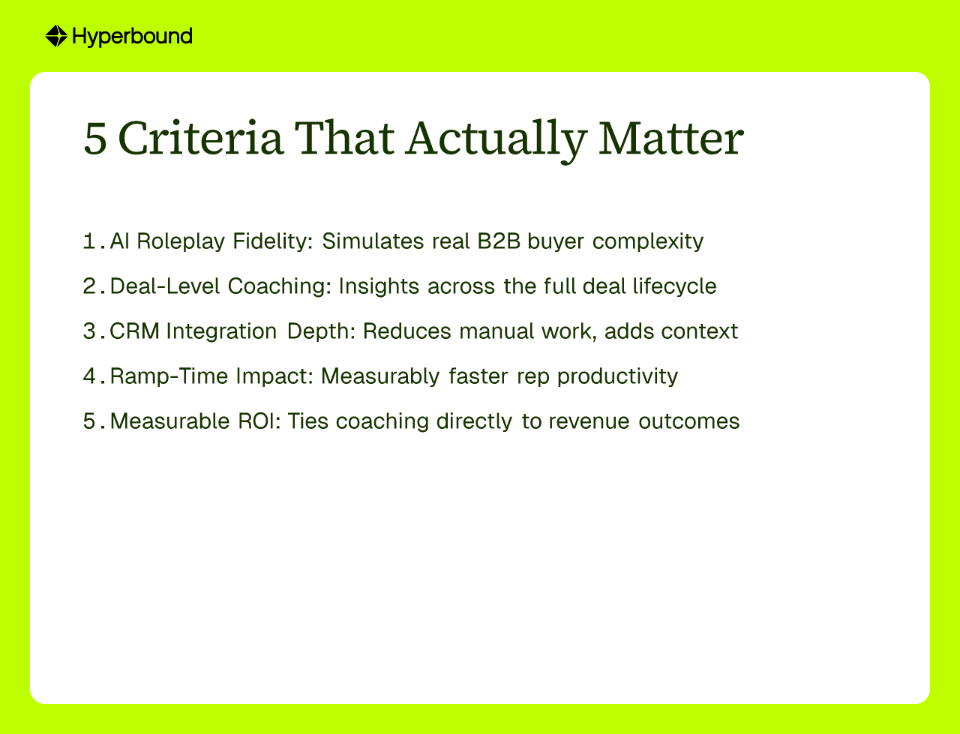
Here are the nine best sales coaching platforms for B2B revenue teams, assessed against those criteria.
Best for: Closing the gap between conversation insight and behavior change — before deals are lost.
Hyperbound is the only platform built specifically to solve the intervention gap. It pioneered the Revenue Activation category to describe what happens when teams stop just analyzing call data and start using it to change outcomes. The model is built around a continuously reinforcing loop: Practice → Perform → Activate.
Hyperbound Practice is the entry point. Reps master conversations before they happen using AI buyer personas trained on over 2 million hours of real B2B sales conversations — not generic scripts. This is a meaningful distinction. Users on r/sales describe the common failure mode of AI roleplay tools: they "fail to adapt to unexpected inquiries" and produce objection handling so predictable it stops being useful. Hyperbound's AI is trained on what makes your top reps win, so the scenarios mirror the actual complexity your reps face. It includes Bitesized Roleplays for tenured reps who won't sit through 30-minute generic certs, Multiparty Roleplays for complex multi-stakeholder deals, and Screen Comprehension for demo practice.
Hyperbound Perform moves coaching from individual calls to the full deal lifecycle. Instead of analyzing conversations in isolation, it surfaces deal-level insights across all calls and emails in an opportunity — flagging deal momentum and early risk signals while outcomes are still yours to change. Auto-CRM Fill eliminates manual data entry by capturing and updating CRM fields from real conversations.
Kota Activate sits above both products as an AI orchestration layer. It analyzes pipeline-wide trends, references historical closed-won and lost patterns, and recommends personalized coaching interventions directly in Slack or Teams — turning managers into more proactive coaches without adding to their workload.
Where it shines: The proof points are hard to ignore. Vanta achieved a 60% ramp reduction (from 210 days down to 72) and $125M+ pipeline influenced. Nivoda saw 2x revenue year-over-year and a 150% increase in demo rates after adopting the platform.
Where to set expectations: As a category-defining platform, the full Perform and Activate vision continues to roll out (Perform live March 2026). Teams buying now are also buying into a roadmap — which is the right bet, but worth knowing.
Best for: Best-in-class conversation intelligence and revenue visibility.
Gong is the undisputed leader in capturing and analyzing customer interactions. It automatically records, transcribes, and surfaces insights from every call and email, giving revenue teams an unparalleled view into what is actually happening in the field. Metrics like talk-to-listen ratios, topic trends, and competitor mentions give managers a consistent signal for identifying coachable moments.
Where it shines: Gong customers like Diligent report a 7.4% increase in close rates and new hires hitting quota three weeks faster. As a source of truth for what is happening across your pipeline, it is genuinely hard to beat.
Where it falls short: Gong is, at its core, a data and analytics platform. It records what happened — it does not change what happens next. The coaching loop is manual and manager-dependent. There is no native practice layer, so the insights it surfaces require a separate workflow to translate into rep behavior change. It is a giant library of data without a built-in mechanism to act on it before the next call.
Best for: Structured onboarding programs and large-scale sales readiness initiatives.
Mindtickle is a mature platform for building and delivering formal training content, certifications, and onboarding paths at scale. If your core need is rolling out a new product messaging framework to 200 reps or ensuring every new hire completes a structured readiness program, it performs well.
Where it shines: Programmatic readiness, content management, and certification workflows are genuine strengths. It is well-suited for sales enablement leaders managing large, structured initiatives across distributed teams.
Where it falls short: The platform is more focused on certifying that reps know the material than building the conversational muscle to apply it when a real buyer pushes back. Dynamic, adaptive conversation simulations are not its core strength. Reps can complete certifications and still struggle when an objection lands in a live call that did not appear in the training module.
Best for: AI-powered roleplay with a focus on engagement and gamification.
Second Nature offers an engaging approach to sales practice, using lifelike avatars and gamified leaderboards to drive rep adoption. It covers a range of use cases including CRM integration and video analysis for feedback on tone and body language.
Where it shines: UI engagement and session completion rates tend to be strong, and the platform covers a broad set of use cases across the sales cycle.
Where it falls short: Users and competitive assessments note that the AI's objection handling can feel generic — particularly for experienced B2B reps who have heard every variation of a pricing pushback. When scenarios are not trained on a company's actual call data and real buyer behavior, experienced reps hit the ceiling of usefulness quickly. The realism gap is real for complex enterprise sales motions.
Best for: Connecting coaching to sales content within a unified enablement platform.
Highspot places coaching alongside the collateral, battlecards, and playbooks reps use every day, creating contextual relevance. Their approach to deal coaching uses AI to convert meeting activity into structured insights and ties it to buyer interactions. Their own research found that "91% of B2B GTM leaders using AI in coaching reported their reps met or exceeded sales goals."
Where it shines: The unified platform experience is its strongest trait. When training content, pitch practice, and deal performance all live in one place, enablement has a better shot at creating a coherent rep experience.
Where it falls short: Highspot is content-first, not conversation-first. The coaching capability is largely an extension of the content management system. It excels at reinforcing static playbooks but is less suited for the dynamic, unscripted reality of live B2B buyer conversations where deals actually get won or lost.
Best for: Asynchronous video-based practice and peer-to-peer learning.
Allego's library of video-based practice tools allows reps to record themselves pitching and receive feedback from managers and peers. The collaborative format creates a repository of best practices and enables rich, asynchronous coaching conversations.
Where it shines: Flexible practice formats and collaborative learning make it appealing for distributed teams. The peer-to-peer feedback model can surface practical knowledge that top-down training often misses.
Where it falls short: Scale and consistency are its Achilles heel. When feedback depends on human reviewers — managers watching recordings, peers leaving comments — training quality becomes uneven across a large team. It does not scale as effectively as AI-driven, automated feedback for teams growing quickly.
Best for: Real-time guidance during live conversations, particularly in high-volume call center environments.
Balto takes a different approach: rather than coaching before a call, it acts as a live safety net during one. Reps receive real-time prompts, checklists, and recommended responses while the call is in progress.
Where it shines: For high-velocity, more scripted sales environments, in-the-moment guidance can reduce errors and improve consistency.
Where it falls short: Real-time prompting builds dependency, not capability. Reps may follow the right script on the call but fail to internalize the why behind it. Long-term, this approach risks creating reps who need the tool in perpetuity rather than developing durable sales skills that compound over time.
Best for: Customizable AI roleplay scenario building for specific sales motions.
TrainHQ is an emerging player focused on enabling teams to build their own practice scenarios mapped to their unique sales process. It aims to create a closed-loop performance management system connecting practice to performance metrics.
Where it shines: Customizability is its core differentiator, giving enablement teams control over the specific scenarios they build and how they are structured.
Where it falls short: It is primarily a practice-layer tool. The cross-deal analysis, deal health tracking, and AI orchestration that mature platforms offer are not part of the current offering. For teams that need only the practice piece, it is worth evaluating — but it leaves the broader intervention gap unaddressed.
Best for: AI avatar technology and training in compliance-heavy or regulated industries.
Quantified is a niche platform known for its realistic AI avatar technology and strong traction in industries where precise messaging and script adherence are requirements — financial services, pharma-adjacent B2B, and similar sectors.
Where it shines: The avatar realism is among the most realistic available, and for use cases where companies need reps to deliver a specific, compliance-approved message, it performs well.
Where it falls short: The specialized focus limits its agility for fast-moving B2B SaaS sales teams. When your competitive landscape changes monthly and your messaging evolves with every product release, a platform optimized for script adherence may not serve the dynamic demands of modern enterprise sales.
Evaluating sales coaching platforms requires knowing which metrics to watch and when. According to industry research on coaching ROI, impact follows a predictable sequence:
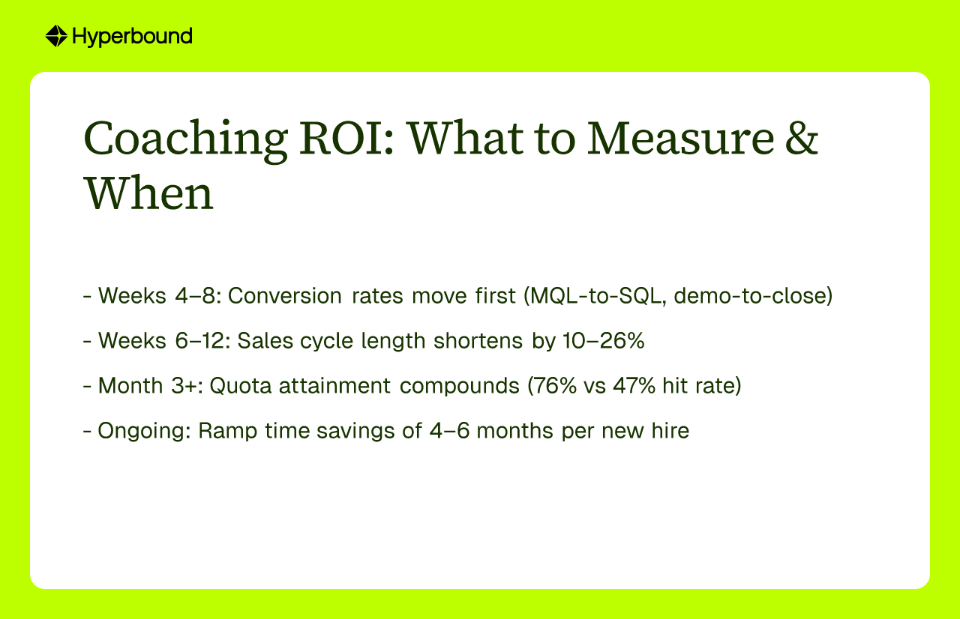
The platforms that make ROI measurable are the ones that connect coaching activity directly to these outcomes — not just tracking completion rates on training modules, but tying rep skill development to real deal behaviors and revenue results.
The era of passive conversation intelligence has done its job. It made execution visible for the first time — and that was real progress. But visibility was never the same as improvement. Knowing that three reps fumbled the pricing conversation last Tuesday does not change what happens this Tuesday unless something in the system intervenes.
The best B2B revenue teams are making a shift: from analysis to action, from reporting to intervention, from watching the replay to changing what happens before the next play runs. That is the Revenue Activation mindset — and it is where the next wave of competitive advantage in sales will be built.
Most of the sales coaching platforms on this list solve a real piece of that puzzle. Gong gives you visibility. Mindtickle gives you structured readiness. Highspot connects coaching to content. But none of them close the full loop between insight and behavior change across the entire deal lifecycle.
Hyperbound is built from the ground up to do exactly that. Practice prepares reps before real conversations happen. Perform surfaces deal-level coaching while the deal is still winnable. Kota orchestrates both, recommending the right intervention at the right moment — directly in the tools your team already uses.
Vanta cut ramp from 210 days to 72. Nivoda doubled revenue year-over-year. These are not incremental improvements — they are what happens when coaching stops being a post-mortem and starts being an active part of how revenue gets created.
If you are evaluating sales coaching platforms for your B2B revenue team, the question worth asking is not just "what does this tool show me?" It is: "what does this tool change?"
A sales coaching platform is a software tool designed to improve the performance of sales representatives through practice, feedback, and skill development. These platforms go beyond traditional sales training by providing tools like AI-powered role-playing, conversation intelligence to analyze real calls, and personalized feedback to help reps master everything from discovery calls to pricing negotiations. The goal is to build durable skills and directly impact revenue outcomes.
The intervention gap is the critical delay between analyzing a past sales call and actively changing a seller's behavior before their next one. Most platforms are good at showing you what went wrong on a call that already happened. However, by the time that insight is reviewed, the deal has moved on. Closing this gap means using insights from past calls to proactively train reps on specific skills they can apply in their very next conversation, preventing deals from being lost.
AI roleplay tools improve sales performance by allowing reps to practice handling objections, navigating complex conversations, and mastering their pitch in a safe, repeatable environment. Unlike generic scripts, the most effective AI roleplay tools (like Hyperbound Practice) are trained on a company's real call data. This creates highly realistic buyer personas and scenarios, allowing reps to build conversational muscle memory for the specific challenges they will actually face, leading to higher confidence and better outcomes in live deals.
Conversation intelligence (CI) tools record and analyze what happened on past calls, while sales coaching platforms use those insights to actively change what happens on future calls. A CI platform like Gong is exceptional at providing data and visibility—the "what." A true coaching platform, like Hyperbound, provides the "how" by incorporating a practice and activation layer. It takes the data from past calls and turns it into targeted training simulations and proactive coaching recommendations to improve future performance.
The ROI of a sales coaching platform is measured by tracking improvements in key sales metrics like conversion rates, sales cycle length, quota attainment, and new hire ramp time. Leading indicators like MQL-to-SQL conversion rates often improve within the first 4-8 weeks. Over a few months, you should see a shorter sales cycle and higher quota attainment. A significant long-term benefit is the reduction in ramp time for new hires, which can save a company 4-6 months of productivity per rep.
The most important features are those that directly lead to behavior change and revenue impact, not just data analysis. Look for five key criteria: high-fidelity AI roleplay that mirrors real buyer complexity, deal-level coaching that analyzes the entire deal lifecycle, deep CRM integration to reduce manual work, a measurable impact on rep ramp time, and a clear connection between coaching activities and revenue outcomes.
See how Hyperbound closes the intervention gap →








Use Cases
Legal