
Your sales team has more data than ever before. Call recordings, deal timelines, CRM activity logs, engagement scores — the dashboards are full. And yet, win rates are flat, ramp times are long, and managers are still flying blind on which deals are actually going to close.
Sound familiar? You're not alone. As one sales leader put it bluntly: "We want to not just understand what our customers are buying, but get a better understanding of why." That's the problem with most revenue intelligence platforms today — they tell you what happened, not why, and they certainly don't tell you what to do next.
A real revenue intelligence platform doesn't just capture conversations and surface dashboards. It closes the loop between what's happening in deals and what reps actually do differently as a result. Industry analysis shows the market in 2026 is shifting toward AI-native orchestration platforms that execute workflows — not just display data.
The difference matters. Standalone call scoring, for example, often functions as "expensive reporting" — it identifies issues without providing a way to fix them. A scorecard flags that a rep is failing to handle pricing objections. But without an operational loop that connects that insight to targeted practice, the insight expires and behavior never changes.
True revenue intelligence activates behavior. It connects conversation data to coaching, coaching to skill-building, and skill-building to deal outcomes.
Every tool on this list was evaluated against five criteria that matter most to sales teams in 2026:
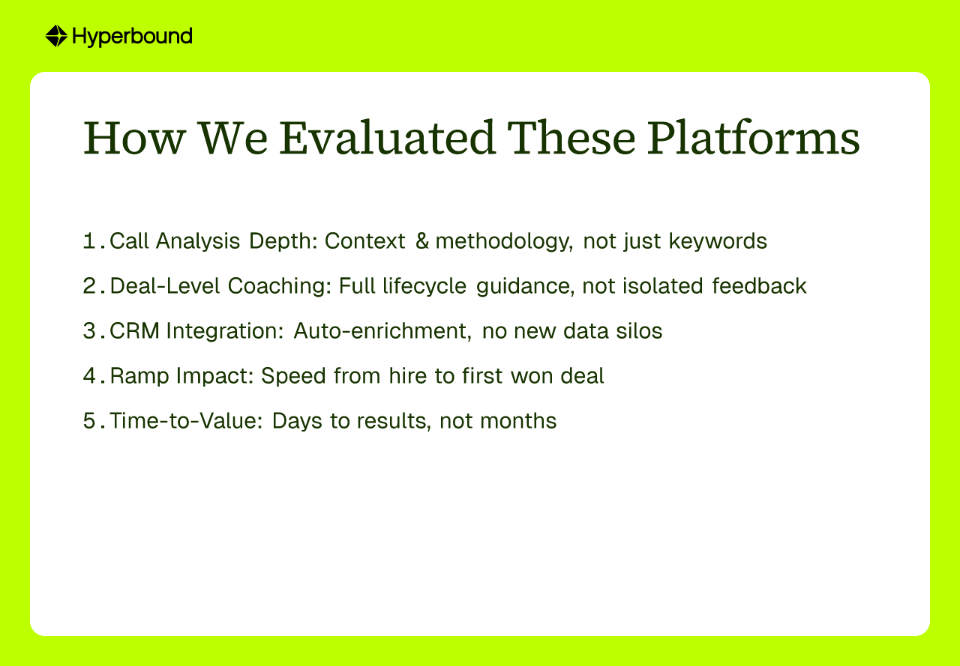
With those criteria in mind, here are the 10 best revenue intelligence platforms for sales teams in 2026.
Hyperbound isn't just another call intelligence tool. It coined the Revenue Activation category — the idea that data alone doesn't change outcomes, but pairing insights with targeted practice and AI-orchestrated coaching does.
The platform is built around a Practice → Perform → Activate loop that no other tool on this list replicates end-to-end.
What it does well:
Where it falls short:
Gong is the established market leader in conversation intelligence. It captures and analyzes interactions across calls, email, and web conferencing, and has built one of the most sophisticated deal risk and pipeline inspection engines available.
What it does well:
Where it falls short:
Salesforce Einstein is the native AI layer built into the Salesforce CRM. It's not a standalone revenue intelligence platform, but for teams already living inside Salesforce, it offers activity capture, AI summaries, and pipeline analytics without switching context.
What it does well:
Where it falls short:
Revenue Grid is purpose-built for automated data capture and sales sequencing within Salesforce. As one RevOps leader noted: "Everyone is talking about call recordings and AI insights, but reliable email tracking is a must" — and Revenue Grid delivers exactly that.
What it does well:
Where it falls short:
Clari has established itself as the go-to revenue forecasting platform for sales leadership. It analyzes pipeline data using AI to remove the guesswork — and the politics — from revenue projections.
What it does well:
Where it falls short:
Salesloft combines sequencing, dialing, and conversation insights in a single platform aimed at driving outbound volume and pipeline creation.
What it does well:
Where it falls short:
Outreach is a market-leading sales execution platform built for large, complex organizations managing high volumes of accounts and sequences simultaneously.
What it does well:
Where it falls short:
Chorus.ai brings call recording, transcription, and conversation analytics to the ZoomInfo ecosystem. It's an accessible option for teams already paying for ZoomInfo's data platform.
What it does well:
Where it falls short:
Claap is a modern, collaborative AI call analysis tool that's winning customers away from Gong with simpler onboarding, async collaboration features, and a significantly lower price point.
What it does well:
Where it falls short:
Apollo.io is primarily a sales intelligence and outbound engagement platform, not a revenue intelligence platform in the traditional sense. It earns a spot on this list because many growing teams start here before graduating to more sophisticated tools.
What it does well:
Where it falls short:
Not every team has the same problem. Here's how to match your specific pain to the right platform.
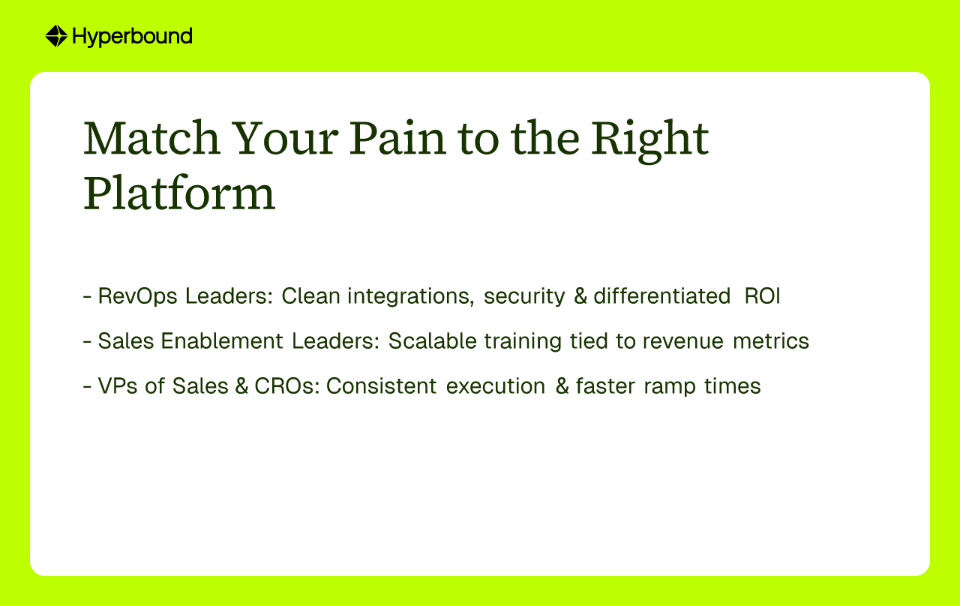
Your pains: Tool sprawl, data governance concerns, proving ROI on new investments, and the recurring objection that "Gong already does this."
What you need: A platform that integrates cleanly with your existing stack, adds a genuinely differentiated capability (not just another dashboard), and comes with enterprise-grade security your IT team won't reject.
Your pains: You're outnumbered — often 1 enablement professional serving 50–100 reps — 80% of training is forgotten within 30 days, and you can't prove your programs are actually moving revenue metrics. As one practitioner asked: "Will my team want to use this after the first two weeks?"
What you need: A scalable, engaging platform that makes training stick, directly ties practice to live deal performance, and gives you the data to prove impact.
Your pains: Stagnant win rates you can't pinpoint the root cause of, long ramp times that inflate CAC, inconsistent execution across your team, and managers who coach differently (or not at all).
What you need: A system that scales what your best reps do across the entire floor — and connects training investment directly to pipeline outcomes.
The global conversation intelligence market is projected to grow from $23.4B in 2024 to $55.7B by 2035, and 46% of US sales teams already use AI call-recording tools. The tools are everywhere. The data is everywhere. What's still rare is a platform that connects the dots all the way through — from what happened in a call, to what a rep needs to practice, to whether that practice actually moved a deal forward.
That's the gap the best revenue intelligence platforms in 2026 are racing to close. Tools like Gong and Clari are powerful anchors for intelligence and forecasting. But if your goal is to activate behavior change at scale — to turn conversation data into consistent deal execution across every rep on your floor — Hyperbound is the platform purpose-built for that outcome.
See how teams like Vanta, LinkedIn, and Nivoda are using Hyperbound to ramp faster, win more, and build sales teams that don't just understand their pipeline — they move it.
A revenue intelligence platform is a tool that captures and analyzes customer-facing interactions—such as calls, emails, and meetings—to provide insights into sales performance and pipeline health. These platforms go beyond traditional CRM data by analyzing conversational data to help teams understand what is happening in their deals, identify at-risk opportunities, and forecast more accurately.
Revenue intelligence focuses on providing data and insights about what happened in deals, while revenue activation focuses on turning those insights into action to change what happens next. A revenue intelligence tool like Gong might identify that a rep struggles with objection handling. A revenue activation platform like Hyperbound takes the next step by automatically assigning targeted practice and coaching to fix that specific skill gap, directly linking insight to behavioral change.
Revenue intelligence platforms improve sales performance by providing data-driven coaching, reducing ramp time for new hires, and ensuring consistent execution of sales methodologies across the team. They give managers visibility into every deal, allowing them to pinpoint the root cause of stalled deals and provide specific, timely feedback. This leads to higher win rates, faster sales cycles, and more predictable revenue.
CRM integration is crucial because it creates a single source of truth and eliminates data silos. A strong integration automatically syncs all activities (calls, emails, meetings) and conversational insights to the correct records in your CRM (like Salesforce or HubSpot). This saves reps from manual data entry, enriches your CRM data, and ensures that insights from the revenue intelligence platform are available where your team already works.
These platforms help by making sales coaching scalable and data-driven. Managers can review call recordings and AI-generated scorecards to identify coachable moments without having to shadow every call. More advanced "revenue activation" platforms take this further by connecting identified skill gaps to automated, personalized training modules, such as AI-powered roleplays, ensuring that training is relevant and directly tied to improving real-world deal outcomes.
The choice depends on your primary goal. Choose Gong if your main objective is enterprise-grade conversation intelligence, deep deal inspection, and a robust call library for manual review. Choose Hyperbound if your goal is to activate behavior change and close the loop between insights and outcomes. Hyperbound is designed to not just identify skill gaps but to automatically deliver the practice and coaching needed to fix them, measurably reducing ramp time and improving conversion rates.
You can measure ROI through several key performance indicators (KPIs). Look for direct impacts on revenue metrics like increased win rates, higher demo-to-close conversion rates, and shorter sales cycles. You should also measure efficiency gains, such as a reduction in new hire ramp time (e.g., time to first won deal) and time saved on manual data entry for reps. The best platforms will provide dashboards to track these metrics and prove their impact on your bottom line.








Use Cases
Legal