
Your sales reps are spending 3–11 hours a week hunting for internal information instead of selling. You've invested in training materials that almost none of them use. And 80% of what they do learn is forgotten within 30 days. Meanwhile, sales managers spend only 5–8% of their time coaching — and it's the first thing cut when the quarter gets tight.
This isn't a motivation problem. It's a tooling problem.
Gartner predicts that by 2026, 65% of B2B sales organizations will transition from intuition-based to data-driven decision-making. The platforms that make that shift possible aren't your grandfather's sales enablement tools — static content libraries and slide decks that reps ignore. They're revenue enablement platforms: a fundamentally different category.
According to Gartner, a Revenue Enablement Platform (REP) "unites sales and customer-facing enablement and revenue functions" — spanning sales, customer success, marketing, partners, and presales — and is "designed to provide a comprehensive enablement program for sales and marketing leaders." The shift from sales enablement to revenue enablement reflects a broader truth: the entire customer-facing organization needs to be aligned, skilled, and activated, not just the SDRs.
So what separates a true revenue enablement platform from a legacy tool in 2026? Four capabilities matter most:
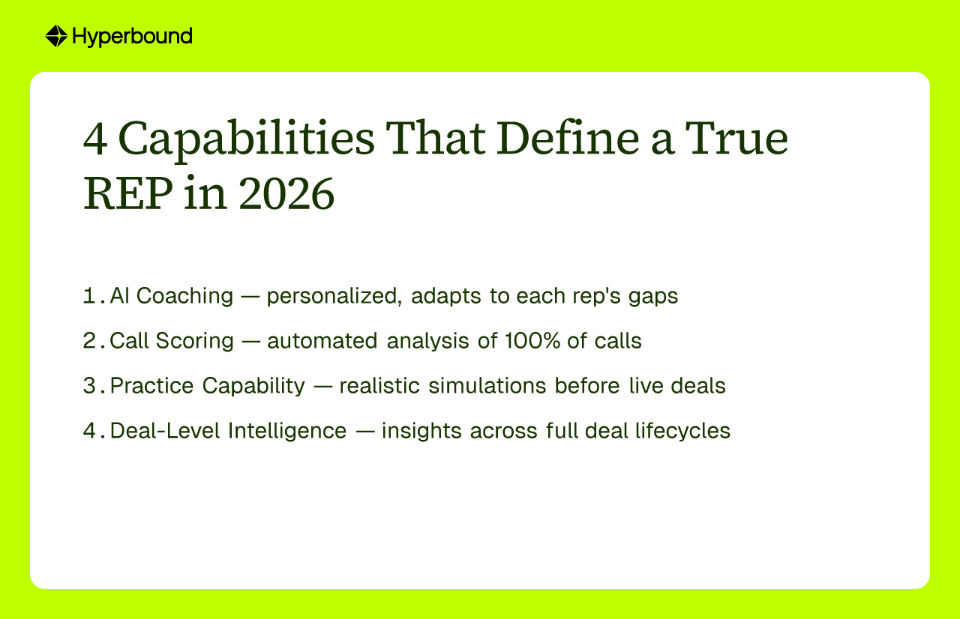
We evaluated nine of the leading revenue enablement platforms against a consistent scorecard across four dimensions: Onboarding Speed, Coaching Depth, AI Capability, and Integrations. Here's what we found.
Best for: Teams that want to close the loop between rep practice and real-deal outcomes
Hyperbound coined the Revenue Activation category — because there's a critical difference between analyzing your call data and actually doing something with it. Founded in 2024 by Sriharsha "Sai" Guduguntla (ex-Salesforce Einstein) and Atul Raghunathan (ex-Meta Ads ML) and backed by Y Combinator, Peak XV Partners, and Snowflake Ventures, Hyperbound is purpose-built to turn insights into closed-won deals.
The platform operates on a three-part model — Practice → Perform → Activate — forming a continuous improvement loop: score real calls, identify skill gaps, practice targeted roleplays, then score again.
.png)
The implementation process is structured and white-glove: Planning Call → Bot Buildout → Scorecard Buildout → Launch Prep → Official Launch, with dedicated account manager and solutions engineer pairing throughout. Integrations span Gong, Salesforce, HubSpot, Pipedrive, Outreach, Zoom, MS Teams, Seismic, Highspot, Showpad, and SSO/SCIM — with SOC 2 Type II, GDPR, ISO 27001, and HIPAA compliance baked in.
The proof points are hard to argue with: Vanta achieved a 60% ramp reduction — cutting time-to-productivity from 210 to 72 days — along with 4x BDR team growth and 5x pipeline growth. Nivoda saw a 50% ramp reduction, 2x revenue YoY, and a 150% increase in demo conversion rates.
"Hyperbound gave us a way to practice that actually mirrors what we face in the field." — Rob Rangel, Director of Sales Performance, Nivoda
With 45,000+ active users across 7,000+ companies and a 4.9/5 G2 rating, Hyperbound is the revenue enablement platform for teams that want practice to directly drive pipeline.
Best for: Mid-market to enterprise teams that need best-in-class conversation intelligence
Gong is the market standard for conversation analytics. It records, transcribes, and analyzes sales calls at scale — surfacing deal risk signals, competitive intelligence, and rep performance trends that managers simply can't catch manually.
.png)
Gong excels at telling you what happened on your calls and why deals are at risk. Its AI is unmatched for call intelligence. The gap: it doesn't give reps a dedicated environment to practice how to improve. There's no roleplay layer, no safe space to rehearse objection handling before a high-stakes call. Teams that rely on Gong alone often find that insights accumulate without translating into behavioral change — a core reason many pair it with Hyperbound's practice layer.
Best for: Large global enterprises with mature enablement programs needing content governance
Seismic is the incumbent enterprise revenue enablement platform, built around digital content management, training, and buyer engagement. Its acquisition of recent strategic assets has made it an even broader suite play for complex organizations.
.png)
Seismic's AI surfaces relevant content and personalizes seller experiences, but its core strength remains content delivery and governance — not behavioral coaching or dynamic skill practice. Implementation is complex and pricing typically starts at $50K+ annually, requiring dedicated internal resources and a clear governance plan. If your primary challenge is content chaos at scale, Seismic delivers. If you need reps to actually change how they sell, you'll need to supplement.
Best for: Organizations where quick access to the right marketing assets drives sales outcomes
Highspot built its reputation on superior content search and guided selling "plays" — making it easier for reps to find and use the right materials at the right moment in the sales cycle.
.png)
Average contract sizes hover around $91K/year, so Highspot is a significant investment. Its AI-powered content scoring and recommendation engine is genuinely impressive. However, like Seismic, its coaching depth is limited — it analyzes content usage rather than rep behavior, leaving the skill development gap unaddressed.
Best for: Enterprises focused on data-driven onboarding and measuring sales readiness
Mindtickle positions around a "Readiness Index" — a composite score of rep knowledge, skill, and behavior that helps enablement leaders track team preparedness in a measurable way.
.png)
Mindtickle offers solid conversation intelligence and coaching programs, with estimated entry minimums around $90K annually for enterprise deployments. The key differentiation from Hyperbound: Mindtickle's AI roleplays lean on more generalized scenarios, whereas Hyperbound's simulations are trained on 2M+ hours of real B2B sales conversations drawn from your actual ICP and buyer personas. For teams where simulation fidelity and the practice-to-performance loop are the priority, that distinction matters.
Best for: Field sales teams in manufacturing, life sciences, and visual-heavy industries
After merging with Bigtincan, Showpad has become a go-to revenue enablement platform for organizations where reps sell on the road with tablets — think 3D product demos, offline content access, and mobile-first experiences.
.png)
Showpad's AI leans toward content recommendation rather than conversational practice. Implementation is tailored to specific industry needs, which adds setup time but produces more relevant output for niche use cases. If your team sells complex physical products and needs immersive, offline-accessible content experiences, Showpad is purpose-built for that motion.
Best for: Mid-market teams focused on improving the buyer experience across the deal lifecycle
Dock takes a different angle on revenue enablement — instead of coaching reps, it centers on the buyer's experience. Digital sales rooms, collaborative workspaces, and seamless sales-to-onboarding handoffs are its core value proposition.
.png)
Dock offers a free tier and transparent pricing — a breath of fresh air in a category notorious for opaque contracts. Its "AI enablement agent" can generate personalized proposal documents and deal workspaces quickly. The trade-off is clear: Dock optimizes the buyer side of the equation, not the rep side. If you need reps to improve their execution skills, you'll need another tool alongside it.
Best for: Distributed or remote teams that thrive on peer-to-peer, video-based learning
Allego built its platform around the insight that sellers learn best from other sellers. Short video submissions, peer coaching challenges, and asynchronous feedback loops are its differentiating features.
.png)
Allego formalizes the sharing of best practices and gives managers a way to provide structured video feedback — valuable for remote teams. Its AI supports transcription and content analysis, but doesn't drive interactive simulations or automated coaching at scale. Teams that already have strong peer-coaching culture will get the most from it.
Best for: Organizations that want one LMS to handle sales, HR, and customer education in one place
WorkRamp is a corporate learning management system that happens to serve sales teams — alongside HR, IT, and customer training. If your priority is consolidating L&D across the entire organization onto one platform, WorkRamp is worth evaluating.
.png)
WorkRamp excels at course delivery, completion tracking, and certification workflows — the table stakes of any L&D program. But it's not purpose-built for sales performance. AI is not a core focus, and there's no dynamic roleplay or call scoring capability. For sales teams specifically, it functions more as a training repository than a revenue enablement platform.
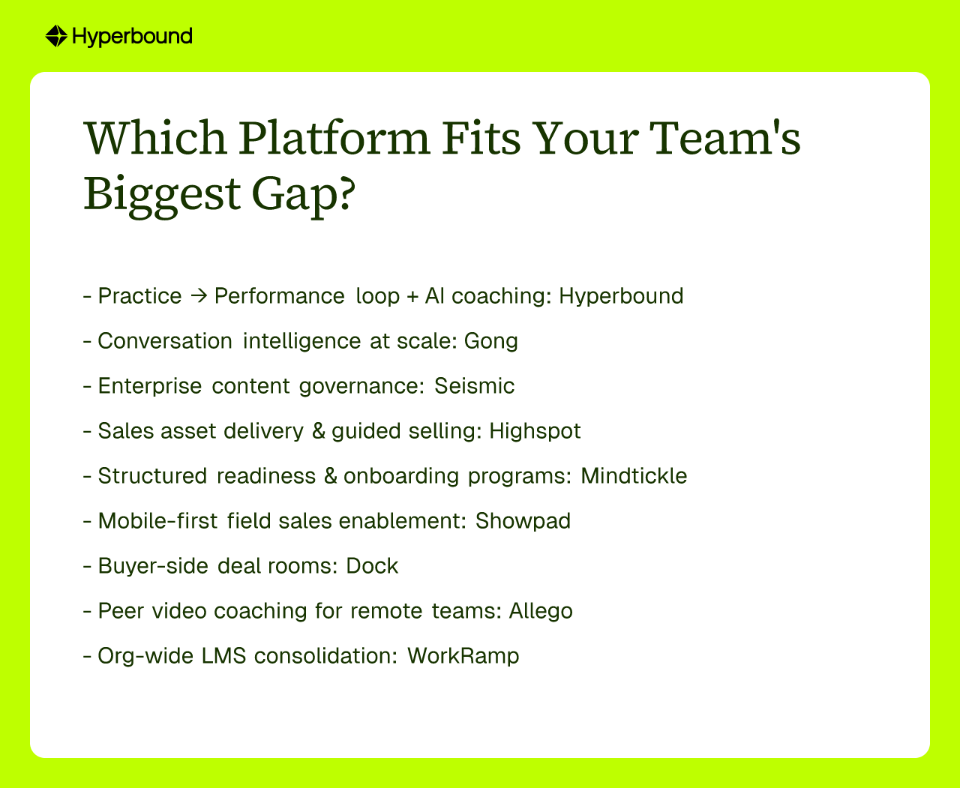
Not every team has the same gap. Use this framework to match your primary challenge to the right solution:
.png)
The platforms that will define revenue enablement in 2026 aren't just content libraries or call recorders. They're systems that change behavior — connecting what reps practice to what they do on live calls, and connecting those behaviors to actual deal outcomes.
If your team is still relying on training that's forgotten within 30 days, or call intelligence that generates insights no one acts on, the gap isn't data. It's activation.
A revenue enablement platform (REP) is a tool designed to unite and support all customer-facing teams—including sales, customer success, and marketing—to drive revenue growth. Unlike traditional sales enablement tools that focus solely on the sales team, REPs take a holistic view of the entire customer lifecycle. According to Gartner, they provide a comprehensive program for sales and marketing leaders to ensure the entire GTM organization is aligned, skilled, and equipped to succeed.
The key difference is scope: sales enablement focuses narrowly on equipping the sales team, while revenue enablement supports the entire customer-facing organization, including marketing, customer success, and partners. This shift reflects the understanding that revenue generation is a team sport. Aligning all GTM functions on messaging, skills, and data leads to a more consistent customer experience and better business outcomes than siloing enablement efforts within the sales department alone.
The four most critical capabilities for a modern revenue enablement platform are AI Coaching, automated Call Scoring, a Practice Capability for simulations, and Deal-Level Intelligence. These features move beyond static content libraries. AI Coaching personalizes development for each rep's specific needs. Call Scoring provides objective analysis of 100% of conversations. Practice capabilities allow reps to build skills in a risk-free environment. Deal-Level Intelligence offers insights across the entire sales cycle, not just isolated calls.
AI-powered sales coaching is important because it provides personalized, scalable, and data-driven guidance that human managers cannot deliver on their own. Sales managers typically spend only 5–8% of their time coaching. AI can analyze every single call to identify specific, individual performance gaps and recommend targeted practice exercises. This allows teams to close the loop between identifying a weakness (e.g., poor objection handling) and actively improving it through realistic simulations, leading to faster ramp times and better quota attainment.
To choose the right platform, first identify your team's single biggest challenge, and then match that need to a platform's core strength. For example, if your primary issue is a lack of real-world practice opportunities that translate to better performance, a tool like Hyperbound is ideal. If you need best-in-class conversation analysis, Gong is a strong choice. If your main problem is managing a massive library of sales content for an enterprise team, Seismic or Highspot would be a better fit. Use your top priority to guide your evaluation.
The return on investment (ROI) for a revenue enablement platform is typically measured by metrics like reduced ramp time, increased quota attainment, higher conversion rates, and larger deal sizes. For example, companies using platforms with strong practice and coaching capabilities report significant improvements. Vanta reduced its new-hire ramp time by 60% (from 210 to 72 days), and Nivoda saw a 150% increase in demo conversion rates and doubled its revenue year-over-year after implementing a platform like Hyperbound.
Yes, platforms like Hyperbound are designed to integrate seamlessly with conversation intelligence tools like Gong to create a complete performance loop. Gong is excellent at analyzing what happened on past calls to generate insights. Hyperbound then activates those insights by providing a dedicated environment for reps to practice and improve on the specific skill gaps Gong identified. This combination allows teams to move from just understanding problems to actively fixing them, which is why many organizations use both tools together.
Ready to see what Revenue Activation looks like in practice?
Vanta cut ramp time from 210 days to 72. Nivoda doubled revenue year-over-year. Both started with Hyperbound.










Use Cases
Legal