
You finally got your team onto a conversation intelligence tool, calls are being recorded, transcripts are piling up, and dashboards are full of data. Then you check quota attainment and nothing has changed.
Sound familiar? You're not alone. Across sales communities online, the frustration is palpable: "useful information gets lost after meetings," and for many teams, "most call transcription tools out there will offer very similar features" — leaving leaders wondering what they're actually paying for.
Here's the uncomfortable truth: 84% of sales reps missed quota last year, and the average new hire takes 381 days to ramp fully. That's not a data problem. That's an Insight-Practice Gap — the chasm between what your team knows it should do and what actually happens on live calls.
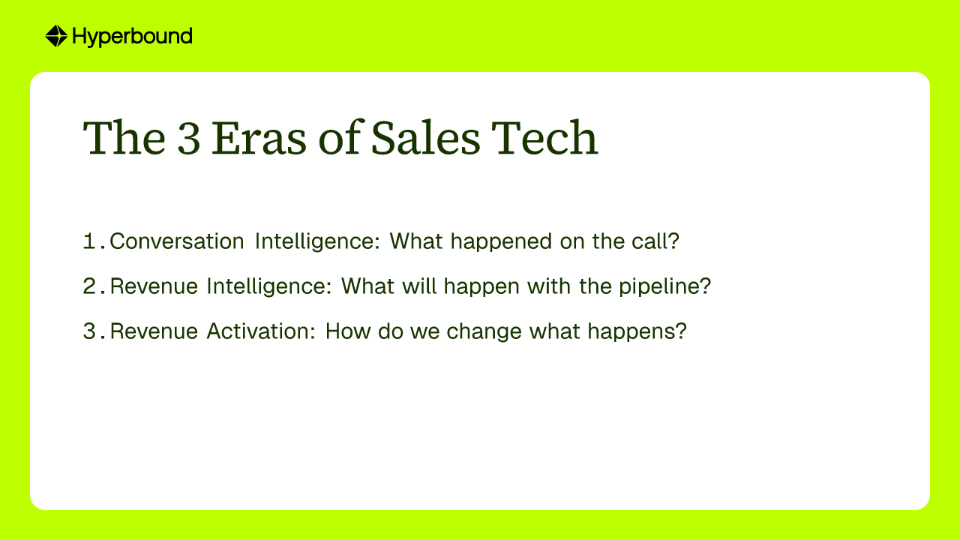
The sales tech market has evolved in three waves:
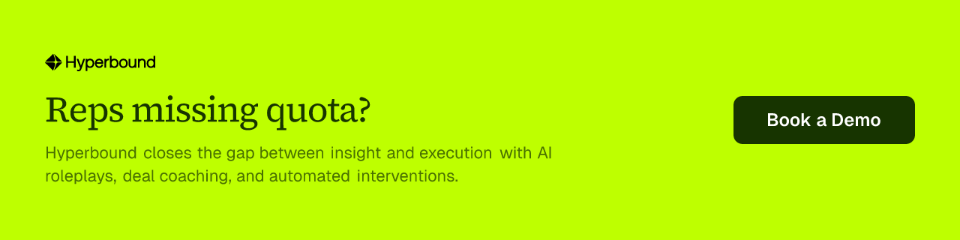
This guide scores seven platforms across five criteria — Call Analysis Depth, Practice & Skill-Building, Deal-Level Coaching, Cross-Deal Pattern Recognition, and Coaching Automation — to help you find the right tool for your team's maturity stage.
.png)
Best for: Sales organizations ready to close the gap between insight and execution, and tie training investment directly to revenue outcomes.
Scores:
.png)
Hyperbound coined the "Revenue Activation" category, and its platform is built around a continuous improvement loop: Practice → Perform → Activate. While conversation intelligence tools record what happened, Hyperbound intervenes before and during deals — while outcomes are still yours to change. The result is a closed loop: score real calls, identify skill gaps, run targeted practice, then score real calls again.
Hyperbound Practice is the entry point. AI buyer personas are trained on 2M+ hours of real B2B sales conversations — not generic scripts. This directly addresses the skepticism many sales reps have about AI role-playing tools being unrealistic or unable to handle unexpected questions. Reps can build digital twins of specific buyers from LinkedIn profiles, practice demo presentations with live screen sharing via Screen Comprehension, and knock out focused Bitesized Roleplays between calls. Multiparty roleplays simulate complex deals with multiple AI stakeholders simultaneously.
Hyperbound Perform goes beyond single-call analysis. Instead of coaching on one conversation in isolation, Perform rolls up insights across every touchpoint in a deal — calls, emails, and stakeholder interactions — to surface deal health signals and recommend specific next steps while the deal is still winnable. It integrates with Gong, Salesloft, Chorus, and other call recording systems, and auto-fills CRM data (HubSpot now; Salesforce coming soon), letting reps review before anything gets pushed.
Kota Activate sits above Practice and Perform as the orchestration layer. Available directly in Slack or Microsoft Teams, Kota analyzes data from both products simultaneously, references historical closed-won and closed-lost patterns, and recommends personalized coaching interventions — then acts on them. It can generate a targeted roleplay based on a gap it detected in a rep's real call without a manager lifting a finger.
Proof points: Vanta reduced ramp time by 60% (210 days down to 72) and grew its BDR team 4x. Nivoda saw a 150% increase in demo conversion rate and 2x revenue YoY. LinkedIn deployed Hyperbound across 3,000+ sellers in NAMER and EMEA. The platform has delivered 1.1M+ simulated call minutes across 45,000+ active users, and holds a 4.9/5 rating on G2.
Limitations: Hyperbound is purpose-built for skill activation and coaching. It is not a standalone content management system — for version-controlled sales collateral, you would still pair it with a platform like Highspot or Seismic (both of which it integrates with natively).
Best for: Large enterprises needing structured onboarding, programmatic training content, and sales readiness certification at scale.
Scores:
.png)
Mindtickle is a comprehensive enablement suite bundling CI features with learning modules, content management, and coaching workflows. Its strengths lie in programmatic onboarding and managing large-scale training initiatives — it excels at certifying reps on product knowledge before they ever speak to a buyer.
Where it falls short is in dynamic realism. Its practice environment is not trained on millions of hours of real sales conversations, and its coaching insights do not operate deeply at the deal-lifecycle level. Mindtickle solves for knowledge readiness. It does not close the loop between what a rep practiced and what is happening in their live pipeline.
Best for: Teams that have basic conversation intelligence but want a more direct layer of skill diagnostics and coaching actions.
Scores:
.png)
AmpUp AI positions itself as a CI tool that bridges the gap between analysis and execution, using features like a "Sales Brain" to diagnose skill gaps and a "Skill Lab" to surface practice scenarios based on objections encountered in real deals. That connection between call analysis and coaching action is a meaningful step forward from traditional conversation intelligence.
The limitation is architectural. AmpUp's practice layer is reactive — it responds to objections from past calls — rather than proactive in preparing reps for full deal cycles with rich, persona-specific buyer simulations. It also lacks the cross-product orchestration layer that turns insights into automated coaching interventions without requiring manager effort.
Best for: RevOps and sales leaders who need a robust system of record for customer conversations and deep, call-level analytics.
Scores:
.png)
Gong is the market-defining conversation intelligence platform, and it earned that position legitimately. It records, transcribes, and analyzes calls at scale — giving RevOps and sales leaders unprecedented visibility into what is actually being said in the field. Its call library is unmatched, and its cross-deal pattern recognition surfaces trends across the pipeline that would otherwise be invisible to sales leadership.
But Gong is structurally built to report on what happened. That is its architecture, and it is also its ceiling.
As one community member put it: "we're not huge fans of Gong's pipeline management/gamification/1:1 coaching tools." That sentiment points to something real: Gong's coaching features are limited to managers leaving comments on past recordings. By the time that feedback lands, the call is over, the deal has moved on, and the moment for meaningful intervention has passed.
There is no dedicated practice layer in Gong. Reps cannot rehearse the conversation before it happens. There is no environment to build skill between deals. And its deal-level coaching does not synthesize insights across every call, email, and meeting in a deal lifecycle — it operates call-by-call. Gong records the call. Revenue Activation changes it. That distinction is the gap between conversation intelligence and what comes next.
Gong works exceptionally well as a foundation and integrates with Hyperbound — meaning teams do not have to choose. They can use Gong's call library as an input into Hyperbound's coaching and practice workflows.
Best for: High-velocity SDR and AE teams focused on executing structured, multi-channel outreach at scale.
Scores:
.png)
Salesloft and Outreach are the engines of modern outbound motion. They automate sequences, manage activity cadences, and give managers visibility into rep activity volume across channels. Both have incorporated CI features in recent years, but conversation analysis is an addition to their core purpose, not a design principle.
These platforms are built to increase activity. They are not built to improve the quality of what happens inside that activity. There is no practice environment, no deal-level coaching that synthesizes behavior across an entire opportunity, and no automated coaching workflow for skill development. For pipeline execution, they are essential. For Revenue Activation, they are a starting point at best.
Best for: Enterprise organizations in regulated industries that need strong content governance, version control, and a reliable source of truth for sales collateral.
Scores:
.png)
Highspot and Seismic solve a real and important problem: getting the right content to the right rep at the right time. Their AI-driven content organization, battlecard delivery, and sales asset management are genuinely best-in-class for enterprises managing large, fast-changing content libraries.
But they solve for what to say, not how to say it. They are content platforms, not coaching platforms. There is no conversation analysis, no practice environment, and no deal-level coaching. They are a critical part of a mature revenue tech stack — and notably, both integrate natively with Hyperbound's SCORM-compatible practice layer, which is where the skill development side of the equation gets handled.
Best for: Teams new to AI roleplay who want a simple, standalone tool to introduce basic practice scenarios for common objections and pitches.
Scores:
.png)
Second Nature offers a focused entry point into AI roleplay — reps can practice pitches and objection handling against an AI persona before jumping into live calls. For teams with no existing practice infrastructure, it lowers the barrier to getting started.
The limitations are structural. Scenarios in Second Nature are generic rather than built from a team's actual sales conversations and top-performer behaviors. As one practitioner noted in a community discussion, "I found it a bit unrealistic for B2B sales role-playing. Prospects often ask unexpected questions or take the conversation in different directions, which it doesn't really handle well." More critically, it is a disconnected practice tool. There is no loop connecting what a rep practiced back to what is happening in their live deals — which means the skill-building stays siloed from actual revenue outcomes.
The sales tech landscape in 2026 has moved beyond passive analytics. Having a library of recorded calls is no longer a competitive edge — every team on your competitor's list has one too. The gap between hitting and missing quota now lives in the space between insight and action: whether your reps can actually apply what they know when they're on a live call with a real buyer.
The difference between conversation intelligence and revenue activation is the difference between a dashboard and a result. CI tells you what happened. Revenue Activation changes what will.
The teams winning right now have a structured loop: score real calls, identify specific skill gaps, run targeted practice, then measure whether that practice moved the deal. Data is the starting point. Revenue is driven by changing behavior at scale — before the call, during the deal, while the outcome is still yours to determine.
Revenue Activation is the third wave of sales technology, focused on actively changing sales outcomes rather than just reporting on them. It closes the "Insight-Practice Gap" by connecting call analysis with targeted, AI-driven practice and real-time coaching interventions to improve seller performance.
Revenue Activation is proactive, while Conversation Intelligence is reactive. CI platforms like Gong are excellent for recording and analyzing past calls to tell you what happened. Revenue Activation platforms like Hyperbound use those insights to create targeted practice and automated coaching to change what will happen on future calls.
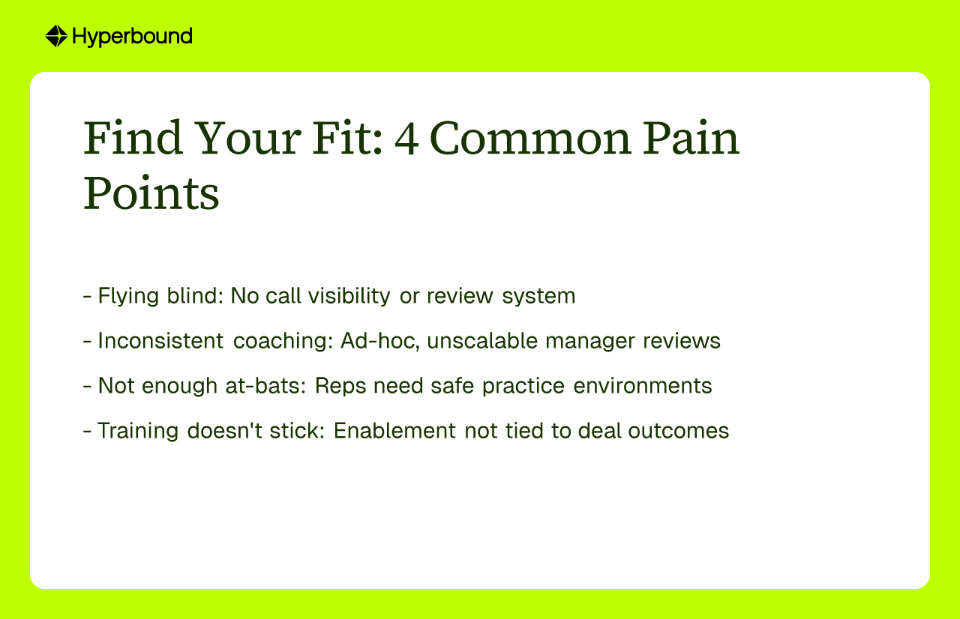
Traditional sales coaching is often ineffective because it's manual, inconsistent, and happens after the fact. Managers are busy and can't review every call, and feedback on a past call doesn't prepare a rep for the next one. This creates an "Insight-Practice Gap," where reps know what they should do but haven't had enough practice to execute it under pressure.
AI sales role-playing provides a safe, scalable environment for reps to practice their skills without risking live deals. Unlike generic scripts, advanced platforms use AI trained on real B2B conversations to simulate realistic buyer personas and objections. This allows reps to build muscle memory, master new messaging, and gain confidence before ever speaking to a real prospect.
Yes, leading Revenue Activation platforms are designed to integrate with your existing sales tools. Hyperbound, for example, integrates with CI tools like Gong and Chorus to pull call data, CRMs like HubSpot and Salesforce to sync deal information, and content management systems like Highspot to incorporate sales collateral into practice scenarios.
Teams that implement a Revenue Activation platform can expect tangible improvements in core sales metrics. Key results often include significantly reduced ramp time for new hires (Vanta cut ramp time by 60%), increased demo-to-close conversion rates, higher quota attainment, and accelerated revenue growth.
A Revenue Activation platform is best for sales organizations that have moved beyond basic call recording and are focused on improving seller effectiveness. It's ideal for teams struggling with inconsistent coaching, long ramp times, or a sense that their enablement efforts aren't translating into better performance on live calls.

Stop watching your deals close the wrong way. See how Hyperbound's Revenue Activation platform can cut ramp time and lift your win rates — book a demo today.









Use Cases
Legal
.png)