
Promoting a top-performing sales rep to manager is one of the most common decisions in sales leadership. It is also one of the most reliably costly. The logic is straightforward: if someone closes at the highest level, they should be able to teach others to do the same. Research and a consistent pattern of outcomes say otherwise.
This is not an isolated error in judgment. It is a predictable structural problem, and the costs are measurable.
In 1969, Laurence Peter described what has since been called the Peter Principle: people in hierarchies get promoted based on performance in their current role until they reach a level where they are no longer competent. Sales organisations have tested this more rigorously than most.
A peer-reviewed study by Benson, Li, and Shue, published in the Quarterly Journal of Economics and available as NBER working paper w24343, analysed roughly 48,000 sales associates and 5,000 managers across more than 200 firms. The finding is unambiguous: sales performance is negatively correlated with managerial performance. The strongest individual sellers are systematically worse bets for a management promotion than reps with weaker individual numbers.
The quantified impact is significant. Managers whose own sales had doubled before promotion saw approximately a 10% drop in the performance of each of their new direct reports. A typical new manager oversees around five reps. That 10% drag, multiplied across the team, represents a total sales decline roughly equivalent to half of one worker's full output.
The numbers reflect a structural incompatibility between the two roles rather than an individual performance failure.
A top rep's edge is often pattern recognition built through personal sales cycles: reading a buyer's hesitation, knowing when to push on price and when to wait. That recognition is real. It is also largely non-transferable. When asked why they closed a deal, many strong reps cannot articulate an answer their team can use. Advising a struggling rep to rely on instinct is not coaching.
Management requires the opposite disposition. It requires documentation, repeatable process, the ability to diagnose why a rep is failing rather than simply stepping in to close the deal personally. The two skill sets are not adjacent. They are frequently in tension.
There is also a behavioural pattern that emerges when a top individual contributor takes a management role. Rather than building systems that let reps succeed independently, new managers with strong individual sales backgrounds tend to focus on individual deals, close on behalf of direct reports, and inadvertently signal that the team's role is to support the manager's pipeline rather than the reverse. The calendar fills with deal reviews rather than coaching sessions. Forecast calls consume the week. The rep who was once the team's best closer is now the team's most expensive bottleneck.
The profile contrast is direct:
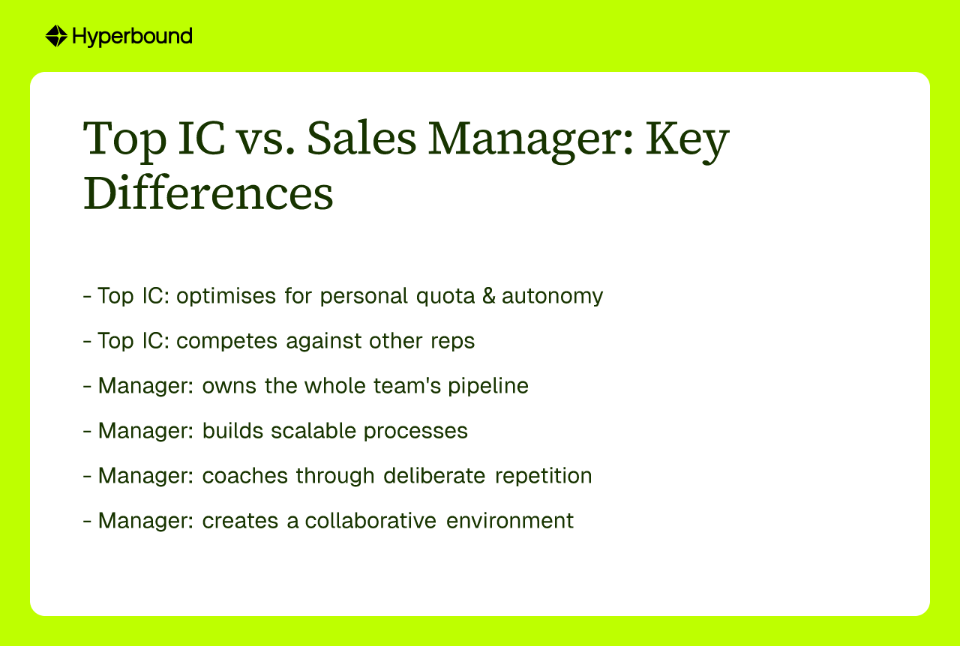
These are different jobs. Treating one as a natural progression of the other is the root of the problem.
The financial case against this promotion pattern is rarely calculated before the decision is made.
Consider a rep generating $800,000 in annual revenue who is promoted into a $120,000 manager role. To break even on what they previously contributed as an IC, their team needs to produce nearly $700,000 more than it would have under a competent manager. That calculation excludes the cost of replacing them as an IC, a process that typically takes six to nine months of ramp time for a new hire.
It also excludes the damage that occurs in the interim. New managers who were strong individual contributors tend to decrease team performance during their first six months as they adjust to a role with a fundamentally different success model. The organisation absorbs two losses simultaneously: the output of its best closer and the output of the team now reporting to someone learning on the job.
The performance gap between strong and weak managers is substantial. Teams under high-performing sales leaders average around 105% quota attainment; teams under underperforming managers average around 54%. That is a 51-point swing that flows directly from a single promotion decision.

The path forward has two components: changing who gets promoted, and changing how coaching scales after the promotion.
The same Benson, Li, and Shue study that identified sales performance as a negative predictor of managerial success also identified the single strongest positive predictor: collaboration experience. Reps who had worked cross-functionally, mentored peers, or contributed to team outcomes beyond their own quota produced better results as managers.
Most organisations do not measure this. Quota attainment is visible and appears objective. Collaboration is harder to quantify and easier to overlook. The result is a systematic bias toward promoting the wrong people.
The structural fix is a dual-track career ladder: parallel progression paths for ICs and managers, each with defined levels, titles, scope, and promotion criteria. This retains top individual contributors without forcing them into roles they are not suited for. A principal-level seller with expanded scope and competitive compensation does not need to become a manager to progress. Mature sales organisations define both tracks explicitly.
Even when the right person is promoted, manager bandwidth remains the binding constraint on team development. A manager's pattern recognition only reaches the reps who have time on the calendar that week. When teams grow, episodic coaching delivered by a single manager cannot scale. The model fails at the point of greatest need. We cover the fix in detail in sales coaching software for managers who can't scale themselves.
The limitations of the old approach are most visible at this scale. Klaviyo's enablement team was serving 1,000 or more reps across sales, customer success, and partnerships with a structure built on live sessions and manager-led roleplays. That model could not stretch to meet the team's size. After moving to continuous practice with Hyperbound, Klaviyo managers recovered five to seven hours per week and the company recorded a 42% increase in new-hire productivity per rep year over year.
Vanta's SDR team scaled from around 30 to more than 120 reps and ramp times stretched past 200 days because coaching was manual and could not keep pace. With Hyperbound embedded into the daily workflow as a practice ritual rather than a scheduled event, Vanta cut ramp time from approximately 210 days to 75 days, a 60% reduction, and reduced the time to first meeting and first opportunity by 30%. Vanta CRO Stevie Case stated directly that without Hyperbound, the team would not have hit its pipeline goals.
ALKU scaled an internship programme to more than 300 participants without adding coaching headcount and cut time to first deal from six months to three. The throughput improvement came from what Hyperbound describes as repetition compression: the practice volume that previously required weeks or months of live call experience now happens in a single focused session.
Top-performing sales reps do not make poor managers because they lack character or potential. Top individual sales performance and effective sales leadership are different competencies. Using the first as the primary criterion for the second produces predictable and expensive failures.
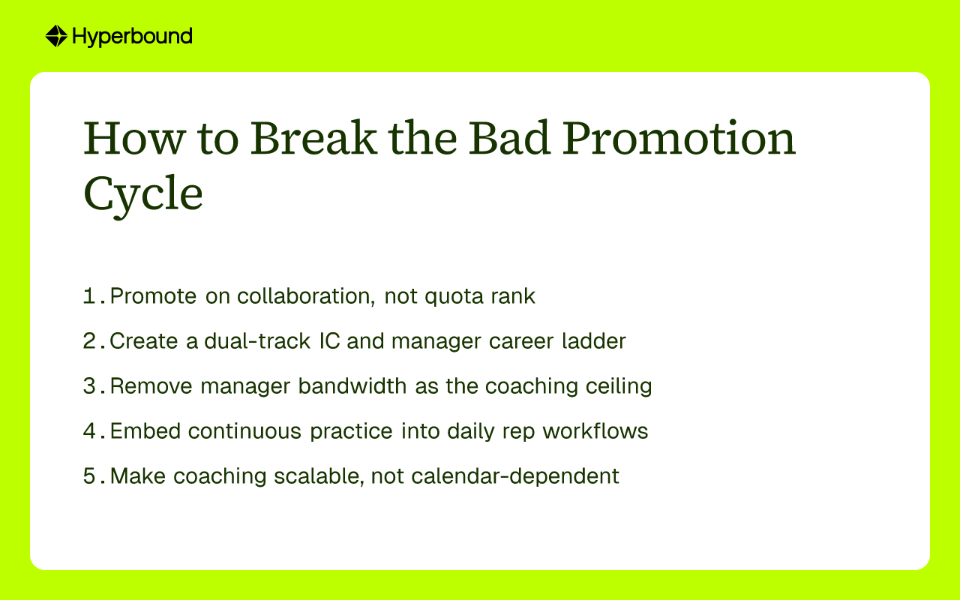
The correction is structural. First, promotion criteria should weight collaboration experience and coaching behaviour rather than quota rank alone. Organisations should create a dual-track career system so that top ICs have a path forward that does not require becoming a manager. Second, manager bandwidth should be removed as the ceiling on team development. When coaching depends entirely on the manager's availability, the team's growth is always capped by the manager's calendar.
Sales organisations that move from episodic, manager-dependent training to continuous performance improvement remove that ceiling. The manager's pattern recognition becomes a resource the entire team can access consistently, rather than a scarce resource rationed by scheduling.
The question for sales leaders is whether the promotion criteria and coaching infrastructure currently in place would pass that test. If promotion decisions still flow mainly from quota rank and if rep development still depends on finding time on a manager's calendar, the conditions for the same failure are still in place.

The skills that make an individual a top contributor, including personal selling ability, pattern recognition, and autonomy, are different from the skills required to manage and coach a team. Top reps often rely on non-transferable instincts and default to managing individual deals, closing deals themselves instead of building repeatable processes. This mismatch leads to lower team performance. The role requires different capabilities.
Research shows sales performance is negatively correlated with managerial performance. A peer-reviewed study by Benson, Li, and Shue analysed roughly 48,000 sales associates and 5,000 managers across more than 200 firms and found that the strongest individual sellers are systematically worse bets for management. Managers whose own sales had doubled before promotion saw about a 10% drop in each direct report's performance.
The costs are both immediate and compounding: the organisation loses the best closer's individual production, the new manager's team performance typically drops during the first six months, and replacement and ramp costs accrue for the vacated IC role. For example, a rep generating $800,000 in revenue would need their team to produce nearly $700,000 more than under a competent manager just to break even. Teams under underperforming managers average around 54% quota attainment versus 105% under high-performing leaders.
Organisations should evaluate collaboration experience, mentoring behavior, cross-functional contributions, and evidence that the rep can coach others without stepping in to close deals. The same research that found sales performance is a negative predictor of managerial success identified collaboration as the strongest positive predictor. Promotion criteria should be built around these observable behaviors, not just quota rank.
A dual-track career ladder with parallel progression paths for individual contributors and managers retains top ICs without forcing them into management. It provides defined levels, expanding scope, and competitive compensation. A principal-level seller can continue to grow and be recognised for their closing ability without becoming a manager and without the predictable failure that follows.
The Peter Principle states that people in hierarchies get promoted based on performance in their current role until they reach a level where they are no longer competent. In sales, this occurs when top reps are promoted to manager solely because of quota attainment. Managing and selling require different skill sets. The data confirms this pattern is systematic, not anecdotal.
New sales managers can be trained through a shift from episodic, manager-dependent coaching to continuous, scalable practice. They need tools that compress repetition and allow every rep to practice without waiting for calendar time. For example, Klaviyo recovered five to seven hours per manager per week and increased new-hire productivity by 42% after moving to continuous practice, while Vanta cut ramp time from 210 days to 72 days using daily AI roleplays.
Yes, technology that removes manager bandwidth as the coaching ceiling can help. Platforms like Hyperbound enable continuous practice through AI roleplays and repetition compression, so a new manager's pattern recognition is not the bottleneck. This allows teams to scale coaching consistently, even as the team grows, and prevents the common trap of new managers becoming the team's most expensive bottleneck.










Use Cases
Legal