
You've just wrapped a product demo. The prospect seemed engaged the whole way through — nodding along, asking questions — and then it happens. "We need to think about it." Or worse: silence. You try to address it, but your words feel clunky, rehearsed, disconnected from what they actually said.
Sound familiar? You're not alone. According to sales reps on Reddit, the #1 mistake isn't bad rebuttals — it's "thinking I knew the problem, instead of actually listening to my clients." Objection handling is hard not because reps lack information, but because they haven't practiced responding in the moment — flexibly, empathetically, and without a rigid script.
Here's the real problem: most handling objections training is static, one-time, and nearly impossible to measure. Your reps attend a workshop, receive a set of rebuttals, and promptly forget 70% of it before their next call. There's no feedback loop. No way to know if it actually worked. And by the time a rep hears "your price is too high" on a live call, the workshop feels like a distant memory.
The good news? A new generation of training tools has emerged — and the best ones don't just teach theory. They build real skill through realistic practice, actionable feedback, and measurable outcomes.
In this guide, we'll cover 8 of the best objection handling training tools available today, organized by use case:
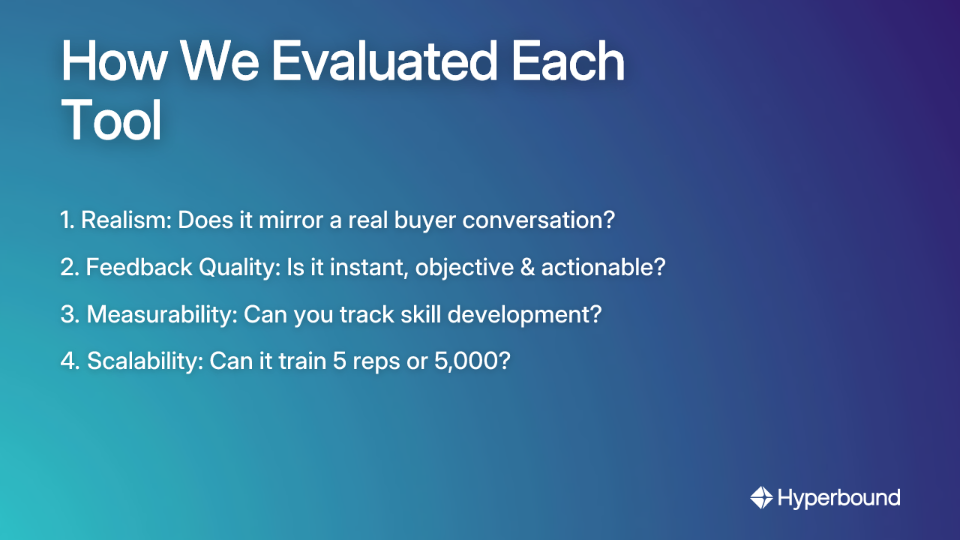
We'll evaluate each tool against four criteria:
Let's get into it.
AI roleplay simulators directly address the core complaint reps have about traditional practice: "real world experience always beats any role-playing." The best tools in this category close that gap by making practice feel indistinguishable from the real thing.
Best for: Teams that want to make objection handling practice realistic, repeatable, and measurable — while building directly from insights in real calls.
Hyperbound Practice is the flagship product of Hyperbound's Revenue Activation Platform, and it's the most sophisticated AI roleplay tool available for sales teams today.
What separates it from the pack is where the AI comes from. Hyperbound's buyer personas aren't built on generic scripts or hypothetical scenarios — they're trained on 2M+ hours of real B2B sales conversations. That means reps practice against AI that knows how actual buyers push back, deflect, and ask hard questions in your specific industry.
Key features:
Proof it works:
The bigger picture: Hyperbound isn't just a practice environment. It's part of a continuous improvement loop. Hyperbound Perform scores 100% of real calls against custom methodology scorecards, surfaces where objections are being mishandled in live deals, and then feeds those insights back into targeted roleplays in Practice. The result is a closed loop: score real calls → identify skill gaps → practice → repeat.
.png)
Best for: Teams exploring AI simulation as an entry point, particularly those comfortable with avatar-driven interfaces.
Second Nature offers customizable AI role-plays for sales scenarios and delivers immediate feedback on conversational skills. It uses virtual avatars to simulate buyer interactions across different conversation types.
It's a reasonably strong contender in the AI practice space, particularly for teams that want a standalone roleplay tool. Where it differs from Hyperbound: Second Nature's AI relies on generic scenarios, while Hyperbound's buyer personas are trained directly on real call data — meaning the pushback feels more authentic and industry-specific.
.png)
These tools record and analyze real sales calls, giving managers and reps visibility into which objections are coming up most, how top performers handle them, and where deals go sideways. They turn the rep recommendation to "listen to top agents" into a scalable, data-driven workflow.
Best for: Teams that want to use real call data to identify objection patterns and coach reps on what actually happens in the field.
Gong is the market leader in conversation intelligence. It records, transcribes, and analyzes 100% of customer interactions — surfacing patterns in what top reps say, when they say it, and how deals evolve over time. For objection handling training, this means managers can pinpoint specific moments where a rep fumbled a concern, share clips of how a top performer handled the same objection, and provide context-based coaching tied to real examples.
The key limitation: Gong shows you what happened but doesn't give reps a place to practice changing it. It's retrospective by design. Pairing it with a practice platform like Hyperbound — which can turn Gong's insights into targeted AI roleplays — closes that gap.
.png)
Best for: Teams already in the ZoomInfo ecosystem looking for integrated conversation intelligence.
Chorus.ai offers call recording, transcription, and AI-driven analysis — similar in scope to Gong. It flags key moments in deals, tracks topic trends, and helps managers understand deal health based on rep behavior across conversations. It's particularly strong for teams that want to tie conversation data to their ZoomInfo prospecting workflow. Like Gong, it's a retrospective analysis tool and works best in combination with a proactive practice environment.
.png)
These platforms handle the structured delivery of training content. They're the system of record for onboarding curricula, certification programs, and ongoing skill development. They don't create the "practice" experience themselves, but they provide the scaffolding that makes training repeatable and trackable at scale.
Best for: Enterprise sales teams seeking a comprehensive readiness platform that combines content delivery, coaching, and basic roleplay in one system.
Mindtickle is a broad sales readiness platform covering content management, structured onboarding, conversation intelligence, and coaching tools — including its own roleplay capabilities. Its "sales readiness index" tracks competency development over time, making it easy for managers to see where reps stand across skills including objection handling.
The key difference from Hyperbound: Mindtickle is an all-in-one platform where roleplay is one feature among many. Hyperbound is purpose-built for AI simulation fidelity — making it the better pick when realistic objection practice is the primary goal. Mindtickle is often ranked among the top LMS tools for structured sales training programs.
.png)
Best for: Remote or distributed teams that want to create a culture of peer learning and shared best practices.
Saleshood takes a distinctive approach — it emphasizes collaborative, peer-to-peer learning. Reps can record and share videos of their best pitches and objection responses, and managers can give asynchronous feedback. This directly mirrors the sales community wisdom of "listen to top agents" and "try to emulate what they would say," but operationalized at scale. It's a strong fit for teams that want to capture institutional knowledge and replicate it across a growing org.
.png)
Sometimes the right "tool" is a mental model. These frameworks don't require software — they give reps a repeatable structure for navigating any objection, no matter how unexpected. When baked into a practice platform like Hyperbound, they become second nature.
Best for: Establishing a foundational, team-wide approach to objections built on curiosity and empathy rather than scripts.
The LAER framework — Listen, Acknowledge, Explore, Respond — is one of the most effective mental models for objection handling because it directly combats the #1 mistake reps make: assuming they know the objection before fully hearing it.
Here's how it works:
Reps who practice LAER consistently through roleplay stop treating objections as roadblocks and start treating them as a discovery process. Pair this framework with a tool like Hyperbound, and reps can run hundreds of LAER-structured simulations across every buyer type before ever touching a live prospect.
Best for: Organizations that need a formal, enterprise-grade LMS to house and track all sales training initiatives — including objection handling courses.
Docebo is an enterprise Learning Management System that allows enablement teams to build structured learning paths, deliver courses on topics like objection handling, and track completion and performance at the org level. It offers virtual coaching capabilities and CRM integration for a unified view of rep readiness.
Docebo is the foundation — the place where your training content lives and gets assigned. The experiential, practice component (actually doing objection handling until it's reflexive) is where a tool like Hyperbound integrates to complement it.
.png)
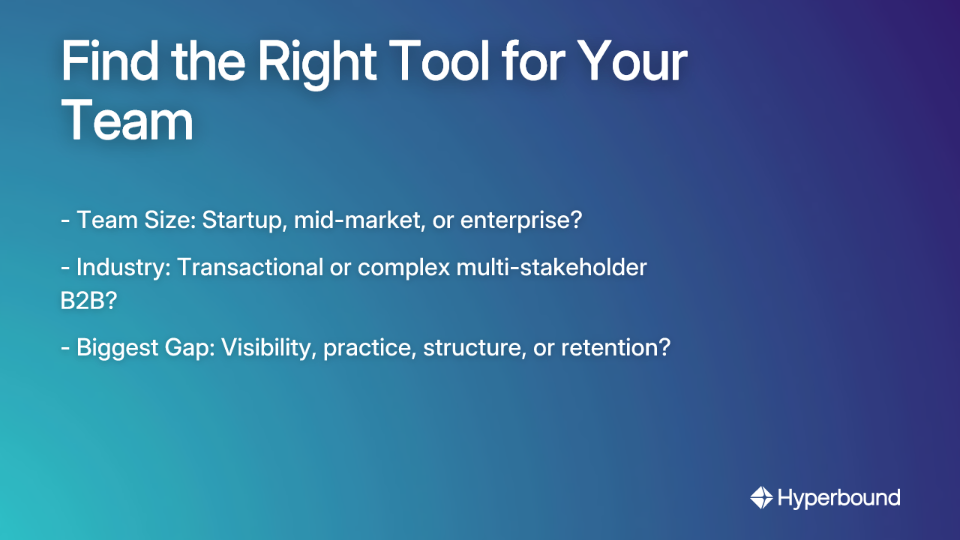
Not every tool is the right fit for every team. Use these questions to find yours.
Startup / Small team (5–20 reps): Your priority is speed to productivity and efficiency of implementation. You don't need a six-month rollout. An AI Roleplay Simulator like Hyperbound Practice is ideal — it can be up and running quickly, gets new reps certified on your core objection responses fast, and gives managers visibility into rep readiness without adding headcount.
Mid-market / Scaling team (20–100 reps): You need scalability and integration. Look for platforms that connect to your CRM and existing LMS, and provide manager-level dashboards to track team-wide progress. A strong combination: a conversation intelligence tool like Gong to surface what's happening on real calls, plus Hyperbound to turn those insights into practice reps can do on demand.
Enterprise (100+ reps): Security, compliance, multilingual support, and the ability to deploy across business units are non-negotiable. Look for enterprise-grade compliance — SOC 2 Type II, GDPR, ISO 27001 (Hyperbound holds all three) — and scale credentials like Hyperbound's deployment to 3,000+ sellers across three LinkedIn business units.
Complex B2B (SaaS, Financial Services, Medical Devices): Multi-stakeholder deals mean multi-party objections. You need a tool that can simulate a champion and a skeptical economic buyer in the same call. Hyperbound's multiparty roleplay feature was built exactly for this — and it's actively expanding into medical device and financial services verticals.
High-volume / Transactional sales: Your reps need to master the first 30 seconds and handle pattern-rejection quickly. Prioritize a tool with bitesized roleplays focused on cold calling objections and early-stage brush-offs.
Objection handling is a skill, not a personality trait. And like any skill, it degrades without deliberate, repeated practice. Static, one-off training sessions — worksheets, slides, one-time workshops — aren't enough anymore.
The best handling objections training tools create a continuous cycle: understand what's failing on real calls, practice closing those gaps in realistic simulations, measure whether the practice is working, and repeat. That's the difference between reps who know how to handle an objection and reps who actually do it when it matters.
If you're ready to move beyond static training and build a team that handles objections with confidence and consistency, see what Hyperbound Practice can do for your team.
The most effective way to train for sales objection handling is through continuous, realistic practice with instant, actionable feedback. This approach moves beyond static scripts and one-time workshops, which have low knowledge retention rates. By using tools like AI roleplay simulators, sales reps can practice responding to common and unexpected objections in a safe environment that mirrors real buyer conversations. This builds muscle memory and confidence, so they can handle pushback flexibly and effectively on live calls.
Role-playing is crucial because it allows sales reps to practice their responses under pressure without risking a live deal. Traditional training often fails because reps forget what they learned when faced with a real objection. Realistic role-play, especially with AI simulators, closes the gap between knowing what to say and actually saying it effectively in the moment. It allows for repetition, builds confidence, and helps reps internalize frameworks like LAER so their responses become second nature.
AI improves objection handling skills by providing scalable, realistic, and on-demand practice with objective, data-driven feedback. AI roleplay simulators can replicate countless buyer personas and scenarios, allowing reps to practice far more than they could with traditional manager-led role-plays. After each session, AI provides instant, unbiased feedback on performance, adherence to methodology, and specific word choices. This creates a continuous improvement loop where reps can identify weaknesses and practice until they master the skill.
The main types of tools are AI Roleplay Simulators, Conversation Intelligence & Coaching Platforms, Sales Enablement & LMS Platforms, and foundational Frameworks & Methodologies. Each category serves a different purpose. AI simulators (like Hyperbound) are for realistic practice. Conversation intelligence tools (like Gong) analyze real calls to identify skill gaps. LMS platforms (like Docebo) provide structured content delivery. Frameworks (like LAER) provide mental models for navigating conversations. The most effective training programs often combine tools from multiple categories.
To choose the right tool, you should evaluate your team's specific needs based on its size, industry, and biggest training gaps. For example, a small startup might prioritize a fast-to-implement AI roleplay tool, while a large enterprise will need a solution with robust security, scalability, and integration capabilities. A team struggling with complex, multi-stakeholder deals should look for tools with multiparty simulation features. Start by identifying your core problem: is it a lack of visibility into calls, a lack of practice, or a lack of structured training content?
LAER is a framework for handling objections that stands for Listen, Acknowledge, Explore, and Respond. It helps by forcing reps to fully understand the buyer's concern before offering a solution. This four-step process prevents reps from making the common mistake of jumping to a conclusion and providing a rehearsed, irrelevant rebuttal. By actively Listening, Acknowledging the concern's validity, Exploring the root cause with questions, and only then Responding, reps can turn objections into opportunities for deeper discovery and build stronger trust with the buyer.
You can measure the ROI of objection handling training by tracking improvements in key sales metrics like conversion rates, deal velocity, and average deal size. Modern training platforms provide robust analytics to connect practice to performance. Look for skill development scores, competency tracking, and certification rates within the training tool. Then, correlate those improvements with business outcomes in your CRM. For example, you can track if reps who complete objection handling simulations have a higher meeting-to-opportunity conversion rate or a shorter sales cycle.








Use Cases
Legal