
You landed the role. Now the real pressure begins.
Most new medical device sales reps enter their first week expecting a structured program that prepares them to stand in an OR, speak fluently about Ablation products with an Interventional Radiologist, and earn the trust of nursing staff who've seen a hundred reps walk through those doors. What they often get instead is a stack of PDFs, a few ride-alongs with a veteran rep, and a prayer.
The problem is that medical device sales rep onboarding is fundamentally different from onboarding in any other industry. Reps aren't just learning a product—they're learning medical terminology, navigating complex hospital credentialing systems, managing relationships with "egotistical and arrogant" doctors (as one rep on Reddit bluntly put it), and simultaneously trying to win over the nursing staff who actually control access to the OR. They're doing this under the watchful eye of FDA and HIPAA regulations, where a single off-label claim can carry serious legal consequences.
MedTech companies tend to fall into one of two traps:
The stakes are high. The global medical devices market is projected to reach $539.10 billion, and organizations with robust sales training programs in regulated industries see up to 25% higher sales performance. Weak onboarding doesn't just slow ramp time—it actively burns pipeline.
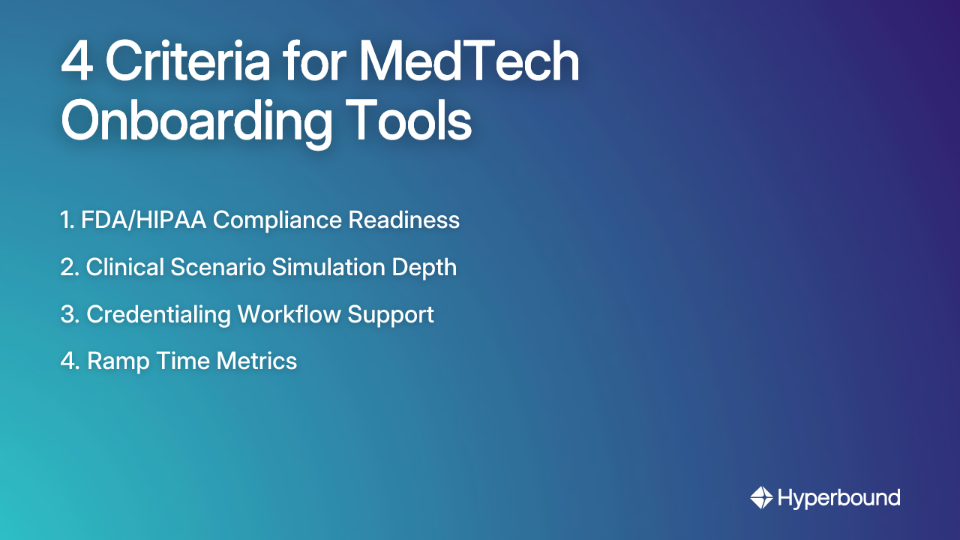
The best medtech onboarding programs evaluate tools against four criteria specific to this industry:
Here are the 8 best programs and tools that meet that bar.
Best for: Scalable, realistic conversational practice in a compliant environment
One of the most consistent complaints from new medical device reps is that they don't get enough at-bats before they're in the field. The ride-along model is inherently limited—there are only so many cases to shadow, and learning by burning real pipeline when facing demanding surgeons is a painful way to ramp.
Hyperbound Practice solves this directly. It lets reps practice discovery calls, objection handling, and clinical questioning with AI buyer personas that are built from analysis of 2M+ hours of real B2B sales conversations—not scripted robots. Reps can simulate conversations with a skeptical surgeon, a cost-focused hospital administrator, or a Clinical Sales Specialist being asked about off-label use, all before a real patient outcome is on the line.
Why it works for MedTech specifically:
The results speak for themselves: Vanta achieved a 60% reduction in ramp time using Hyperbound Practice—cutting onboarding from 210 days down to 72. For a medtech company where a new rep might take 9–12 months to reach full productivity, that kind of compression is transformative.
Simulation-based training has been shown to boost rep confidence by up to 45%—exactly the kind of confidence you need when a surgeon questions your clinical data mid-procedure.
Best for: Structured onboarding programs with measurable competency frameworks
Mindtickle is one of the more mature sales readiness platforms, and its strength in MedTech lies in its ability to define what "ready" actually looks like. Using an Ideal Rep Profile (IRP) framework, enablement teams can map the exact competencies a Clinical Sales Specialist needs—product knowledge, clinical fluency, compliance awareness—and build structured learning paths to develop them.
This matters enormously in an industry where consistency isn't just a performance goal—it's a regulatory requirement.
Key features for MedTech onboarding:
Evidence: Janssen India reportedly cut ramp time in half by leveraging Mindtickle for structured, accessible training—a compelling proof point for any medtech organization looking to standardize onboarding at scale.
Best for: Ensuring reps always have compliant, current content in the field
Using outdated promotional materials or off-label claims in medtech isn't just a sales problem—it's a legal one. Highspot solves this by acting as the single source of truth for every piece of content a rep touches, from IFUs to competitive battlecards to clinical study summaries.
For onboarding specifically, Highspot ensures that as new reps learn the product and sales process, every piece of content reinforcing that training is approved, current, and role-appropriate.
Key features for MedTech onboarding:
Best for: Learning from the best calls your team has ever made
The ride-along has always been the gold standard for onboarding in medtech—watching a veteran rep navigate a tough discussion about pricing with hospital procurement, or handle a surgeon's challenge about clinical evidence. The problem is it's expensive, unscalable, and entirely dependent on geography and timing.
Gong is the modern, scalable replacement. By capturing and analyzing 100% of customer-facing conversations, it gives new reps access to a curated library of real calls—the best discovery conversations, the sharpest objection responses, the winning approaches to multi-stakeholder deals.
Key features for MedTech onboarding:
For medtech enablement leaders, Gong is the institutional knowledge engine. It captures what your top Clinical Sales Specialists actually say—and makes it accessible to every new rep from day one.
Best for: Connecting training content to the exact moment a rep needs it
Where Highspot focuses on content governance, Seismic excels at intelligent content delivery—surfacing the right asset at the right moment in the sales cycle. For a rep who just finished a Hyperbound simulation on handling objections about device compatibility and needs to follow up with a clinical white paper, Seismic closes that gap automatically.
For MedTech onboarding, Seismic's value is preventing the "rogue content" problem—where a new rep, unable to quickly find the approved material, improvises with outdated or non-compliant resources.
Key features for MedTech onboarding:
Best for: Compliance-integrated conversation practice with AI healthcare professionals
CareerTrainer is a niche player that deserves attention precisely because of its industry focus. Unlike horizontal AI roleplay tools, CareerTrainer is purpose-built for life sciences—meaning its AI HCP personas are calibrated to the specific dynamics of pharmaceutical and medical device sales conversations, with compliance guardrails baked in.
For any medtech organization where off-label communication risk is top of mind, having a simulation platform with built-in compliance feedback is a meaningful differentiator.
Key features for MedTech onboarding:
Evidence: CareerTrainer cites that AI-powered training helps reduce the typical 6–12 month ramp-up time in medtech, and notes that one-time training seminars waste up to 40% of training budgets due to rapid knowledge decay. The platform's continuous practice model addresses this directly.
Best for: Building the institutional infrastructure that all other tools plug into
This isn't a single product—it's a program component that separates mature medtech onboarding programs from ad hoc ones, and it's often the most overlooked.
Medical device sales reps carry a cognitive load unlike any other sales role. They need to recall clinical study data, understand device specs and IFUs (Instructions for Use), navigate hospital credentialing systems like Vendormate or Reptrax, and access "tech notes" from senior reps about quirks at specific accounts. Without a centralized system for this, new reps are constantly reinventing the wheel—and often getting it wrong.
The best onboarding programs build a structured knowledge system that includes:
Sales enablement systems that include structured clinical knowledge management have been shown to directly impact rep effectiveness and, by extension, patient outcomes—a reminder that in this industry, bad onboarding has consequences that extend beyond the quota.
Best for: Scenario-specific practice for product launches and competitive situations
Second Nature rounds out the list as another AI roleplay option with a track record in sales training. Its primary value for MedTech onboarding is flexibility—enablement teams can build customized scenarios quickly, making it useful for targeted training around a new product launch, a specific competitive threat, or a tricky customer archetype a new rep is about to encounter.
Key features for MedTech onboarding:
While it lacks some of the medtech-specific compliance depth and the real call data foundation of Hyperbound Practice, it's a viable option for teams that need a lightweight, configurable roleplay tool to complement a broader onboarding stack.
.png)
There's no single tool that solves the medical device sales rep onboarding challenge. The best programs layer multiple capabilities:
.png)
But if there's one layer that unlocks the value of everything else, it's scalable practice. A rep can consume all the clinical content in the world and still freeze when a surgeon challenges their evidence in a 90-second hallway conversation. Content informs. Practice builds the confidence to act on it.
AI roleplay tools like Hyperbound Practice give medtech sales teams the infrastructure to turn knowledge into conversational fluency—at scale, in a compliant environment, with measurable outcomes tied directly to ramp time. With HIPAA compliance already in place and proof points like Vanta's 60% ramp reduction on the table, the question for MedTech enablement leaders isn't whether AI simulation belongs in your onboarding program. It's how quickly you can get it in.
The reps who thrive in medical device sales aren't just the ones who know the product. They're the ones who've practiced the conversation enough times that walking into an OR feels like familiar territory.
Build onboarding that creates those reps.
The biggest challenge is preparing reps for the unique combination of clinical complexity, strict regulatory compliance (FDA/HIPAA), and difficult multi-stakeholder conversations with surgeons and hospital administrators. Unlike other sales roles, MedTech reps must master medical terminology, navigate hospital credentialing, and build trust in high-stakes environments like an operating room. Traditional training often fails to provide the realistic, hands-on practice needed to build confidence and fluency in this compliance-heavy setting.
Traditional ride-alongs are not enough because they are unscalable, inconsistent, and don't provide reps with the opportunity to practice themselves. A rep's learning is limited to the specific cases a veteran rep handles, which may not cover the full range of products or challenging scenarios. Furthermore, ride-alongs are passive; they don't allow the new rep to build conversational muscle memory. Modern tools like conversation intelligence (Gong) and AI simulation (Hyperbound) offer a scalable way to review best practices and get unlimited, safe at-bats.
The most critical features for a MedTech onboarding tool are FDA/HIPAA compliance readiness, in-depth clinical scenario simulation, support for credentialing workflows, and clear metrics for tracking ramp time. These features directly address the industry's unique demands. Compliance is non-negotiable. Realistic simulations prepare reps for the OR. Credentialing support unblocks access to hospitals. And ramp time metrics prove the program's ROI by showing how quickly reps become productive.
AI roleplay helps new MedTech sales reps by providing a safe, scalable, and consistent environment to practice high-stakes conversations with AI-powered surgeons, nurses, and administrators before they face real ones. Platforms like Hyperbound Practice allow reps to get unlimited "at-bats" handling objections, answering clinical questions, and navigating multi-stakeholder dynamics. These tools can provide instant feedback on performance, flag non-compliant language, and build the conversational confidence needed to be credible in the field, significantly reducing ramp time.
Top training platforms ensure compliance through features like HIPAA-compliant architecture, AI-powered scorecards that flag risky or off-label language, and centralized, pre-approved content hubs. For example, AI roleplay tools like Hyperbound are built on HIPAA-compliant infrastructure. Their AI can be trained to recognize and correct reps who make off-label claims during a practice session. Similarly, content management systems like Highspot ensure that reps can only access the latest, compliance-approved marketing materials and clinical studies.
A realistic ramp-up time for a medical device sales rep using traditional methods is typically 9 to 12 months to reach full productivity. However, the goal of modern onboarding stacks is to drastically reduce this. By leveraging structured training programs and AI simulation tools, companies have demonstrated the ability to cut this time significantly. For instance, Vanta used Hyperbound to reduce their ramp time by 60%, from 210 days down to just 72.
No, a single tool cannot effectively handle all aspects of MedTech onboarding. The most successful companies build a "stack" of specialized tools that work together. A modern stack combines a sales readiness platform (like Mindtickle) for structured learning, a content management system (like Highspot) for compliant materials, conversation intelligence (like Gong) for real-world examples, and an AI simulation tool (like Hyperbound) for realistic practice. Each component addresses a specific and critical part of the onboarding challenge.










Use Cases
Legal