
You open your call recording platform on a Monday morning, stare at 47 unreviewed recordings from last week, and feel the familiar sinking sensation. Somewhere in those calls is the reason three deals slipped last quarter. But finding it — and doing something about it before the next call — feels like searching for a needle in a haystack while the hay is on fire.
This is the reality most sales managers live in. And it's why this list exists.
Before we rank anything, let's get precise about what we mean by deal coaching tools — because most platforms sold as "sales coaching software" are actually just call recording libraries with a search bar.
So, what is deal level coaching, exactly? True deal-level coaching analyzes every touchpoint across an opportunity's full lifecycle — calls, emails, stakeholder interactions — and surfaces behavioral patterns that explain why a deal is moving or stalling. It connects the dots between a shaky discovery call in week one and a lost deal in week six. It tells you what to do next, not just what happened last.
Call-level tools, by contrast, analyze conversations in isolation. They're useful for post-call debriefs, but they miss the arc. A rep can nail a discovery call and completely fumble the champion-building conversation two weeks later — and a call-level tool won't connect those events for you. As one sales manager put it in a Reddit discussion on AI sales coaching: "It doesn't just flag one call, it gives you the common threads so you can coach more strategically."
That's the standard we're holding every tool to.
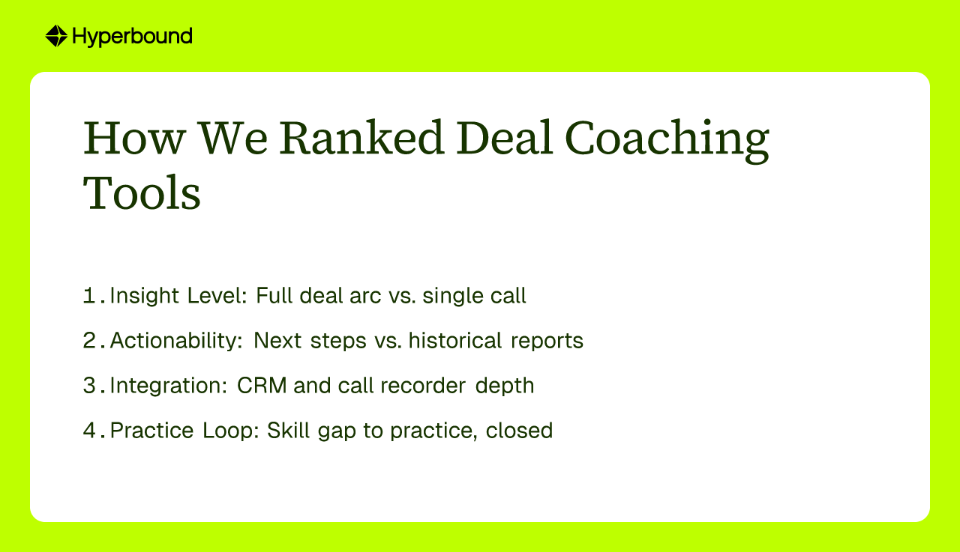
Each tool in this list is evaluated across four dimensions:
Let's get into it.
Best for: End-to-end deal lifecycle coaching with a closed practice loop
Insight level: Deal-level | Actionability: Proactive | Practice loop: Closed
Hyperbound Perform sits at the top of this list because it's the only tool built from the ground up around a simple but powerful idea: coaching should happen while the deal is still winnable, not after the post-mortem.

Most tools are rearview mirrors. Perform is a windshield.
Here's what makes it different from everything else on this list:
Cross-deal analysis across all calls. Perform doesn't analyze one call at a time. It looks across every conversation in a deal — from first cold call to latest stakeholder touchpoint — and surfaces what's helping or hurting momentum. It matches behavioral patterns against historical closed-won and closed-lost deals to flag early risk signals before they become fatal. This is what deal coaching actually looks like when it's built right.
Bite-Sized Roleplays triggered by deal-specific needs. When Perform detects that a rep is struggling with pricing objections in a specific active deal, it doesn't just log a coaching note. It can trigger a short, targeted practice session from Hyperbound Practice — calibrated to that deal's specific stakeholders and scenarios. This solves the problem that sales practitioners consistently flag: long, generic training sessions don't work. Short, contextual practice tied to live deals does.
Auto-CRM fill. Perform automatically captures action items, stakeholder updates, and call notes and pushes them into the CRM (HubSpot now, Salesforce coming soon) for rep review before submission. Manual data entry is eliminated, and CRM hygiene improves as a side effect — not because you enforced a process, but because the tool handles it.
The results back it up. Vanta achieved a 60% ramp reduction — cutting time-to-productivity from 210 days to 72. Nivoda saw a 150% increase in demo rate and 50% faster ramp. Hyperbound's team closed their strongest quarter ever using Perform internally before its customer release.
Perform sits inside Hyperbound's broader Revenue Activation Platform, with Kota — the AI assistant that orchestrates Practice and Perform — sitting above both. A manager can ask Kota directly in Slack: "Which deals are at risk of stalling due to a weak champion?" Kota surfaces the deals and recommends a specific coaching intervention. That's the intervention gap being closed in real time.
Live March 2026. Not a forecasting tool — a deal execution tool.
Best for: Call analytics and conversation intelligence at scale
Insight level: Call-level | Actionability: Reactive | Practice loop: Open
Gong is the incumbent, and for good reason. It records, transcribes, and analyzes sales conversations at scale better than almost anyone. If you want a searchable library of every call your team has ever made, with topic tagging, talk ratio analysis, and keyword alerts, Gong delivers.
The deal intelligence features have also matured. Gong can flag risks at a deal level — surfacing things like lack of next steps being set or competitor mentions spiking across a pipeline. So it's moved beyond pure call analysis.
But here's where it stops short: Gong tells you what happened. It stops short of recommending what to do next. Managers reviewing deals in Gong still need to manually listen through multiple call recordings, piece together the narrative, and form their own coaching recommendation. The insight is there. The guided action is not.
One manager in a Reddit thread on AI coaching tools put it bluntly: "I would take that transcript and plug it into ChatGPT and ask it to give me feedback based on my criteria." That workaround — and the fact that it exists — says something important about the gap between having data and knowing what to do with it.
Gong is also a significant investment. As noted in that same discussion: "Gong is the market leader and great if you're a larger org with the budget for it. But you're easily looking at six-figures per year." For teams that need visibility without the enterprise price tag, the math doesn't always work.
If you already have Gong, it's worth knowing that Hyperbound Perform integrates directly with it — so you don't have to rip and replace. You can use Gong's recordings as the input and Perform as the layer that turns those recordings into deal-level coaching and guided next steps.
Best for: Post-call feedback and rep coaching on individual conversations
Insight level: Call-level | Actionability: Reactive | Practice loop: Open
Chorus operates in similar territory to Gong — strong on recording, transcription, and call-level analysis. It's a solid tool for managers who want data-driven feedback to share with reps after a specific conversation.
Where it falls short is the same place Gong does: it analyzes calls in isolation rather than across the deal arc. Connecting a rep's behavior on a discovery call to what happened three weeks later during a procurement discussion requires a manager to manually bridge that gap. Chorus surfaces the raw data; the coaching interpretation is left to the human.
It also lacks a native practice mechanism. When you identify that a rep needs to work on their multi-threading skills across three deals, Chorus will show you the evidence but won't help you do anything about it.
Best for: Pipeline visibility and forecast management
Insight level: Pipeline/activity-level | Actionability: Risk flags only | Practice loop: N/A
Clari is a revenue operations platform built around making pipeline more predictable. It aggregates data from CRM, email, and calendars to give sales leaders a clear picture of what's in the funnel and how likely it is to close.
The limitation is that Clari answers "what" and "when" — not "how" or "why." It can tell you that buyer engagement has dropped on a deal, but it can't analyze the call recordings to explain why the buyer went cold. It identifies the symptom (deal at risk) without diagnosing the behavioral root cause (rep failed to build a second champion after the first went dark).
For pipeline management and forecast rollups, Clari is genuinely strong. For deal coaching — understanding what a rep should do differently in their next call — it's not the right tool.
Best for: Sales engagement workflows and process adherence
Insight level: Activity-level | Actionability: Process-focused | Practice loop: Open
Salesloft combines cadence management with conversation intelligence and some pipeline visibility. It's a cohesive platform for ensuring reps follow the right process — the right sequence, the right touchpoints, the right frequency.
The coaching within Salesloft tends to be process-oriented: did the rep follow the cadence? Did they send the follow-up email? That's valuable for consistency, but it's different from behavioral coaching grounded in what's actually said on calls. Activity adherence and deal execution quality are different things, and Salesloft is better at tracking the former than developing the latter.
Best for: Activity-based deal health scoring
Insight level: Activity-level | Actionability: Activity-driving | Practice loop: N/A
Outreach is a leading sales engagement platform with deal health scoring built on engagement signals — email opens, reply rates, meetings booked, response times. It's useful for identifying which deals have momentum and which have gone quiet.
The challenge is that activity can be a misleading proxy for deal health. A rep can send 12 emails and book three meetings on a deal that's going nowhere. High activity doesn't equal high quality, and Outreach's insights are primarily surface-level — what's happening, not why. For sales managers trying to understand the behavioral dynamics inside a stalling deal, it doesn't go deep enough to be a coaching tool in the true sense.
Best for: Standalone practice and skill building in isolation
Insight level: N/A (no real deal analysis) | Actionability: Practice-only | Practice loop: Disconnected
Tools in this category offer AI-powered roleplay scenarios for reps to practice cold calls, discovery conversations, and objection handling. The concept is sound, and for teams with zero practice infrastructure, they provide a starting point.
The structural problem is that the practice is disconnected from reality. Reps practice generic scenarios that aren't informed by what's actually happening in their live deals. A rep can spend 30 minutes practicing a cold call objection while their most important deal this quarter is dying because nobody built a business case with the economic buyer.
Some early AI simulators also drew criticism for feeling robotic — making it easy for reps to "game" the interaction rather than develop genuine skills. Without real call data informing the scenarios, there's no guarantee reps are practicing the things that actually matter for their current pipeline.
This is precisely why a closed-loop system matters. Practice should be triggered by real performance gaps, calibrated to real deal conditions, and measured against real call outcomes. Standalone simulators offer a piece of the picture; they don't close the loop.
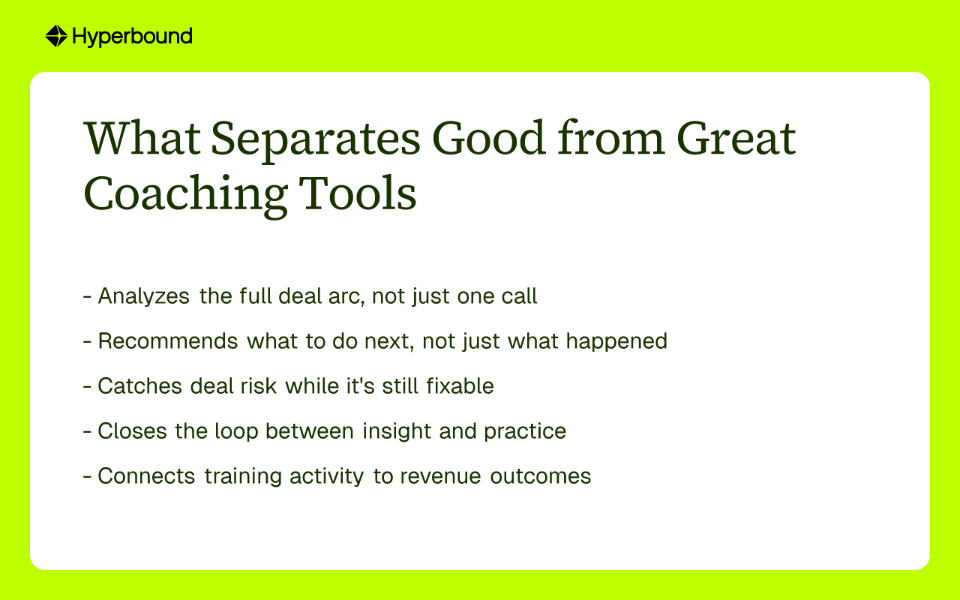
Most of the tools on this list are good at one thing: showing you what happened. They record calls. They transcribe. They surface keywords and flag risk. That's useful. But visibility was never the same as improvement.
Sales managers tell us the same thing over and over: "I need to improve rep skill gaps not just on a deal or call — I need to find the common threads so I can coach more strategically." The tools at the bottom of this list give you the data. The tools at the top give you something more valuable: they tell you what to do next, and they help your reps do it better.
The shift happening right now in sales management isn't about collecting more call recordings. It's about closing the gap between insight and intervention — catching deals while they're still winnable, identifying the specific behavior that needs to change, and actually changing it through targeted practice tied to live deal context.
That gap has a name: the intervention gap. And it's why deal coaching tools ranked by depth look so different from conversation intelligence tools ranked by volume.
Deal coaching software analyzes every touchpoint across a deal's entire lifecycle to provide proactive guidance, whereas call recording software typically analyzes individual conversations in isolation for reactive feedback. The key distinction lies in the scope of analysis. A call recording tool might help you debrief a single discovery call, but a true deal coaching platform connects that call's events to subsequent interactions, identifying behavioral patterns that explain why a deal is stalling or progressing. It shifts the focus from "what happened on this call?" to "what must we do next to win this deal?".
Analyzing the entire deal lifecycle is crucial because a single successful call doesn't guarantee a win; the entire sequence of interactions determines the outcome. A deal can be lost long after a great discovery call. For example, a rep might fail to build a strong champion or mishandle procurement objections weeks later. Deal lifecycle analysis connects these disparate events, revealing the true root cause of a stalled or lost opportunity. This allows managers to provide strategic coaching on the entire sales process, not just on isolated call performance.
AI improves sales coaching by automatically analyzing vast amounts of data from calls, emails, and CRM entries to identify deal risks, surface rep skill gaps, and recommend specific, actionable interventions in real-time. Instead of manually sifting through hours of call recordings, managers can rely on AI to connect behavioral patterns (like frequent competitor mentions or a lack of multi-threading) to deal outcomes. Advanced AI tools can even trigger targeted practice simulations based on the specific challenges a rep is facing in a live deal, closing the gap between identifying a problem and fixing it.
A "closed practice loop" is a system where performance gaps identified in live deals automatically trigger targeted practice sessions for the sales rep, and the results of that practice are measured against future performance. This approach is far more effective than generic training. For example, if a tool detects a rep struggling with pricing objections on an active deal, it can initiate a roleplay scenario calibrated to that specific deal's context. This ensures that training is relevant, timely, and directly applied to winning current business.
Yes, advanced deal coaching platforms like Hyperbound Perform are designed to integrate with call recording tools like Gong and Chorus. You don't need to rip and replace your existing conversation intelligence platform. A deal coaching tool acts as an intelligence layer on top of your call library, using the recordings from Gong or Chorus as the raw data input and then applying its deal-level analysis to provide proactive coaching recommendations and trigger practice.
CRMs and sales engagement platforms like Clari or Salesloft are excellent for tracking activity and forecasting, but they can't analyze the quality of conversations to diagnose why a deal is at risk. These platforms can tell you that engagement has dropped, but they can't tell you it's because the rep failed to establish a business case with the economic buyer during a call. They track the "what" (activity) but miss the "how" and "why" (behavioral execution), which is where true deal coaching provides value.
The era of passive call analysis is over. Stop watching. Start winning.










Use Cases
Legal