
You've just wrapped a strong discovery call. The prospect shared exactly what's breaking in their current process, dropped a few golden objections you've never heard before, and hinted at a Q3 budget. Then the call ends — and by the time your rep updates the CRM, half of that context is gone. That's the classic Sales Ops headache: useful information gets lost after meetings, reps rely on manual notes and CRM updates, and when insights stay buried in call notes, coaching and forecasting both suffer.
That's the problem conversation intelligence was built to solve.
But here's the catch: not every tool calling itself a "conversation intelligence platform" actually is one. A basic call recorder captures what was said. A real conversation intelligence platform tells you what it means — for the deal, for the rep, and for your next coaching conversation.
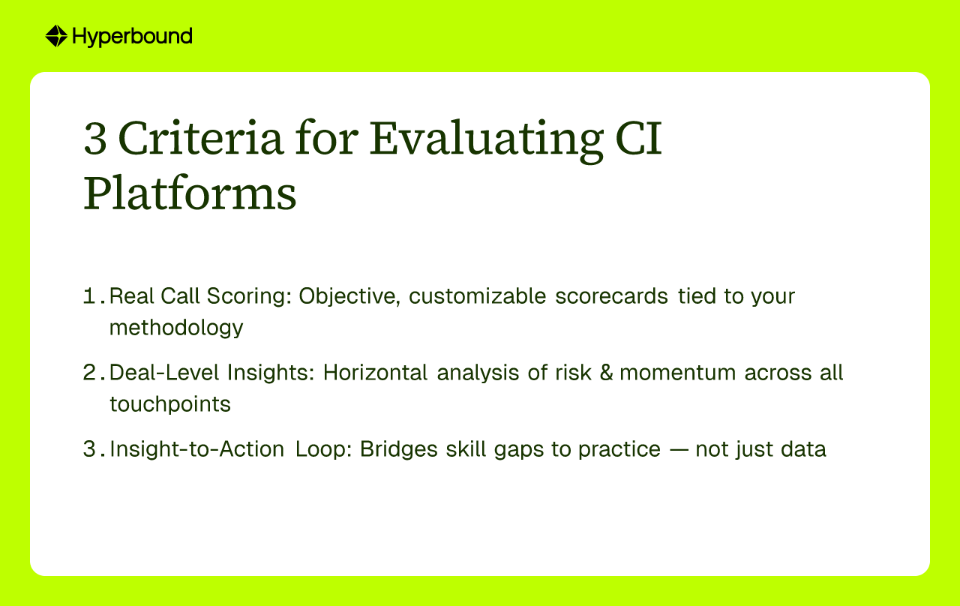
Before we jump into the list, it's worth anchoring on the three criteria that actually matter when evaluating these tools:
With those criteria in mind, here are the 9 best conversation intelligence platforms for sales teams.
Core Use Case: Hyperbound is the Revenue Activation Platform — a category it created to describe what happens when teams stop just analyzing call data and start using it to change outcomes. It runs on a continuous loop: score real calls → identify skill gaps → practice with AI roleplays → improve on real calls. Then repeat.
Strengths:
Limitations:
Core Use Case: Gong captures, transcribes, and analyzes business conversations at scale to surface macro-level trends, deal risks, and coaching opportunities across enterprise revenue teams.
Strengths:
Limitations:
Core Use Case: Analyzing call data and integrating it with ZoomInfo's broader go-to-market intelligence suite for richer prospect and account context.
Strengths:
Limitations:
Core Use Case: A conversation intelligence platform focused on real-time feedback, CRM auto-sync, and giving managers tools for in-the-moment coaching and team collaboration.
Strengths:
Limitations:
Core Use Case: Primarily designed for large contact centers to monitor agent performance, automate quality assurance, and maintain compliance across high-volume customer interaction channels.
Strengths:
Limitations:
Core Use Case: A lightweight AI meeting assistant that records, transcribes, and summarizes conversations across video conferencing platforms.
Strengths:
Limitations:
Core Use Case: Making it easy to clip, annotate, and share key moments from customer conversations with internal teams — particularly useful for product, marketing, and customer research.
Strengths:
Limitations:
Core Use Case: Clari is a Revenue Platform built around pipeline visibility and AI-driven forecast accuracy. Its conversation intelligence capabilities — acquired through Wingman — support that primary forecasting mission.
Strengths:
Limitations:
Core Use Case: An AI meeting assistant that manages the full meeting lifecycle — scheduling, pre-meeting agendas, live transcription, post-meeting summaries, and action item tracking.
Strengths:
Limitations:
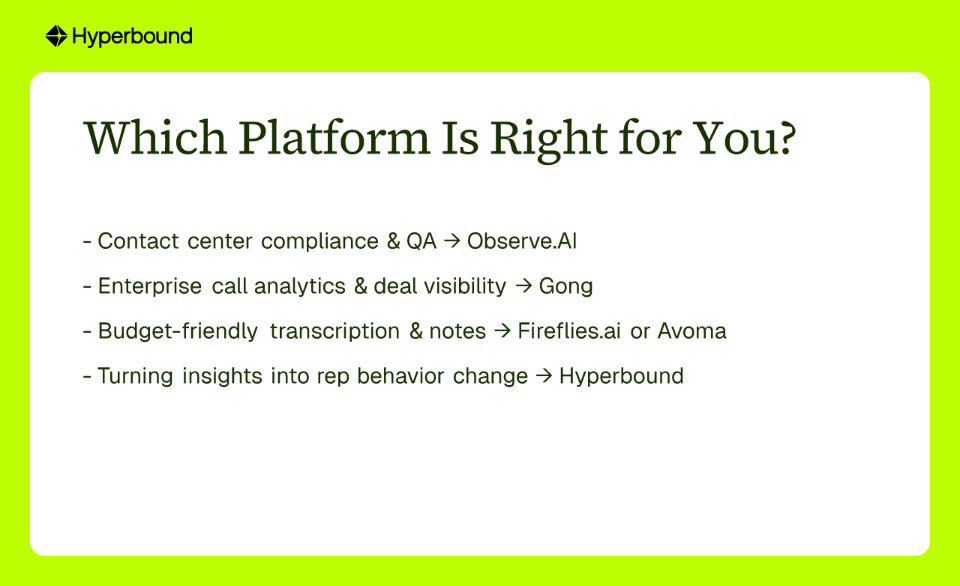
The right conversation intelligence platform depends on one foundational question: do you need a system of record to analyze past calls, or a system of action that actively changes future outcomes?
.png)
.png)
A few heuristics to guide your decision:
Every tool on this list captures data. The best ones surface meaningful patterns. But as sales leaders consistently find, the teams that actually win with conversation intelligence aren't just the ones with the most data — they're the ones with a structured process for turning that data into better rep behaviors, faster.
The first generation of conversation intelligence platforms gave us the what. The next generation is about the so what — connecting real call performance directly to coaching, practice, and deal outcomes in one continuous loop.
For sales teams ready to move beyond passive analysis and activate their conversation data into revenue, Hyperbound is the only platform on this list built end-to-end for that outcome.
A conversation intelligence (CI) platform is a tool that records, transcribes, and analyzes customer conversations to uncover insights that drive revenue. Unlike basic call recorders, true CI platforms use AI to score calls, identify deal risks, and surface coaching opportunities, telling you not just what was said, but what it means for your sales process.
Conversation intelligence helps sales teams by providing data-driven insights to improve coaching, forecasting, and overall sales performance. It automates the process of analyzing calls, which helps identify winning behaviors of top reps, pinpoint skill gaps in the rest of the team, and provide a clear, objective view of deal health and pipeline risk.
The main difference is that call recording simply captures the audio of a conversation, while conversation intelligence analyzes it. A call recorder creates a record of what was said. A conversation intelligence platform adds layers of analysis, such as topic detection, sentiment analysis, and structured call scoring, to extract actionable insights about rep performance and deal momentum.
When choosing a conversation intelligence tool, you should look for three key capabilities: real call scoring, deal-level insights, and an "insight-to-action" loop. Real call scoring means the platform can objectively measure performance against your specific sales methodology. Deal-level insights provide a holistic view of a deal across all touchpoints. Most importantly, an insight-to-action loop connects identified skill gaps directly to practice and coaching tools to ensure reps actually improve.
The "insight-to-action loop" is a process that closes the gap between identifying a sales rep's weakness and actively fixing it. Most conversation intelligence tools are "insight-only"—they show you what happened on a call. A platform with an insight-to-action loop, like Hyperbound, takes the next step by using those insights to trigger targeted practice, such as AI roleplays, ensuring that data leads to tangible behavior change and improved performance.
Conversation intelligence improves sales coaching by replacing subjective feedback with objective, data-backed insights. Managers can stop randomly sampling calls and instead focus on key moments identified by AI. It allows for personalized coaching at scale by surfacing specific, coachable skill gaps for each rep and providing a library of best-practice examples from top performers' calls.









Use Cases
Legal