
You're one enablement leader supporting 50 to 100 reps. You've invested real effort building out training pathways, messaging frameworks, and slide decks in tools like Brevity — and yet, you have almost no way to prove any of it is working.
The uncomfortable truth: research consistently shows that 80% of sales training is forgotten within 30 days. Your reps complete the module, click through the slides, pass the quiz — and then go back to winging their discovery calls the same way they always have.
Worse, when pipeline stalls or win rates dip, you can't point to your training program as the fix. Brevity and tools like it are, at their core, content delivery systems. They solve the storage problem. As one sales enablement leader put it bluntly in the r/sales community: "Most sales enablement platforms are just fancy content dumping grounds. They solve the storage problem but not the actual problem, which is getting your reps the right info at the exact moment they need it."
In 2026, the bar has moved. The best enablement leaders aren't just managing content — they're building measurable skill. If you're re-evaluating Brevity, this list is built specifically for your priorities: measurability, scalability, LMS integration, and coaching automation.
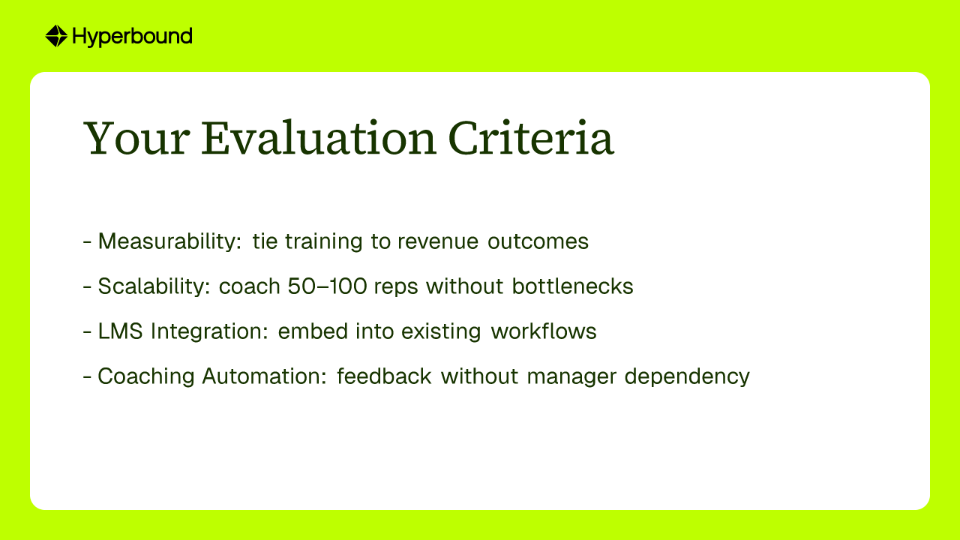
If the core problem with Brevity is that you can't tie training to outcomes, Hyperbound Practice is the most direct solution on this list.
Hyperbound coined the Revenue Activation category — the idea that data alone doesn't change outcomes. What changes outcomes is when that data gets turned into deliberate practice. Hyperbound Practice lets reps rehearse cold calls, discovery, objection handling, demos, and renewals against AI buyer personas built from 2M+ hours of real B2B sales conversations — not generic scripts.
Why it matters for enablement leaders specifically:
Customer proof points that speak for themselves:
Trusted by Autodesk, Monday.com, IBM, Vanta, and LinkedIn, Hyperbound is the platform built for enablement leaders who need to prove the ROI of their programs — not just track completion rates.
Best for: Enablement leaders who need to close the loop between training investment and revenue results.
Gong is the market standard for analyzing what's actually happening on your team's sales calls. It surfaces deal risk, tracks talk ratios, and gives managers rich material for coaching conversations and deal reviews.
Where it falls short as a Brevity alternative: Gong is fundamentally reactive. It tells you what happened after a call ended. It doesn't give reps a safe-to-fail environment to practice before a high-stakes call. It can tell you a rep is struggling with objection handling — but it can't do anything to fix that skill gap at scale. If you already have Gong and feel like you're drowning in data without a clear path to behavior change, you're not alone.
Best for: Teams with a mature coaching culture that want richer data to fuel their 1:1s and deal reviews.
Seismic is the enterprise standard for managing, distributing, and personalizing sales content at scale. If content governance, version control, and asset analytics are your primary headache, Seismic is a serious platform with deep enterprise integrations.
Where it falls short: Seismic's core strength is content, not skill practice. Reps learn about messaging through it — but they don't get to practice delivering that messaging. Notably, Hyperbound integrates directly with Seismic via SCORM, which means the two can actually complement each other well if your org is already invested in Seismic's content layer.
Best for: Large organizations with complex content governance needs and mature enablement programs.
Highspot brings strong content management, powerful search, and a well-designed interface for building "sales plays" that combine guidance, content, and training into a single workflow. Its analytics on content engagement are genuinely useful for understanding what materials reps actually use.
Where it falls short: Like Seismic, Highspot is content-first. It helps reps prepare for a call, but it doesn't simulate being on the call. The practice layer — the piece that actually builds the muscle memory — is missing. Again, Hyperbound's direct SCORM integration with Highspot means you don't have to choose between the two; many teams use Highspot for content delivery and embed Hyperbound roleplays inside those same learning paths.
Best for: Organizations prioritizing content accessibility, sales play operationalization, and content engagement analytics.
Mindtickle is a dedicated sales readiness platform with structured onboarding paths, certification programs, video coaching, and quizzes. It takes training more seriously than a pure content platform and acknowledges the need for practice with its own roleplay features.
Where it falls short: Mindtickle's roleplay functionality exists, but it lacks the depth of conversational AI that Hyperbound delivers. Hyperbound's buyer personas are built from analysis of 2M+ hours of real B2B conversations and can be customized to reflect your specific top-performer behaviors — not generic roleplay scripts. For enablement leaders who need practice scenarios that mirror the actual complexity of their deals and buyers, the difference in simulation fidelity is significant.
Best for: Companies with high rep turnover who need to formalize and standardize their onboarding and certification process.
Showpad combines content management, training, and coaching in a single interface — offering a more holistic view than pure content platforms. It includes video practice and manager review workflows, which is a step closer to building skills, not just delivering content.
Where it falls short: Showpad's coaching model is still heavily manager-dependent, which doesn't solve the fundamental scalability problem: one enablement leader can't personally review video submissions from 80 reps. The automated, AI-driven practice and scoring loop that allows a rep to get dozens of at-bats on their own time — without requiring manager bandwidth — isn't there yet. Like Seismic and Highspot, Showpad is also a named Hyperbound integration partner, so SCORM embeds work here too.
Best for: Teams looking for an all-in-one platform that unifies content delivery and basic coaching under one roof.
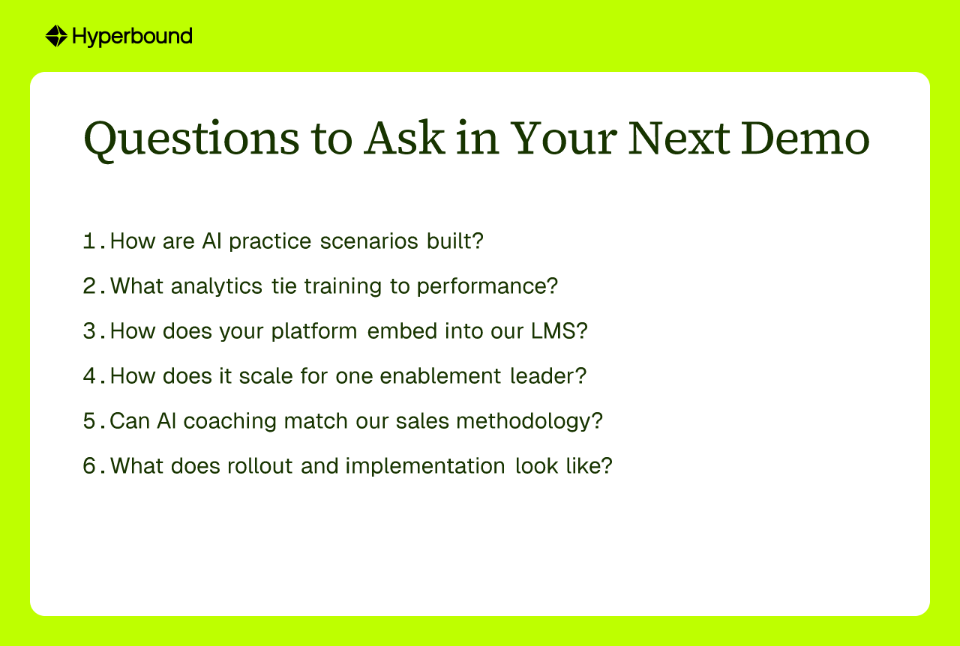
Evaluating Brevity alternatives? Use this framework to cut through the noise and ask the questions that actually reveal whether a platform will solve your real problems.
On Simulation Realism: "How are your AI practice scenarios built? Are they generic scripts, or are they grounded in analysis of real B2B sales conversations specific to our industry and buyer profiles?"
On Measurability: "What specific analytics connect training activity to on-field performance? Can you show me a dashboard that ties practice scores to ramp time, win rates, or deal velocity?"
On LMS Integration: "Can you show me exactly how your platform embeds into our existing LMS — like Seismic or Highspot — to create a seamless experience for reps?"
On Scalability: "How does your platform enable one enablement person to deliver consistent coaching to a team of 50-100 reps without becoming a bottleneck?"
On AI Coaching: "How does your AI provide coaching feedback? Can it be tuned to our specific methodology — MEDDPICC, Challenger, SPICED?"
On Implementation: "What does your rollout process look like? How long does it take to build custom scorecards and roleplay bots, and what support do you provide during launch?"
These questions map directly to the evaluation criteria that matter most: measurability, scalability, integration depth, and the quality of AI-driven coaching. Any vendor worth your time should be able to answer them concretely, with examples.
If you're searching for Brevity alternatives, you're likely asking a bigger question: how do I build a training program that actually changes rep behavior — and prove it?
Static content delivery platforms — however well-organized — can't close that gap on their own. They help reps find information. They don't help reps internalize it, practice it under pressure, and apply it when it counts.
The shift happening in 2026 is from passive learning to active skill development. Winning enablement teams aren't just managing content libraries. They're creating deliberate practice environments where reps get safe, repeatable at-bats against realistic AI buyers — and where every session produces measurable data that connects directly to ramp time, conversion rates, and win rates.
That's the standard worth holding your next vendor to.
The primary problem with many sales enablement platforms like Brevity is that they function as content storage systems but fail to provide measurable proof that training is actually improving rep performance and driving revenue. They solve the content storage problem, but they can't track whether skills are being developed or applied, making it impossible for enablement leaders to prove the ROI of their programs.
Tying sales training directly to revenue outcomes is crucial because it allows enablement leaders to prove the financial impact and ROI of their programs to leadership. When you can show a clear line from a training module to improvements in metrics like ramp time, demo conversion rates, or win rates, enablement shifts from being a cost center to a strategic growth engine.
AI sales coaching scales enablement by providing every rep with consistent, on-demand practice and objective feedback without relying on the limited time of managers or a single enablement leader. AI-powered roleplay tools allow reps to practice calls and objection handling against realistic AI buyers anytime. The AI provides instant, methodology-aligned feedback, creating a scalable coaching loop that saves weeks of manager time.
Revenue Activation is the process of turning sales data and training content into deliberate practice that directly leads to measurable improvements in revenue-generating activities. While traditional training often stops at content delivery, Revenue Activation closes the loop by providing a safe environment where reps can actively practice applying knowledge, with platforms tracking skill progression and tying it to on-field performance.
Yes, top Brevity alternatives are designed to integrate seamlessly with your existing tech stack. For example, platforms like Hyperbound are SCORM-compatible and offer direct integrations with Seismic, Highspot, and Showpad. This allows you to embed AI-powered roleplays directly into the learning paths and sales plays your reps already use.
The key difference is that conversation intelligence tools like Gong are reactive (analyzing past calls), while AI practice platforms like Hyperbound are proactive (preparing reps for future calls). Gong is excellent for understanding what happened on a call, while Hyperbound provides a safe environment for reps to practice and build skills before a high-stakes customer call.
If you're ready to move beyond content storage and into revenue activation, see how Hyperbound Practice is helping teams at Autodesk, Vanta, and LinkedIn cut ramp time by 50% and turn training into a measurable growth engine.









Use Cases
Legal