
You've invested in training. Your team sat through the workshops, completed the modules, and nodded along to the playbooks. Then they got on a call with a multi-stakeholder deal — one that requires buy-in from procurement, finance, and the VP — and everything they "learned" evaporated.
Sound familiar? You're not alone. Most sales coaching programs are designed for the transactional world: short cycles, single buyers, predictable objections. They're not built for the reality of B2B selling, where larger deals attract more competition, decisions take months, and you need to navigate multiple departments just to get a contract signed.
The numbers back this up: sales reps forget 80% of what they learn in training within 30 days. For most organizations, traditional enablement is essentially a sunk cost. The fix isn't more training — it's smarter coaching that's continuous, data-driven, and tied to real-deal performance.
This guide cuts through the noise. Instead of a generic roundup, we've categorized the best sales coaching programs by use case — AI-native, enterprise readiness, methodology-based, and content-led — so you can match the right program to your team's actual need.
Best for: B2B sales teams that want measurable ramp reduction and coaching tied directly to real call data and deal outcomes.
Hyperbound isn't just another sales coaching program — it's the first Revenue Activation Platform, built on the idea that data alone doesn't change outcomes. Every B2B sales team has call recordings and pipeline dashboards. What they're missing is the bridge between insight and behavior change.
Hyperbound closes that gap through a three-part model: Practice → Perform → Activate.
Hyperbound Practice is where reps build skills before they burn real pipeline. AI buyer personas — trained on 2M+ hours of real B2B sales conversations — simulate cold calls, discovery, demos, multi-stakeholder negotiations, and objection handling. This isn't generic roleplay. The AI reflects the actual complexity your reps face: champions who can only do so much, economic buyers who go dark, and procurement teams that slow everything down.
For tenured reps who won't sit through another 45-minute certification module, Bitesized Roleplays deliver focused, deal-specific practice in minutes. AI Scorecards provide instant, objective feedback on methodology adherence, talk ratios, and missed opportunities after every session.
Hyperbound Perform (live March 2026) takes coaching into active deals. Unlike tools that analyze calls in isolation, Perform rolls up insights across every touchpoint in a deal — calls, emails, stakeholder interactions — to surface early risk signals and recommend deal-winning actions while there's still time to act. This is true deal-level coaching, not just post-call feedback.
Kota Activate sits above both products as an AI orchestration layer. Available in Slack or Teams, Kota lets managers ask questions like "Which reps are struggling with champion-building?" and get instant answers backed by real call data — then automatically generate targeted roleplays or coaching interventions in response.
The proof points are hard to argue with:
If your team needs a sales coaching program that closes the loop from practice to pipeline, Hyperbound is the category leader.
Best for: Teams that want deep visibility into what's happening on calls and across their pipeline.
Gong is a widely-used conversation intelligence platform. It records, transcribes, and analyzes sales calls at scale, surfacing trends in rep behavior, deal risk signals, and competitive mentions.
The limitation is real, though: Gong is fundamentally an analytics tool. It tells you what is happening — which objections are being raised, which deals have gone quiet — but it doesn't give reps a built-in mechanism to practice and improve based on those insights. As one framing puts it, Gong creates "a giant library of data" without a clear path to behavior change. It's a useful foundation, but teams that want to go from insight to action will need to pair it with a practice layer.
Best for: Organizations that want to instill a standardized, philosophy-driven selling system across their entire team.
Sandler Training is one of the most recognized names in B2B sales methodology. Built around the principle of buyer-seller equality, Sandler's system emphasizes thorough discovery, pain-finding, and disqualifying bad-fit prospects early. It's as much a mindset shift as it is a skill-building program.
The format is primarily workshop-based with reinforcement over time — which is its strength and its weakness. Teams that commit to the Sandler philosophy and have managers who actively reinforce it see real results. But for distributed or fast-growing teams, the lack of scalable, on-demand practice makes ROI harder to measure.
Best for: Large enterprises needing a comprehensive platform for onboarding, content management, and certification at scale.
Mindtickle offers a broad suite of sales readiness capabilities — structured learning paths, content libraries, call analysis, and certification tools. For enterprise teams managing thousands of reps across multiple product lines, its content management and compliance tracking features are genuinely strong.
Where it falls short is in the depth of AI simulation. Mindtickle's roleplay capabilities exist, but they're not purpose-built with the same fidelity as dedicated practice platforms. The coaching tends to be more post-call than pre-call, which means reps are still learning on live deals rather than before them.
Best for: Teams that need to strengthen interpersonal communication, confidence, and relationship-building fundamentals.
Dale Carnegie has been teaching people how to connect with other humans since 1912 — and its principles are as relevant in B2B sales as ever. When a 6-month deal comes down to whether your champion trusts you enough to go to bat internally, soft skills matter.
The program is delivered through instructor-led sessions (in-person and virtual), and participants consistently report lasting improvements in presence and communication. The drawback is scale and cost — it's not designed for rolling out to 50+ reps quarterly. And there's no technology layer for tracking skill application back to deal outcomes.
Best for: Teams that want to connect sales coaching tightly to playbooks, messaging, and content execution.
Highspot sits at the intersection of sales enablement and coaching. Its strength is ensuring that when reps are in front of a buyer, they have the right content, properly positioned, and aligned with current messaging. Coaching in Highspot is built around playbook adherence — tracking whether reps are using the right talk tracks and materials.
The limitation is dynamism. Highspot excels at static content delivery and process compliance, but it's less suited for building adaptive conversational skills. It's a content-led approach — powerful for message consistency, but not designed to simulate the unpredictability of a live B2B deal.
Best for: Teams looking to introduce AI roleplay practice with avatar-based simulations.
Second Nature brought AI avatars into sales training early and has built a solid platform for structured practice. Reps can rehearse pitches, handle objections from AI personas, and receive automated feedback.
The gap compared to more data-native platforms is that Second Nature is a direct roleplay competitor to Hyperbound. Its scenarios tend to be generic rather than built from a company's actual winning conversations. There's no layer that analyzes your top reps' real calls and reverse-engineers their behaviors into practice scenarios. For teams with a unique ICP or complex competitive landscape, that lack of specificity limits how transferable the practice is, per research comparing AI coaching platforms.
Best for: Complex B2B solution-selling environments where differentiation through insight is the primary competitive advantage.
The Challenger Sale methodology fundamentally changed how many B2B teams think about selling — moving from relationship-building to teaching customers something new about their own business. For enterprise deals where your product requires a buyer to change their worldview, Challenger creates a powerful framework.
Like Sandler, though, it's a philosophy that requires deep organizational commitment and consistent manager reinforcement to stick. The workshop model delivers the "what" and "why" of insight-led selling but lacks the scalable technology infrastructure to practice the "how" repeatedly, at the rep level, tied to real deals.
With eight strong options across different categories, the right choice depends on what your team actually needs. Here are three questions to pressure-test any sales coaching program before you commit:
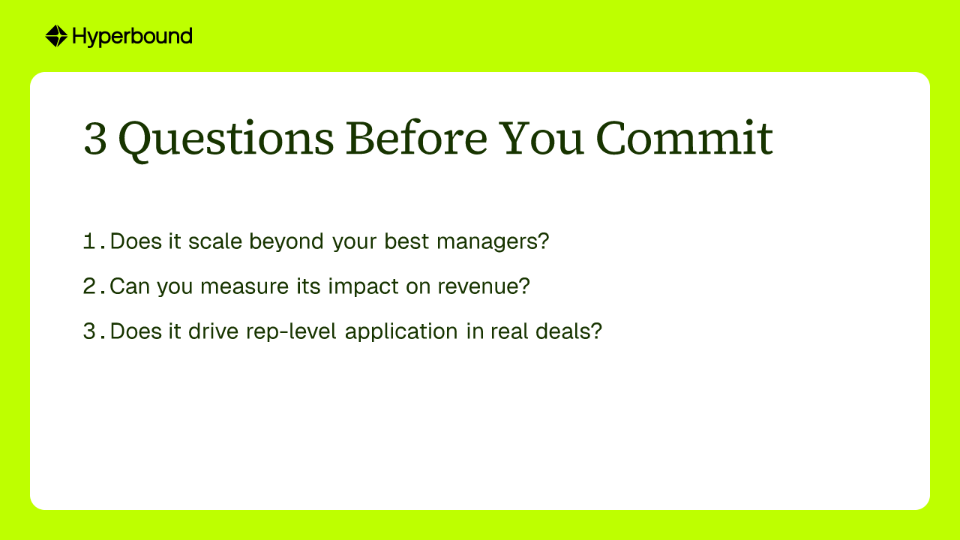
1. Does it scale beyond your best managers?
Sales managers only spend 5–8% of their time coaching, and it's the first thing that gets cut when pipelines are busy. Any program that relies on manager-led reinforcement will plateau. Look for platforms that enable on-demand, self-directed practice and can analyze 100% of calls — not just the <1% a manager gets to review. Enterprise-grade integrations (SSO/SCIM, CRM, LMS) are table stakes for teams above 50 reps.
2. Can you measure its impact on revenue — not just completion rates?
"Course completion" is a vanity metric. The right coaching program should connect skill development to business outcomes: ramp time reduction, demo conversion rate increases, faster time to first won deal, and improvements in deal health across the pipeline. If a vendor can't give you proof points tied to revenue performance, keep looking.
3. Does it drive rep-level application in the context of real deals?
Generic training has a short shelf life, especially for senior reps. The best sales coaching programs deliver deal-specific coaching — practice scenarios generated from a rep's actual upcoming calls, coaching interventions triggered by real conversation data, and feedback grounded in your company's closed-won patterns. The closer the training is to the actual deal, the faster it translates to pipeline.
The era of the annual sales kickoff workshop is over. B2B sales in 2026 demands continuous, data-driven coaching that's embedded in how reps actually work — not scheduled quarterly and forgotten within a month.
Each program on this list serves a real purpose. Gong tells you what's happening on calls. Sandler and Challenger give you frameworks for thinking about selling. Dale Carnegie builds the human foundation. But for teams that need a complete sales coaching program — one that takes insights from real conversations, turns them into targeted practice, and connects that practice directly to deal outcomes — Hyperbound is the only platform that closes the full loop.
It's not just a coaching tool. It's a Revenue Activation Platform that uses your own data to make every rep execute like your best.
The main problem with traditional sales training is that reps forget up to 80% of what they learn within a month. Most programs are one-size-fits-all and fail to provide the continuous, deal-specific reinforcement needed to handle complex B2B sales cycles, making them a sunk cost for many organizations.
AI improves sales coaching by providing scalable, on-demand practice and objective, data-driven feedback. Platforms like Hyperbound use AI to simulate realistic buyer conversations, allowing reps to practice handling objections and navigating multi-stakeholder deals in a safe environment. AI can also analyze 100% of sales calls to identify coaching opportunities, saving managers time and ensuring interventions are tied to real performance data.
A conversation intelligence (CI) tool like Gong records and analyzes sales calls to tell you what is happening in your deals. A revenue activation platform like Hyperbound takes it a step further by using those insights to drive behavior change through targeted practice, helping reps apply how to win deals based on proven patterns from your top performers. CI provides the data; revenue activation turns that data into measurable performance improvements.
To choose the right sales coaching program, you should focus on three key criteria. First, ensure it can scale coaching beyond your managers' limited time. Second, verify that you can measure its impact on hard revenue metrics like ramp time and win rates, not just completion rates. Finally, confirm that it drives skill application in the context of your team's actual, in-flight deals.
You can measure the ROI of a sales coaching platform by tracking its impact on core business outcomes. Look for quantifiable improvements in metrics such as: rep ramp time reduction, increases in demo-to-close conversion rates, faster time to a rep's first won deal, and overall increases in pipeline generation and deal velocity.
Yes, AI roleplay is highly effective for experienced reps when it moves beyond generic scenarios. The best platforms offer focused, "bitesized" roleplays that allow senior reps to practice for a specific upcoming call or a complex negotiation in just a few minutes. This respects their time and helps them sharpen skills for the high-stakes, multi-stakeholder deals they typically manage.
If you're serious about cutting ramp time, improving win rates, and building a coaching culture that actually scales,






Use Cases
Legal