
Your sales reps are losing more than 5 hours every single week to manual CRM logging — and that's before you account for the deals quietly dying because the data in your CRM is wrong.
If you've been in the trenches with a sales team, you already know the frustration. As one sales manager put it on Reddit: "Manual data entry after every call is an absolute time-sink and morale killer for sales teams." Another rep summed it up even more bluntly: "Sales reps were spending more time typing notes than closing deals."
The problem isn't just lost hours. It's bad data. Incomplete CRM fields, forgotten follow-ups, missed signals — these aren't minor inconveniences. They're the reason deals slip and pipeline reviews turn into guess-work sessions. And as one community member cautioned, "Most CRMs end up with better notes… but not better qualification." Faster typing doesn't fix bad data at the source.
That's where automatic CRM data entry software comes in. The right tool doesn't just transcribe your calls — it captures the right information, pushes it into the right fields, and ideally, lets a human verify it before a mistake becomes a pipeline problem.
This guide evaluates the 7 best automatic CRM data entry tools against five concrete criteria so you can choose the one that fits your team's workflow:
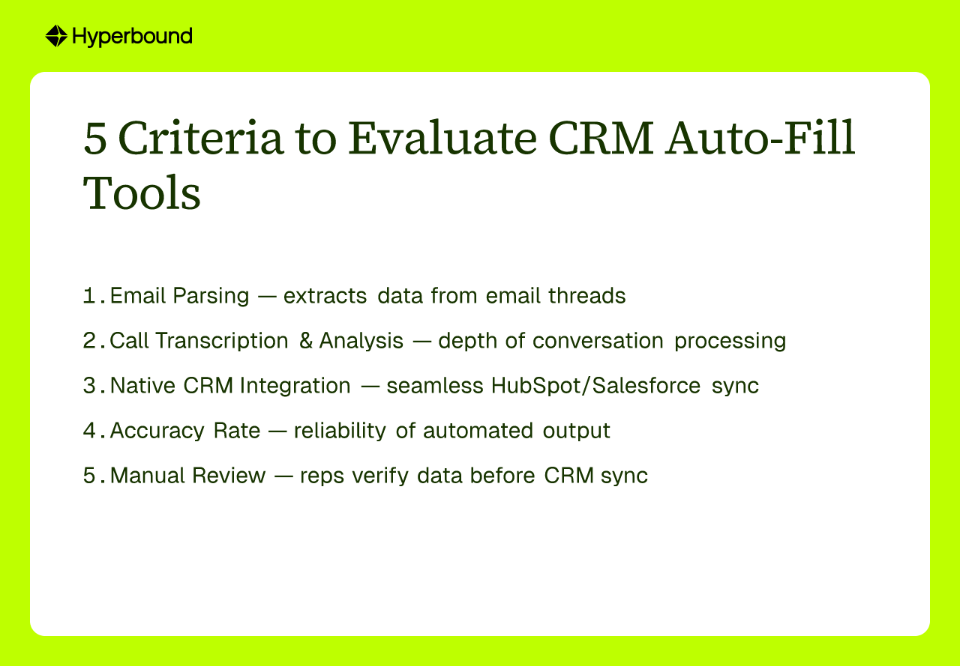
Let's get into it.
Hyperbound Perform is built for sales teams that care about two things equally: zero manual CRM entry and zero bad data. Its Auto-CRM Fill feature automatically captures and updates CRM fields from real sales conversations — but here's the differentiator: reps can review AI-captured data before it ever hits the CRM.
This human-in-the-loop approach directly addresses one of the most common concerns in sales communities — the fear of "too many errors and hallucinations" from AI tools. By giving reps a review step, Hyperbound prevents bad data at the source rather than cleaning it up downstream.
But Auto-CRM Fill is only part of the story. Perform sits inside Hyperbound's broader Revenue Activation Platform, which means it doesn't just log what happened on a call — it analyzes conversations across the entire deal lifecycle to surface deal-level coaching insights and recommended next steps. It's the missing link between call-level data and closed-won outcomes.
Evaluation:
.png)
Best for: HubSpot teams that want call-driven auto-fill and deal coaching. Hyperbound Perform is your shortest path to zero manual entry — without sacrificing data quality.
Sybill is purpose-built for teams that want to automate CRM data entry at maximum speed and volume. It captures call notes, action items, and sentiment automatically, then pushes structured data directly into your CRM — no human review required.
Sybill claims a 100% field fill rate and estimates it saves teams up to 14 hours per week. For teams juggling dozens of calls a day and prioritizing throughput over verification, Sybill is a strong contender.
Evaluation:
.png)
Best for: High-volume teams across multiple CRMs who want maximum automation with minimal friction and don't require a verification step.
Modjo gives teams flexibility that most automatic CRM data entry tools don't offer: the ability to choose between semi-automation and full automation at the field level. If you want to automate 90% of your CRM fields but keep human review on a handful of high-stakes ones, Modjo is built for that.
With a claimed 90% field fill rate and conversation intelligence baked in, it's particularly strong for teams that want tight control without sacrificing significant automation gains.
Evaluation:
.png)
Best for: Teams that want granular, field-level control over what gets automated vs. reviewed by a human.
Aircover takes a different approach: rather than doing post-call analysis, it acts as a real-time assistant during the call itself, capturing meeting notes, action items, and key moments as they happen. Think of it as your rep's co-pilot, not their admin assistant.
For teams where the biggest gap is live call documentation — rather than post-call CRM sync — Aircover fills a unique slot in the stack.
Evaluation:
.png)
Best for: Teams whose primary pain is capturing notes during calls rather than automating post-call CRM sync.
If your team is all-in on Salesforce, Einstein is the natural default. As Salesforce's native AI layer, Einstein Activity Capture syncs emails and calendar events automatically, while Einstein Conversation Insights handles call transcription and analysis — all within the Salesforce data model.
The integration is seamless precisely because it's not an integration at all — it's built-in. The trade-off: Einstein only works within Salesforce. If you run a mixed CRM environment or plan to migrate, this won't travel with you.
Evaluation:
.png)
Best for: Teams fully committed to the Salesforce ecosystem who want a native, no-integration-required solution.
Much like Einstein is to Salesforce, HubSpot's native AI tools are built to streamline data entry for teams living entirely in HubSpot. Conversation intelligence, email parsing, and AI-assisted property population are all part of the HubSpot Sales Hub.
If your team already uses HubSpot as its CRM, the path of least resistance is leveraging what's already there. The limitation, again, is that it doesn't play well outside its own ecosystem.
Evaluation:
.png)
Best for: Teams fully committed to HubSpot who want built-in automation without adding another vendor to the stack.
Streak is a CRM that lives entirely inside Gmail — and its AI autofill is designed specifically for that context. If your sales process is driven almost entirely by email, Streak reads your Gmail threads, pulls out key deal data, and populates your pipeline without ever leaving your inbox.
The limitation is significant: Streak only syncs with its own CRM. If you're on HubSpot or Salesforce, this isn't your tool. But for small or lean teams whose entire workflow runs through Gmail, it's a surprisingly powerful option.
Evaluation:
.png)
Best for: Small sales teams whose entire workflow lives in Gmail and who don't need HubSpot or Salesforce compatibility.
.png)
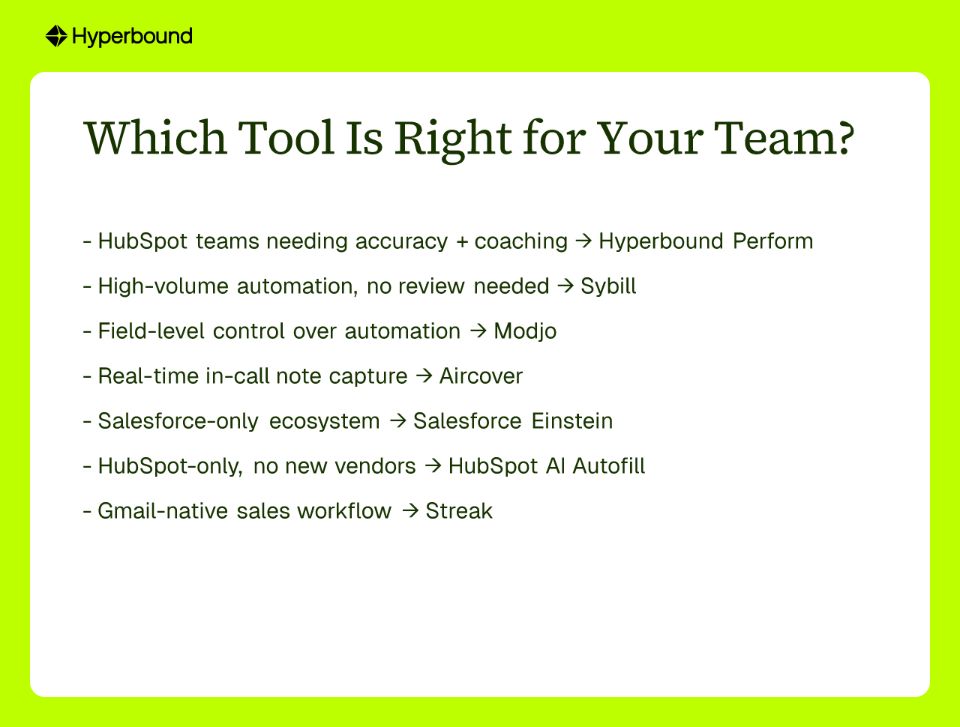
Not every automatic CRM data entry software tool is built for the same problem. Use this framework to find your match:
Manual CRM data entry isn't just a time problem — it's a revenue problem. Every hour a rep spends typing notes is an hour they're not selling. Every bad CRM field is a pipeline signal you can't trust. And every deal lost because of an incomplete handoff is a compounding cost to your business.
The tools on this list solve the time problem in different ways. But the best automatic CRM data entry software does more than fill fields — it turns every conversation into a signal that helps your team win the next deal.
That's what separates Hyperbound Perform from the rest of the list. It closes the loop between what was said on a call, what gets logged in the CRM, and what reps should do next to move the deal forward. The manual review feature means your data is clean before it enters the system. The deal-level coaching means that clean data immediately gets put to work.

Ready to see what zero manual entry and deal-level intelligence looks like in practice? Explore Hyperbound Perform →
Automatic CRM data entry software is a tool that uses AI to listen to sales calls, read emails, and analyze conversations to automatically capture and log key information into your CRM system. Instead of reps manually typing notes, deal stage updates, or contact information, the software identifies relevant data points—like action items, budget, timeline, and stakeholder roles—and pushes them into the correct CRM fields.
Automatic CRM data entry is important because it saves sales reps significant time and dramatically improves the quality of your CRM data. Sales reps can lose over five hours per week to manual logging. Automating this process frees them up to focus on selling. More importantly, it prevents the incomplete or inaccurate data that leads to lost deals, poor forecasting, and ineffective pipeline reviews.
While features vary, a manual review capability is one of the most critical for ensuring data accuracy. AI can sometimes make mistakes, so a tool that allows a sales rep to quickly review and approve AI-captured data before it syncs to the CRM prevents bad data at the source. This human-in-the-loop approach, found in tools like Hyperbound Perform, combines the speed of AI with the reliability of human verification.
To choose the right tool, evaluate your team's specific needs based on your primary CRM, workflow priorities, and tolerance for errors. Ask key questions: What is your CRM (e.g., Salesforce, HubSpot)? Is speed or 100% accuracy more important? Do you need just data entry, or also deal-level coaching and insights? Your answers will guide you to the best fit, as outlined in the decision framework above.
Not yet. While AI is incredibly powerful, it is not infallible and can produce errors or "hallucinations." Relying on fully automated, unverified AI can introduce subtle but significant errors into your CRM, undermining trust in your data. The most effective systems use AI to do the heavy lifting but empower a human to give the final approval before data is committed to the record.
The primary difference is the focus on verified data accuracy and integrated, deal-level coaching. Native tools are excellent for basic automation within their ecosystem. Hyperbound Perform, however, is built specifically to solve the bad data problem by including a mandatory rep review step. Furthermore, it goes beyond simple data entry by analyzing conversations across an entire deal to provide reps with actionable coaching insights to help them win.










Use Cases
Legal