
You've organized your GTM content in Highspot. Your reps know exactly where to find the one-pagers, battle cards, and case studies. And yet — you still have a nagging feeling that something isn't working. Sound familiar?
Here's the honest truth that too many Sales Enablement Managers discover too late: "I had zero clue what was actually being used in deals." And even when content is being used, reps forget up to 80% of training within 30 days, making even the best library of assets practically irrelevant the moment a live objection lands.
The problem isn't content access. It's conversation competence.
Highspot excels as a content management system. But it's fundamentally a static library — it can't score a real call, run a rep through a tough objection drill, or tell a manager which skill gaps are killing deals in the pipeline right now. As one enablement practitioner put it, "the only thing that's worked for us in practice is having content + analytics + training in one flow."
The market is shifting from content enablement to rep readiness — and that's exactly what this list is about.
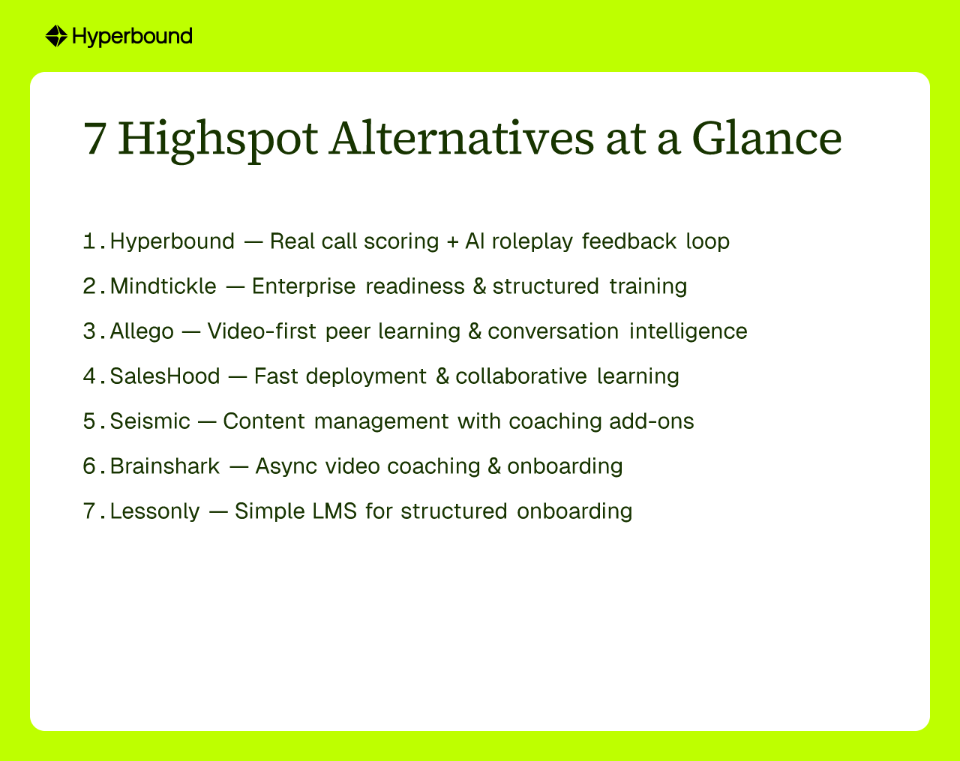
Below are 7 Highspot alternatives built for teams that need more than a digital filing cabinet. We've filtered the market specifically to tools that offer AI coaching, AI roleplay, or real call scoring — ruling out pure content management platforms. For each, you'll find a Best For label, a no-fluff Limitation note, and a Pricing Tier signal to help you qualify quickly.
Best for: Teams that want to close the loop between real call data and rep practice to drive measurable behavior change.
Hyperbound pioneered the Revenue Activation category — the idea that analyzing call data alone doesn't change outcomes. What actually moves the needle is using that data to drive targeted rep practice, and then closing the loop again. Their three-product model makes this operational:
The result is a continuous improvement loop: Score Real Calls → Identify Skill Gaps → Practice Targeted Roleplays → Score Real Calls Again. This is the Perform → Practice feedback cycle that sets Hyperbound apart from any other platform on this list.
The proof points are concrete. Customers report a 50% faster ramp time, a 150% increase in DM → demo conversion rate, and Vanta reduced ramp time from 210 to 72 days — a 60% reduction. Nivoda achieved 2x revenue YoY and a 150% demo rate increase after deploying Hyperbound with their sales team.
Hyperbound integrates with your existing stack: Salesforce, HubSpot, Gong, Outreach, Zoom, Google Meet, and LMS/CMS platforms including Seismic and Highspot via SCORM.
Limitation: As a newer platform (founded 2024), Hyperbound has less market awareness than legacy enablement suites. Teams looking for a single platform that also handles deep content management at Highspot's level will still need a separate CMS.
Pricing Tier: Custom pricing. Demo available at hyperbound.ai.
Best for: Enterprise revenue teams seeking a comprehensive, structured training and readiness platform.
Mindtickle is one of the most established names in the sales readiness category and one of the more substantive Highspot alternatives for teams that need a wide-ranging platform covering onboarding, continuous training, and coaching in one place.
Their flagship differentiator is the Readiness Index — a proprietary scoring system that quantifies team-wide skill levels and tracks performance over time. On the AI coaching front, Mindtickle offers AI Sales Role Plays with real-time feedback and Call AI for conversation intelligence on live deals, giving managers visibility into what's happening in real customer conversations and how that maps back to rep development.
The platform's structured approach makes it particularly strong for large teams that need to standardize onboarding paths and certifications at scale.
Limitation: The depth of features comes with real trade-offs. Setup is complex, the admin learning curve is steep, and the platform can feel heavy for smaller or mid-market teams. Annual costs for enterprise deployments can average around $92K, making it a significant commitment.
Pricing Tier: Custom. Enterprise-focused.
Best for: Teams that value peer-to-peer learning and want to leverage video coaching as the core of their rep development strategy.
Allego built its reputation on video-first learning — enabling reps to record themselves, share clips with managers and peers, and receive structured feedback. It remains one of the stronger Highspot alternatives for organizations where organic knowledge-sharing and manager-led video review are pillars of the coaching culture.
On the AI side, Allego offers a Live Dialogue Simulator for AI-powered roleplay practice and Conversation Intelligence to analyze real sales calls. Their generative AI layer can surface insights and summaries from call recordings and learning content to speed up manager review.
Limitation: The user interface can feel cluttered, and initial setup is often cited as complex. Allego's roleplay capabilities are newer additions and may lack the simulation fidelity of purpose-built platforms. Teams looking for automated, methodology-specific call scoring at scale will find the toolset less mature than dedicated options.
Pricing Tier: Per user/month. Often cited in the $45–$60/user/month range, with bundled and à la carte options depending on feature set.
Best for: Fast-growing teams that want to deploy enablement programs quickly and foster a culture of collaborative, peer-driven learning.
SalesHood is built around the premise that reps learn best from each other. The platform combines AI Role-Playing, video coaching, and collaborative learning tools to help teams build consistent messaging and share best practices across the org at speed.
It's particularly well-suited for teams running frequent product launches or messaging updates who need new plays in reps' hands fast. The AI roleplay feature allows practice against realistic scenarios with real-time feedback, and performance insights aim to connect learning progress to sales metrics.
Limitation: Navigation and UX have been cited by users as areas for improvement. SalesHood leans more toward team-based, collaborative learning than individualized, data-driven coaching interventions. Teams with a strong need for granular, per-rep AI coaching grounded in real call behavior may need to supplement it with other tools.
Pricing Tier: Custom, with some sources citing a starting point of approximately $40/user/month.
Best for: Large enterprises already deeply invested in Seismic for content management who want to layer in basic coaching capabilities without switching platforms.
Note: Seismic and Highspot announced a definitive merger agreement in February 2026. If you're reading this as a Highspot user evaluating alternatives, the Seismic-Highspot merger means the two platforms are converging — so "switching to Seismic" may effectively mean staying in the same ecosystem. Evaluate based on the combined roadmap, not just Seismic's current feature set.
Their Practice & Coaching module offers scenario-based training and AI-powered feedback on rep submissions. For live calls, Seismic provides some AI-assisted analysis and coaching recommendations integrated into its broader analytics suite, which is strong on tracking content ROI and rep engagement with training materials.
Limitation: Coaching and roleplay remain add-on functionality — they're not the core product. The experience doesn't match purpose-built coaching platforms, and the overall platform complexity is high. Price tags for Seismic enterprise deployments can reach approximately $500K over two years, making it more of a platform consolidation decision than a coaching-first choice.
Pricing Tier: Enterprise-level custom pricing.
Best for: Companies focused on creating consistent, video-based onboarding and training content with solid readiness analytics.
Note: Brainshark was acquired by Bigtincan in 2021, and following Vector Capital's acquisition of Bigtincan, Brainshark was merged into Showpad in October 2025. The product is now branded as Bigtincan Readiness within the Showpad ecosystem. Evaluate based on Showpad's current platform and roadmap. Its Video Role Play feature allows reps to record responses to prompts and submit them for manager review and scoring — making it a good fit for teams where manager-led, asynchronous coaching is the norm.
Readiness Scorecards provide useful analytics for tracking course completion and team-wide readiness levels, giving enablement leaders a cleaner view into who has completed what.
Limitation: The coaching model is fundamentally asynchronous and manager-dependent. There's no true real-time AI coaching or automated real call scoring — feedback loops are slower than what modern, AI-native platforms offer. For teams that need immediate, data-driven coaching at scale, this is a meaningful gap.
Pricing Tier: Custom/tiered pricing.
Best for: Teams needing a straightforward, easy-to-adopt LMS for structured onboarding and training programs.
Now part of the Seismic family (branded as Seismic Learning), Lessonly remains one of the most approachable learning management platforms in the enablement space. With the Seismic-Highspot merger underway, Lessonly's future positioning within the combined entity is worth asking about during evaluation. Reps actually use it — which, as any enablement professional knows, is half the battle. Its clean UX solves the adoption problem that plagues heavier platforms ("Reps balked at the heavy UI, so usage stats looked great while half the team kept PDFs on their desktop").
Lessonly allows managers to incorporate roleplay exercises within lessons, with reps recording video, audio, or screenshare responses for feedback.
Limitation: Lessonly is a learning tool first — it wasn't built as an AI coaching engine. It lacks dynamic AI roleplay, automated call scoring, and the kind of real-time coaching feedback that defines the higher end of this list. If your primary need is rep readiness driven by live call data, Lessonly won't get you there on its own.
Pricing Tier: Custom/monthly subscription.
.png)
.png)
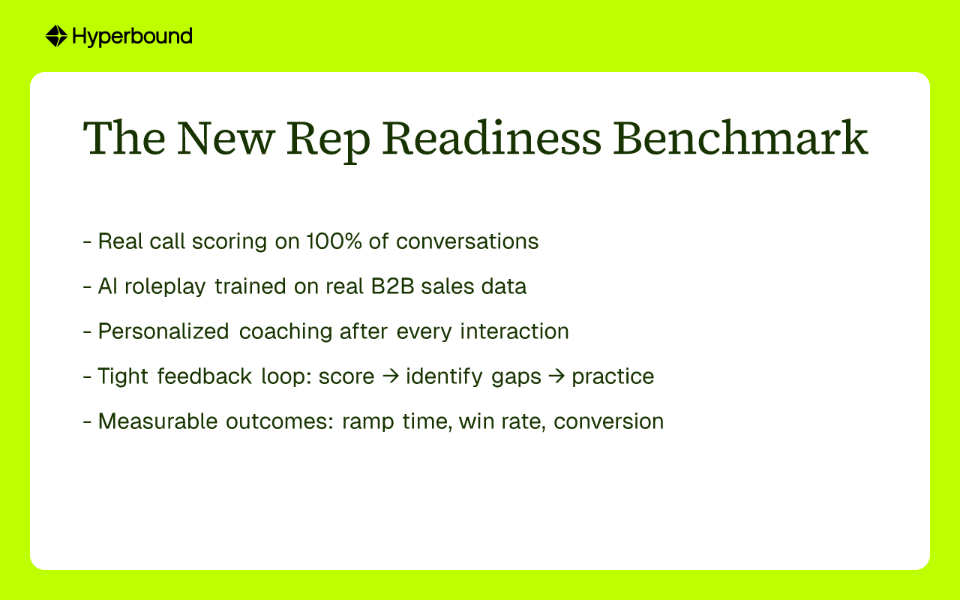
Choosing a sales enablement platform in 2026 is no longer about finding the best digital filing cabinet. The new benchmark is rep readiness — and that requires more than an organized asset library. As practitioners have noted, "What actually works in practice?" is the question worth obsessing over, not just which vendor has the slickest demo.
The best Highspot alternatives on this list don't just give your reps a map — they train them to navigate the terrain of real customer conversations, over and over, until the hard moments feel easy.
If your team's primary challenge is ramp time, inconsistent win rates, or the gap between what managers coach and what actually happens on live calls, the tools that create a tight feedback loop between real-world performance and deliberate practice will deliver the most measurable ROI.
Hyperbound is purpose-built to operationalize exactly that loop. By scoring 100% of real calls with Hyperbound Perform and turning those findings into targeted AI roleplay sessions with Hyperbound Practice, coaching stops being a reactive activity and becomes a continuous, data-driven cycle. The outcomes — like 50% faster ramp time and Vanta's 60% reduction in new rep ramp (from 210 to 72 days) — reflect what happens when practice is directly connected to the behaviors that win real deals.
Highspot is insufficient for modern sales teams because it primarily functions as a content management system, failing to address the critical need for improving conversation competence through real-time coaching and practice. While excellent for organizing and distributing sales collateral, Highspot is a static library. It cannot analyze live sales calls, identify skill gaps in real-time, or provide reps with dynamic practice to handle objections. The market is shifting from simply providing content access to ensuring reps are fully prepared for any conversation—a gap Highspot doesn't fill.
Content enablement focuses on providing sales reps with the right content and materials, while rep readiness focuses on equipping them with the skills and confidence to use that content effectively in live customer conversations. Content enablement, where tools like Highspot excel, is about organizing assets like one-pagers and case studies. Rep readiness is about measurable competence: can the rep handle a tough objection, articulate value, and navigate a complex deal? Readiness platforms use tools like AI call scoring and roleplay to build and verify these critical selling skills.
AI roleplay improves sales performance by providing reps with a safe, scalable, and consistent environment to practice real-world sales scenarios, receiving instant, data-driven feedback on their performance without needing a manager present. Unlike traditional roleplay, which is time-consuming and often inconsistent, AI simulations can be done anytime, anywhere. Platforms like Hyperbound use AI buyer personas trained on millions of real B2B conversations, allowing reps to practice specific skills like objection handling and discovery. The immediate, objective feedback helps them correct mistakes and build muscle memory for critical moments in a deal.
The primary benefit of connecting real call scoring with AI practice is the creation of a continuous, data-driven improvement cycle for each sales rep. Here’s how the loop works: First, AI scores 100% of a rep's real customer calls against your sales methodology (e.g., MEDDIC). This automatically identifies specific skill gaps (e.g., struggling with pricing objections). Then, the platform prescribes targeted AI roleplay exercises to practice that exact skill. This ensures training is personalized and directly addresses the weaknesses that are impacting real deals, leading to faster ramp times and higher win rates.
Yes, most leading Highspot alternatives are designed to integrate seamlessly with your existing tech stack, including CRMs like Salesforce and HubSpot, conversation intelligence tools like Gong, and even content management systems (CMS) like Highspot itself. For example, Hyperbound integrates with Salesforce, HubSpot, Gong, Outreach, and offers SCORM compatibility to plug into learning management systems (LMS) and CMS platforms. This ensures that data flows between systems, providing a holistic view of rep performance from training to deal outcomes.
For small or mid-market teams, platforms that are quick to deploy and focus on high-impact coaching, like Hyperbound or SalesHood, are often the best fit. These platforms prioritize rapid value and collaborative learning without the complex, lengthy setup associated with enterprise-level suites like Mindtickle or Seismic. They focus specifically on the core challenge of improving conversational skills through AI roleplay and call coaching, which delivers a direct and measurable ROI for fast-growing teams.
The ROI of a rep readiness platform is measured through key sales metrics like reduced ramp time for new hires, increased conversion rates (e.g., discovery calls to demos), higher win rates, and improved quota attainment. Leading platforms provide dashboards that connect training activities to performance outcomes. For instance, you can track how reps who complete specific AI roleplay modules perform on their live calls. Concrete proof points, such as Vanta reducing ramp time by 60% with Hyperbound, demonstrate a clear financial return by getting reps productive faster and closing more deals.
Ready to move beyond static content and start building a team that masters customer conversations consistently?











Use Cases
Legal