
FullyRamped deserves credit for what it does well. For early-pipeline phone work and basic onboarding simulations, it gave sales teams a low-friction way to get reps off the bench and onto calls faster. If your primary need is simple prospecting practice, it gets the job done.
But here's what sales teams are discovering in 2026: basic simulations aren't enough anymore.
It's not just anecdotal. Sales reps venting on Reddit put it bluntly — AI tools often "fall short in mimicking the complexities of real human interactions," struggling with the "awkward silences, weird tangents, and emotional dynamics of real conversations." Others found that even popular AI tools just agree and tell them why they're right — hardly a challenging objection-handling environment.
The result is a growing gap between what FullyRamped was built for — simple simulations — and what modern revenue teams actually need: coaching depth tied to real deal data, CRM-connected intelligence, and AI that can go off-script without falling apart.
This article covers seven genuine FullyRamped alternatives worth evaluating in 2026, along with a decision framework to help you match the right tool to your team's specific situation.
Hyperbound isn't just a roleplay tool — it's a Revenue Activation Platform, a category it created to describe what happens when teams stop merely analyzing call data and start using it to change outcomes.
The proof is hard to argue with. Vanta's CRO Stevie Case reported a 60% reduction in ramp time — dropping from 210 days to 72 — alongside 4x BDR team growth and a 5x increase in pipeline after adopting Hyperbound. Nivoda saw a 50% ramp reduction, 150% demo rate increase, and 2x revenue YoY. LinkedIn deployed it across 3,000+ sellers in NAMER and EMEA.
What makes Hyperbound's AI different is where it comes from. The AI buyer personas are trained on 2M+ hours of real B2B sales conversations — not generic scripts written in a conference room. That's why reps describe the AI as genuinely unpredictable in the right way: it pushes back, goes on tangents, and handles curveballs the way real buyers do.
Hyperbound Practice is the entry product and covers the full sales cycle — cold calls, discovery, demos, objection handling, renewals, and upsells. Notable features include:
Hyperbound Perform takes it further by deploying AI scorecards on real calls, surfacing deal-level insights across the entire deal lifecycle — not just isolated conversations. It integrates with Gong, Chorus, and Salesloft to score 100% of calls automatically and surface early risk signals while deals are still winnable. It's not a forecasting tool; it's a deal coaching layer grounded in actual buyer behavior.
Sitting above both is Kota Activate — an AI Revenue Analyst that orchestrates practice and performance data to recommend the right coaching intervention at the right time.
Integrations: Salesforce, HubSpot (CRM); Gong, Outreach, Aircall (Call Intelligence); Seismic, Highspot, Showpad (LMS/CMS); Zoom, Google Meet, MS Teams; SSO/SCIM for enterprise security.
Compliance: SOC 2 Type II | GDPR | ISO 27001 | HIPAA
Best for: High-growth B2B teams and enterprises looking to close the loop between practice and real-world deal performance.
Second Nature has been in the AI roleplay market since 2018, making it one of the more mature options available. It supports B2B, B2C, and customer support scenarios, and offers video communication analysis to assess body language and non-verbal cues — a differentiator for teams where presence and delivery matter as much as content.
Second Nature also allows trainers to upload PDFs and other resources to customize roleplay scenarios, making it reasonably adaptable to new messaging or product launches.
The limitation? Some users report that interactions can feel scripted once the AI hits the edge of its training — objection handling in particular can feel more like a checklist than a real conversation. It also has less emphasis on post-sales coaching for CSMs and AMs. For teams whose primary need is presentation polish and soft-skills development, it's a solid pick. For teams needing deal-level intelligence or full-cycle B2B simulation depth, it falls short.
Best for: Teams prioritizing non-verbal communication, presentation training, and soft-skill development.
Mindtickle is a broad sales readiness platform where AI roleplay is one feature among many. Its strength is in combining traditional training content — courses, quizzes, and certification paths — with performance analytics that track rep progress and training completion across the organization.
For sales enablement leaders managing large programs with multiple content types, Mindtickle's unified dashboard has real appeal. It's a known platform with strong enterprise penetration.
Where it struggles: the roleplay feature isn't purpose-built. According to sales enablement practitioners, the simulation depth is less tailored to the nuances of complex, multi-threaded sales environments. If realistic AI conversation practice is the core need rather than a supplementary feature, you'll likely outgrow what Mindtickle's roleplay module offers.
Best for: Organizations wanting a single platform for content management, training completion tracking, and basic roleplay — without needing deep simulation fidelity.
PitchMonster does exactly what its name suggests: it helps reps drill and perfect their pitch. Using structured, scripted conversation trees, it creates controlled practice environments where reps can rehearse core messaging until it sticks.
The upside is focus. For onboarding new reps on a specific pitch or ensuring consistent messaging after a product launch, PitchMonster's structured approach reduces variability.
The downside is equally clear: it's narrow. Discovery calls, negotiation, multi-stakeholder dynamics, and closing conversations are largely outside its scope. As noted in independent tool comparisons, it's not a comprehensive solution for the full B2B sales cycle — it's a specific drill, not a training program.
Best for: Teams needing targeted, repetitive pitch practice for specific messaging campaigns or new hire onboarding.
Gong is the market leader in conversation intelligence, and it earns that reputation. For generating data-driven insights from recorded sales calls — what top performers say, when they say it, and why deals move forward — few tools compete with it.
The limitation is structural: Gong analyzes what happened. It doesn't give reps a place to practice getting it right before the next call. There's no safe environment to rehearse objection responses, test new messaging, or prepare for a high-stakes renewal conversation. The insight exists; the practice loop doesn't.
This is precisely why Hyperbound integrates with Gong rather than replacing it. Gong surfaces the "what," Hyperbound closes the loop with the "what to do about it" — targeted practice informed by real call data.
If your team already has Gong and is looking to add a practice layer on top of it, you should be evaluating Hyperbound rather than Gong as a standalone alternative.
Best for: Teams whose primary need is call recording, deal analytics, and conversation intelligence — who already have a separate training solution in place.
Quantified takes a different approach to AI roleplay, leading with AI avatar technology designed for high-stakes, compliance-sensitive conversations. Financial services, medical devices, and pharmaceutical sales are natural fits — industries where message discipline isn't just preferred, it's required.
For those verticals, Quantified's ability to enforce specific language, track compliance adherence, and simulate complex regulatory conversations is genuinely useful. It also supports some customization for high-stakes scenario types.
For typical B2B SaaS sales motions, however, it can feel like overkill. Higher costs and limited integrations make it less accessible for broader sales teams, and its niche focus limits its applicability outside regulated industries.
Best for: Sales teams in financial services, medical devices, or pharmaceutical sectors where compliance language and message discipline are non-negotiable.
Yoodli is an AI speech coaching tool built for communication improvement at the individual level. It provides personalized feedback on pacing, clarity, filler word usage (the "ums" and "ahs"), and delivery patterns.
For a new rep who knows the playbook but struggles to communicate clearly under pressure, Yoodli offers targeted, low-pressure practice. It's genuinely useful as a personal development tool.
What it isn't: a sales training platform. There are no sales methodologies baked in, no objection-handling frameworks, no deal-specific scenarios, and no CRM integration. Independent reviewers position it as a communication aid, not a replacement for B2B sales simulation. Reps looking to improve their talk track or handle multi-stakeholder deals won't find what they need here.
Best for: Individual contributors working on foundational communication skills — pacing, clarity, and reducing filler words.
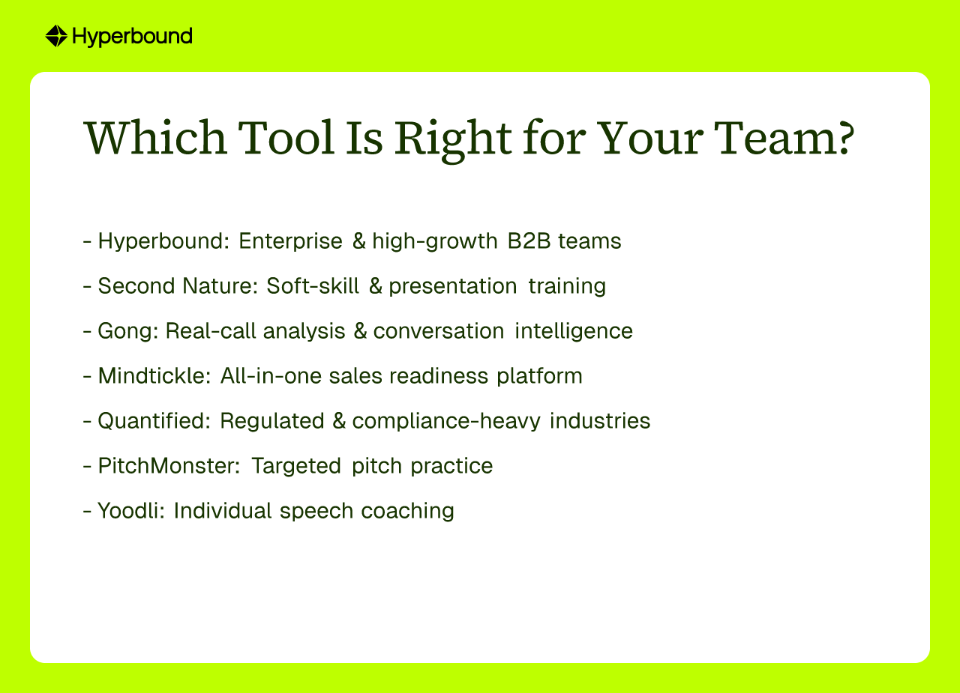
Use this table to match your team profile to the right tool. Every team has different constraints — budget, tech stack, use case, and stage of growth. The best platform isn't the one with the longest feature list; it's the one that fits where you are and where you need to go.
.png)
FullyRamped built a useful on-ramp for sales teams exploring AI roleplay. But the market has moved significantly. In 2026, the most competitive revenue teams aren't just looking for a place to practice — they're looking for platforms that close the loop between what reps practice and what actually happens on deals.
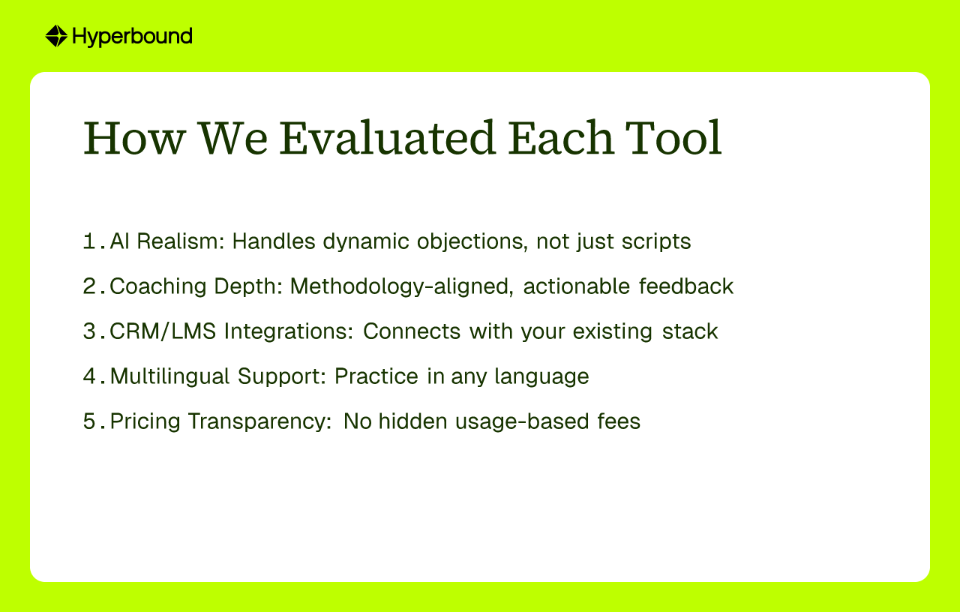
The tools that earn their place in the tech stack are the ones that can simulate realistic buyer behavior (not just agree with everything a rep says), deliver coaching tied to methodology rather than surface-level metrics, and integrate with the call intelligence and CRM tools your team already depends on.
If you're evaluating FullyRamped alternatives, the right question isn't "which tool has the most features?" It's "which tool turns practice into measurable pipeline?" For most high-growth B2B teams, that answer increasingly points to platforms like Hyperbound — where the practice loop is built from real winning deals, not generic scripts, and where every session feeds back into a continuous improvement cycle across your entire revenue team.
The goal isn't more practice. It's practice that actually translates to performance.
A true FullyRamped alternative goes beyond simple simulations by offering deep coaching, realistic AI, and seamless integration with your existing sales technology stack. Key features to look for include: AI trained on real conversation data, coaching aligned with your sales methodology, robust CRM and call intelligence integrations (like Salesforce and Gong), and support for the entire sales cycle, from cold calls to renewals.
AI realism is crucial because it prepares sales reps for the unpredictability and complexity of actual customer conversations, which scripted tools cannot replicate. Realistic AI, trained on millions of hours of real sales data, can push back, go on tangents, and introduce curveballs just like a real buyer would. This creates a challenging and effective practice environment for handling objections and navigating complex deal dynamics.
Gong analyzes what happened on past calls, while Hyperbound provides a safe environment to practice and improve before the next call. Gong is a powerful tool for analyzing recorded calls to find insights. Hyperbound acts on those insights by allowing reps to practice specific scenarios, rehearse objection handling, and apply coaching in a simulated environment. The two platforms are complementary; Hyperbound integrates with Gong to create a complete loop of analysis, practice, and performance.
Yes, modern AI roleplay tools are highly effective for experienced reps, not just new hires. While excellent for reducing ramp time, platforms like Hyperbound offer "bitesized" roleplays for tenured reps to sharpen specific skills, practice for high-stakes negotiations, or prepare for new product launches. They provide a continuous development loop that keeps the entire team at the top of their game.
Leading platforms like Hyperbound offer deep integrations with major CRMs like Salesforce and HubSpot, connecting practice data directly to deal performance. This integration is critical because it allows sales leaders to see the impact of training on real-world outcomes. By connecting practice scores and activities to CRM data, you can measure how improved skills translate into increased pipeline, faster deal cycles, and higher win rates.
The main problem with FullyRamped is that its basic simulations are no longer sufficient for the complex needs of modern sales teams. While useful for simple prospecting practice, it struggles to mimic the nuances of real human interactions, such as unpredictable objections or emotional dynamics. Revenue teams today require deeper coaching, CRM-connected intelligence, and AI that can handle dynamic, off-script scenarios.










Use Cases
Legal