
For many mid-market revenue teams, the #1 operational complaint about Allego isn't about features—it's about friction. Specifically, the lack of deep, seamless CRM integration.
Sound familiar? You're probably dealing with the "info scattered across Google Docs, CRM, random Slack threads" situation. Your reps are already telling you the CRM "just slows down productivity" and feels like it's built more for management's metrics than for the people actually closing deals. And now your sales enablement platform is making it worse—not better.
The irony is painful: you invested in a platform to align your team and sharpen execution, but instead you're managing another disconnected data silo. Call recordings don't automatically update your CRM. Scoring insights live in a dashboard nobody has time to open. And translating what you learned from a call into actual rep behavior change? That requires a manual process nobody follows.
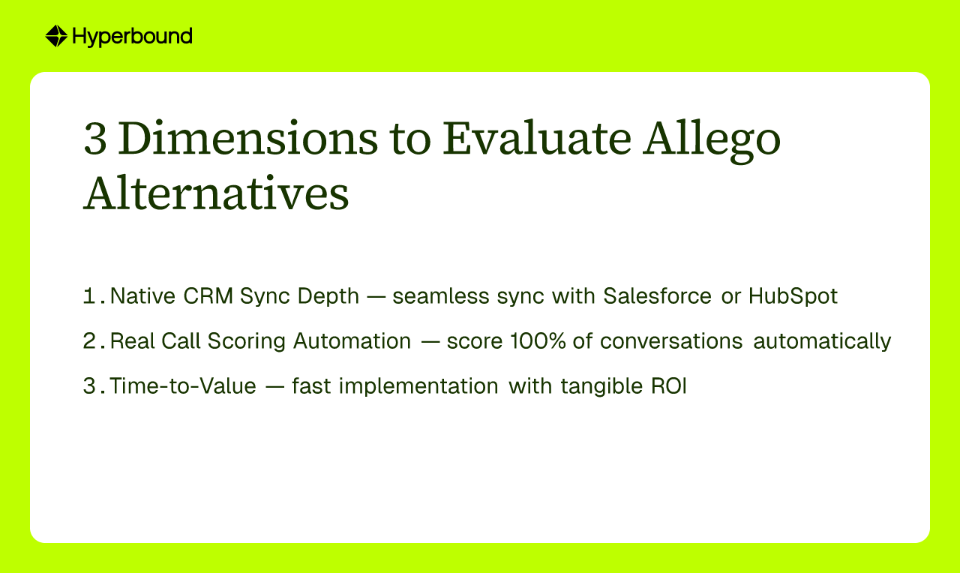
If you're evaluating Allego alternatives, the bar should be higher than just "does it have a CRM logo on the integrations page." This guide evaluates the best options across three dimensions that actually drive operational efficiency:
The best tools in this space have moved beyond passive "conversation intelligence" into what Hyperbound calls Revenue Activation—a category where you don't just analyze call data, you use it to change outcomes. Here are the top five Allego alternatives worth your attention.
CRM Integration Verdict: Excellent — native, bidirectional integrations with Salesforce and HubSpot, with Auto-CRM Fill that eliminates manual data entry entirely.
If there's one platform built specifically to close the gap between call analysis and revenue outcomes, it's Hyperbound. While most tools give you insights and leave the follow-through to you, Hyperbound's architecture is designed to turn what happens on a call directly into what happens next—in your CRM, in coaching, and in rep behavior.
Auto-CRM Fill is the standout feature for RevOps and enablement leaders exhausted by dirty CRM data. Hyperbound Perform listens to your actual sales conversations and automatically updates CRM fields—MEDDICC criteria, next steps, objections raised, key stakeholders, deal risks—without the rep lifting a finger. No more "Salesforce is the bane of my existence." The data your managers need is already there.
AI Real Call Scoring covers 100% of your team's conversations—not the 2–5% a manager might randomly review. That's not a small distinction. When managers only hear a fraction of calls, coaching becomes reactive and biased. Hyperbound scores every call against your custom methodology scorecard, so you get a consistent, complete picture of what's actually happening in the field.
But here's what separates Hyperbound from every other tool on this list: call scoring is tied directly to coaching and practice, with no manual workflow required. When Perform identifies a skill gap—say, a rep consistently fumbling pricing objections—Kota Activate automatically recommends a targeted AI roleplay in Hyperbound Practice to fix it. The loop closes itself: Score → Identify → Practice → Score again.
This is the Practice → Perform → Activate model, and it's what makes Hyperbound a true Allego alternative rather than just another call recording tool with a CRM logo on the integrations page.
Best for: Revenue teams who want to close the loop between call analysis and behavior change, automating CRM busywork while systematically improving rep performance.
Proof it works: Vanta used Hyperbound to cut ramp time by 60%—from 210 days down to 72—while scaling their BDR team 4x. Nivoda saw a 50% ramp reduction, 2x revenue YoY, and a 150% increase in demo conversion rates.
CRM Integration Verdict: Strong — robust data sync and deal intelligence that pushes call insights directly into CRM records.
Gong.io is the market standard for conversation intelligence, and for good reason. It captures and analyzes call data at scale, tracks topics and deal risks, and enriches CRM records with call summaries and engagement signals. With the launch of AI Trainer, Gong has also added AI roleplay capabilities — reps can practice against AI scenarios built from real customer interactions and receive scored feedback. If your primary need is a deep analytics layer on top of your pipeline with emerging practice capabilities, Gong delivers.
Where it differs from a purpose-built Revenue Activation platform: Gong's deepest strength remains conversation intelligence and CRM data enrichment. AI Trainer is a meaningful addition to the practice side, but the fully automated orchestration that connects real call scoring → deal risk → targeted practice assignment → behavior measurement on the next call isn't as tightly integrated as platforms built around that loop from the ground up. Coaching insights from scored calls still largely require a manager to interpret and act on them.
Best for: Enterprise teams who need powerful analytics, forecasting intelligence, and emerging AI roleplay capabilities in a single conversation intelligence platform.
CRM Integration Verdict: Good — context-aware content delivery within CRM workflows, though more focused on content access than call data sync.
Note: Highspot and Seismic announced a definitive merger agreement in February 2026. If you're evaluating Allego alternatives, be aware that Highspot is converging with Seismic into a single entity — evaluate based on the combined roadmap.
Highspot solves a real problem: getting the right content in front of reps at the right moment in the deal cycle. Its smart content recommendations surface relevant collateral based on CRM data like deal stage, industry, and persona. Digital Sales Rooms create trackable buyer-seller collaboration spaces, and engagement data flows back into your CRM.
The honest limitation: Highspot solves the "where is the content?" problem brilliantly. It doesn't solve the "why isn't my rep executing well on calls?" problem. As one practitioner put it, tools like these "solve the storage problem but not the actual problem, which is getting your reps the right info at the exact moment they need it"—and on a live call, that means rep skill, not a document link.
Best for: Organizations whose primary enablement challenge is content management, consistency, and delivery across a distributed sales team.
CRM Integration Verdict: Effective — connects readiness and training program data to CRM performance outcomes for a structured view of rep development.
Mindtickle is a comprehensive sales readiness platform with structured onboarding, AI roleplay capabilities, a Readiness Index that benchmarks rep competency against top performers, and Call AI for conversation intelligence on real customer calls — providing call scores, coaching recommendations, and deal health insights tied to CRM outcomes. If you need a platform to run formal training programs with measurable certification paths alongside real call analysis, Mindtickle checks a lot of boxes.
The differentiation comes down to the automation of the coaching loop. While Mindtickle offers both Call AI and roleplay in the same platform, the automated bridge between identifying a gap on a real call and triggering targeted practice for that specific gap requires more manual orchestration. Hyperbound is purpose-built around that automated loop, with buyer personas trained on 2M+ hours of real B2B sales conversations and Kota orchestrating the connection between call scoring and practice assignment.
Best for: Companies looking for a structured, comprehensive platform to run formal onboarding programs, certifications, and sales readiness measurement at scale.
CRM Integration Verdict: Good — as a sales engagement platform, it offers solid native CRM workflow integration, though call scoring depth is limited.
Salesloft sits in an interesting position as an Allego alternative because it combines outreach sequencing, call recording, and basic conversation intelligence in one platform. For teams who want to consolidate vendors, that's appealing. The CRM integration is solid for tracking engagement activity, and the built-in call recording feeds into basic analysis.
The trade-off is depth. Call scoring and coaching in Salesloft is functional, not specialized. It's an inch-deep, mile-wide solution when it comes to call analysis—useful for surface-level visibility but not the kind of granular, methodology-specific scoring that drives consistent behavioral change across a team.
Best for: Teams who want an all-in-one sales engagement platform and are comfortable with basic call intelligence as part of a broader outreach toolset.
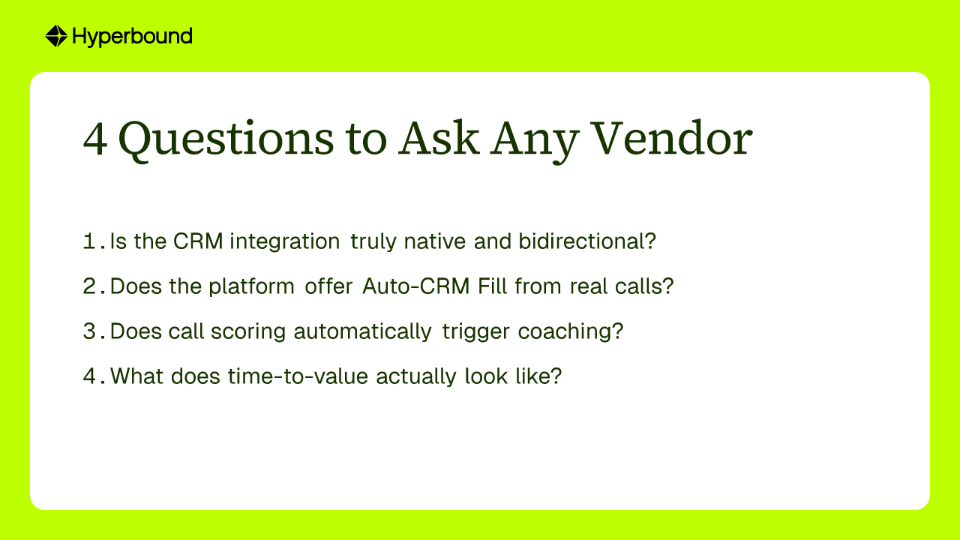
Before you sign another contract and discover the "integration" is just a Zapier workaround, use these four questions to pressure-test any vendor's CRM story. They'll also help you quickly identify whether a platform is built for operational depth—or just built to look good in a demo.
Ask: "Is your CRM integration truly native and bidirectional? Does it rely on a third-party connector like Zapier or Workato? Can you show me how custom fields are mapped and updated in real-time?"
A logo on an integrations page means nothing. What you need is a deep, seamless sync that maintains data integrity without constant maintenance. Ask to see field-level mapping—and specifically ask what happens when a call is recorded. Does data flow automatically into the opportunity record, or does someone have to push a button?
Ask: "Can your platform automatically listen to a sales call and update CRM fields—next steps, key objections, MEDDICC criteria—without the rep doing anything manually? Can I see that in a live demo?"
This is the test that separates true automation from theoretical integration. Manual CRM data entry is the single biggest driver of poor data hygiene and rep resentment. A platform that listens to calls and fills fields automatically—like Hyperbound Perform's Auto-CRM Fill—removes the friction that makes CRMs feel like "the bane of my existence" and turns them into accurate, real-time sources of truth.
Ask: "When your platform identifies a skill gap on a scored call—like weak objection handling—what happens next? Does the rep automatically receive a targeted coaching prompt or practice recommendation? Is that connected to the opportunity record in our CRM?"
Insights without a path to action are just dashboard decorations. A modern Revenue Activation platform should close the loop automatically: score → identify skill gap → recommend practice → improve → score again. If the answer is "a manager reviews the insights and assigns training manually," that's a red flag—it means the tool adds work instead of eliminating it.
Ask: "Walk me through your implementation playbook from contract sign to my team seeing results. What's a realistic timeline for the first rep to complete a scored call and receive coaching?"
A complex, multi-month implementation kills momentum and adds cost before you see a single benefit. For context: with Hyperbound, building a custom AI buyer persona and scorecard can be done in under 10 minutes, and most customers are realizing value within the first month—with a structured playbook that goes from planning call to official launch without requiring a dedicated implementation team.
Choosing the right Allego alternative isn't about swapping one tool for another—it's about upgrading the operational foundation of your revenue team. The biggest gains come from eliminating CRM friction, automating the rote work that slows reps down, and closing the loop between what you learn on a call and what actually changes in rep behavior.
Look for a platform that doesn't just generate insights, but activates your team—automatically filling your CRM from real conversations, connecting every scored call directly to coaching, and giving reps a realistic place to practice the specific skills they need to improve.
The primary issue with Allego's CRM integration is its lack of depth, which creates a disconnected data silo. This means critical information like call recordings, scoring insights, and coaching data doesn't automatically sync with your CRM. This forces reps into manual data entry, which reduces productivity and leads to incomplete or inaccurate CRM data.
Deep CRM integration is crucial because it creates a single source of truth and eliminates tedious manual work for sales reps. When an enablement tool syncs seamlessly with your CRM, it can automatically update deal information, log call outcomes, and connect rep performance directly to revenue outcomes. This leads to cleaner data, more accurate forecasting, and more time for reps to focus on selling.
Revenue Activation is the evolution of Conversation Intelligence (CI). While CI tools are great at analyzing call data to tell you what happened, Revenue Activation platforms use that data to automatically trigger actions that change future outcomes. This includes auto-updating your CRM, assigning targeted AI-driven coaching, and creating a closed loop between performance, practice, and results.
Automatic call scoring provides unbiased, consistent feedback on 100% of a team's conversations—not just the 2-5% a manager can manually review. This comprehensive data allows you to identify systemic skill gaps and winning behaviors. Advanced platforms like Hyperbound then use these scores to automatically recommend targeted coaching and AI practice exercises, allowing you to scale effective coaching without increasing manager workload.
Auto-CRM Fill is a feature that uses AI to listen to sales conversations and automatically update relevant fields in your CRM. For example, it can populate MEDDICC criteria, summarize next steps, log objections, and identify key stakeholders without the sales rep lifting a finger. This saves reps hours of administrative work and ensures your CRM data is always accurate and up-to-date.
Hyperbound differs by focusing on automatically closing the loop between call analysis and rep behavior change. While Gong excels at conversation analytics and has recently added AI Trainer for roleplay practice, Hyperbound's Practice → Perform → Activate model provides a fully automated orchestration layer (Kota) that connects call performance directly to targeted coaching and AI practice — without requiring a manager to interpret insights and manually assign training. It is built to be a Revenue Activation platform, using call insights to drive automated actions that directly impact performance and revenue.
Ready to see how a Revenue Activation Platform connects call scoring, coaching, and your CRM into one seamless workflow? Explore Hyperbound Perform →










Use Cases
Legal