
Discovery calls are the single biggest variable in whether a deal advances or dies. A rep who asks sharp, layered questions builds instant credibility and momentum; a rep who fumbles the first 20 minutes rarely recovers. Yet the dominant training method in most sales orgs is still "learn by doing"; meaning reps are burning real pipeline to get better, one awkward call at a time. The cost is high: wasted budget, lost deals, and ramp times that stretch across quarters.
A new generation of AI roleplay tools is changing how reps prepare. But not all tools are built the same. Sales professionals on Reddit have flagged the core problem with most of them: they feel "unrealistic for B2B sales role-playing" because "prospects often ask unexpected questions or take the conversation in different directions, which it doesn't really handle well." Others complain that generic AI "just agrees and tells me why I'm right" — which makes for zero-pressure practice that doesn't translate to real-world readiness.
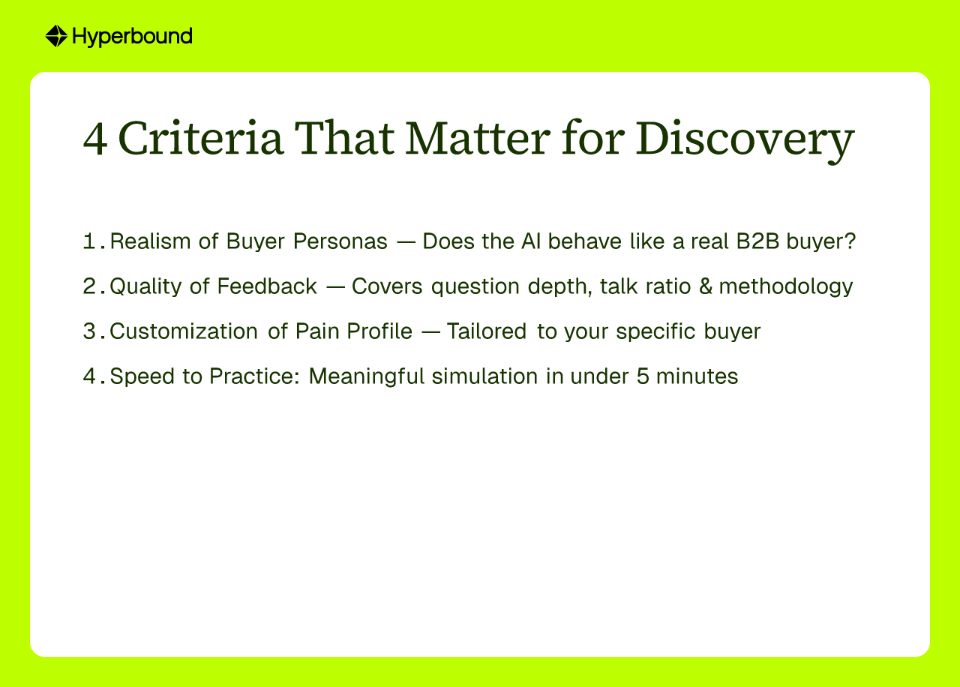
This article cuts through the noise and evaluates the top AI roleplay tools specifically for discovery call preparation. We assessed each tool across four criteria that actually matter for discovery:
Best for: Teams that want to close the gap between training and revenue outcomes.
Hyperbound Practice earns the top spot because it was built to solve the exact problems that plague generic roleplay tools — robotic personas, shallow feedback, and scenarios that don't mirror real deals. Here's how it stacks up across each criterion:
Realism of Buyer Personas: Hyperbound's AI buyer personas are built from analysis of real B2B sales patterns, not curated scripts or public datasets. The platform has delivered 2M+ hours of simulated calls, and that volume of practice has produced buyer behavior that adapts dynamically — skepticism, follow-up questions, pivots to different concerns, the way a real B2B buyer would. This is what separates a persona that builds genuine muscle memory from one that just validates whatever the rep says. And it is the reason Hyperbound Practice is the entry point into the broader Revenue Activation Platform: reps do not just practice in isolation; they are building skills that feed into a continuous loop of scoring real calls, identifying gaps, and closing them before the next opportunity.
Quality of Feedback: Hyperbound's AI Scorecards go well beyond talk-listen ratios. For discovery calls specifically, they track question depth, open-ended vs. closed question ratios, and adherence to sales methodologies like MEDDIC or BANT. These are the metrics no generic roleplay tool tracks — and they are the exact metrics that separate average discovery from elite discovery. Managers can use scorecards to certify reps on playbook execution at scale, tying training directly to the behaviors that drive closed-won deals.
Customization of Pain Profile: Reps can build a "digital twin" of a specific buyer directly from their LinkedIn profile, using Hyperbound's LinkedIn Chrome Extension. This means a rep preparing for a call with a VP of Engineering at a fintech company can practice against a persona with the exact title, company context, and likely pain points they'll face on the actual call, not a generic placeholder. Hyperbound also supports Multiparty Roleplays, letting reps practice discovery calls that include multiple stakeholders simultaneously (e.g., an economic buyer and a technical champion in the same session).
Speed to Practice: For experienced reps who don't need full certification runs, Bitesized Roleplays offer short, focused practice on a single scenario or objection — ideal for a 5-minute warm-up before a high-stakes discovery call. The LinkedIn Chrome Extension also makes it easy to launch a practice session directly from a prospect's profile without switching tools.
The proof points are hard to argue with: Vanta reduced ramp time by 60% (from 210 to 75 days), Nivoda saw a 150% increase in DM-to-demo conversion rates, and LinkedIn deployed it to over 3,000 sellers across three business units. With a 4.9/5 rating on G2 and 2M+ hours of simulated calls delivered, Hyperbound is the clearest choice for teams serious about mastering discovery.
Best for: Teams looking for a dedicated roleplay platform with decent customization.
Second Nature has built a reputation as a conversational AI roleplay tool that allows for free-flowing practice sessions without rigid script structures. Its key strength is the ability to create personalized buyer personas from URLs and configure scenarios around specific products or industries. Users on Reddit have noted that it "scores my performance, gives me feedback" — which makes it a step above basic AI chatbots for structured improvement.
Where it falls short for discovery call prep is depth of feedback specificity. The platform doesn't publicly detail training on a comparable corpus of real B2B call data, which means persona behavior can feel more generic under pressure. For teams with less demanding discovery training needs, it's a reasonable shortlist contender — but the gap in question-quality analysis and methodology-specific scoring is real.
Best for: Reps who benefit from audio realism and voice-based practice environments.
PitchMonster differentiates itself through voice cloning technology, creating an immersive, lifelike audio experience that makes practice feel closer to an actual phone call. The AI is designed to be context-aware, adapting responses as the conversation develops rather than following a static logic tree.
The caveat for discovery-focused teams is in the name itself: this platform is optimized for pitching and delivery, not the art of deep inquiry that defines a great discovery call. Discovery is about asking better questions and uncovering latent pain; feedback loops that primarily assess pitch effectiveness and engagement metrics won't sharpen a rep's ability to diagnose a buyer's real problem. Good for pre-call confidence and delivery practice, less powerful for building discovery discipline.
Best for: Organizations already running Highspot as their core enablement platform.
Highspot's AI Role Play module fits neatly inside a broader enablement ecosystem that includes content management, guided selling, and deal intelligence. For teams already using Highspot, the integration means skills practice and content readiness live in the same environment, reducing tool sprawl.
For discovery call preparation specifically, the trade-off is simulation depth. As a feature within a larger platform, its AI roleplay layer doesn't carry the same specialization as purpose-built tools. The AI buyer personas aren't anchored to a proprietary corpus of real B2B discovery conversations, and the scorecards — while useful — aren't calibrated to the specific question-quality and methodology dimensions that matter most for discovery. A good option if platform consolidation is the priority; less ideal if elite discovery coaching is the primary goal.
Best for: Analyzing what happened after real calls, not preparing before them.
Gong is a widely-used conversation intelligence platform that surfaces talk ratio data, deal risk signals, and keyword trends from recorded calls. It analyzes what happened after the fact — which is genuinely useful context for managers.
The critical gap for discovery call preparation: Gong is reactive, not proactive. It tells you what went wrong after the fact. It does not give reps a risk-free environment to build the muscle memory and question discipline they need before they get on the call. Gong is "a giant library of data" — and that's genuinely valuable. But data alone does not change rep behavior on the next call. For teams using Gong today, Hyperbound actually integrates directly with it, turning Gong's call analysis into targeted practice scenarios that close the skill gaps Gong identifies. The two tools are complementary, not redundant.
Discovery call performance is a skill. And like every skill, it degrades without deliberate practice and sharpens with the right kind of repetition. The gap isn't effort — most reps genuinely want to improve. The gap is the quality of the practice environment they're given.
Of the tools evaluated here, Hyperbound Practice is the clear standout for 2026. Its AI buyer personas built from analysis of real B2B sales patterns and refined across 2M+ hours of simulated calls, its discovery-specific AI Scorecards that track question depth and methodology adherence, and its persona customization via LinkedIn make it the only platform that prepares reps for the version of discovery that actually happens, not the idealized version. And unlike point-solution roleplay tools, Hyperbound Practice connects to a broader Revenue Activation system: score real calls in Perform, identify the skills costing you deals, practice the fix in Practice, and close the loop with real-call scoring again. Whether for onboarding a new class of SDRs or for sharpening a tenured AE's opening questions before a high-value meeting, Hyperbound has the tooling to make that practice count.
The future of high-performing sales teams is not more pipeline reviews or more call recordings to ignore. It is a continuous cycle: score real calls, identify the specific skill gaps costing deals, use targeted AI roleplays to close those gaps before the next opportunity, then score again to verify improvement. That cycle — Practice, Perform, Activate, repeat — is what Hyperbound calls Revenue Activation. And it is what separates a roleplay tool from a platform that actually moves win rates. For teams that master the discipline of discovery as part of that cycle, the result is not a one-time bump; it is a compounding advantage.
An AI roleplay tool for sales is a software platform that allows sales representatives to practice conversations with an AI "buyer" in a risk-free environment. It simulates real-world scenarios, like discovery calls or objection handling, providing reps with instant feedback on their performance. Unlike traditional roleplay with managers, these tools are available on-demand and can scale training across an entire organization, helping reps build muscle memory and confidence before engaging with actual prospects.
Realistic practice is crucial because real B2B buyers are unpredictable, often asking unexpected questions or raising objections that are not in a script. If a practice environment is too agreeable or "robotic," it fails to prepare reps for the pressures and dynamics of a live call. AI tools built from analysis of real B2B sales patterns, refined through millions of hours of simulated calls, create this realism, building the reflexes needed to handle skepticism, pivots, and tough questions effectively, which is the key to advancing a deal.
The best AI roleplay tools create realistic buyer personas by building their AI from analysis of real-world B2B sales patterns, not generic scripts. This approach, refined through millions of hours of simulated practice, allows the AI to reproduce the nuances of how real buyers behave — their skepticism, specific pain points, and tendency to deviate from the expected path. Top-tier tools also allow for deep customization, enabling reps to create a "digital twin" of a specific prospect using information from their LinkedIn profile for highly targeted practice.
Look for feedback that goes beyond basic metrics like talk-listen ratio and analyzes the quality of the conversation itself. For discovery calls, the most valuable feedback focuses on surgical details like question depth (are questions open-ended?), adherence to sales methodologies (like MEDDIC or BANT), and the ability to uncover pain points. Tools with customizable AI Scorecards provide this level of insight, allowing managers to measure and coach the specific behaviors that lead to successful outcomes.
An AI roleplay tool is a proactive practice environment, while a conversation intelligence tool like Gong is a reactive analysis tool. Gong is excellent for analyzing recorded calls to see what went right or wrong after the fact. An AI roleplay tool provides a risk-free space for reps to practice and build skills before a high-stakes call. The two are complementary; insights from Gong can be used to create targeted practice scenarios in a tool like Hyperbound to close skill gaps proactively.
The main benefits include faster ramp times for new hires, increased conversion rates on key funnel stages like demos, and standardized playbook execution across the entire team. By providing a scalable and consistent practice environment, these tools help reps master discovery skills more quickly, leading to better pipeline generation and more closed deals. Companies using these tools have seen tangible results like a 60% reduction in ramp time and a 150% increase in DM-to-demo conversion rates.










Use Cases
Legal