
If you've ever stared at a sales dashboard crammed with insights nobody acts on, you already understand the core problem with most AI sales enablement tools today: they're excellent at telling you what went wrong, and nearly useless at helping your reps fix it.
The landscape has never been more crowded. According to sales professionals on Reddit, most platforms end up as "fancy content dumping grounds" — they solve the storage problem, but not the actual problem: getting your reps the right information, in the right format, at the exact moment they need it. Info stays scattered across Google Docs, CRM fields, and Slack threads, while reps keep burning pipeline on preventable mistakes.
This guide cuts through the noise. We've segmented the top 8 ai sales enablement tools for 2026 by primary use case — AI roleplay and coaching, conversation intelligence, content delivery, revenue orchestration, and native CRM AI — and evaluated each one through a single lens:
Does this tool help reps practice and improve, or does it just report?
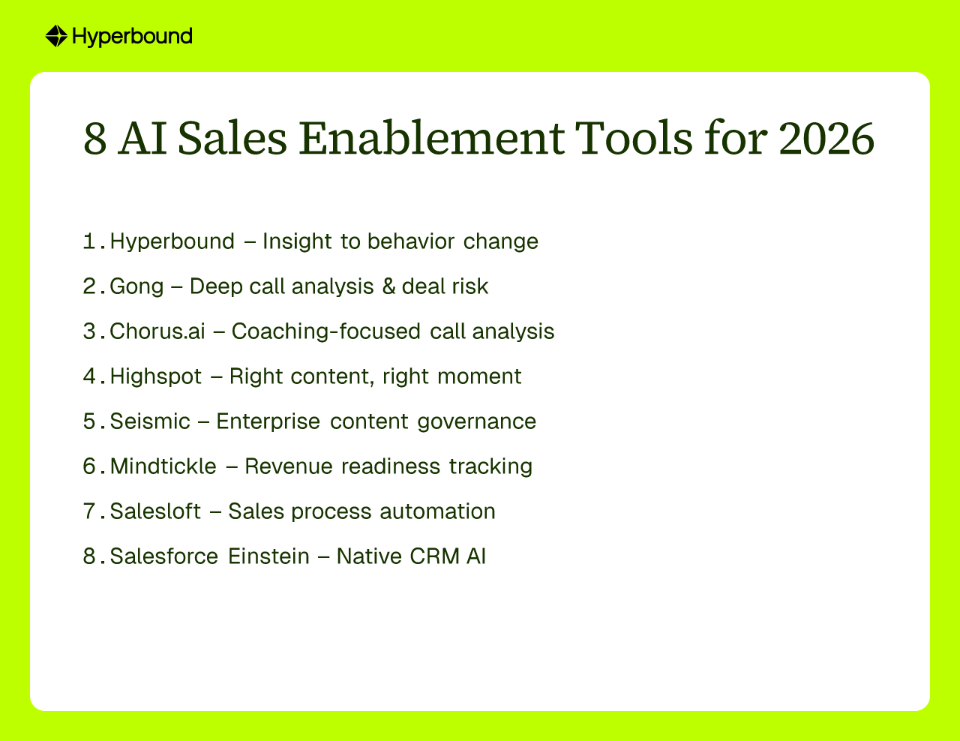
That distinction matters more than any feature checklist. Let's get into it.
Best for: Closing the loop from insight to behavior change
Most tools stop at the insight. Hyperbound is built for what comes next.
Hyperbound pioneered the "Revenue Activation" category — a term that describes what happens when teams stop just analyzing call data and start using it to change outcomes. The platform connects real sales conversation analysis directly to a targeted practice environment, creating a continuous improvement cycle: Score Real Calls → Identify Skill Gaps → Practice Roleplays → Score Real Calls.
The proof points are hard to ignore. Vanta's CRO Stevie Case reported a 60% reduction in ramp time (from 210 days down to 72) alongside a 5x increase in pipeline after deploying Hyperbound. LinkedIn rolled it out across 3,000+ sellers spanning three business units in NAMER and EMEA. Nivoda saw a 50% ramp reduction, 2x revenue growth YoY, and a 150% increase in demo conversion rates.
Hyperbound's product suite runs across three interconnected layers:
Hyperbound Practice is the entry point — and the engine room for skill-building. AI buyer personas are trained on over 2 million hours of real B2B sales conversations, meaning reps aren't practicing against a scripted bot. They're going up against dynamically responsive personas that push back, go off-script, and behave like real buyers. Scenarios cover cold calls, discovery, demos, objection handling, renewals, upsells, and more. Bitesized Roleplays solve the tenured rep problem: short, focused sessions that don't feel like generic onboarding repackaged. And with support for 25+ languages, global enterprise teams can practice in the rep's native language or in the prospect's.
Hyperbound Perform takes real call data and turns it into deal-level intelligence. Unlike tools that analyze calls in isolation, Perform rolls up insights across every touchpoint in a deal — from first cold call to close — to surface what's actually helping or hurting momentum. AI Real Call Scoring automatically evaluates 100% of customer conversations against your methodology. The Auto-CRM Fill feature directly addresses one of the biggest rep complaints: that CRMs "slow down productivity" and become a burden rather than a tool.
Kota Activate is the orchestration layer that sits above both. Kota acts as an AI Revenue Analyst — ingesting data from Practice and Perform simultaneously, then recommending personalized coaching interventions at the right time to convert strategic insights into closed-won outcomes.
Evaluation verdict: Hyperbound is the only platform on this list that fully closes the loop from insight to behavior change. It doesn't just report on performance; it creates a scalable, repeatable practice engine anchored in real call data.
Best for: Deep call analysis and deal risk flagging
Gong is the established market leader in conversation intelligence. It records and analyzes sales calls at scale, flags deal risks, surfaces competitor mentions, and generates coaching recommendations based on actual call data. For managers who want to understand what's happening in their pipeline, it's one of the most powerful tools available.
The limitation is well-documented: Gong tells you what happened, but bridging the gap between that insight and actual rep behavior change still depends on managers. With most frontline managers spending only 5–8% of their time on coaching, that bridge often doesn't get built. Gong feeds insights into a human process that doesn't always scale.
Evaluation verdict: Outstanding at generating insights. Relies on managers to translate those insights into improved rep behavior — which doesn't scale consistently.
Best for: Coaching-focused call analysis at scale
Chorus.ai, now part of ZoomInfo, shares similar DNA with Gong — call transcription, trend identification across the team, and surfacing coaching opportunities based on communication patterns. It's particularly useful for managers who want a structured view of team-wide performance without listening to hours of calls.
Like Gong, the core gap is the same: it identifies coaching moments, but the mechanism for acting on them is manual. Reps can't self-correct at scale, and the coaching quality depends entirely on the manager's availability and skill.
Evaluation verdict: Strong for manager-assisted coaching. Falls short of closing the loop into rep practice and self-improvement.
Best for: Getting the right content to reps at the right moment
Highspot is one of the most respected names in sales enablement for a reason. It directly tackles the pain that many teams know too well: information scattered across Google Docs, CRM records, and random Slack threads. Highspot centralizes that content, uses AI to surface the right asset based on deal context, and tracks buyer engagement so reps know what's landing.
Where it falls short is the conversational layer. Highspot helps reps with what to share — the right deck, the right case study, the right battlecard. It doesn't help reps practice how to talk about it, handle the objections that follow, or navigate the live conversation with confidence.
Evaluation verdict: Best-in-class for content delivery and knowledge management. Reports on content usage but doesn't build conversational muscle memory.
Best for: Enterprise-scale content governance and message consistency
Seismic operates at the enterprise end of the content management spectrum. It excels at ensuring message consistency across large, distributed sales teams — dynamic content libraries, AI-driven recommendations, and buyer engagement tracking built for organizations where content sprawl is a real operational risk.
Like Highspot, Seismic is fundamentally a knowledge transfer platform. It equips sellers with the right information. But information and execution are two different things. A rep who knows the right answer and a rep who can confidently deliver it under pressure in a live conversation are not the same rep.
Evaluation verdict: Powerful for content governance and ensuring reps have what they need. The final step — applying that knowledge in a high-stakes conversation — isn't its core focus.
Best for: Comprehensive revenue readiness tracking
Mindtickle brands itself around "Revenue Readiness" — a broad platform covering onboarding, training, coaching, and roleplay simulations within one suite. It includes AI-assisted role-play as part of its offering, which puts it closer to the practice-and-improve end of the spectrum than most tools in this category.
The trade-off is depth. Because Mindtickle is a broad readiness platform rather than a purpose-built AI roleplay engine, its simulation fidelity may not match what a specialized tool can offer. AI buyer personas that are genuinely trained on millions of hours of real B2B conversations require a level of focus and model training that generalist platforms haven't fully replicated.
Evaluation verdict: A solid all-in-one for teams that want readiness tracking alongside basic roleplay. May not deliver the simulation depth needed for high-stakes skill development.
Best for: Sales process automation and workflow management
Salesloft is a revenue orchestration platform built to streamline how sellers engage throughout the entire sales lifecycle. Its Rhythm AI engine prioritizes seller actions, automates multi-channel sequences, and combines conversation intelligence with forecasting signals. For teams that struggle with "keeping everything organized across multiple tools," Salesloft is one of the better solutions for centralizing the workflow.
The key distinction: Salesloft is exceptional at improving sales process efficiency. It ensures the right outreach happens at the right time. What it doesn't address is the quality of the conversation that happens inside that process. Automating more touchpoints doesn't help if the calls themselves aren't improving.
Evaluation verdict: Outstanding for workflow automation and sales process discipline. Not designed to improve the quality of rep conversations through practice.
Best for: AI-driven intelligence inside your existing CRM
Salesforce Sales Cloud with Einstein AI brings predictive scoring, automatic activity capture, and deal health signals directly into the CRM that most enterprise teams are already using. For reps who feel like the CRM is the "bane of their existence," Einstein at least attempts to reduce the manual burden and surface actionable priority signals.
The honest assessment: Einstein makes Salesforce smarter, but it's still fundamentally a reporting and prioritization tool. It helps you identify which deals to focus on. It doesn't help you improve how you execute on those deals. It's an analytical layer, not a skill development platform.
Evaluation verdict: Best for prioritizing effort within your existing CRM stack. Delivers no mechanism for improving rep conversation quality or building skills at scale.
The 2026 AI sales enablement market will continue to produce beautiful dashboards, compelling demos, and feature lists a mile long. Most of it will not move your revenue number.
Before evaluating another platform, ask yourself one question:
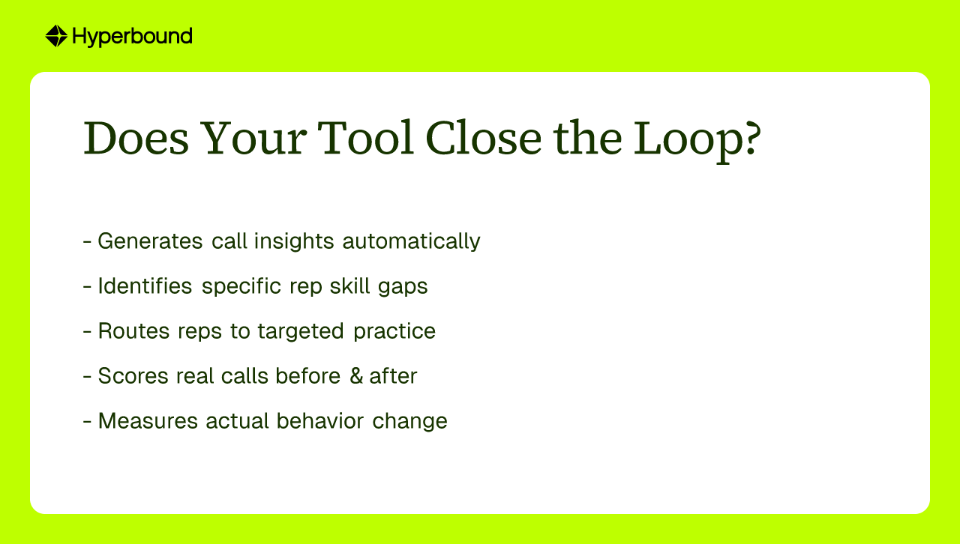
Does this tool close the loop from insight to behavior change?
Here's what that loop actually looks like in practice:
The tools that generate insights but leave behavior change to chance are not enablement platforms — they're expensive reporting suites.
The tools that close the loop — that connect what happened on a real call to a targeted, repeatable practice environment, and then measure whether the behavior actually changed — those are the ones worth investing in.
Research consistently shows that 80% of training content is forgotten within 30 days. The only antidote to that forgetting curve is spaced repetition and deliberate practice tied to the actual scenarios your reps are facing right now. That's not a content problem. It's an activation problem.
Only one platform on this list is purpose-built to solve that activation problem end-to-end. Hyperbound scores your real calls, identifies the specific skill gaps holding deals back, routes reps to targeted practice, and then scores the next round of real calls to measure whether anything changed. That's not a feature. That's a revenue system.
If your team is still buying insights without building a mechanism for acting on them, you're not enabling your sellers — you're just watching them lose in HD.
AI sales enablement tools are software platforms that use artificial intelligence to help sales teams sell more effectively. They cover a wide range of functions, from analyzing sales calls (conversation intelligence) and managing sales content to automating workflows and practicing sales conversations. The most advanced tools go beyond simply providing data and insights; they create systems to actively improve seller skills and behaviors, directly impacting revenue.
Conversation intelligence tools analyze past conversations to tell you what happened, while AI roleplay tools create a practice environment for reps to improve how they handle future conversations. Tools like Gong and Chorus.ai are excellent for generating insights from real call data—flagging deal risks or identifying coaching moments. However, they rely on managers to manually translate those insights into behavior change. AI roleplay platforms like Hyperbound close this loop by using those insights to create targeted, repeatable practice scenarios, allowing reps to build conversational muscle memory and measurably improve their skills.
AI-powered roleplay is effective because it provides a scalable, consistent, and safe environment for sales reps to practice real-world scenarios and receive instant, unbiased feedback. Traditional roleplay is often inconsistent and time-consuming for managers. AI roleplay solves this by offering on-demand practice against dynamic AI personas trained on real B2B conversations. This allows reps to master their talk tracks, handle objections, and build confidence before engaging with actual buyers, directly combating the "forgetting curve" where 80% of training is lost without reinforcement.
Hyperbound improves sales performance by creating a continuous feedback loop between real-world call analysis and targeted AI-driven practice. It's a three-step cycle: 1) It analyzes 100% of a team's real sales calls to identify specific skill gaps. 2) It automatically routes reps to AI roleplay scenarios designed to fix those exact gaps. 3) It then scores their subsequent real calls to measure tangible behavior change. This "Insight to Behavior Change" loop has been shown to dramatically reduce ramp time, increase pipeline, and boost conversion rates.
No, native CRM AI like Salesforce Einstein is primarily an analytical tool, not a skill development platform. CRM AI is designed to make your existing system smarter by prioritizing leads, flagging at-risk deals, and automating data entry. It helps your team identify where to focus their efforts. However, it doesn't help them improve how they execute in those high-stakes conversations. It provides the "what," but not the "how," leaving a critical gap in rep development and performance.
The most important question to ask is: "Does this tool close the loop from insight to behavior change?" Many tools offer compelling dashboards and reports (insights), but very few provide a mechanism for reps to act on that information and improve (behavior change). Look for a platform that not only analyzes what happened on past calls but also provides a targeted, scalable way for reps to practice and demonstrably improve their skills for future calls. An expensive reporting suite is not an enablement platform.








Use Cases
Legal