
You're supposed to be a player-coach — the manager who runs pipeline reviews in the morning, closes deals in the afternoon, and still finds time to develop your team. But if you're being honest, coaching is the first thing that gets cut when the calendar fills up.
And the data backs that up. Sales managers spend just 5–8% of their time on actual coaching, and most are listening to less than 1% of their team's recorded calls. That means you're flying blind on 99% of conversations — and losing deals you'll never fully diagnose.
Meanwhile, the pressure hasn't let up. The average sales manager now oversees 12.1 reps, making manual call review mathematically impossible. And 38% of reps report receiving little to no coaching at all — even when 90% of sales leaders claim they coach monthly.
The frustration is real. As one sales manager put it on Reddit: "I am looking for how to improve rep skill gaps not just on a deal or call. Then help me recommend what to change across all rep calls." That's not a feature request — that's a manager who's exhausted by tools that surface problems without solving them.
Most AI coaching tools make this worse, not better. They dump more call transcripts into your lap and call it "insight." But more data to review isn't what you need — you need a system that multiplies your coaching impact without multiplying your hours.
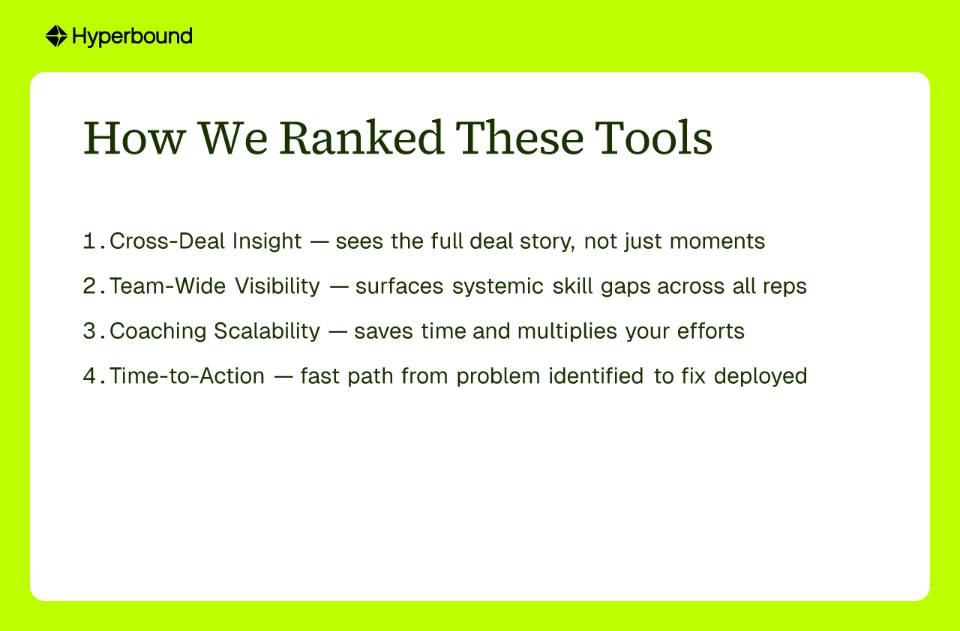
This list is ranked by one criteria: direct impact on your workflow as a manager. Specifically:
Here are the 7 best AI coaching tools for sales managers in 2026, ranked by impact.
Why it's #1: It's the only platform that closes the entire coaching loop — from skill gap identification, to targeted practice, to deal-level coaching — all orchestrated by a single AI layer.
Most tools do one thing well. Hyperbound does three, and connects them. Its Practice → Perform → Activate triangle is built specifically for the manager who needs to change outcomes, not just observe them.
Practice lets you stop running repetitive roleplays and start assigning hyper-realistic AI role-playing scenarios your reps will actually learn from. The AI buyer personas are trained on 2M+ hours of real B2B sales conversations — not generic scripts — so reps practice against scenarios that mirror their actual deals. Managers can build digital twins of specific buyers from LinkedIn profiles, create custom scorecards aligned to their methodology, and run certifications to verify reps are message-ready before they touch live pipeline.
Perform is the game-changer for deal coaching. Instead of randomly sampling calls and hoping you catch something, Hyperbound Perform analyzes all touchpoints across an entire deal — calls, emails, stakeholder interactions — to give you a true picture of deal health. The AI Deal Coaching dashboard surfaces early risk signals, tracks where momentum is stalling, and answers the question managers actually need answered: "What's really happening in this deal, and what should my rep do next?"
Kota (Activate) sits above both products as your AI Revenue Analyst. Available directly in Slack or Teams, Kota analyzes your full pipeline simultaneously, references historical closed-won and lost patterns, and recommends specific coaching interventions. Ask it, "Which reps are struggling with pricing objections on mid-stage deals?" and it doesn't just answer — it can automatically create a targeted roleplay for that rep and assign it, right from the conversation thread.
Proof point: Hyperbound saves managers an average of 3.5 workweeks of coaching time per year by automating call reviews and surfacing the coaching moments that matter most. Vanta used this closed-loop system to achieve a 60% reduction in ramp time — dropping from 210 days to 72 — while growing their BDR team 4x and driving 5x pipeline growth.
Best for: Managers who want to build a scalable coaching engine that directly connects skill development to win rates and revenue — not just a reporting dashboard.
Gong helped pioneer the conversation intelligence category and is used as a system of record for customer conversations at many large organizations. It provides a deep archive of call data with powerful search functionality.
For managers, Gong is best used for building libraries of best-practice call snippets, identifying talk patterns across your team, and running structured deal inspection in pipeline reviews. It excels at answering what happened on a specific call.
The gap, though, is significant. Gong is fundamentally an analysis tool — a "giant library of data" that surfaces coaching moments but has no native, integrated AI practice environment to actually fix them. The gap between insight and action is left entirely to the manager to bridge manually. One Reddit user summed it up: "Gong is the market leader and great if you're a larger org with the budget for it" — with that budget often running into six-figures annually, making it inaccessible for many growing teams.
Best for: Enterprise teams with dedicated sales enablement functions that need a robust call analysis platform and have the resources to build their own coaching programs around the data.
Chorus is a strong Gong alternative that layers ZoomInfo's B2B contact and company data directly onto call analysis. For managers, this means you get richer context about who your reps are actually talking to alongside the conversation transcript.
It records, transcribes, and analyzes calls in a familiar way, and the ZoomInfo data enrichment can help frame coaching conversations with better buyer intelligence. If your team is already deeply embedded in the ZoomInfo ecosystem, the integration creates genuine workflow efficiency.
The limitation is familiar: like Gong, Chorus is primarily an analysis tool. It highlights what was said, but doesn't provide a native practice environment to systematically build the skills to say it better next time. Coaching remains largely manual.
Best for: Sales teams already running ZoomInfo who want to add a layer of conversational intelligence to their existing data stack without adding a separate tool.
Outreach Kaia and Salesloft Rhythm represent a meaningful evolution in sales coaching: embedding guidance directly into the platforms where reps already work. Rather than coaching after the fact, these tools surface real-time content cards, battle cards, and objection handling prompts during a live call.
For managers overseeing high-volume SDR and BDR teams, this can seem useful. The "whisper" features let you listen in live and feed real-time guidance to a rep mid-conversation without the prospect hearing. It can serve as a temporary crutch to rescue a call that's going sideways.
The limitation is that this approach is tactically reactive rather than strategically developmental. It helps win this conversation but does less to build the foundational skills that make reps consistently strong across every conversation. It's more of a performance aid than a development platform, and the cross-deal, team-wide skill analysis that managers actually need is largely absent.
Best for: High-volume SDR and BDR teams who need immediate, real-time guidance within their prospecting workflow and are already running Outreach or Salesloft as their SEP.
Clari Copilot occupies a unique niche: it connects conversation analysis directly to revenue forecasting. If your biggest pain as a manager is walking into pipeline reviews with unreliable data and optimistic rep updates, Clari Copilot attempts to solve this problem.
It analyzes call data to identify deal risk signals and feeds those signals directly into Clari's forecasting engine. The result is a more defensible pipeline review — one grounded in what buyers are actually saying, not just what reps are entering into the CRM.
Where it differs from a true coaching platform is intent. Clari Copilot is designed primarily for forecast accuracy, with rep development as a secondary benefit. It's better at flagging which deals are at risk than systematically building the skills to rescue them. Managers who need granular coaching at the rep level will find it less comprehensive than purpose-built AI coaching tools.
Best for: Sales leaders and managers in enterprise organizations where pipeline predictability and forecast accuracy are the top priority and coaching is managed through a separate system.
Mindtickle is a leader in the broader sales enablement and readiness category, particularly for organizations that need structured, curriculum-based learning at scale. If you're onboarding dozens of reps at once or rolling out a major messaging change, Mindtickle gives you a structured framework to build and deploy those programs.
Its video role-play features, quizzes, and certification workflows are well-suited to standardized onboarding. Managers can track completion, knowledge scores, and readiness benchmarks across a distributed team — visibility that's hard to get from informal coaching alone.
The gap shows up when you move beyond structured training into the messy, deal-specific coaching that frontline managers actually need day-to-day. Mindtickle's practice simulations are designed for knowledge reinforcement but are far less dynamic than the AI scenarios in platforms like Hyperbound. This makes it more of a knowledge-check tool than a true skill-building environment where reps can practice against realistic buyer objections tied to live deals.
Best for: Enablement teams focused on scaling standardized onboarding, certification programs, and new product launch training across large, distributed sales forces.
Salesken takes real-time guidance to its logical extreme: live, on-screen AI cues that tell reps what to say as the conversation unfolds. It analyzes the call in real time and surfaces suggested responses, talking points, and next steps based on what the prospect is saying.
For transactional inside sales teams or contact centers where message consistency is critical and calls follow a more predictable pattern, this can improve performance in the short term. Managers benefit from the conversation analytics and scoring that come out of each call.
The concern worth flagging: over time, real-time prompting can create dependency rather than capability. Reps who rely on on-screen cues during every call may not be developing the critical thinking and conversational instincts that drive performance when the AI isn't there. Long-term skill development and cross-deal coaching depth are less emphasized.
Best for: High-volume, transactional inside sales teams or contact centers where message consistency and on-the-spot support take precedence over deep skill development.
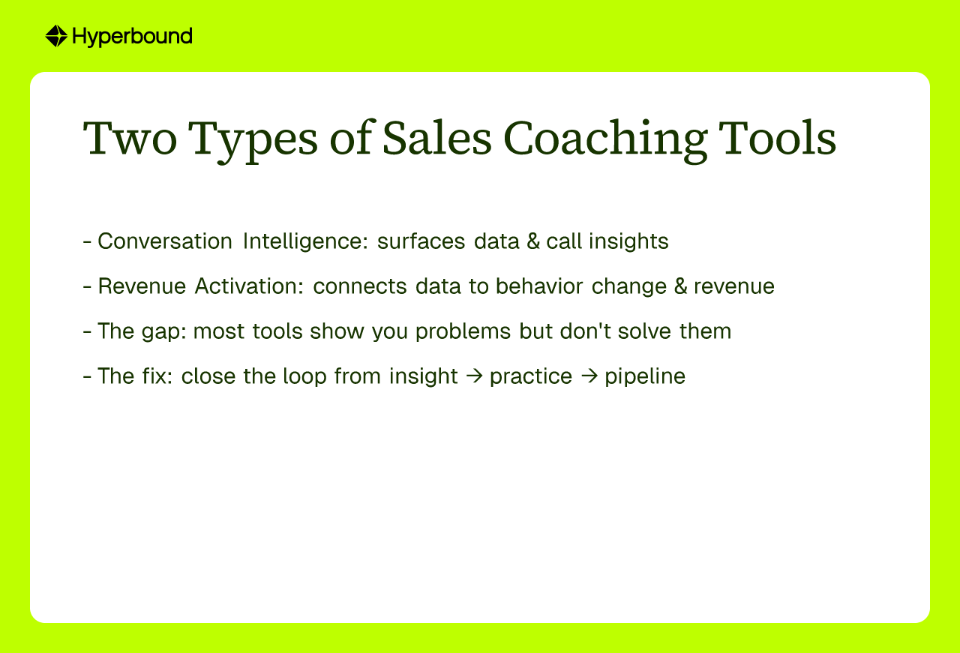
The sales coaching landscape has quietly split into two camps. The first camp — call recording and conversation intelligence tools — gives you more data to analyze. The second camp — Revenue Activation platforms — connects that data directly to changed behavior and closed deals.
Most managers don't need another call recording tool. They need a system that multiplies their coaching impact without multiplying their hours. The tools at the bottom of this list are valuable, but they still leave the hardest part — turning insight into skill, and skill into pipeline — entirely up to you.
That's the gap Revenue Activation closes. Record real calls, score them automatically, identify the skill gaps holding your team back, build those skills through targeted practice, and let AI orchestrate the right coaching intervention at the right time. Rinse, repeat — across every rep, every deal, every quarter.
The proof is in the outcomes: Vanta cut ramp time by 60%. Nivoda doubled revenue year-over-year while increasing demo rates by 150%. And managers using the full Hyperbound loop reclaim an average of 3.5 workweeks of coaching time per year — time that goes back into the deals, conversations, and development that actually move the number.
An AI sales coaching tool is a software platform that uses artificial intelligence to analyze sales conversations, identify rep skill gaps, and automate coaching workflows. These tools help sales managers scale their coaching efforts by moving beyond manual call reviews to provide data-driven insights and targeted training for their entire team.
Manual call review is ineffective because it is not scalable. With managers overseeing an average of 12 reps, it's mathematically impossible to listen to a meaningful percentage of calls. This means managers often have visibility into less than 1% of their team's conversations, forcing them to coach based on incomplete data and gut feelings rather than systemic patterns.
Conversation Intelligence (CI) tools focus on recording, transcribing, and analyzing sales calls to tell you what happened. Revenue Activation platforms take this a step further by connecting those insights directly to actions that change behavior and drive revenue. They close the loop from identifying a skill gap to providing targeted practice (like AI role-plays) and deploying deal-level coaching to improve outcomes.
AI helps identify team-wide skill gaps by analyzing 100% of sales conversations—including calls and emails—across the entire team. It can spot systemic patterns, such as reps consistently struggling with pricing objections or failing to establish next steps. This allows managers to move from ad-hoc, individual feedback to strategic, team-wide coaching programs that address the root cause of performance issues.
Yes, AI coaching tools can significantly reduce sales rep onboarding and ramp time. By providing a platform for new hires to practice realistic sales scenarios with AI buyer personas, they can build skills and confidence before ever speaking to a live prospect. Platforms like Hyperbound have been shown to cut ramp time by over 60% by providing structured, scalable practice and certification.
The most important features are those that directly impact a manager's workflow and multiply their coaching impact. Key features to look for include:
If you're ready to stop drowning in call reviews and start running a coaching operation that actually changes outcomes,
see how Hyperbound's Revenue Activation Platform works →










Use Cases
Legal