
Most sales reps don't dread live calls because they don't know their product. They dread them because they haven't had enough at bats. Cold calls, discovery conversations, high-stakes objection moments — these are skills you build through repetition, not reading. And for a long time, the only way to get those reps was to fumble through real calls with real prospects.
That's changing fast.
But fair warning: the skepticism around AI sales call simulation tools is real and warranted. Reddit's sales communities are full of takes like "Expecting one to be an avatar of a realistic customer is a massive stretch" — and honestly, for a lot of tools out there, that's still true. Many AI simulations are too robotic, too scripted, and too predictable to actually prepare you for the curveballs that come on live calls.
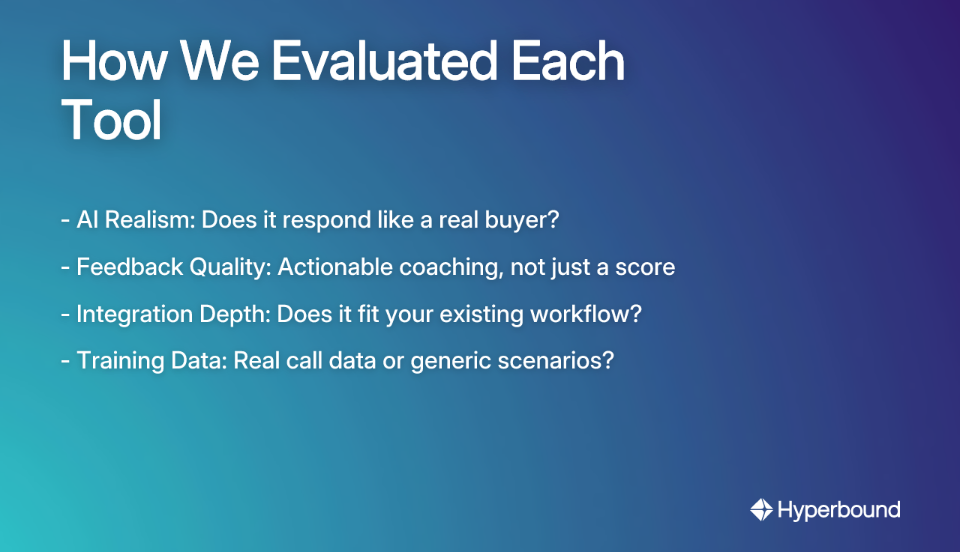
So this guide isn't just a list. We evaluated each tool on the criteria that actually matter:
We've also organized the list by use case so you can skip straight to what's relevant for your team — whether that's cold calling, discovery, objection handling, or post-sales.
Best for: Cold calling, discovery, objection handling, demos, renewals, upsells
If there's one platform that directly addresses the "too robotic" criticism, it's Hyperbound Practice. The AI buyer personas aren't built from generic scripts — they're trained on 2M+ hours of real B2B sales conversations. That distinction matters enormously in practice: the AI pushes back in ways that feel genuinely unpredictable, because the data it learned from reflects how real buyers actually behave.
With over 250,000+ AI simulations delivered across 7,000+ companies, Hyperbound has refined its simulations to a degree that standalone competitors simply can't match. You can practice cold calls, run full discovery conversations, handle objections, demo with screen sharing, or even simulate a multiparty call with both a champion and an economic buyer in the room — simultaneously.
Feedback quality is where Hyperbound truly separates itself. After every roleplay, AI Scorecards deliver objective, instant feedback covering talk ratios, methodology adherence, key selling moments, and specific missed opportunities. AI Coaching then surfaces methodology-aligned recommendations — not just what went wrong, but why and how to fix it.
Integration depth is equally strong. Hyperbound embeds directly into reps' calendars, CRM, LMS/CMS, and Slack, reducing the friction that kills adoption of most training tools.
The proof points speak for themselves. Vanta cut their ramp time by 60% — from 210 days down to 72 — while growing their BDR team 4x and generating 5x pipeline. Stevie Case, Vanta's CRO, credits Hyperbound Practice as a core driver of that result. Other validated outcomes include 50% faster ramp, a 150% increase in DM-to-demo conversion rate, and 2x faster time to first won deal.
For B2B teams serious about turning practice into performance, Hyperbound Practice is the benchmark.
Best for: Objection handling, new messaging rollouts, scripted talk track consistency
Second Nature positions itself as a "virtual pitch partner" — and for specific use cases, it delivers. It's a solid choice when your primary goal is drilling consistency on a specific talk track: a new product launch, a refreshed value prop, or a set of common objections you need every rep to handle the same way.
The tradeoff is realism. Second Nature's simulations are built primarily around scripted scenarios rather than a large dataset of real calls. This means they're predictable — which is great for memorizing a talk track, but less effective at preparing reps for the unexpected moments that define real sales calls. Feedback and scoring are available and useful for tracking progress over time, and CRM integrations are in place for the major platforms.
Think of Second Nature as a solid rep-consistency tool when standardization is the priority, rather than dynamic simulations that challenge how you think on your feet.
Best for: Pitch refinement, filler word reduction, pacing and tone improvement
PitchMonster takes a different angle than most sales call simulation tools. Rather than focusing primarily on what you say, it zeroes in on how you say it. Its standout feature is AI Speech Coaching, which analyzes sentence structure, pacing, filler words ("um," "like," "you know"), and vocal delivery in real time.
For reps who have their messaging down but stumble in delivery — especially on cold calls where first impressions happen in the first ten seconds — PitchMonster addresses a real gap. You can also create custom role-plays to simulate specific customer interactions you're struggling with, giving it some flexibility beyond purely scripted scenarios.
The limitations worth noting: integration depth is reportedly lighter than enterprise-grade platforms, and the simulations lean toward delivery coaching rather than the dynamic, back-and-forth conversation practice you'd need for complex discovery calls. PitchMonster claims a 37% increase in sales performance and a -30% ramp time for users — metrics worth exploring if communication delivery is your team's primary bottleneck.
Best for: Analyzing real calls, identifying coaching gaps, deal-level insights
Gong is one of the most powerful tools in B2B sales — but it's important to be clear about what it is and isn't. Gong is a call intelligence and deal analytics platform, not an AI sales call simulation tool. Its strength is recording and analyzing 100% of real sales conversations to surface what's working, where deals are at risk, and which rep behaviors correlate with closed-won outcomes.
What Gong does exceptionally well is help managers coach from real data. If a rep is consistently losing deals in the negotiation stage, Gong will surface that pattern. If your talk ratio is off on discovery calls, you'll see it in the data.
The limitation: Gong identifies problems but doesn't give reps a place to practice fixing them. That's the gap a simulation platform fills. Think of Gong as the diagnostic and Hyperbound as the gym — Gong tells you where to train, Hyperbound is where you do the reps. Used together, they form a powerful coaching loop.
Best for: Enterprise sales, executive-level conversations, complex multi-threaded deals
Simmie is a niche tool built specifically for high-stakes enterprise selling scenarios. The AI is designed to simulate C-Level buyer behavior — adapting dynamically to a rep's responses rather than following a simple linear script. This makes it a compelling option for enterprise AEs who regularly navigate complex buying committees and need to practice conversations with skeptical executives.
Simmie claims its platform enables 3.2x more practice sessions per month compared to traditional training methods. Feedback is delivered through rubric-based scoring after each session. It's a specialized tool rather than a broad platform, but for the specific problem of enterprise conversation readiness, it's worth evaluating.
Best for: Comprehensive onboarding, continuous skill development, all-in-one readiness
Mindtickle is a broad sales readiness platform — think onboarding modules, content management, coaching, and roleplay rolled into one ecosystem. If your team needs a single platform to manage the full sales enablement function, Mindtickle covers a lot of ground.
The tradeoff is simulation depth. Compared to purpose-built AI sales call simulation tools, Mindtickle's roleplay features tend to be less dynamic and more static in their training content. The feedback and performance analytics are solid within the platform's ecosystem. For organizations that want a unified tool and don't need highly sophisticated simulation fidelity, Mindtickle is a strong contender. For teams where simulation realism is the top priority, a dedicated platform will go further.
Best for: Renewals, upsells, QBRs, de-escalation, churn risk conversations
Post-sales teams are consistently undertrained when it comes to high-stakes conversations — and the revenue impact of that gap is significant. Net Revenue Retention (NRR) lives or dies on how well your CSMs and AMs handle renewal conversations, expansion pitches, and difficult customer moments.
Hyperbound's AI Post-Sales Roleplays is the only purpose-built simulation platform for this motion. You can practice with AI personas built to simulate a frustrated churning customer, a happy expansion candidate, or an executive stakeholder in a QBR — all scenarios with dramatically different dynamics than a standard sales call.
Custom scorecards are designed specifically for post-sales conversations, providing feedback on value communication, ability to identify expansion cues, and handling difficult conversations with the appropriate empathy and confidence. For Heads of Customer Success looking to standardize best practices and reduce reactive churn, this is a category that no other tool in this list addresses.
.png)
Not every team needs the same thing. Here's how to think through the decision:
1. What's your primary goal?
2. How critical is realism to you?
This is the most important question. There are fundamentally two types of AI in this space:
If your reps are struggling because practice doesn't feel real enough to transfer to live calls — which is the most common complaint in the sales community — the training data behind the AI is the variable that matters most.
3. Do you want to close the loop between practice and real-world performance?
This is where the conversation shifts from "good training tool" to something more fundamentally impactful. The most advanced revenue teams don't train in isolation — they build a continuous improvement cycle where practice is informed by real performance data and real performance improves because of targeted practice.
Hyperbound's full platform is built exactly for this:
The result is what Hyperbound calls Revenue Activation: a continuous cycle of Score Real Calls → Identify Skill Gaps → Practice Roleplays → Score Real Calls. It's not just about getting more practice reps — it's about getting the right practice reps at the right time, grounded in what's actually happening in your pipeline.
The best AI sales call simulation tool isn't the one with the most features — it's the one that makes your reps better on real calls. Start with what your team actually needs, evaluate honestly on AI realism and feedback quality, and if you want practice to directly move pipeline, look for a platform that closes the loop between simulation and live performance.
An AI sales call simulation tool is a software platform that allows sales representatives to practice conversations with an AI-powered "buyer" in a safe, repeatable environment. These tools create realistic scenarios for cold calls, discovery, objection handling, and even post-sales conversations. Unlike traditional role-playing with a manager, AI simulators provide instant, objective feedback and can be used on-demand, allowing reps to get the "at-bats" they need to build confidence and refine their skills without risking live deals.
AI realism is crucial because it prepares sales reps for the unpredictable nature of real customer conversations, which scripted or robotic training cannot replicate. Many reps struggle when live calls don't follow a script. Simulators trained on real call data, like Hyperbound, can push back, ask tough questions, and behave like actual buyers. This level of realism ensures that the skills developed during practice are directly transferable to high-stakes situations.
AI sales simulators offer significant advantages over traditional role-playing by being scalable, consistent, and available on-demand for private practice. While role-playing with a manager is valuable, it's time-consuming and often inconsistent. AI simulators allow reps to practice as much as they need without taking up a manager's time. They also provide objective, data-driven feedback through scorecards, analyzing metrics like talk ratios and methodology adherence, which is often more consistent and detailed than human feedback alone.
Yes, AI simulation tools are highly effective for experienced sales reps, not just new hires. While they are excellent for ramping up new team members by accelerating their learning curve, seasoned reps use these platforms to refine advanced skills. This includes practicing for high-stakes C-suite conversations, testing new messaging for a product launch, or mastering complex, multi-threaded deal scenarios.
A call intelligence platform analyzes past, real-world calls to identify skill gaps, while a simulation platform provides a practice environment to fix those gaps. Think of a tool like Gong as the diagnostic that tells you what to work on by analyzing performance data from your actual customer conversations. An AI simulation platform like Hyperbound is the "gym" where you perform targeted role-plays to improve. The most effective strategies use both in a continuous loop: analyze calls, practice the weaknesses, and measure improvement.
To choose the right tool, first define your primary goal (e.g., ramping new hires, improving NRR, or drilling talk tracks) and then evaluate each platform's AI realism and feedback quality. If you need to ramp new hires quickly with realistic practice, a data-driven platform like Hyperbound is a strong choice. If you need to ensure consistency on a specific script, a tool like Second Nature might suffice. The most critical factor is whether the AI is trained on real call data, as this directly impacts how well the practice prepares reps for live calls.
Absolutely. Specialized AI simulation tools are designed to help Customer Success Managers (CSMs) and Account Managers (AMs) practice critical post-sales conversations. Platforms like Hyperbound for Post-Sales offer AI personas and scorecards tailored to scenarios like renewals, upsells, and churn risks. This allows teams to practice handling frustrated customers or identifying expansion opportunities, directly impacting Net Revenue Retention (NRR).










Use Cases
Legal