
Every time an untrained SDR picks up the phone and dials a real prospect, your company is paying for their education with pipeline.
Think about what that actually means. A burned contact at a target account can close that door for months — or permanently. A rep who fumbles the first 30 seconds of a cold call sets a negative first impression that's nearly impossible to recover from. And at scale, across an entire SDR team that's still learning on the job, those individual mistakes compound into a very real revenue problem.
The numbers confirm it: 80% of sales training is forgotten within 30 days, and 72% of training initiatives fail outright — primarily because there's no safe, repeatable environment for reps to actually practice what they've learned. The instinct to "just dial" is understandable, but as one sales rep put it on Reddit: "Real calls offer invaluable experience. However, with the stakes so high, I'm cautious about using real prospects for practice."
That tension — needing real-world experience without real-world risk — is exactly what AI cold call roleplay practice tools are built to solve. They're the flight simulator equivalent for SDRs: a place to crash, learn, and take off again before it counts.
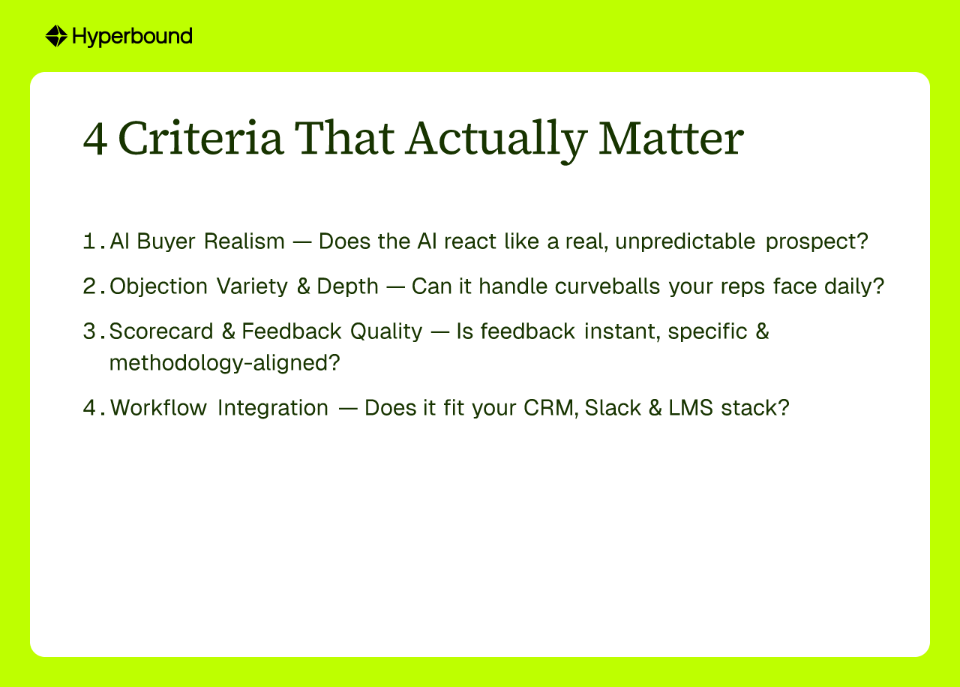
But not all tools are created equal. To cut through the noise, we evaluated eight platforms across four criteria that actually move the needle for SDR teams:
Here are the 8 best cold call roleplay practice tools for SDR teams.
Best for: SDR teams that want the most realistic AI cold call roleplay practice available
Hyperbound Practice is the gold standard for cold call roleplay practice — and it's not particularly close. While most tools bolt on a roleplay feature, Hyperbound built the entire platform around one mission: turning insight into rep behavior change, before prospects pay the price for it.
AI Buyer Realism: This is where Hyperbound separates itself from every other tool on this list. Its AI buyer personas are trained on 2M+ hours of real B2B sales conversations — not scripted templates or generic objection trees. That means the AI handles cold calls the way real buyers do: with distracted openers, unexpected pivots, and objections that don't come from a textbook. With 250,000+ simulations delivered across 7,000+ companies, the model has been continuously refined on what actually happens when SDRs call real humans.
You can also build digital twins of specific buyer personas from LinkedIn profiles, and even use voice cloning to mirror exact buyer archetypes your reps encounter in the field. If realism is the threshold — and "if it doesn't feel real, it defeats the whole purpose" — Hyperbound clears it by a wide margin.
Objection Variety & Depth: Hyperbound covers the full cold call lifecycle — openers, gatekeepers, objection handling, setting the meeting — and supports multiparty roleplays so reps can practice navigating calls where both a champion and an economic buyer are on the line. The AI generates objections dynamically, not from a fixed list, which means reps encounter novel resistance just like they would on a real dial.
Scorecard & Feedback Quality: After every simulation, reps receive instant AI-generated scorecards tracking talk-to-listen ratio, filler word usage, methodology adherence, key selling moments, and specific missed opportunities. This is the data management actually wants to see — it closes the loop between practice activity and skill development. Bitesized Roleplays let tenured reps skip the generic 20-minute sessions and drill a single skill in minutes, which dramatically increases adoption among reps who have lists of 500+ prospects and no patience for training theater.
Gamification features (leaderboards, scoring) drive healthy competition, and Certifications let enablement leaders verify rep readiness at scale before a new product launch or messaging update hits the field.
Workflow Integration: Hyperbound embeds directly into the tools SDRs already use — HubSpot, Salesforce, Seismic, Highspot, Showpad (via SCORM), Slack, and Microsoft Teams. Practice shows up in the rep's calendar and workflow, not in a separate app they have to remember to open.
If your SDR team is burning pipeline while reps learn to cold call, Hyperbound Practice is the fix.
Best for: Teams that want a visual, avatar-based practice experience
Second Nature offers AI sales training with visually rendered avatars that simulate buyer conversations. It's a strong fit for teams where rep engagement is the primary barrier to adoption — the gamified, visual format can make cold call roleplay practice feel less like a chore.
AI Buyer Realism: Second Nature's avatars are polished, but the scenarios tend to follow more scripted response paths. The platform is well-suited for practicing structured sales pitches rather than replicating the unpredictability of a live cold call.
Scorecard & Feedback Quality: Performance tracking is available, though feedback depth varies by scenario. It's generally sufficient for onboarding but may not provide the granular, methodology-aligned coaching data that sales managers need to track skill development over time.
Workflow Integration: Integrates with major LMS platforms and CRMs, making it relatively easy to embed in existing enablement programs.
Bottom line: A solid option for teams earlier in their training maturity, particularly where visual engagement drives adoption. For organizations that need the AI to mirror real B2B buyer behavior — not scripted scenarios — the gap between Second Nature and tools trained on live call data becomes apparent quickly.
Best for: Enterprise teams running large-scale structured enablement programs
Mindtickle is a comprehensive sales readiness platform that combines roleplays, assessments, video coaching, certifications, and analytics into a single suite. It's purpose-built for enablement at scale — onboarding cohorts, product launch certifications, and ongoing skill reinforcement.
AI Buyer Realism: Mindtickle does offer roleplays, but AI simulation is a module within a broader platform rather than the core product. The depth of AI persona realism and dynamic objection handling doesn't match a platform purpose-built for simulation fidelity.
Scorecard & Feedback Quality: Strong analytics and manager-facing dashboards make Mindtickle a good fit for organizations that need detailed reporting tied to training completion and assessment scores.
Workflow Integration: Integrates with major CRMs, LMS platforms, and communication tools, which supports enterprise deployment.
Bottom line: Mindtickle is a legitimate enterprise enablement platform. If your priority is a comprehensive learning management suite with roleplay as one of many features, it deserves consideration. If the primary goal is the highest-fidelity cold call roleplay practice environment for SDRs, a purpose-built simulation tool will outperform it.
Best for: Analyzing past calls — not practicing future ones
Gong is one of the most widely used conversation intelligence platforms in B2B sales. It records, transcribes, and analyzes real sales calls, surfacing patterns from top performers and identifying where deals are at risk.
AI Buyer Realism: Gong does not offer AI roleplay or simulated buyer interactions. It is a post-call analysis tool, not a pre-call practice environment.
Scorecard & Feedback Quality: For real call analysis, Gong's scorecards and deal insights are excellent. The problem is that feedback arrives after the call has already happened — after the contact has already been burned if the rep wasn't ready.
Workflow Integration: Deep CRM and sales engagement integrations make Gong a central hub for many sales teams.
Bottom line: Gong is a "giant library of data" — it tells you what happened on past calls with great precision. What it doesn't do is let your reps practice so the next call goes differently. It's reactive by design. For SDR teams, Gong works best as a complementary tool alongside a dedicated cold call roleplay practice platform.
Best for: Post-call transcript analysis and team performance reporting
Chorus is another conversation intelligence platform, now owned by ZoomInfo. Like Gong, it captures and analyzes sales calls, providing transcripts, keyword tracking, and team performance dashboards.
AI Buyer Realism: No AI roleplay or simulation capability.
Scorecard & Feedback Quality: Chorus provides solid call-level analytics and coaching moments surfaced from recorded conversations. Managers can review snippets and leave feedback, but it's asynchronous and dependent on managers actually doing the review.
Bottom line: Chorus is valuable for reviewing the game tape. Running drills before the game requires a different tool. For SDR teams specifically, the absence of any proactive practice environment is a meaningful gap, particularly during ramp.
Best for: Managing outbound sales workflows and engagement cadences
Salesloft is a sales engagement platform built to help SDR teams execute their outbound motion — email sequences, call tasks, and multi-channel cadences — more effectively. It includes call recording and some manager-facing coaching features.
AI Buyer Realism: Salesloft does not offer AI roleplay practice. Coaching is based on analysis of real recorded calls, not simulated practice environments.
Scorecard & Feedback Quality: Coaching capabilities exist but are tied to live call recordings. There's no mechanism for reps to practice objection handling or refine their cold call opener before dialing.
Bottom line: An excellent tool for running outbound at scale. Not a cold call roleplay practice platform. Teams using Salesloft for their outbound sequencing will still need a dedicated simulation tool if they want reps practicing before they hit the phones.
Best for: Sales sequencing, pipeline management, and AI-assisted sales workflows
Outreach is a direct competitor to Salesloft in the sales engagement category, with strong capabilities around sequencing, email and call analytics, and AI deal insights. It's a powerful operational platform for managing a high-volume SDR motion.
AI Buyer Realism: Like Salesloft, Outreach does not offer AI cold call roleplay practice or simulated buyer interactions.
Scorecard & Feedback Quality: Analytics are available at the deal and team level, but they're based on real activity data — not practice performance.
Bottom line: Outreach excels at automating and optimizing the sales workflow. Building the skills that make that workflow effective is outside its scope. SDR teams relying solely on Outreach for skill development are leaving a significant gap in their training stack.
Best for: Entry-level teams getting started with structured sales roleplay
PitchMonster offers a straightforward approach to sales pitch practice with predefined roleplay scenarios and basic performance tracking. It's a reasonable starting point for teams that have never used a formal practice tool before.
AI Buyer Realism: The AI buyers in PitchMonster are less dynamically adaptive than platforms trained on large real-world call datasets. Scenarios can feel predictable after a few repetitions, which limits the tool's ability to prepare reps for the genuine unpredictability of a live cold call.
Scorecard & Feedback Quality: Basic feedback is available, but the depth of coaching insights — particularly talk-to-listen ratio analysis, filler word tracking, and methodology adherence scoring — is limited compared to dedicated AI roleplay platforms.
Bottom line: A viable option for teams taking their first step into structured roleplay. As SDR teams scale and need simulations that mirror real buyer behavior, the lack of training on actual B2B call data becomes a constraint.
There are a lot of tools in this space. Here's a simple checklist to cut through the options and make a confident decision.
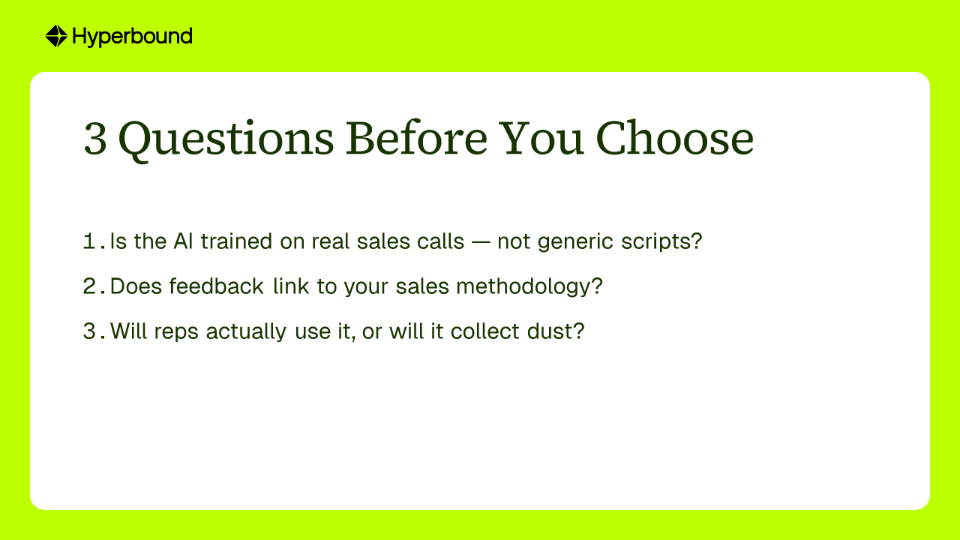
1. Is the AI trained on real sales conversations — or generic scripts?
This is the single most important question. Realism is everything in cold call roleplay practice. An AI buyer that responds from a scripted objection tree will not prepare your reps for the prospect who says "I've got 30 seconds, make it count" or hangs up mid-pitch. Look for a platform trained on millions of hours of actual B2B call data, not one that was hand-scripted in a conference room.
2. Does the feedback actually link to your sales methodology — and can management see it?
Reps need specific, actionable coaching after every simulation — not just a pass/fail score. And managers need visibility into skill gaps across the team, not just anecdotal observations from ride-alongs. If the scorecard doesn't tie back to your methodology (SPIN, MEDDIC, Challenger, etc.) and doesn't roll up to a manager dashboard, adoption will stall quickly.
3. Will reps actually use it — or will it become shelfware?
The best cold call roleplay practice platform is the one your reps open regularly. That means it needs to live inside the tools they already use (Slack, CRM, LMS), it needs to offer short formats for experienced reps who won't sit through a 20-minute generic scenario, and it needs to feel relevant to the deals they're actually working.
If your answers to all three questions point toward realistic AI, methodology-aligned scoring, and seamless workflow integration — that's Hyperbound.
The cost of learning cold calling on live prospects is real: burned contacts, lost pipeline, and conversion rates that stay stubbornly low. Conversation intelligence tools like Gong and Chorus tell you what went wrong after the fact. Sales engagement platforms like Salesloft and Outreach help you execute outbound at scale. But neither category trains your reps before they call.
That's the gap that dedicated cold call roleplay practice tools fill — and among them, Hyperbound Practice stands apart. With AI buyer personas trained on 2M+ hours of real B2B conversations, instant methodology-aligned scorecards, and integrations that embed practice directly into your existing stack, it's the only platform that connects realistic simulation to measurable behavior change.
If your team is ready to stop paying for SDR education with pipeline, schedule a Hyperbound demo and see the difference that real AI realism makes.
AI cold call roleplay tools are software platforms that use artificial intelligence to simulate realistic sales conversations. They provide a safe, repeatable environment for Sales Development Reps (SDRs) to practice their pitch, handle objections, and refine their skills without the risk of losing a real prospect.
AI roleplay offers significant advantages over traditional methods, such as practicing with a manager. The key benefits are scalability, consistency, and a non-judgmental practice space. Reps can practice on-demand anytime, receive instant, unbiased feedback, and drill specific scenarios repeatedly, which is difficult to scale with manager-led sessions.
These tools directly impact performance by accelerating skill development in a controlled environment. By repeatedly practicing with realistic AI buyers, SDRs build muscle memory for handling tough objections, improve their talk tracks, and gain confidence. This leads to measurable improvements in key metrics like faster ramp times, higher conversion rates from conversation to meeting, and increased pipeline generation.
Gong and Chorus are conversation intelligence tools, not practice platforms. They are excellent for analyzing past calls (reviewing the "game tape") to see what went right or wrong. In contrast, AI roleplay tools are for proactively practicing future calls (like a "batting cage"). The two are complementary: you use roleplay tools to fix the mistakes that conversation intelligence tools uncover.
The most critical factor for realism is the data the AI is trained on. Platforms like Hyperbound train their AI on millions of hours of real B2B sales conversations, not pre-written scripts. This allows the AI to replicate the unpredictable nature of human buyers, including interruptions, left-field questions, and a wide variety of nuanced objections.
Advanced AI roleplay platforms provide instant, data-driven scorecards after every simulation. This feedback goes beyond a simple pass/fail grade, analyzing metrics like talk-to-listen ratio, filler word usage, pace, and adherence to your company's sales methodology. This allows for targeted coaching and measurable skill tracking.
No, AI practice tools are valuable for sales reps at all experience levels. While they are essential for accelerating the onboarding and ramp time of new hires, veteran reps can use them to master new messaging, prepare for a new product launch, or practice navigating calls with difficult-to-reach executive personas.










Use Cases
Legal