
Your enterprise sales team is leaving revenue on the table — and traditional training is a big reason why.
Here's the uncomfortable truth: frontline sales managers spend only 5–8% of their time coaching, and they're listening to less than 1% of recorded calls. Meanwhile, 80% of sales training content is forgotten within 30 days. You can build the most comprehensive onboarding program in the industry, and within a month, most of it has evaporated.
For distributed enterprise teams — where you might have hundreds of reps across multiple geographies, product lines, and languages — that's not a training problem. It's a revenue problem.
The real issue isn't effort. Enablement leaders are outnumbered, often supporting 50–100 reps per person. Managers want to coach but get pulled into pipeline reviews, admin, and escalations. The result? Inconsistent execution, long ramp times, and win rates that stubbornly refuse to move — no matter how much you spend on content and LMS.
AI roleplay for enterprise sales teams changes the equation. Instead of depending on managers to find time, these platforms give reps on-demand, realistic practice that reinforces skills before real conversations happen. The best ones don't just run generic scripts — they simulate real buyers, adapt to unexpected objections, and close the loop by connecting practice performance to live deal data.
But not all AI roleplay tools are built for enterprise scale. This list is ranked specifically on criteria enterprise buyers care about: integration depth (CRM, LMS, call intelligence), multilingual support, scalability across distributed teams, and the ability to create a closed-loop feedback system from real call data.
Here are the 8 best AI roleplay tools for enterprise sales teams, ranked.
Best For: Enterprise sales teams that want AI roleplay grounded in real buyer conversations — not generic scripts.
Hyperbound Practice is the flagship product of the Hyperbound Revenue Activation Platform, and it earns the top spot on this list for one core reason: the AI buyer personas aren't built from hypothetical scripts. They're trained on 2M+ hours of real B2B sales conversations. That means reps aren't just practicing against a chatbot — they're sparring against something that responds the way actual buyers do, including unexpected objections, topic switches, and multi-threaded challenges that users of other platforms frequently describe as unrealistically easy.
Hyperbound has delivered 250,000+ simulations across 7,000+ companies, with notable enterprise customers including LinkedIn, Autodesk, Monday.com, Vanta, and Bloomberg.
Key Enterprise Features:
Proof Points:
Potential Limitations: Hyperbound is purpose-built for B2B SaaS and adjacent enterprise verticals — it's not designed for retail, B2C, or pharma.
Best For: Large-scale conversation intelligence and deal visibility.
Gong is the market-leading conversation intelligence platform. It records, transcribes, and analyzes sales calls at scale, giving revenue leaders deep visibility into what's actually happening in customer conversations. For enterprise teams, it's often the "system of record" for sales reality.
Key Enterprise Features:
Why it Made the List: Gong is the dominant platform for understanding what happened in sales conversations. Many AI roleplay tools (including Hyperbound) integrate with it directly, making it foundational infrastructure for any enterprise sales stack.
Potential Limitations: Gong is an analytical tool. As practitioners note on Reddit, "you're easily looking at six-figures per year," and it doesn't include a dedicated practice layer. It tells managers what went wrong — but doesn't give reps a safe environment to fix it before the next call.
Best For: Teams that prefer visual, avatar-based sales simulations.
Second Nature uses AI-powered avatars to create a visual-first roleplay experience. Reps practice pitches and objection handling with on-screen personas, which can appeal to learners who respond better to face-to-face simulation.
Key Enterprise Features:
Why it Made the List: Second Nature is one of the more established names in enterprise AI roleplay and has built a meaningful customer base among mid-to-large sales organizations.
Potential Limitations: The AI personas operate primarily from scripted scenarios rather than real B2B call data — which means reps are practicing against predictable patterns rather than the nuanced, dynamic objections they'll actually encounter. For complex enterprise sales cycles with long timelines and multiple stakeholders, that gap in realism can limit transfer to live conversations.
Best For: Organizations looking for an all-in-one revenue enablement and readiness platform.
Mindtickle is a broad sales readiness platform that combines content management, structured learning, conversation intelligence, and AI-assisted coaching. It's a strong choice for enterprises that want a single vendor to manage their full enablement stack.
Key Enterprise Features:
Why it Made the List: Mindtickle has deep enterprise adoption and brings together multiple enablement functions under one roof — making it an attractive option for teams trying to consolidate tools.
Potential Limitations: Because AI roleplay is one feature within a larger platform, it may not match the simulation fidelity of a purpose-built tool. Teams with complex, fast-moving sales motion may find the roleplay depth insufficient for advanced skill development.
Best For: Continuous AI coaching for globally distributed teams.
Awarathon is built for scale — designed to provide 24/7 access to AI coaching through realistic simulations across large, global teams. Its "Trinity AI" feedback engine analyzes product knowledge, tone, and pacing to generate detailed competency reports.
Key Enterprise Features:
Why it Made the List: Awarathon's emphasis on continuous coaching and detailed performance analytics makes it a solid contender for enterprises running large-scale enablement programs across multiple regions.
Potential Limitations: The platform doesn't natively connect to live deal activity or real call data, meaning the feedback loop between what happens in practice and what happens in actual deals requires manual intervention rather than automated insight.
Best For: Sales engagement automation and workflow execution.
Salesloft is a leading sales engagement platform that manages outreach cadences across email, phone, and social. Its Conversations feature adds call recording and analysis capabilities, making it an adjacent player in the coaching space.
Key Enterprise Features:
Why it Made the List: Salesloft is part of core enterprise sales infrastructure. Its call recording and coaching cues are valuable for frontline managers — and it integrates with dedicated roleplay tools like Hyperbound to create a more complete practice-to-performance workflow.
Potential Limitations: Salesloft is built for execution, not skill development. It can surface insights from recorded calls, but it doesn't offer a risk-free, dedicated environment where reps can practice and iterate on specific skills before their next live conversation.
Best For: Enterprise-grade sales content management and enablement.
Seismic is the market leader in sales enablement content management. It ensures reps have the right messaging, playbooks, and marketing materials at the right moment in the buying cycle.
Key Enterprise Features:
Why it Made the List: Seismic is foundational infrastructure for enterprise enablement. It's also a direct integration partner for Hyperbound Practice via SCORM — meaning teams can embed AI roleplays directly into Seismic's learning modules, turning static content into active practice.
Potential Limitations: Seismic delivers knowledge — it ensures reps know what to say. It doesn't provide practice — the repetition and feedback loops that build confident execution under pressure. For teams serious about changing rep behavior, a dedicated roleplay layer is essential.
Best For: Gamified roleplay and competitive training for mid-market teams.
PitchMonster uses gamification — leaderboards, scoring, and team competitions — to drive engagement in sales roleplay practice. It's a strong fit for teams where adoption and rep motivation are the primary challenges.
Key Enterprise Features:
Why it Made the List: Driving rep adoption of any training tool is genuinely difficult. PitchMonster's gamification approach addresses that problem directly — and for some team cultures, friendly competition is the most effective motivator.
Potential Limitations: PitchMonster is primarily positioned for SMB and mid-market. For large enterprises with complex requirements — deep CRM integrations, global language support, deal-level coaching loops, and AI trained on real vertical-specific B2B data — it may not have the infrastructure depth required.
.png)
.png)
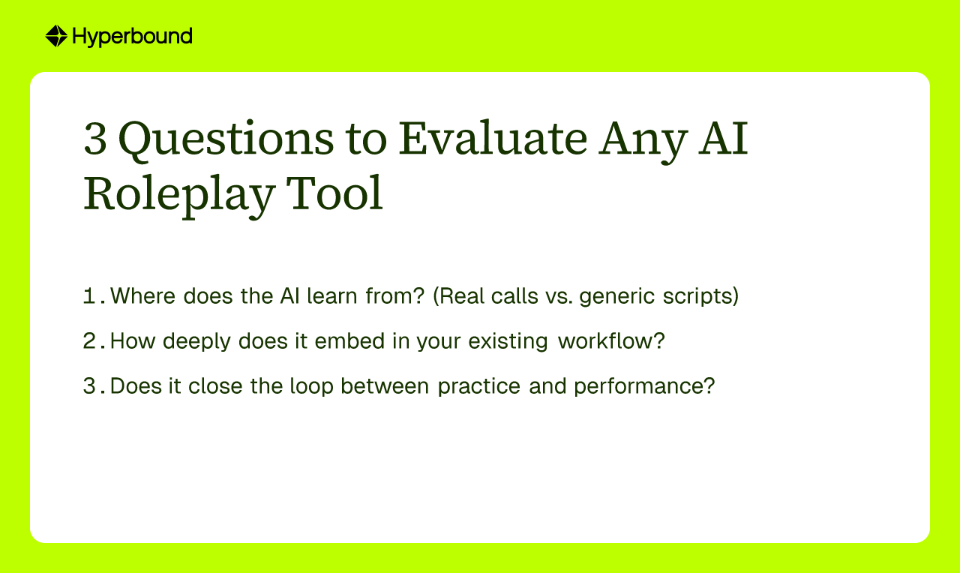
Before signing a contract, evaluate any AI roleplay platform against three questions that separate tools that generate activity from tools that change outcomes:
1. Where does the AI learn from? There's a meaningful difference between a platform trained on generic sales scripts and one trained on real B2B call data. Reps widely report that AI interactions "feel robotic" and fail to push back realistically — because the underlying model has never encountered how actual buyers behave. Look for platforms that can articulate exactly what data trained their AI personas, and whether that data reflects your buyer type and industry.
2. How deeply does it embed in your existing workflow? The best AI roleplay tool your team never uses is worthless. Look for SCORM compatibility to embed practice inside your LMS (Seismic, Highspot, Showpad), native CRM integrations to trigger practice at key deal stages, and Slack/Teams integration so coaching happens where work already happens — not in a separate tab reps have to remember to open.
3. Does it close the loop between practice and performance? The most underrated capability in this category is the ability to connect roleplay performance to real call behavior. A tool that identifies a skill gap in a live deal and automatically generates targeted practice for that specific gap — then tracks whether the rep improves on subsequent real calls — is fundamentally more powerful than a standalone practice environment. This is the difference between a training tool and a revenue activation platform.
Enterprises no longer have the luxury of waiting months to see whether a training initiative moved the needle. The stakes are too high — long ramp times drive up customer acquisition cost, inconsistent coaching creates wide performance variance across regions, and stagnant win rates are increasingly difficult to explain to leadership.
AI roleplay for enterprise sales teams is no longer a nice-to-have. It's the mechanism by which repeatable, scalable skill development actually happens — and the tools on this list represent the strongest options available.
If you're looking for the deepest enterprise integration, the most realistic AI buyer simulations, and a genuine closed loop between practice and live deal performance, Hyperbound is the category leader. Its Revenue Activation Platform — connecting Practice, Perform, and Kota Activate — is the only solution that analyzes what makes your top reps win, turns those insights into realistic practice, and then measures whether that practice is actually changing behavior on real deals.
AI roleplay for sales is a training technology that allows sales representatives to practice conversations with an AI "buyer" in a safe, simulated environment. This technology provides on-demand practice for handling objections, pitching products, and navigating complex sales scenarios, offering instant feedback without needing a manager or peer to be present.
AI roleplay is more effective because it provides scalable, consistent, and on-demand practice, which helps reps retain information far better than traditional methods. Unlike one-off training sessions where 80% of content is forgotten within a month, AI roleplay allows for continuous reinforcement of skills, leading to faster ramp times and improved performance in live calls.
The best AI roleplay platforms integrate deeply with your existing sales stack, including CRM, call intelligence, and learning management systems (LMS). For example, a tool like Hyperbound can connect with Salesforce to trigger practice scenarios based on deal stages or pull data from Gong to create simulations based on real customer conversations, creating a seamless workflow for reps and managers.
The primary difference is realism and effectiveness; AI trained on real calls understands and replicates the unpredictable nature of actual buyers, while scripted AI follows predictable patterns. An AI persona built from millions of hours of real B2B conversations, like Hyperbound's, can present nuanced objections and topic changes, preparing reps for the complexity of live deals far better than a scripted chatbot.
Driving adoption for AI roleplay tools hinges on integrating them directly into the sales workflow and demonstrating clear value to the reps. Top platforms achieve this through gamification (leaderboards and certifications), seamless LMS and CRM integrations that make practice a natural part of the job, and by creating simulations so realistic and relevant that reps feel genuinely more prepared for their calls.
Yes, leading enterprise AI roleplay tools are designed for deep customization. Enablement teams can create specific scenarios that match their company's products, target buyer personas, and common objections. Advanced platforms even allow for the creation of AI "digital twins" of specific buyers based on their LinkedIn profiles, ensuring the practice is highly relevant to the rep's actual sales calls.
AI roleplay tools provide instant, data-driven feedback on a rep's performance immediately after a simulation. This feedback typically analyzes various factors, such as talk-listen ratio, pacing, use of key messaging, and effectiveness in handling objections. This automated scoring and analysis allows reps to understand their strengths and weaknesses and iterate quickly without waiting for manager review.
Ready to stop analyzing calls and start changing outcomes? Book a demo of Hyperbound today.








Use Cases
Legal