
There's a conversation happening in sales leadership right now that sounds something like this: "I don't need another tool that tells me what happened on a call. I need something that tells me what to do next — while the deal is still winnable."
That frustration points to a critical distinction that most buyers miss when evaluating AI sales coaching software: the difference between AI sales coaching and AI deal coaching.
AI sales coaching focuses on the rep. It records calls, scores conversations, and helps with onboarding. It's valuable — but it operates in isolation, analyzing individual interactions without connecting them to the live opportunity at stake.
AI deal coaching focuses on the deal. It analyzes every touchpoint across an opportunity's lifecycle — from the first cold call to the final negotiation — surfaces deal health risks while they're still fixable, and recommends specific next actions to move the deal forward. It's the difference between a post-game film session and a live GPS directing you to the win.
As one sales leader put it in a discussion on r/sales: "The key is to find a solution that connects call analysis, performance metrics, and enablement into one seamless workflow." Most tools promise this. Very few deliver it.
This article evaluates the 7 best AI deal coaching software tools available today — scored against the criteria that actually matter to a VP of Sales or Sales Manager: deal-level vs. call-level insight, CRM integration depth, proactive risk detection, and whether the tool closes the loop to practice.
Primary Focus: AI Deal Coaching across the full opportunity lifecycle
If you've ever wished your coaching tool could give you "the common threads so you can coach more strategically" — not just flag a single bad call — Hyperbound Perform was built for exactly that.
Perform is the only AI deal coaching software that analyzes all calls in a deal together, not in isolation. Instead of handing you a scorecard for each interaction and leaving you to connect the dots, it rolls up insights across every touchpoint in the deal lifecycle and tells you, specifically, what's helping the opportunity, what's putting it at risk, and what the rep should do next.
Key capabilities:
The proof: Vanta achieved a 60% ramp reduction (from 210 to 72 days) with Hyperbound. Nivoda saw a 50% ramp reduction and doubled revenue year-over-year. These results stem from closing the loop between insights and action — the core of what Perform delivers.
The bottom line: Perform is not a forecasting tool. It's the missing layer between call-level coaching and pipeline outcomes — catching deal risk while it's still fixable and directing reps toward the behaviors that win.
Primary Focus: Call recording, transcription, and trend analysis
Gong is the market leader in conversation intelligence for good reason. It records and analyzes calls at scale, surfaces keyword trends, tracks talk ratios, and gives managers a bird's-eye view of what's being said across thousands of interactions. For large organizations with the budget for it (and that budget can easily reach six figures annually), it's an indispensable source of conversational data.
The Gap: Gong is a rearview mirror, not a GPS. It excels at telling you what happened on individual calls, but it struggles to connect the narrative across a multi-touchpoint deal. A discovery call, a technical demo, and a procurement negotiation are each analyzed in isolation. Gong tells you the rep talked too much in the demo — but it doesn't connect that behavior to deal risk, recommend what to do next, or close the loop to practice. It's analysis without prescription.
Primary Focus: Conversation insights and individual interaction coaching
Chorus offers solid analysis of individual sales interactions — calls and emails — and provides detailed feedback for coaching reps on their performance in specific meetings. Its strength is helping managers quickly review calls and leave timestamped coaching comments for reps.
The Gap: Chorus provides the puzzle pieces, not the assembled picture. It excels at the single-call level but doesn't connect insights across multiple touchpoints in a deal. To understand the true health of an opportunity — what a BDR said in the discovery call, how the AE handled objections in the demo, whether the economic buyer was ever properly engaged — a manager still has to manually stitch together those separate conversations. That's exactly the kind of time-consuming, low-leverage work that AI deal coaching software should eliminate.
Primary Focus: Pipeline analytics and revenue forecasting
Clari is a best-in-class tool for sales leadership and RevOps teams who need reliable pipeline visibility and forecast accuracy. It aggregates CRM data, email activity, and behavioral signals to surface deal risk and give leaders a cleaner picture of where the quarter is heading.
The Gap: Clari tells you what — it can flag that a deal is stalled or that a forecast is at risk. But because it doesn't analyze the behavioral patterns driving those outcomes, it can't tell you why (e.g., the rep hasn't engaged the economic buyer) or how to fix it (e.g., a specific next-step conversation to have). It's a status monitor, not a behavioral coaching engine. You still need a separate tool to bridge the gap between the risk signal and the corrective action.
Primary Focus: Sales engagement, cadence management, and pipeline visibility
Salesloft is a powerful all-in-one platform for managing how reps engage prospects — cadences, call logging, and pipeline tracking all in one place. It's an excellent tool for ensuring reps follow a structured process and for surfacing pipeline metrics against activity benchmarks.
The Gap: Salesloft is process-driven, not behavior-driven. It can confirm that a rep completed the demo stage, but it can't tell you whether the demo actually resonated with the buyer's stated pain points. It surfaces what happened in the sequence, not how effectively it happened. Coaching in Salesloft is largely manual and manager-initiated — there's no engine that connects conversation quality to deal momentum and surfaces adaptive guidance while the opportunity is still live.
Primary Focus: Sales engagement and activity-driven pipeline insights
Outreach is a leading sales engagement platform that offers deal health scoring based on engagement metrics — email opens, meeting attendance, response rates — and suggests actions based on that activity data.
The Gap: Outreach can mistake activity for progress. A deal with high engagement activity may still be moving backward if the conversations themselves are ineffective. Outreach can flag a drop in email open rates but can't diagnose the root behavioral cause — whether the rep failed to connect the product to the buyer's business case, or lost momentum by talking to the wrong stakeholder tier. Activity tracking is a useful signal, but it's not a substitute for behavioral insight at the deal level.
Primary Focus: Sales simulation and safe rep skill-building
AI sales simulators like Second Nature are genuinely valuable for onboarding new reps and certifying teams on new messaging or methodology. They provide a risk-free environment to practice pitches, work through common objections, and build confidence before going live with real prospects.
The Gap: Simulators are disconnected from live deals. The practice is generic — calibrated to personas and scenarios built in advance, not to the specific stakeholders, objections, and conversation history of an active opportunity. A rep can ace a simulation but still fumble a real deal because the scenario didn't mirror their actual buyer. Without a link to live deal data, the practice is untethered from the outcomes that actually matter. (For what it's worth, Hyperbound Practice solves this by connecting roleplay recommendations directly to gaps identified in real deals via Perform — making practice relevant to the live game, not just hypothetical.)
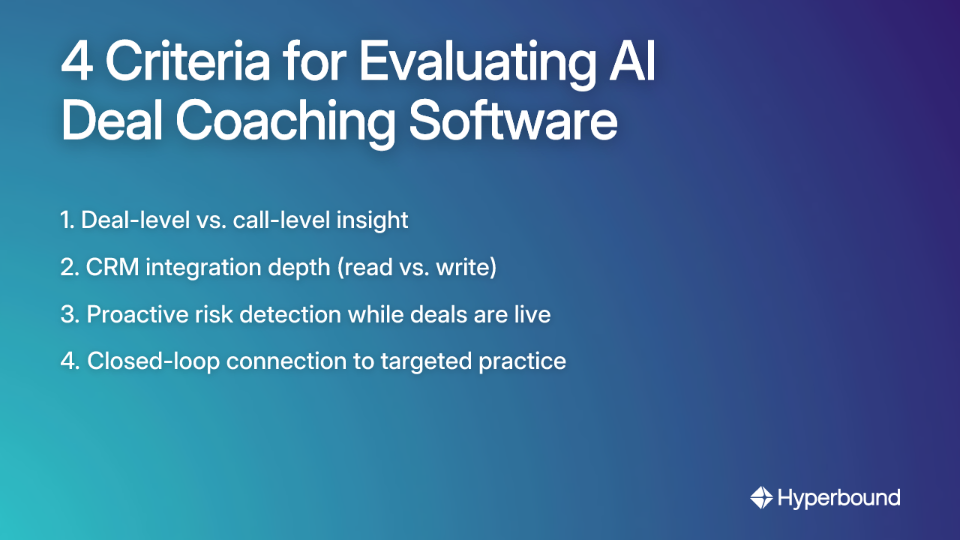
Before you invest in any tool, hold it against these four questions:
.png)
.png)
.png)
Most AI sales coaching tools were built to answer one question: "How did that call go?"
That's a useful question. But it's not the question that wins deals.
The question that wins deals is: "What do we do next — right now — to keep this opportunity moving?"
Answering that requires a tool that can look across every touchpoint in a deal, understand the full context of what's been said and done, and surface specific, actionable guidance while there's still time to act on it. That's the gap that most conversation intelligence platforms, engagement tools, and standalone simulators leave wide open.
Hyperbound Perform was built to close that gap — analyzing real behavior across the entire deal lifecycle, flagging early risk signals, and connecting those insights directly to targeted practice through Hyperbound Practice. It's not another call scorer. It's the layer that turns data into deal momentum.
AI sales coaching focuses on individual representative performance on a single call, while AI deal coaching analyzes every interaction across an entire deal to provide guidance on winning the opportunity. Think of sales coaching as a post-game film review for a single player's performance; it's useful for skill development but happens in hindsight. Deal coaching is like a live GPS for the entire team, analyzing the full deal lifecycle as it happens, identifying risks, and recommending the next best move to secure a win.
Deal-level insight is more important because deals are won or lost across multiple conversations, not just one. Analyzing calls in isolation misses the overall narrative, momentum, and risks that develop over the entire sales cycle. A great discovery call can be undone by a poor demo. A true deal coaching platform connects these interactions automatically, showing how early conversations impact later stages and flagging critical gaps while there's still time to fix them.
AI deal coaching software improves sales performance by reducing ramp time, increasing win rates, and improving forecast accuracy. It achieves this by providing reps and managers with real-time, actionable guidance on live deals. Instead of waiting for a weekly pipeline review, managers are alerted to deal risks as they emerge, and reps get specific, data-backed recommendations on what to do next.
The most important features are the ability to provide deal-level insights, deep two-way CRM integration, proactive risk detection for live deals, and a closed-loop connection to targeted practice. A top-tier tool should analyze the entire opportunity, write key data back to your CRM automatically, flag risks while deals are still winnable, and connect identified gaps directly to a practice module so reps can drill the exact skills needed.
Yes, leading AI deal coaching platforms are designed to integrate seamlessly with your existing tech stack, including CRMs like Salesforce and call recording systems like Gong, Chorus, and Salesloft. This integration is crucial for pulling call and CRM data to build a complete picture of the deal. Advanced platforms also write intelligence back into your CRM, turning it from a passive database into an active coaching system.
A deal coaching platform provides forward-looking, prescriptive guidance to win live deals, whereas a conversation intelligence tool like Gong provides retrospective, descriptive analysis of past calls. Gong is excellent at telling you what happened on a call. A deal coaching platform like Hyperbound Perform tells you what to do next across the entire deal, synthesizing insights from all touchpoints to identify risks and recommend specific actions to move the deal forward.
Ready to stop analyzing calls and start winning deals?
Book a personalized demo of Hyperbound Perform today →










Use Cases
Legal