
Your sales team just completed a two-day onboarding bootcamp. Slides were presented, videos were watched, a quiz was passed. Fast forward 72 hours: ask a new rep to handle a pricing objection cold, and you'll likely hear crickets.
This isn't a management failure. It's biology.
Hermann Ebbinghaus mapped this phenomenon back in the 1880s with his now-famous Forgetting Curve. His research showed that without reinforcement, we forget roughly 70% of newly learned information within 24 hours — and up to 90% within a week. Over a hundred years later, corporate training still hasn't caught up with this inconvenient truth. According to StreamAlive, only 15% of learned concepts are actually applied on the job.
As one sales rep put it bluntly on Reddit: "Reading the book once won't make a difference."
The problem isn't that your team isn't smart or motivated. The problem is that most B2B sales training is architecturally designed to be forgotten.
Picture the typical onboarding program: a dense slide deck covering company history and product features, a library of pre-recorded video courses, maybe a one-day workshop from an external trainer. Everyone watches, everyone nods, everyone passes the end-of-module quiz.
Then Monday morning hits, and a rep gets a real buyer on the phone who says, "We're already working with your competitor." Suddenly, no amount of slide-watching prepares them for the next 30 seconds.
The core failure of passive learning is neurological. One-way information transfer — watching a video, reading a deck — doesn't build the mental pathways required to perform a skill under pressure. The brain encodes passive information weakly. Without active retrieval and repeated application, the memory trace simply fades.
.png)
There's also a financial sting. Ineffective training costs companies approximately $13.5 million per 1,000 employees annually. For most sales organizations, that figure lands somewhere between sobering and infuriating — especially when ramp times are long and quota attainment is already a stretch.
The three biggest structural problems with conventional B2B sales training:
The research on skill acquisition is unambiguous. Active practice — where learners must retrieve and apply knowledge under realistic conditions — dramatically outperforms passive consumption.
According to NTL Institute research (as cited in sales training literature), active practice yields up to 75% knowledge retention, compared to just 5% for lectures. That's not a marginal improvement. That's a fundamentally different outcome.
Two cognitive principles explain why:
For sales specifically, this translates directly to the conversations that matter most: cold calls, discovery questioning, objection handling, negotiation, and closing. These aren't knowledge tasks — they're performance tasks. And performance improves through deliberate, repeated practice against realistic resistance. Think of it the way athletes think about training: "Consider how sports players warm up together before a game, musicians do drills before a concert."
The gym analogy holds. You don't get stronger by watching workout videos.
Here's where most sales managers hit a wall. They know roleplay works. They've tried to implement it. But the execution falls apart.
The feedback from real sales teams is telling:
There's a pattern here. Traditional roleplay fails for three consistent reasons: unrealistic scenarios, peer pressure and performance anxiety, and inconsistent feedback. When scenarios feel fake, reps disengage. When mistakes happen in front of the entire sales floor, reps shut down. When feedback is subjective or nonexistent, nothing improves.
Effective roleplay requires three things:
This is where AI changes the equation entirely.
Hyperbound Practice was built to solve exactly these failure points. Its AI buyer personas are trained on 2M+ hours of real B2B sales conversations — not generic scripts. Reps practice against simulations that actually sound like real buyers: the CFO who immediately asks about ROI, the champion who's bought in but needs help getting executive buy-in, the prospect who's already "happy with their current vendor."
Because the practice happens privately — on the rep's own schedule, without a manager or peer watching — the performance anxiety disappears. Reps who would never voluntarily participate in a shark tank will run ten roleplays on their own when the stakes feel low and the environment feels safe. And after every session, AI Scorecards deliver instant, objective feedback: talk ratio, methodology adherence, handling of key objections, missed moments, and specific coaching guidance.
No waiting. No subjectivity. No cringe.
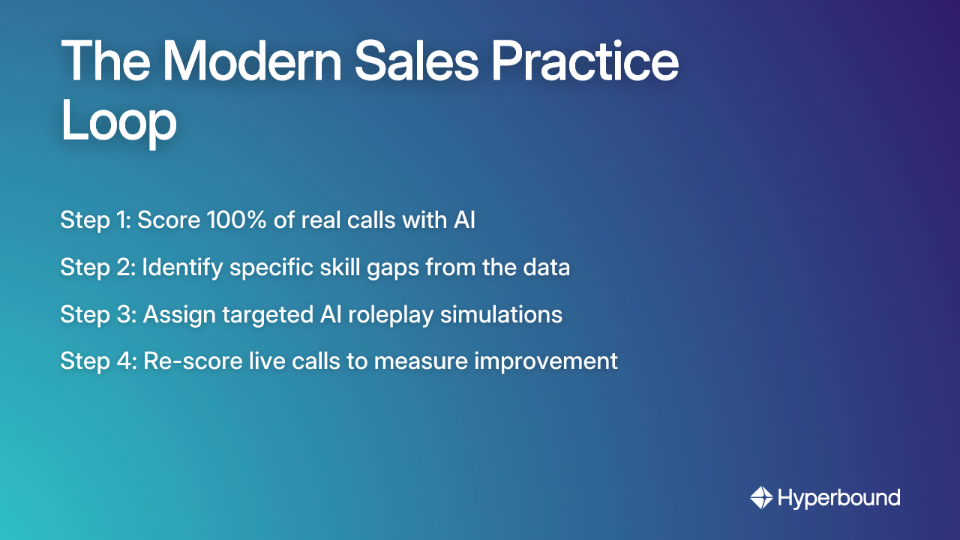
The real unlock isn't just better roleplay. It's connecting roleplay to live performance data in a continuous improvement cycle.
Here's the operational loop that high-performing sales teams are using:
Score Real Calls → Identify Skill Gaps → Practice Roleplays → Score Real Calls
Let's walk through what each stage actually looks like in practice.
You can't improve what you aren't measuring. The first step is establishing a data-driven baseline by scoring 100% of real customer conversations — not just the ones a manager happens to sit in on.
Hyperbound's AI Real Call Scoring deploys AI scorecards across every recorded call, measuring performance against your custom methodology. It integrates directly with tools like Gong, Salesloft, and Chorus — or you can use the built-in Hyperbound Call Recorder. The output isn't a vibe check. It's structured data: where is the team winning, and where are they consistently losing deals?
The call scoring data reveals patterns that would otherwise stay invisible. Maybe 60% of reps are failing to ask a second discovery question before moving to demo. Maybe objection handling around pricing is consistently weak across the BDR team. Maybe reps are talking 70% of the time on cold calls.
This is the diagnostic step that makes everything else targeted. Instead of assigning generic training content, you now know exactly what needs to be practiced.
With identified gaps, reps are assigned targeted simulations. A rep struggling with pricing objections practices against an AI persona specifically designed to push back on cost. A rep preparing for multiparty enterprise calls practices with multiple AI buyer personas simultaneously — a champion and an economic buyer in the same conversation.
Hyperbound Practice supports the full range: cold calls, discovery, demos with screen sharing, objection handling, renewals, and upsells. Every session ends with scored, actionable feedback — and reps can repeat until the skill actually sticks.
After a practice cycle, the team goes back to live calls — and the scoring data tells you whether the needle moved. Did the conversion rate on first calls improve? Are reps handling the pricing objection more effectively? Is ramp time shortening?
This turns training from a one-time event into a continuous system.
The contrast with static coursework couldn't be starker:
.png)
Theory is one thing. Let's talk about what happens when sales teams actually run this model.
Vanta needed to scale a BDR team fast without sacrificing quality. With Hyperbound's practice loop in place, they reduced sales ramp time by 60% — from 210 days down to 72 — while simultaneously growing the BDR team by 4x and increasing pipeline by 5x. As Stevie Case, CRO at Vanta, put it: the loop didn't just train reps faster; it changed how the team's performance system worked end-to-end.
LinkedIn deployed Hyperbound across 3,000+ sellers spanning three business units — LinkedIn Talent Solutions, LinkedIn Sales Solutions, and Sales Development — across both NAMER and EMEA. At that scale, consistency is everything. The ability to run structured, scored AI roleplay practice across thousands of reps with standardized feedback is what makes enterprise-wide skill development actually achievable.
Nivoda saw a 50% reduction in ramp time alongside a 150% increase in demo conversion rates — a result that directly traces back to reps practicing the specific conversations that drive pipeline, not just consuming general training content.
Across the broader Hyperbound customer base — which now includes 250,000+ AI simulations delivered across 7,000+ companies — the consistent pattern is the same: when training is grounded in real call data and driven by active practice, outcomes improve in measurable ways. 50% faster ramp. 2x faster time to first won deal. 150% increase in DM-to-demo conversion. These aren't aspirational benchmarks — they're the downstream results of a training system that's built around how humans actually learn.
The forgetting curve isn't going away. But its impact on your team is entirely within your control.
The shift that matters isn't spending more on training content or running longer onboarding programs. It's moving from passive consumption to active, data-driven practice — from watching and forgetting to doing and improving. Effective B2B sales training isn't about how much your reps know. It's about how well they perform when a real buyer is on the other end of the phone.
The playbook is straightforward: score real calls, surface the gaps, run targeted practice, measure the improvement, and repeat. Every cycle builds skill that actually sticks — because it's built on the right science, the right data, and the right feedback loop.
Most B2B sales training is ineffective because it relies on passive learning methods, which research shows are quickly forgotten. The Ebbinghaus Forgetting Curve demonstrates that learners forget up to 70% of new information within 24 hours without active reinforcement. Passive methods like watching videos don't build the mental pathways needed to perform skills under pressure, whereas active practice does.
Active practice involves sales reps retrieving and applying knowledge in realistic scenarios, while passive learning is the one-way reception of information. Passive learning includes activities like listening to a lecture or reading a slide deck, which leads to knowledge retention as low as 5%. In contrast, active practice, such as role-playing a sales call, forces the brain to recall and use information, boosting retention rates to 75% or higher.
AI sales roleplay solves the key failures of traditional roleplay by providing realistic scenarios, a psychologically safe environment, and immediate, objective feedback. Unlike peer roleplay, which can suffer from unrealistic objections and performance anxiety, AI simulations are trained on real-world conversations. Reps can practice privately anytime, receive instant, data-driven feedback on their performance, and repeat sessions until they master the skill.
The modern sales practice loop is a four-step, continuous improvement cycle designed to make training stick: Score Real Calls, Identify Skill Gaps, Practice with AI Roleplays, and then Score Real Calls again. This data-driven framework turns training from a one-time event into an ongoing system. It uses performance data to pinpoint weaknesses, assigns targeted practice to fix them, and measures the real-world impact to verify improvement.
Teams using an AI-driven practice model can expect significant improvements in key sales metrics, including faster onboarding, higher conversion rates, and increased pipeline. For example, Hyperbound customers have reduced sales ramp time by up to 60%, doubled the speed to a rep's first won deal, and achieved a 150% increase in demo conversion rates by enabling reps to master critical conversations through consistent, targeted practice.
AI sales practice benefits the entire sales team, from new hires to experienced veterans. For new reps, it accelerates ramp time by providing a safe space to master core skills before engaging with real buyers. For tenured reps, it offers a tool to prepare for high-stakes calls, adapt to new messaging, or refine their techniques against specific, challenging objections.
Ready to experience the difference? Try a free AI roleplay simulation with Hyperbound and see what your reps' first conversation could look like when practice actually prepares them for it.








Use Cases
Legal