
You've built the business case. You've calculated the ROI. You've even got a champion nodding along in every meeting. And yet, the deal keeps getting pushed — to next month, next quarter, maybe next year. Or worse, you get the email: "We decided to go in a different direction."
Sound familiar? You're not alone. Sales teams across Reddit are voicing the exact same frustration: "Most of my deals get stuck in the proof of value stage with 1-2 champions," and "I'm managing to build a business case and create ROI but it's just not enough."
The problem isn't your ROI model. The problem is that your deals are showing early warning signs — dropping engagement, single-threaded relationships, a silent economic buyer — and you have no system to catch them in time.
Here's the gap most sales teams miss: when you search for "risk management software," you get tools built for compliance teams, vendor security reviews, and enterprise-wide financial controls. That category of software is excellent — if your risk lives in vendor contracts and audit trails.
But if your risk lives inside a stalling deal? That software is completely useless.
Deal risk for a B2B sales team looks nothing like the risks those tools are designed for. It looks like this:
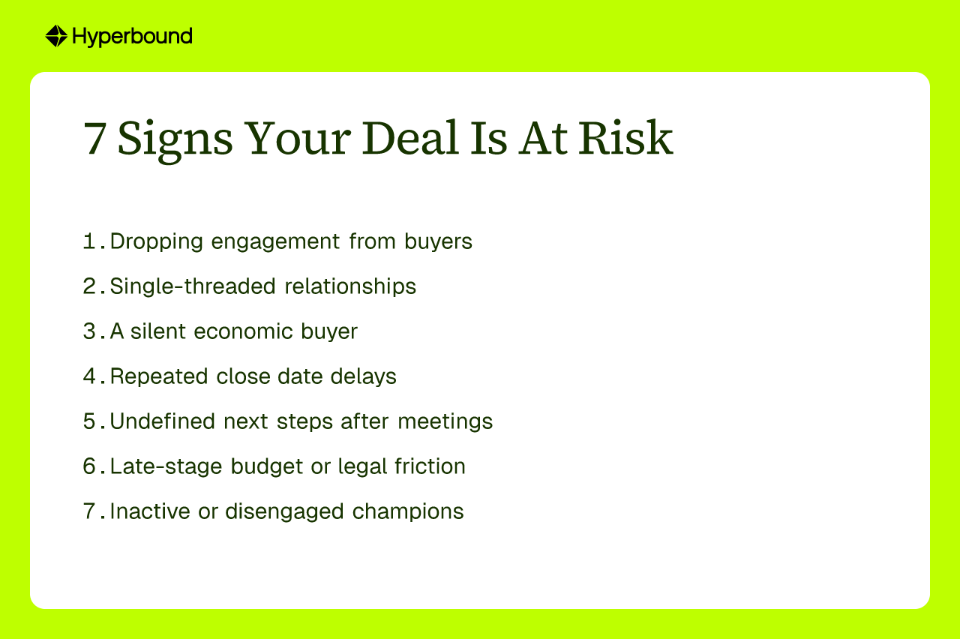
As Revedge.ai notes, these are behavioral signals, not just slipping close dates in the CRM. And they require a fundamentally different category of software to detect and act on.
This article covers seven tools that address deal-level risk — the kind that hides inside conversations, stakeholder maps, and engagement patterns — not the kind that lives in compliance dashboards.
Best for: Identifying deal risk through actual conversation behavior across the full deal lifecycle
Hyperbound Perform is the only deal risk identification software on this list that surfaces risk from what's actually being said — and not said — across every call and email in a deal.
Where most tools analyze individual calls in isolation or flag deals based on CRM field changes, Perform connects conversation behavior across the entire deal lifecycle: from the first cold call through to final negotiation. It doesn't just tell you a deal is at risk. It tells you why, based on real buyer behavior, and what to do next.
Consider the scenario where you're stuck with 1-2 champions and not driving the decision process. Perform will surface that the economic buyer hasn't been in a recorded conversation. It flags that multi-threading is absent. It recommends specific deal-winning actions — not just generic reminders — while the deal is still winnable.
Key capabilities:
The core differentiation: this is the missing layer between call intelligence and pipeline outcomes. Tools like Gong record the call. Hyperbound helps you change it. That's what the company calls the "Revenue Activation" category — using real conversation data not just to report on what happened, but to intervene while outcomes are still yours to shape.
Teams using Perform have reported 2x faster time to first won deal. Vanta's CRO Stevie Case cut rep ramp time by 60% (from 210 to 72 days) while scaling the BDR team 4x after rolling out Hyperbound.

Live: March 2026 | Best for: AEs managing active deals, frontline managers running deal inspection, Sales Leadership seeking pipeline visibility tied to actual buyer behavior
Best for: Conversation intelligence and retrospective deal analysis
Gong is the market leader for capturing, transcribing, and structuring business conversations. It transforms unstructured communication — calls, meetings, emails — into searchable, analyzable data that gives revenue teams something they never had before: visibility.
Smart Trackers automatically surface competitor mentions, objections, and key topics across your entire call library. Deal Boards layer conversation data on top of pipeline views, making it easier for managers to spot which opportunities haven't had meaningful activity lately.
For managers who want to understand what their top reps do differently — or who need real call examples for coaching sessions — Gong is the gold standard. It captures 99% of customer interactions and makes them reviewable, searchable, and usable for team learning.
The limitation: Gong is an exceptional rearview mirror. It shows you what happened. But by the time a call summary lands in a dashboard, the moment to change it is already gone. It surfaces symptoms — a deal with low engagement — but doesn't orchestrate the coaching intervention to fix the underlying behavior before the next meeting.
Pricing: ~$250/user/month plus platform fees | Integrates with: Salesforce, HubSpot, Outreach, Salesloft
Best for: Executive-level pipeline visibility and forecasting
Clari is built for the top of the org chart. Its AI-powered roll-up forecasting gives CROs and VPs of Sales a dramatically more accurate view of the pipeline than what reps self-report — which, as anyone who's sat through a pipeline review knows, tends to be optimistically distorted.
Clari's Waterfall Analytics track how deals flow from stage to stage, revealing where pipeline is consistently leaking. Revenue Cadence features make it easier to run structured, data-driven forecast reviews without the hours of guesswork.
The limitation: Clari is strong at identifying that a deal has stalled, but it doesn't diagnose why at the conversational level. Its intelligence is derived from CRM activity data — emails sent, meetings logged, stage changes — rather than the quality of what was actually said in those meetings. It tells you the deal is at risk; it can't tell you that the champion has gone quiet because you never validated their pain threshold or got the economic buyer in a room.
Pricing: ~$75–$100/user/month | Best for: CROs, VPs of Sales, RevOps leaders
Best for: CRM automation and broad deal health monitoring
Oliv is a generative AI platform built around autonomous agents that handle the administrative burden of deal management. Its appeal: high adoption driven by the fact that reps actually want to use it because it eliminates manual work.
The core agents include a CRM Manager that auto-fills deal data from conversations, a Deal Driver that monitors 100+ deal health indicators and sends proactive alerts, and a Forecaster that generates weekly pipeline roll-ups for managers. Teams buried in manual CRM updates will find real relief here.
The limitation: Oliv's deal health alerts are broad signals — a wide net across many indicators. What it doesn't do is analyze the specific conversation behaviors causing the risk, or translate that risk into a targeted, coachable action. Knowing a deal has low engagement is useful. Knowing why — because your rep hasn't asked about the decision process or engaged a second stakeholder — is what actually changes outcomes.
Pricing: Starts at $19/user/month (modular) | Best for: Revenue teams seeking automated CRM hygiene and pipeline alerts
Best for: Real-time call coaching during live conversations
Outreach is a premier sales engagement platform, but its Kaia (Knowledge AI Assistant) feature earns it a spot here for a specific use case: in-the-moment deal risk mitigation during live calls.
Kaia surfaces real-time coaching cards and content suggestions to reps while a conversation is happening — pulling up a competitor battle card the moment a rival is mentioned, or a relevant case study when a specific objection arises. For SDRs and AEs who need tactical support at decision moments within a call, this is genuinely useful.
The limitation: Outreach's coaching operates at the individual call level, not across the deal lifecycle. It provides tactical live assistance but doesn't give you the cross-deal view you need to answer questions like: Are we multi-threaded on this opportunity? Has deal velocity slowed over the last 30 days? Are we proactively driving the decision process, or just responding?
Pricing: ~$100–$125/user/month | Best for: SDR teams, AEs needing in-call support
Best for: SMB and mid-market teams already in the HubSpot ecosystem
For teams already living inside HubSpot, the Sales Hub offers built-in deal risk identification as part of its all-in-one platform. Predictive Deal Scoring uses machine learning to evaluate deals based on CRM properties and historical close patterns, flagging opportunities most likely to slip. Workflow automations can trigger manager notifications when a deal's score drops below a threshold.
The convenience factor is real: no additional tool, no new integration, no rep behavior change required. Everything surfaces inside the CRM your team is already using.
The limitation: As Revedge.ai highlights, CRM-derived scoring suffers from a "trust gap" — the data is only as good as what reps enter, and it's always a lagging indicator. HubSpot can tell you that a deal looks shaky based on CRM fields. It can't tell you that engagement dropped after the last call because the rep failed to uncover an urgent enough pain or left the meeting without mutual action plans.
Pricing: Included in Sales Hub Professional and Enterprise plans | Best for: SMB to mid-market teams in the HubSpot ecosystem
Best for: Large enterprises embedded in the Salesforce ecosystem
Einstein is Salesforce's native AI layer, delivering opportunity scoring and predictive insights directly within the world's most-used CRM. Opportunity Scoring analyzes historical deal patterns and account activity to estimate close likelihood. Automated Activity Capture logs emails and calendar events, reducing some of the manual data burden that distorts CRM accuracy.
For large organizations deeply invested in Salesforce infrastructure, Einstein is the path of least resistance to some level of deal risk visibility. There's no new tool to procure or integrate — it surfaces insights within the workflows teams already use.
The limitation: Like every CRM-native scoring tool, Einstein's intelligence is rooted in historical data and logged activity — not live conversation behavior. It produces a score, but doesn't provide the granular, actionable playbook for how a rep should change their execution on the next call to move a stalled deal forward. The score tells you what; it can't tell you how.
Pricing: Included with Salesforce Sales Cloud ($165+/user/month) | Best for: Enterprise teams in the Salesforce ecosystem
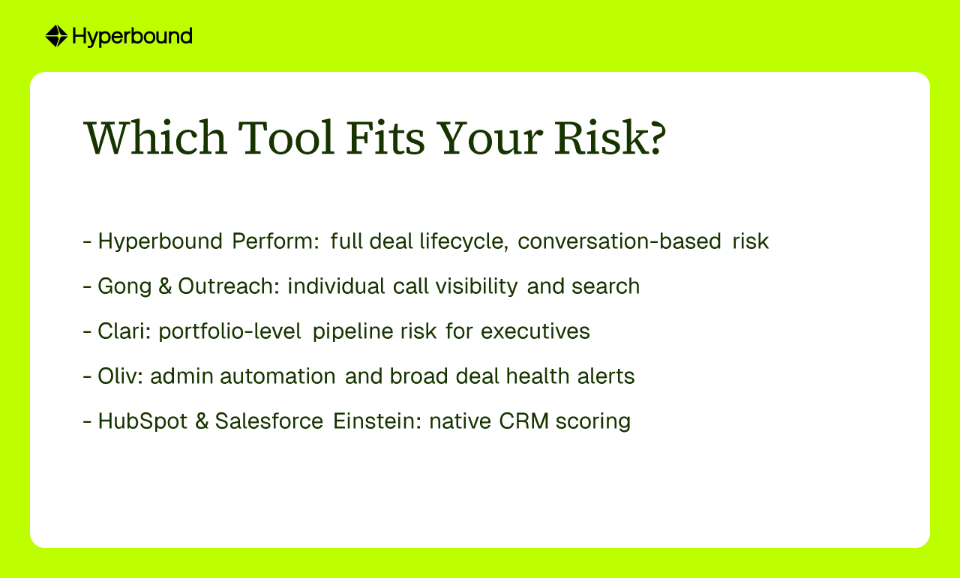
The category you need depends entirely on where your risk actually lives.
If your biggest risks are in vendor contracts, compliance frameworks, or enterprise security reviews — traditional risk management software is the right call.
But if your risk lives inside your deals — in a champion who's gone quiet, a decision process you've never properly mapped, a proof of value that's dragging on without urgency because the rep never uncovered a real pain threshold — you need a different category of tool entirely.
Most deal risk identification software tells you a deal is in trouble. Hyperbound Perform tells you why, based on what was actually said across every conversation in that deal, and gives you a clear, coachable path to turn it around while you still can.
Deal risk software is a category of tool designed specifically for B2B sales teams to identify, monitor, and mitigate risks that could cause a sales opportunity to stall or be lost. Unlike traditional risk management software that focuses on compliance or financial controls, deal risk software analyzes behavioral signals within a deal, such as dropping buyer engagement, single-threaded relationships, or an unengaged economic buyer, to provide early warnings and actionable insights.
General business risk typically involves enterprise-wide issues like compliance, vendor security, or financial audits, which are managed by legal or finance teams. Deal risk is specific to the sales process and lives inside the conversations and relationships of an active opportunity. It includes factors like a disengaged champion, undefined next steps, or late-stage budget friction—risks that traditional software is not designed to detect.
The most common signs that a deal is at risk are behavioral and often hide in plain sight. Key indicators include dropping engagement from buyers, being single-threaded with only one contact, having a silent or un-involved economic buyer, repeated delays in the close date, undefined next steps after meetings, late-stage budget or legal friction, and having champions who become inactive or disengaged.
Your CRM can only tell you if a deal is at risk based on the data that is manually entered by your sales reps. This creates a "trust gap," as the data is often incomplete, subjective, or a lagging indicator of what's really happening. While tools like Salesforce Einstein or HubSpot Sales Hub can score opportunities based on CRM properties and past deals, they can't analyze the quality of conversations or the nuances of stakeholder engagement that reveal the true health of a deal.
Conversation intelligence tools record, transcribe, and analyze calls and emails, turning unstructured conversations into structured data. This helps reduce deal risk by providing visibility into what is actually being said (and not said) in buyer interactions. By analyzing topics, questions, sentiment, and stakeholder participation across all meetings in a deal's lifecycle, these tools can surface risks—like an unaddressed competitor mention or a failure to validate the business case—that would otherwise be missed.
While a tool like Gong provides an excellent "rearview mirror" by recording and analyzing individual calls, Hyperbound Perform is designed to be a "GPS" that actively guides the deal forward. Perform connects conversation behavior across the entire deal lifecycle, not just isolated calls. It doesn't just show you that a deal is at risk; it tells you why based on buyer behavior patterns and provides targeted, deal-specific coaching and roleplays to help your rep win the deal back while it's still salvageable.
Because identifying risk isn't the goal. Reversing it is.
Ready to stop watching and start winning? See how Hyperbound Perform turns deal risk into deal momentum.









Use Cases
Legal