
Quota attainment is declining across B2B sales teams, and the numbers are hard to ignore. In 2025, the average attainment rate dropped to 43%, down from 52% the year prior. As many as 69% of reps are projected to miss their number this year. On Reddit, one sales leader put it directly: "Only 41.2% of software reps are hitting quota as of March 2025. And this has been a consistent decline." The pain is real, and it is widespread.
But not every team is losing. Vanta compressed new hire ramp time by 60% and built a $125M pipeline. Nivoda doubled revenue by improving how their existing reps executed. These are not outliers working in easier markets. They are teams that looked past the common explanations and found the actual problem.
That problem is an execution gap. And most sales leaders are not measuring it.
When quota attainment starts slipping, the same three diagnoses come up almost every time. Each one contains a grain of truth. None of them is the full picture.
"It's the market."
The market is genuinely harder. Sales cycles have increased by 22% since 2022. The average B2B buying group now includes 6 to 10 decision-makers. Budgets are tighter, and hesitation before signing has become the default. As one practitioner noted, "Sales cycles keep getting longer. More decision-makers, smaller budgets, and way more hesitation before signing anything."
That is all true. But the market is the weather. Everyone on your team faces the same conditions. It does not explain why your top 17% of reps are still generating 81% of your revenue while the rest stall. The market is a condition. It is not the root cause of internal performance gaps.
"We have the wrong ICP."
ICP misalignment is a real problem. When sales and marketing point reps at the wrong accounts, pipeline quality suffers. But a perfect ICP does not close deals. Reps do. Even with the right targets, reps who cannot navigate a complex buying conversation, handle objections, or articulate value will still miss quota. ICP is a strategic prerequisite. It does not explain inconsistent execution across reps who share the same territory and target list.
"We made bad hires."
Hiring quality matters. And the frustration is understandable. "Companies have no idea what they're hiring for," is a common complaint among sales practitioners. But blaming hiring ignores two inconvenient facts. First, the system your reps operate in shapes outcomes as much as individual talent. Second, it does not explain why tenured reps who previously hit their numbers are now missing them. That pattern points to something systemic, not a hiring problem.
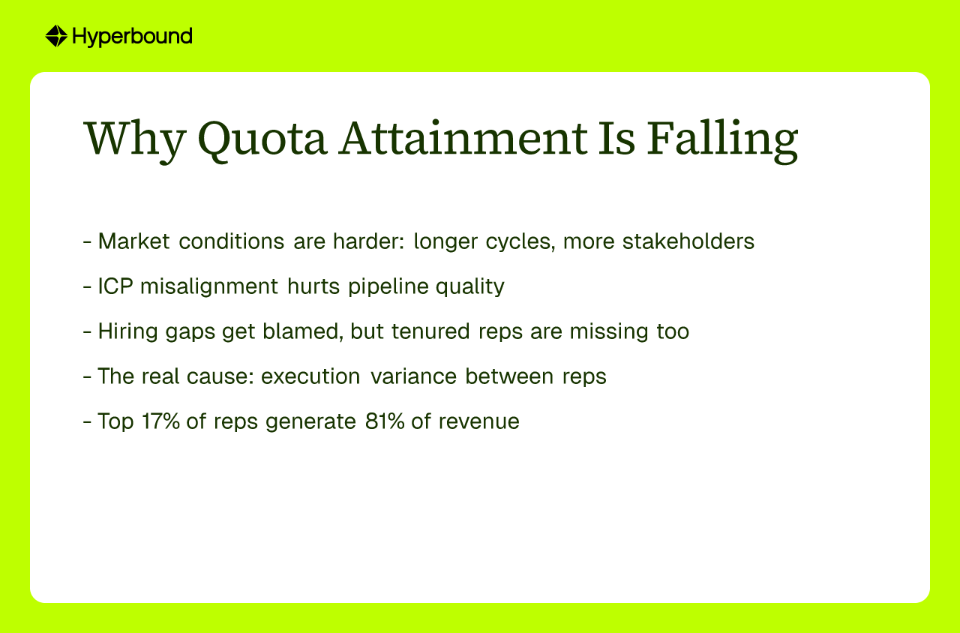
The real culprit behind declining quota attainment is execution variance. The gap between top performers and average performers is not a gap in effort or market access. It is a gap in behavior.
The performance disparity inside most B2B sales teams is extreme. Just 17% of reps generate 81% of the revenue. Those top performers are not working in a different market. They are executing specific behaviors more consistently. They ask better discovery questions. They listen more. They handle objections without going off-script. As one analysis of thousands of sales calls found, the biggest missing skill across average performers is simple: "actually listening and shutting up."
The behavioral gap exists because knowing what good looks like is not the same as being able to do it. And that distinction is where the execution gap lives.
Over the last decade, teams have invested heavily in conversation intelligence platforms like Gong and Chorus. These call recording tools have given every sales org a library of "what good looks like." Leaders can now pull up the best discovery call, the sharpest objection response, the cleanest close. The awareness is there.
The ability is not.
Showing a rep a great call transcript does not equip them to replicate it under pressure with a skeptical prospect. Recording creates awareness. It does not build skill. That is the execution gap, and it is where the new category of Revenue Activation comes in. It is the difference between analyzing what happened and changing what happens next.
The science supports this. Knowledge acquired in a single training session decays rapidly. This is the Forgetting Curve at work. Without repeated, spaced reinforcement, reps retain very little of what they learned in onboarding. Yet most training remains concentrated in a one-time onboarding event, after which reps are largely left to figure out the rest in the field. That is why platforms like Hyperbound Practice provide ongoing, AI-powered roleplays to turn theoretical knowledge into muscle memory.
One rep captured the problem clearly: "Most onboarding is product-focused. The ICP, problems the solution solves, and practical examples are left to in-field experience."
Another compounded the issue: "If onboarding takes 4 weeks and the company's usual sales cycle is 4 to 6 months and ramp-up is just 90 days, the new hire is disadvantaged from the start."
The analogy that fits here is a professional athlete watching game film. Reviewing the tape is critical for awareness. But skills are built through repetition on the practice field. Most sales teams are watching the film. They are not showing up to practice.
Practice without a coach does not produce consistent improvement. And this is where the second structural failure enters.
Sales managers, the people who should be running practice, are not. Research shows that sales managers spend less than 5 to 8% of their time actively coaching their reps. The rest goes to forecasting, pipeline reviews, internal meetings, and deal inspection.
The result is coaching that happens reactively. A manager parachutes into a deal that is about to die. They handle the immediate crisis. The rep learns nothing transferable. The cycle repeats next quarter. This is why teams use platforms like Hyperbound Perform to automate call review and surface deal-level coaching insights, giving managers the leverage to coach strategically instead of reactively.
Proactive coaching, the kind that builds skill before reps enter high-stakes conversations, is nearly absent from most sales organizations. And the cost is measurable. Companies with organized coaching programs achieve 17% greater revenue growth compared to those without. The opportunity cost of reactive-only coaching is not a rounding error. It is a revenue line item.
This confirms what many practitioners already suspect. As one sales leader put it on Reddit: "Most companies are not managed well." The problem is not that managers do not care. It is that the system does not protect time for coaching. Forecasting meetings fill the calendar. Skill development does not.
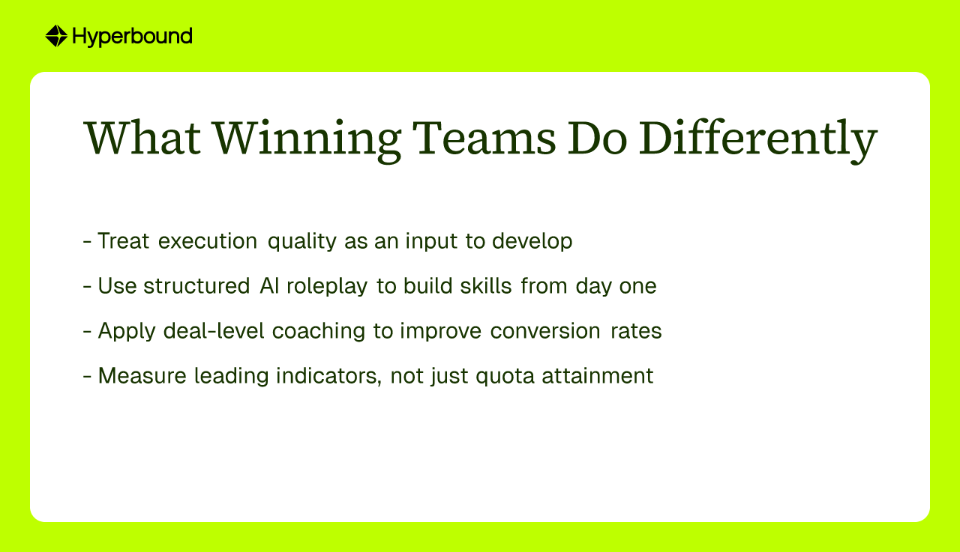
Vanta and Nivoda did not solve a market problem. They solved an execution problem. And the way they solved it is instructive.
Vanta faced a challenge that is common across high-growth B2B SaaS teams: long ramp times that delayed revenue and eroded unit economics. New hires were entering a world where the sales cycle stretched four to six months, and the onboarding window gave them almost no time to develop the skills they needed before they were expected to perform.
By implementing Hyperbound's AI roleplay platform, Vanta gave new hires a structured environment to practice core sales conversations and receive targeted, consistent feedback from day one. The result was a 60% compression in ramp time and a $125M pipeline. The reps were not more talented. They were better prepared. Practice and coaching, applied systematically, accelerated the development curve that most teams leave to chance.
Nivoda approached the problem from a different angle. Their focus was not ramp. It was conversion. In a market where every opportunity is expensive to generate, losing deals at key stages of the sales process is a direct hit to revenue. Using Hyperbound's deal-level AI coaching, Nivoda improved how their existing team executed during critical deal conversations. The focus on skill development translated into a meaningful lift in conversion rates and ultimately 2x revenue growth.
The throughline between both companies is the same. They stopped looking at quota attainment as an outcome to manage and started treating execution quality as an input to develop.
The most important shift a CRO can make is recognizing what kind of metric quota attainment actually is.
It is a lagging indicator. It reflects the aggregate output of everything your team did last quarter. You cannot change last quarter. Staring at attainment percentages and asking why they went down is like reading last year's weather report to predict tomorrow.
The metrics that predict whether attainment will go up or down next quarter are leading indicators. Most sales organizations are not measuring them.
The first is practice volume per rep. How many deliberate practice reps is each person getting on the core skills that drive their role? Discovery. Objection handling. Negotiation. Multithreading. If the answer is zero, awareness of what good looks like will not translate into performance.
The second is coaching intervention rate. How often is a manager providing targeted, specific, skill-based feedback to each rep? Not deal inspection. Not pipeline review. Actual coaching that builds a transferable capability. If this number is low, and at most companies it is, skill gaps will persist regardless of how much call recording data you accumulate.
Most sales organizations are not measuring either of these metrics. They are measuring pipeline, activity, and attainment. They are measuring outputs. The inputs that drive those outputs—and connect directly to revenue—remain invisible. Revenue Activation platforms like Hyperbound are designed to make these inputs visible and actionable for the first time.

Quota attainment has been in decline for years. The rate has been stuck in the low 40s for eight straight quarters. The standard responses, blaming the market, revisiting ICP, overhauling hiring, have not reversed the trend. Because none of them address the root cause.
The root cause is an execution gap. Reps know what good looks like. They cannot reliably replicate it. The practice structure to build that ability does not exist. The coaching bandwidth to reinforce it has collapsed.
The companies reversing the trend are not finding better markets or hiring different people. They are building execution engines. They are treating practice as infrastructure, protecting coaching time, and measuring the leading indicators of performance, not just the lagging ones.
They are closing the execution gap. The era of just watching call recordings is over. The Revenue Activation Era is here. The data is pointing in one direction. The question is whether your team will act on it before another quarter closes the wrong way.
The primary cause is the "execution gap"—the difference in performance between a team's top reps and the rest, stemming from the inconsistent application of sales skills under pressure. While market conditions and ICP are factors, the most significant driver is the variance in how reps execute core sales behaviors on live calls.
These fixes address prerequisites, not the core problem of performance. A perfect ICP and talented reps don't guarantee effective execution in real-world sales conversations. The fact that tenured reps are also missing quota points to a systemic issue with how skills are applied, not just who is being hired or targeted.
A sales execution gap is the difference between knowing what to do and being able to consistently do it under pressure. It's the failure to translate theoretical knowledge (from training or call recordings) into reliable, high-quality performance during live customer interactions. Awareness is not the same as ability.
Teams close the execution gap by creating systems for deliberate practice and proactive coaching. Instead of just reviewing past calls, they use tools like AI roleplays to build muscle memory for key scenarios and empower managers with the bandwidth and insights to provide targeted, skill-based coaching before deals are at risk.
Revenue Activation is a strategy and technology category focused on actively improving sales execution to drive revenue. It moves beyond passive analysis (like call recording) to active skill development, using tools for practice and coaching to ensure reps can consistently perform the behaviors that close deals. It's about changing what happens on the next call, not just studying the last one.
Leaders should track leading indicators like practice volume per rep and coaching intervention rate. Unlike quota attainment (a lagging indicator), these metrics measure the inputs that predict future success. They quantify skill development and coaching effectiveness, allowing leaders to proactively manage performance instead of reactively analyzing failure.









Use Cases
Legal