
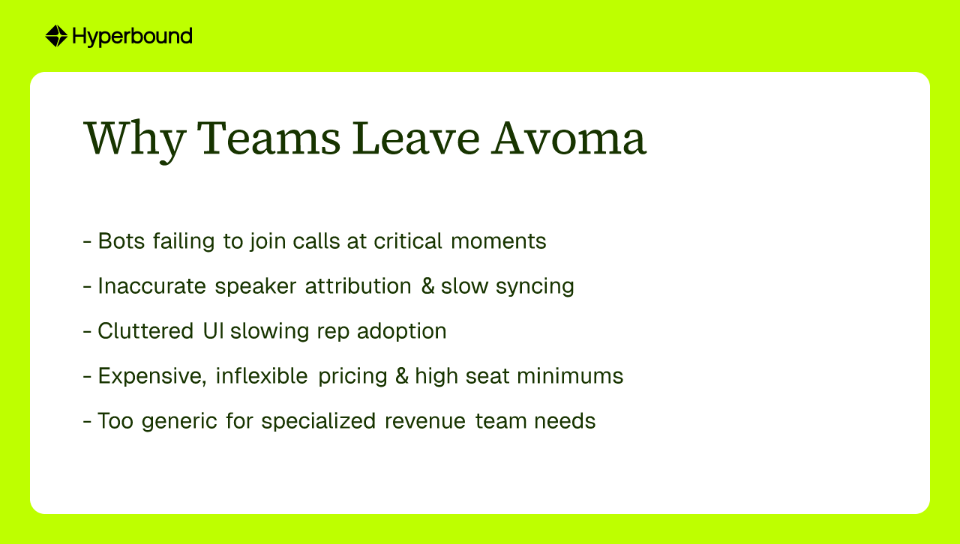
You're here because Avoma isn't quite cutting it anymore. Maybe the bot keeps failing to join calls at the worst moments, the speaker attribution is constantly off, or the pricing model doesn't scale the way your team does. Whatever the trigger, you're not alone — and you're smart to be strategic about what comes next.
But here's the problem with nearly every "Avoma alternatives" list out there: they're generic. They throw 10 tools at you with no context for which one fits your actual situation. You end up more confused than when you started.
This guide is different. Before recommending anything, let's diagnose why you're leaving Avoma — because the right replacement depends entirely on what's broken.
The most common reasons teams look for Avoma alternatives fall into a few honest categories:
That last point is the real crux. Once you've outgrown "just record my calls," you need a tool built for your next-level problem.
Here's how to find it. We've grouped the 9 best Avoma alternatives into four lanes based on what your team actually needs:
Find your lane. Pick your tool.
The problem: You have call recordings. You have transcripts. You might even have some post-call analysis. But your reps aren't getting better. Win rates are flat, objection handling is inconsistent, and new hires are taking too long to ramp.
The missing piece? Most conversation intelligence tools tell you what went wrong after the deal is lost — they don't give reps a way to practice and get better before the next call. As one sales leader put it: "Have you considered just prepping and training reps before they hop on calls?" That shift in thinking — proactive practice over reactive analysis — is what separates teams that improve from teams that just review.
Best for: Revenue teams who want to actively build skills and connect practice to real-world performance.
Hyperbound is the Revenue Activation Platform — and it's the only tool in this category built around a continuous improvement loop: Practice → Perform → Activate. Where Avoma stops at meeting notes and basic coaching, Hyperbound closes the gap between insight and behavior change.
The entry point is Hyperbound Practice: AI sales roleplays trained on over 2M+ hours of real B2B sales conversations — not generic scripts. Reps practice cold calls, discovery, demos (complete with screen sharing), objection handling, and renewals with AI buyer personas that push back like real prospects. One sales rep described it as "the first thing they actually stick with because it feels like practicing with a tough prospect."
After every session, AI Scorecards deliver instant, objective feedback on methodology adherence, talk ratios, and missed opportunities. For tenured reps who don't need a full-length generic roleplay, Bitesized Roleplays offer short, focused practice sessions that fit between calls.
The results speak for themselves:
The tradeoff: Hyperbound is a platform for teams committed to building a coaching culture and driving behavioral change. If you only need passive call recording without any practice layer, it's more than you need — but for anyone serious about improving rep performance, it's exactly right.
Best for: Teams already deep in the ZoomInfo ecosystem who want rich post-call deal intelligence.
Chorus combines conversation analytics with ZoomInfo's firmographic data, giving managers powerful context during deal reviews. It's solid for understanding what happened in a call and connecting it to account-level intelligence.
The tradeoff: Chorus is fundamentally an analysis tool. It surfaces what went wrong but provides no native practice environment to fix identified skill gaps. You'll still need a separate solution to actually develop rep skills — which is why many teams pair it with a platform like Hyperbound.
Best for: Teams that need rep certification on new messaging or sales methodologies.
Second Nature offers AI conversation simulations to help reps practice and get certified before rolling out new playbooks or product messaging.
The tradeoff: While it provides simulations, the AI personas are not trained on real sales call data — which tends to produce less realistic, less challenging practice scenarios. Teams that need the most authentic buyer simulation tend to find Hyperbound's call-trained personas more effective at driving retention and behavior change.
The problem: Your reps are drowning in manual data entry. Your CRM is an unreliable mess. You've heard it all — "Salesforce is the absolute bane of my existence" — and you know the root cause: meetings happen, but the data never makes it cleanly into your system of record without hours of manual work.
You need a tool that automatically captures what was said, pulls out action items, and pushes the right information into your CRM without your reps lifting a finger.
Best for: Teams that live in HubSpot or Salesforce and want seamless meeting-to-CRM data flow.
Grain is purpose-built to automate the handoff between your meetings and your CRM. It auto-logs call recordings, AI-generated summaries, and action items directly into your CRM without any manual effort from reps. Research shows that CRM automation can save each user up to 200 hours per year — and Grain is one of the cleanest tools for capturing that time back.
Pricing: Starts with a free plan; paid plans from $19/user/month.
The tradeoff: Grain is excellent at moving data — but it's not a sales performance tool. It won't coach your reps, surface deal risk signals, or give you insight into why a deal is stuck. It solves the admin problem, not the performance problem.
Best for: Teams that want broad tool integrations and powerful transcription across every meeting platform.
Fireflies.ai connects with a massive ecosystem of tools and delivers robust transcription with AI-generated summaries, topic tracking, and smart search. Fireflies delivers exactly that at scale — automatically pulling out action items, key moments, and follow-ups after every call.
Pricing: Free plan with 800 minutes of storage; Pro plan from $18/user/month.
The tradeoff: Fireflies is a meeting intelligence platform, not a sales coaching platform. It will transcribe and organize your calls with impressive accuracy, but it won't tell you where your deals are at risk or help your reps practice their way to better performance.
The problem: You're not building a revenue activation system. You're an individual contributor, a small team, or someone who simply wants great meeting summaries without an enterprise price tag. As one Reddit user put it perfectly: "I'm looking for a free AI-powered app or tool that can help me record meetings and generate clear meeting minutes or summaries afterward."
You need the basics done beautifully — and done for free.
Best for: Individuals and small teams who want unlimited recording and instant summaries at no cost.
Fathom's free tier is one of the most generous in the market — unlimited recording, instant AI-generated summaries, and an interface clean enough that adoption happens naturally. It's one of the most-recommended tools for anyone starting with AI note-taking, with users frequently noting they prefer it over Avoma for its simplicity.
The tradeoff: Fathom is a personal productivity tool. It has no team analytics, no custom coaching scorecards, and no integration into a broader sales enablement or coaching strategy. It's the right tool until your team's needs grow beyond capturing what was said.
Best for: Async-first teams that need to share meeting highlights quickly with colleagues.
tl;dv also offers unlimited free recording, but its standout feature is how easily you can clip key moments from a meeting and share them with teammates — making it ideal for distributed or async-heavy teams. Summarization is solid, and the interface is built for collaboration.
The tradeoff: Like Fathom, tl;dv is designed for capturing and sharing information, not improving performance. It has no features related to sales coaching, skill development, or deal intelligence. It's a great information-sharing tool, not a revenue tool.
Best for: Teams that want live transcription throughout the meeting, not just a post-call summary.
Otter.ai is one of the most widely recognized names in meeting transcription, offering live captions, speaker identification, action item tracking, and integrations with Zoom, Google Meet, and Microsoft Teams. Its free plan covers the essentials well.
The tradeoff: Otter is strong on transcription accuracy and accessibility, but it's not built for sales-specific workflows or coaching intelligence. If you need more than a transcript and basic summary, you'll want to look at tools built for revenue teams.
The problem: You're past basic call recording — you might already have a call intelligence tool. But the data isn't changing outcomes. Win rates are stagnant. You can't pinpoint why. Your reps are getting insights, but those insights aren't translating into better calls, better deals, or faster closes.
You don't need more analysis. You need a system that connects rep behavior to deal momentum, identifies the specific skills holding your team back, and gives you guided actions to fix it — while the deal is still winnable.
That's what Revenue Activation means: turning data into outcomes.
Best for: Revenue teams ready to close the loop between call analysis, skill practice, and winning more deals.
This is Hyperbound's core mission, and it's where the Practice → Perform → Activate model comes fully into focus.
Hyperbound Perform goes beyond single-call analysis. Rather than reviewing conversations in isolation, it looks across every touchpoint in a deal — from the first cold call to the closing conversation — to surface deal-level risk signals and momentum indicators while deals are still recoverable. AI Deal Coaching pinpoints what needs to happen next to move the opportunity forward. It also scores 100% of real customer calls automatically against custom methodology scorecards.
Kota Activate sits above Practice and Perform as the AI orchestration layer. Kota acts as an AI Revenue Analyst — connecting roleplay performance data with real call scoring data to recommend personalized coaching interventions for managers and reps at exactly the right moment. It doesn't just surface a problem; it tells you what to do about it.
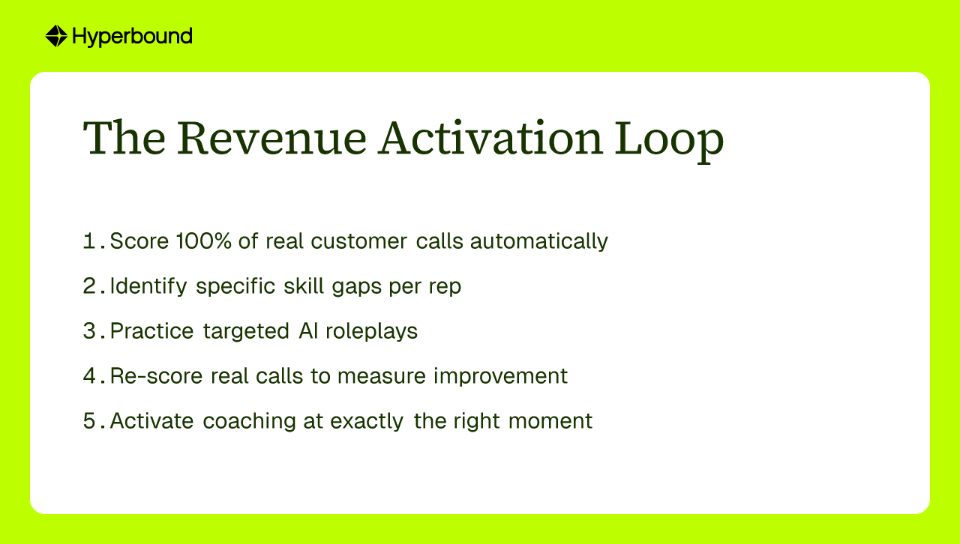
The operational loop looks like this: Score Real Calls → Identify Skill Gaps → Practice Roleplays → Score Real Calls again — continuous improvement, not one-off analysis.
The outcomes this drives are real:
The tradeoff: Hyperbound is a platform for revenue teams serious about growth. It requires a commitment to building a culture of continuous practice and coaching. If you want a passive tool that records calls and generates summaries, this is more than you need. If you want a system that actually changes outcomes — how quickly reps ramp, how consistently they execute, how reliably they close — Hyperbound is built for exactly that.
Still not sure which lane you're in? Here's a simple framework:
.png)
The most common reasons teams seek Avoma alternatives are reliability issues, a cluttered user interface, inflexible pricing, and a lack of specialized features for revenue teams. Many users experience problems like bots failing to join calls, inaccurate speaker identification, and slow data syncing. As teams mature, they often find they need more than a general-purpose meeting assistant and require tools specialized in areas like sales coaching or CRM automation.
Fathom is an excellent free alternative to Avoma for individuals and small teams who primarily need call recording and AI-generated summaries. It offers unlimited recording and a clean interface. However, free tools like Fathom or tl;dv are designed for personal productivity and lack the team analytics, custom coaching scorecards, and deal intelligence features required by growing revenue teams.
Hyperbound's sales coaching focuses on proactive practice rather than just reactive analysis. While most conversation intelligence tools analyze past calls to tell you what went wrong, Hyperbound provides AI-powered sales roleplays that allow reps to practice and improve before a high-stakes call. This approach is built on a continuous improvement loop of Practice → Perform → Activate, which connects skill development directly to real-world performance.
Revenue Activation is the process of turning call data and performance insights into measurable improvements in sales outcomes, such as higher win rates and shorter ramp times. It's a system that moves beyond passive analysis by connecting call scoring (Perform) with targeted skill practice (Practice) and AI-driven coaching recommendations (Activate). The goal is to create a continuous loop that measurably improves rep behavior and drives revenue.
While some platforms attempt to do both, most tools specialize in one area. For example, tools like Grain and Fireflies.ai excel at CRM automation, saving reps hours of manual data entry. Platforms like Hyperbound are purpose-built for sales coaching and performance improvement. The most effective tech stacks often integrate a best-in-class coaching platform with a best-in-class automation tool to solve both problems without compromise.
The best way to choose the right Avoma alternative is to first diagnose your team's primary bottleneck. If your main problem is reps not hitting quota, you need a sales coaching platform (Lane 1 or 4). If your reps are wasting time on manual data entry, you need a CRM automation tool (Lane 2). If you just need basic notes for free, a personal productivity tool is sufficient (Lane 3). Matching the tool to your specific problem is key.
Choosing among Avoma alternatives isn't about finding a one-to-one feature replacement. It's about diagnosing your team's actual bottleneck — and then picking the tool designed to solve that specific problem.
If your team's bottleneck is activity (capturing notes, logging data), the tools in Lanes 2 and 3 have you covered at price points that make sense. If your bottleneck is performance — win rates, ramp time, deal execution — you need something that goes further.
The teams outperforming their peers aren't the ones with the most data. They're the ones who've built a system for turning data into better behavior. That's the Practice → Perform → Activate loop, and it's the difference between revenue teams that analyze their way through a bad quarter and teams that improve their way out of one.
Ready to see what Revenue Activation looks like in practice? Explore Hyperbound and see how teams like Vanta, LinkedIn, and Nivoda are building the continuous improvement systems that compound over time.










Use Cases
Legal