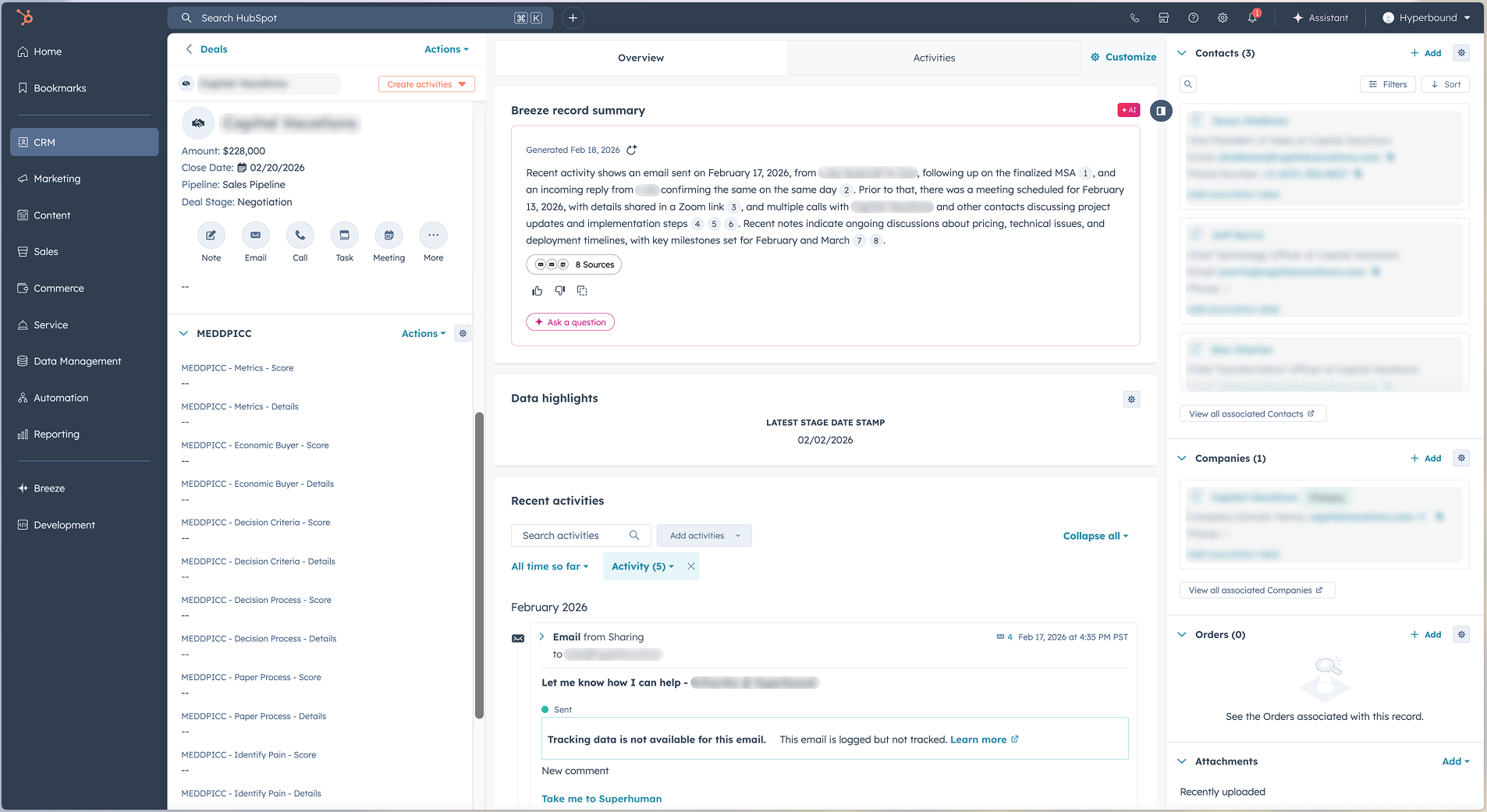
Sales teams don’t struggle with CRM hygiene because they don’t care.
They struggle because hygiene depends on human behavior.
After every call, reps are expected to:
All manually.
Some reps are meticulous. Some are fast but vague. Some update immediately. Some wait until the end of the day or the end of the week.
Even on strong teams, CRM quality ends up varying by:
The result isn’t just messy data. It’s inconsistent truth.
Leaders want clean, reliable pipeline visibility. But the system they rely on depends on manual input — and manual input will always fluctuate.
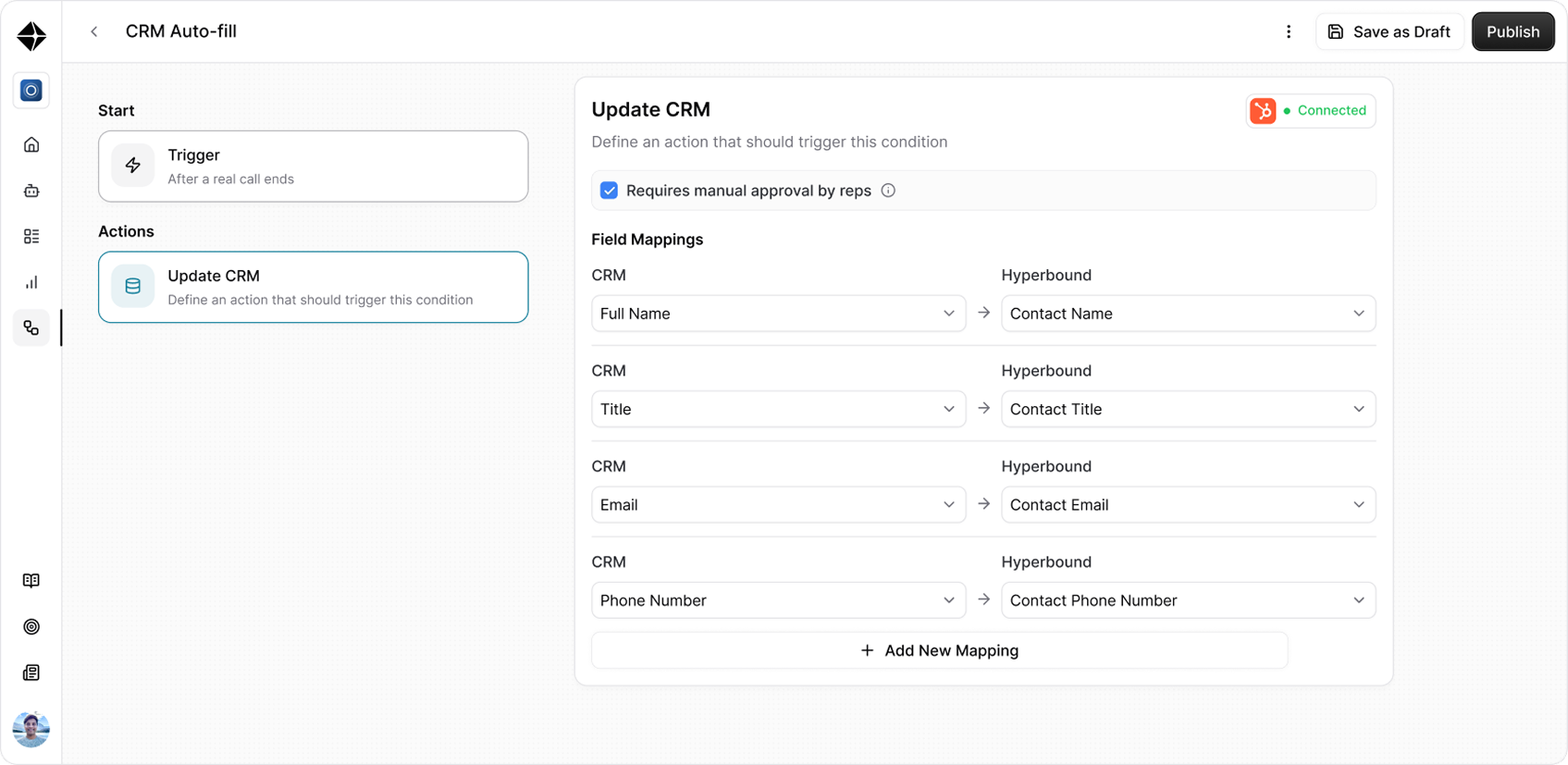
Auto-CRM Fill removes the manual step between conversation and documentation.
Instead of asking reps to remember and translate what happened on a call, Hyperbound analyzes the recorded conversation and extracts the structured deal attributes that matter — automatically.
When a buyer confirms budget, clarifies timeline, outlines the decision process, signals hesitation, or agrees on next steps, that information doesn’t live only in call notes.
It populates the CRM.
No second pass.No delayed updates.No rep re-interpretation.
Just structured fields filled based on what was actually said.
And what it isn’t:
It’s not replacing your CRM.It’s not micromanaging reps.It’s not generating generic summaries that sit unused.
It’s turning real conversations into reliable, structured deal data — without adding lift to the rep.
Every meaningful shift in a deal happens inside a conversation.
Budget gets confirmed or quietly pushed.
A decision-maker reveals themselves or stays hidden.
A timeline tightens or starts to slip.
A champion shows conviction or hesitation creeps in.
These moments are rarely dramatic. They’re subtle. They show up in tone, phrasing, and follow-up questions.
And they’re exactly the details that determine whether a deal progresses or stalls.
Auto-CRM Fill captures structured attributes directly from the conversation, including:
Instead of relying on memory or interpretation, the CRM reflects what was actually said.
No oversimplifying.
No optimism bias.
No lost nuance.
The fields that managers care about most become grounded in real execution.
For reps, CRM updates are rarely the hardest part of the job — just the most constant.
After every call, there’s a mental shift:
From persuasion → to paperwork.
From momentum → to maintenance.
Even when it only takes a few minutes, it adds up. And when the day gets busy, updates get delayed. Or rushed. Or simplified.
Auto-CRM Fill removes that second shift.
When the call ends, the structured deal fields are already updated based on the conversation itself. Reps don’t have to reconstruct what happened or translate it into dropdown language.
That means:
It doesn’t change how reps sell.
It removes the friction that follows it.
For managers, CRM hygiene isn’t about neatness.
It’s about visibility.
When key fields are inconsistent or incomplete, pipeline reviews turn into interpretation exercises. Managers end up asking:
Instead of trusting the data, they interrogate it.
Auto-CRM Fill changes that dynamic.
Because deal attributes are extracted directly from real conversations, managers get standardized, evidence-based visibility across reps and opportunities.
That means:
The CRM stops being a negotiation between rep and manager.
It becomes a reflection of what actually happened.
Structured deal data is valuable on its own.
But its real power shows up when it feeds the system.
When budget, timeline, decision process, risk signals, and next steps are automatically captured from conversations, that data doesn’t just sit in a CRM field.
It becomes fuel for Hyperbound Perform.
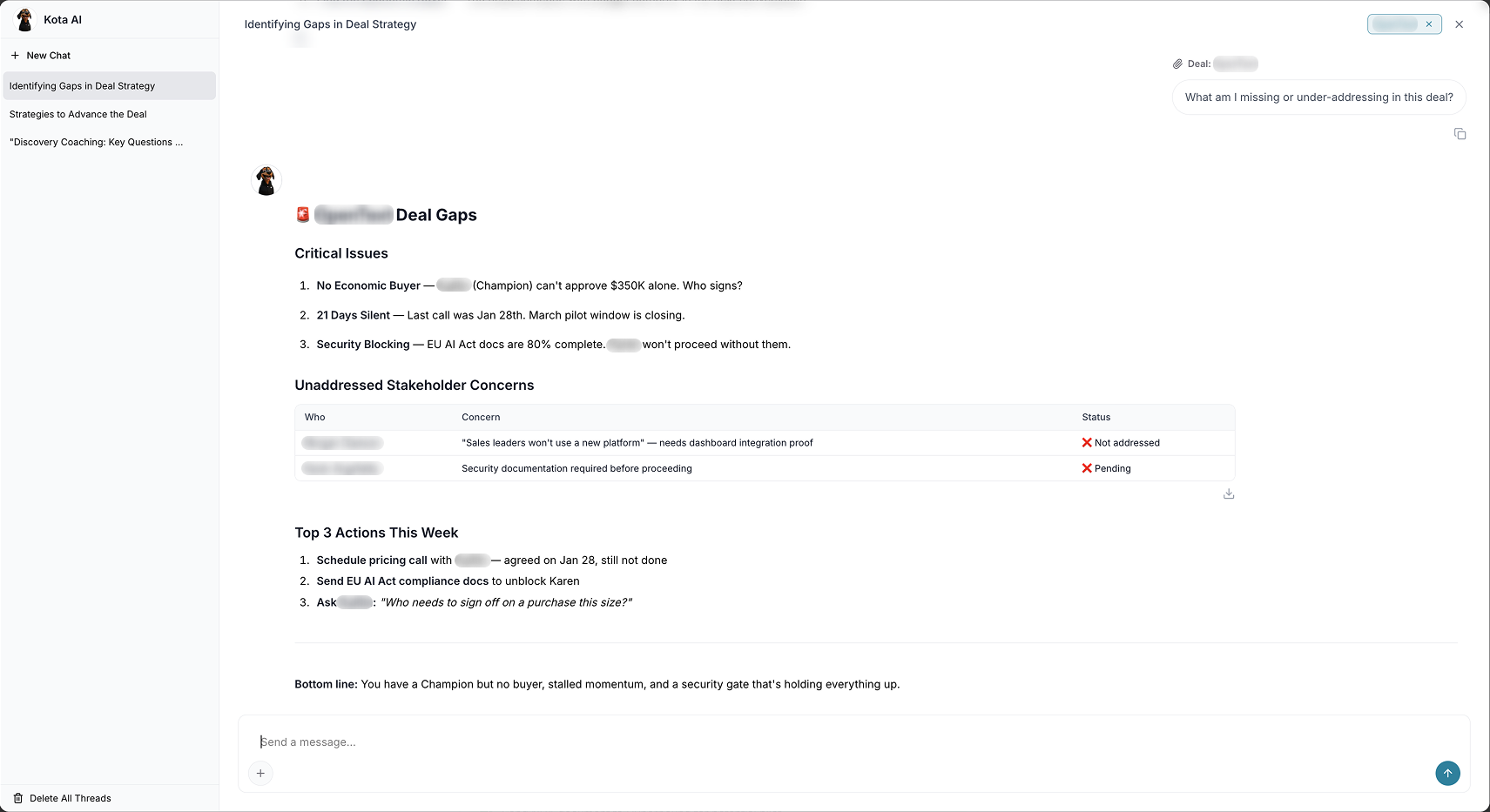
The AI Revenue Analyst can now:
Instead of managers manually scanning notes or relying on instinct, the system analyzes structured attributes at scale.
That shifts CRM data from passive storage to active insight.It’s no longer just “what stage is this deal in?”
It becomes:
.png)
CRMs were never meant to be productivity drains.
But when documentation depends on memory and manual updates, they quietly become one.
Reps spend time reconstructing conversations.
Managers question the accuracy of fields.
Leadership forecasts based on interpretation.
Auto-CRM Fill changes the starting point.
When the system captures deal reality automatically:
The CRM stops being a reporting tool.
It becomes an execution layer.
Because revenue teams shouldn’t have to choose between clean data and productive reps.
They should have both.
Auto-CRM Fill isn’t about cleaner fields.
It’s about removing friction from selling and replacing guesswork with evidence.
When conversation data flows directly into structured deal attributes, execution becomes visible — without asking reps to do more work.
If you’re already using Hyperbound Perform, this layer turns every call into structured intelligence.
And if you’re evaluating how to improve pipeline visibility without increasing admin burden, it’s worth seeing how it works in practice.
Because the best CRM update is the one no one has to do manually.










Use Cases
Legal