
Ever found yourself wanting to move past surface-level small talk, but the fear of asking the "wrong" thing stops you? You're not alone. Many people worry that trying to deepen a conversation will make them sound stilted, nosy, or like they're conducting a "therapy session."
The dilemma is real: we crave meaningful connections but often lack the tools to build them without creating awkward silence. We see lists of "deep questions" online but, as one Reddit user noted, "If anyone asked me any of those questions I'd probably dismiss them."
This guide will equip you with practical techniques to ask thoughtful personal questions that feel natural, not forced. We'll cover the FORD method, strategies for transitioning conversations, and how to rephrase questions to foster genuine connection.
If you've ever tried using a pre-written list of "conversation starters" or "deep questions," you've likely discovered that they rarely work as advertised. Why?
First, these questions often create what feels like an interrogation rather than a conversation. As one Reddit user pointed out, they can "come across as some kind of therapy session" rather than casual dialogue. The goal of good conversation isn't to extract information but to have a reciprocal exchange.
Second, context matters enormously. A question that works perfectly with a close friend might seem invasive or strange when asked of a new acquaintance. As another user wisely noted, "These questions are best for when a friendly relationship has been established." Timing and relationship depth are crucial factors that most question lists ignore.
Finally, many deep question lists focus too heavily on negative experiences or losses, which can dampen enthusiasm and make people uncomfortable. One Reddit user observed that questions "focusing on negatives and losses might be interpreted with less enthusiasm" – not exactly the recipe for an engaging conversation!
If you're looking for a reliable framework to initiate conversations without being weird, the FORD method is your answer. This widely-recommended approach gives you four safe categories to explore:
According to Harvard's Career Services, this method provides a reliable structure for initiating conversations in almost any setting. It works because these topics are generally non-intrusive while still offering opportunities to find common ground.
Remember, the FORD method isn't a rigid checklist – it's a guide to find topics the other person is comfortable discussing. Pay attention to which category generates the most enthusiastic response, then follow that thread.
.png)
The key to deepening conversations naturally lies in what conversation experts call "vertical curiosity" – the art of digging deeper into a current topic rather than jumping to a new one. This approach feels organic because it builds on what's already being discussed.
Here's how to master vertical curiosity:
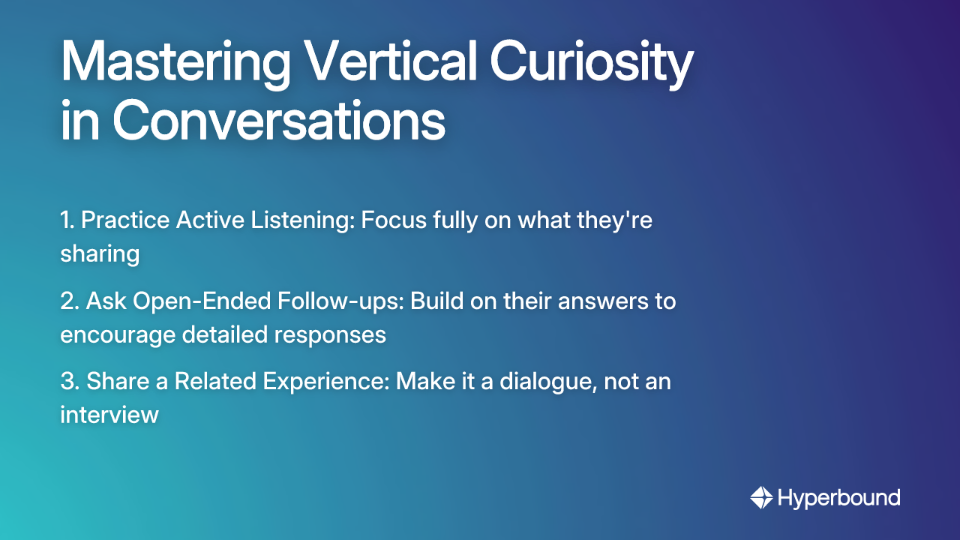
Let's see this transition in action:
Initial FORD question: "What do you enjoy doing outside of work?" (Recreation)
Their response: "I've been getting into photography lately."
Vertical curiosity follow-up: "That's cool! What kind of subjects do you like to photograph?"
Their response: "Mostly landscapes and nature. I find it really relaxing."
Deeper follow-up: "What is it about being in nature with your camera that you find most therapeutic?"
Notice how each question naturally builds on the previous response, creating a smooth path from surface level to more meaningful territory without any awkward jumps.

One of the biggest reasons personal questions can sound weird is poor phrasing. The how of asking is often more important than the what. Here are techniques to make your questions sound more natural:
Questions that focus on negatives can make conversations feel heavy or therapeutic.
Generic questions often sound like clichés or interview prompts.
Here are some side-by-side examples of how to transform therapy-like questions into natural conversation:
.png)
When in doubt, lighten the tone. As one Reddit user wisely suggested, "Remember to paraphrase the question as if you're just articulating it and it's something you would say." Your natural voice and curiosity should come through.
Even the most perfectly phrased question can fall flat if asked in the wrong setting or at the wrong moment. Being attuned to social context is essential for avoiding awkward silence or uncomfortable reactions.
Different settings have different conversational rules:
The most crucial skill is paying attention to how your conversation partner responds:
Different cultures have vastly different norms around personal questions. What's considered normal small talk in one culture might feel invasive in another. If you're speaking with someone from a different background, err on the side of caution with personal topics until you better understand their comfort level.
The goal isn't to memorize a set of perfect questions but to develop a natural curiosity about others that doesn't cross into awkward territory. Here's what that looks like in practice:

The FORD method is a conversational framework that uses four safe topics—Family, Occupation, Recreation, and Dreams—to initiate small talk and build rapport. It provides a reliable starting point for conversations in almost any social or professional setting. By exploring these areas, you can discover common interests and find natural pathways to deeper topics without being intrusive.
You can deepen a conversation without being awkward by practicing "vertical curiosity," which means asking open-ended follow-up questions about the topic already being discussed. Instead of jumping to a new, unrelated "deep" question, listen actively to their response and ask questions that encourage them to elaborate further. This creates a natural and smooth transition from small talk to more meaningful dialogue.
Most lists of "deep questions" fail because they lack context, can feel like an interrogation, and often focus on negative topics that make people uncomfortable. A question that is appropriate for a close friend may seem invasive to a new acquaintance. Successful conversations are reciprocal exchanges, not one-sided information gathering that builds on established rapport.
A great way to make a personal question sound more natural is to frame it with a positive or growth-oriented focus and personalize it to the specific conversation. For instance, instead of asking, "What went wrong with that project?" (negative), you could ask, "What did you learn from that experience?" (growth). Similarly, replace a generic question like "How was your weekend?" with the more engaging, "What was the best part of your weekend?"
You can tell if your questions are making someone uncomfortable by paying close attention to their non-verbal cues and the level of reciprocity in the conversation. Look for signs of discomfort like crossed arms, limited eye contact, or very short answers. If you share something personal and they don't respond with similar openness, it's a signal to pull back to a lighter topic.
If you ask a question that's too personal, the best thing to do is to acknowledge the awkwardness and quickly pivot to a different, lighter topic. You can simply say something like, "Sorry, that might be a bit too deep for now. Anyway, you were telling me earlier about..." This shows social awareness and helps restore comfort, allowing the conversation to continue smoothly.
Building meaningful connections isn't about having a perfect script; it's about being genuinely interested in other people. As one Reddit user insightfully noted, these questions can also be "an EXCELLENT list to get to know yourself, which will give your social skills a boost." This points to an important truth: self-awareness enhances our ability to connect with others.
When you're comfortable with who you are and what you value, you'll naturally ask questions that reflect your authentic curiosity rather than trying to force surface level conversations into something deeper.
Remember that the most memorable conversations rarely come from following a formula. They emerge organically when two people feel comfortable enough to move beyond icebreakers into real human connection – without the weird vibes of a therapeutic interview or an awkward interrogation.
By mastering these techniques, you'll develop the confidence to navigate conversations with ease, creating meaningful connections while avoiding the dreaded awkward silence that comes from asking the wrong question at the wrong time.
The next time you find yourself wanting to deepen a conversation, remember: start safe with FORD, follow their interest with vertical curiosity, phrase questions naturally, and always, always read the room.










Use Cases
Legal