You feel confident. You're not afraid to stand up and speak your mind. But when you open your mouth, the words don't flow as smoothly as you'd like. You might find yourself thinking, "I am confident when it comes to speaking, it's just the fluency I'm lacking in."
This confidence-fluency paradox is surprisingly common. You know what you want to say, but somehow the delivery gets tangled in a maze of hesitations, filler words, and awkward pauses. Your internal confidence doesn't quite match your external expression.
Before diving into solutions, let's clarify what fluency truly means. Fluency isn't just rapid-fire speech—it's the smooth, coherent expression of ideas with appropriate pacing and minimal interruptions.
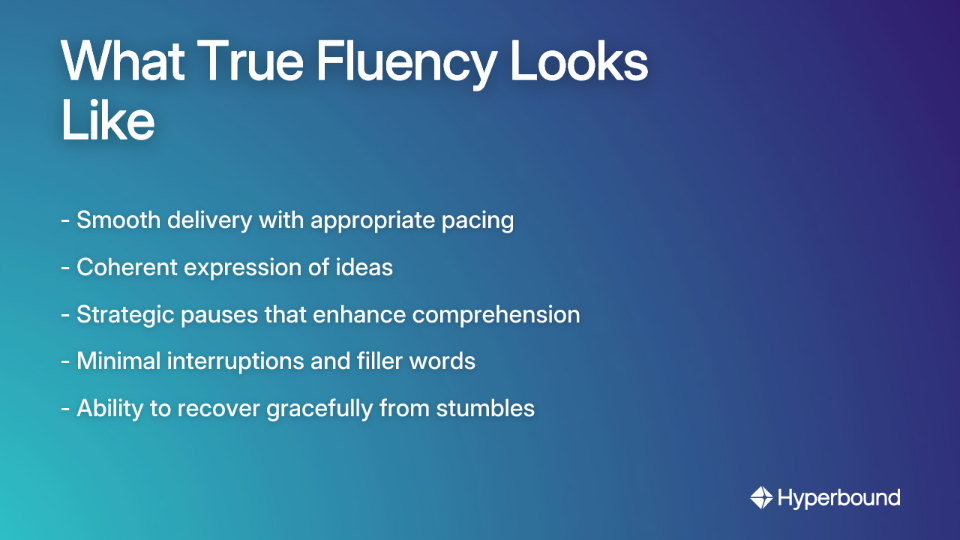
Myth #1: Fluent speaking is always fast speaking. Reality: True fluency is about smooth delivery, not speed. In fact, research shows that an appropriate pace with strategic pauses actually enhances listener comprehension. Focus on clarity over velocity.
Myth #2: Confident speakers never stumble. Reality: Even professional speakers experience moments of disfluency. The difference lies in their ability to recover gracefully. Confidence isn't about perfection—it's about maintaining your composure when inevitable hiccups occur.
Myth #3: You're either born with fluency or you're not. Reality: Fluency is a learnable skill developed through consistent practice and targeted exercises. Your brain can form new neural pathways at any age, allowing you to become more fluent with the right approach.
Speech-Language-Pathologists identify several types of disfluencies that can interrupt your flow:
The good news is that all of these patterns can be improved with targeted practice.
Many fluency issues stem not from your voice but from disorganized thinking. When your thoughts are jumbled, your speech follows suit. Let's address this fundamental issue first.

According to Emerson College's Speech Lab, a clear structure eliminates much of the hesitation in speech:
This mental organization creates a roadmap that reduces the cognitive load while speaking, allowing your words to flow more naturally.
Transitions are the "glue" that holds fluent speech together. Without them, even well-organized thoughts can sound disjointed. Here are techniques to connect your ideas seamlessly:
These verbal bridges not only help your audience follow along but also give you a moment to organize your next thought without awkward silence.

Now for the hands-on work. These exercises, organized from foundational to advanced, will systematically build your fluency skills.
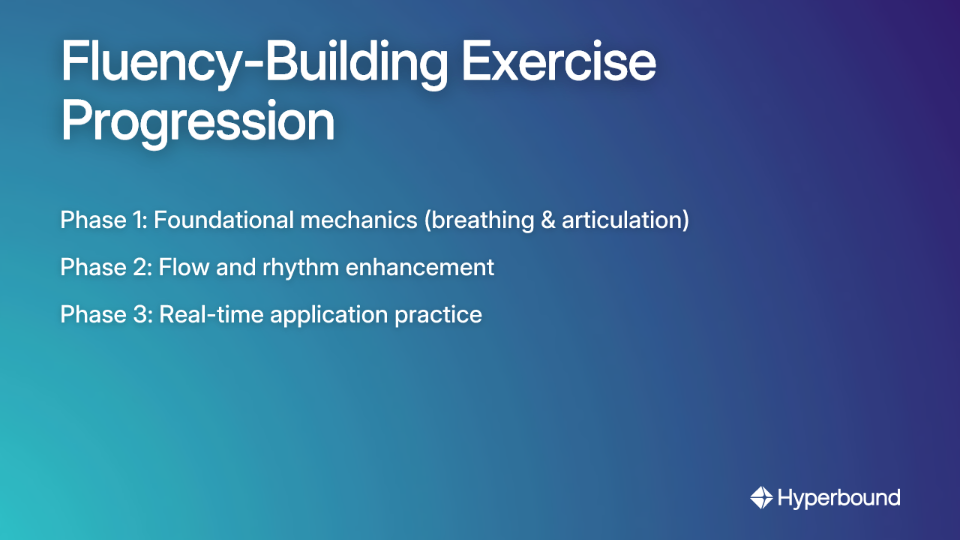
Diaphragmatic Breathing: Your breath is the fuel for speech. Shallow breathing leads to rushed, choppy sentences.
Exercise: Sit or stand straight. Place one hand on your chest and the other on your belly. Inhale slowly through your nose, feeling your belly expand while your chest remains relatively still. Exhale slowly through your mouth. Practice this for 5 minutes daily before any speaking practice.
Articulation & Diction Exercises: Clear articulation is essential for fluency. Try these classic elocution drills:
Exercise 1: Tongue Twisters Start slowly with phrases like "red leather, yellow leather" or "unique New York," focusing on precision rather than speed. Gradually increase your pace as your articulation muscles strengthen.
Exercise 2: Pebbles in Mouth This technique, famously used by Demosthenes (and mentioned by several Reddit users), involves placing a few small, clean pebbles or a wine cork in your mouth while practicing a speech. Focus on enunciating each word clearly despite the obstacle. When you remove the pebbles, your normal speech will feel remarkably fluid.
Mastering Linking Sounds: Natural speech connects words rather than isolating them. Practice these linking techniques from the Advanced Therapy Clinic:
Exercise: Read a paragraph aloud, focusing on connecting:
Slow Speech Drills: Counter-intuitively, slowing down often improves fluency by reducing pressure.
Exercise: Take a paragraph from a book and read it aloud at half your normal speed. Focus on enunciating every syllable and connecting words smoothly. Gradually increase your speed while maintaining clarity.
Filler Word Awareness: Those pesky "ums" and "ahs" can be eliminated with conscious practice.
Exercise: Record yourself speaking for 2-3 minutes on any topic. Listen back and count every filler word. Simply becoming aware is the first step to reduction. Challenge yourself to replace fillers with strategic pauses.
Impromptu Speaking Drills: Thinking on your feet is a crucial fluency skill.
Exercise: Write 10 random topics on slips of paper (e.g., "my favorite vacation," "the best way to make coffee"). Pull one out and speak on it for 60 seconds without preparation. Focus on structure and smooth transitions rather than perfect content.
Out-Shout the Highway: This unconventional but effective exercise strengthens your volume and fullness of voice while maintaining control.
Exercise: Find a noisy environment (like standing near a busy road) and practice projecting your voice without straining. Focus on using breath support rather than throat tension.
Mirror Recitation Tool: Visual feedback enhances awareness of body language issues that may be affecting your fluency.
Exercise: Practice a speech in front of a mirror, observing your facial expressions, gestures, and posture. Ensure your nonverbal communication supports rather than distracts from your verbal message.
Incline and Running Recitation: Physical exertion while speaking builds breath control and mental focus.
Exercise: Recite a memorized passage while walking up a gentle incline or jogging slowly. Focus on maintaining even breath and clear articulation despite the physical challenge.
Perfectionism is the enemy of fluency. Instead of aiming for flawless delivery, set incremental goals:
Celebrate these small wins rather than fixating on every stumble.
Practicing in isolation has limits. Consider these options for feedback and growth:

The confidence-fluency paradox is solvable with commitment to practice. Remember:
Start today by selecting just one or two exercises from this guide—like the 60-second impromptu speeches or filler word awareness—and commit to practicing them three times a week. Your vocal image will gradually transform from confident-but-halting to confidently fluent. The bridge between thinking clearly and speaking clearly is simply consistent, targeted practice.
Confidence is the internal belief in your message and abilities, while fluency is the external skill of delivering that message smoothly and clearly. Many people experience the paradox of feeling confident internally but struggling with delivery, which can manifest as hesitations or filler words. You can be highly confident in what you want to say but still need to develop the practical skills of fluent speech.
You can start seeing noticeable improvements in your speaking fluency within a few weeks of consistent, targeted practice. The key is consistency, not intensity. Committing to 10-15 minutes of specific drills three to five times a week will build new habits and strengthen the neural pathways for smoother speech much faster than infrequent, long sessions.
Structuring your thoughts before you speak creates a mental roadmap, which significantly reduces cognitive load and prevents the hesitations that come from disorganized thinking. When your mind is clear on your core message and main points, your speech naturally becomes more coherent and fluid, allowing you to focus on delivery rather than searching for what to say next.
The most effective method is a two-step process: first, build awareness by recording yourself, and second, consciously replace filler words with strategic pauses. You cannot eliminate a habit you aren't aware of. Once you're conscious of the problem, practice pausing for a second when you feel the urge to use a filler. This not only eliminates the "um" but also makes you sound more thoughtful and confident.
Yes, you can significantly improve your fluency by practicing on your own using drills for breathing, articulation, and pacing. However, incorporating objective feedback will accelerate your progress. External feedback from a speaking partner, a group like Toastmasters, or AI-powered tools can help you identify blind spots that solo practice might miss.
No, speaking fast is a common myth; true fluency is about speaking at an appropriate, controlled pace for clear and smooth delivery. Rushing your speech often leads to mistakes and listener confusion. Effective communicators use strategic pauses and vary their pace to enhance comprehension. The goal is clarity and coherence, not speed.









Use Cases
Legal