
You've got mountains of sales data and a team with varying experience levels. But sometimes it can be overwhelming to have so much data and not know where to start. Should you be examining call recordings? Tracking conversion metrics? Analyzing pipeline velocity? And how do you make sense of the performance differences between your eager new hires, your seasoned veterans, and your standout top performers?
If you're nodding along, you're not alone. Many sales leaders feel they're drowning in data but starving for actionable insights.
The key to unlocking sales performance lies not in treating your team as a monolith, but in segmenting your analysis across three critical groups: New Hires, Tenured Reps, and Top Performers. Each segment faces unique challenges and requires different coaching strategies to maximize their potential.
This guide will walk you through a structured process to:
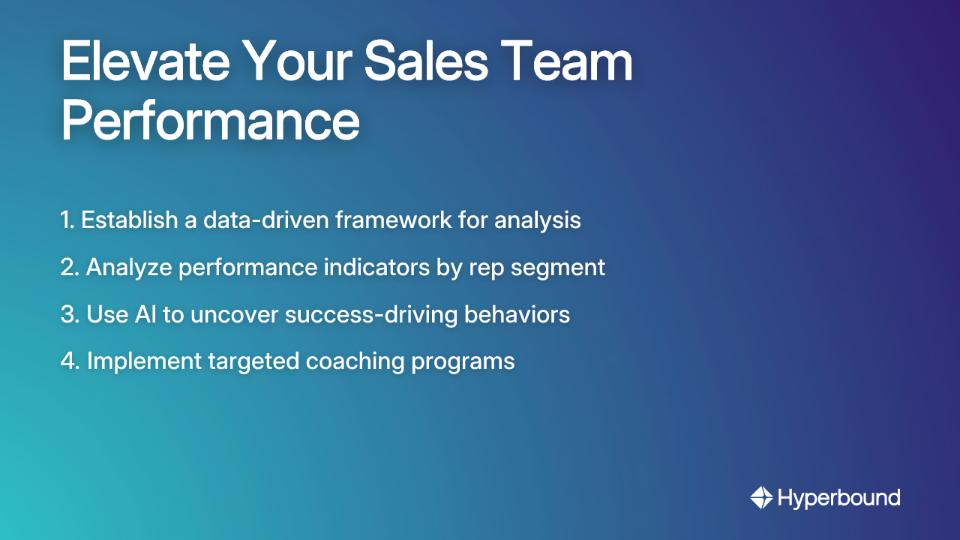
Before diving into segmentation, you need a solid analytical process. Let's follow a systematic approach to transform raw data into actionable intelligence.
Start by collecting data from all relevant sources:
Focus on data cleanliness and integration. Ensure gaps are addressed or explicitly noted to avoid misleading conclusions.
.png)
Align your metrics with business goals. Essential KPIs include:
This is where the magic happens. Don't just look at team-wide averages. Break down your KPIs by:
Translate your insights into specific initiatives with measurable goals. Example: "Increase new hire deal conversion rate from 12% to 18% within 90 days by improving their discovery call skills."
Ensure transparency with the team about goals and the reasoning behind new coaching initiatives. Regularly check in on progress and be willing to adjust based on feedback and results.
Primary Goal: Reduce ramp time and accelerate productivity.
Key Metrics to Track:
What to Look For: Where are your new hires getting stuck? Are they struggling with the initial pitch, objection handling, or discovery? Low conversion rates at specific stages are red flags that require immediate attention.
For example, if new hires are booking initial meetings but failing to advance prospects to the next stage, their discovery skills likely need improvement. If they're making plenty of calls but booking few meetings, their opening pitch may need refinement.
Primary Goal: Re-engage experienced reps and ensure they adapt to new strategies.
Key Insight: Experience, while valuable, does not always equal high performance. Tenured reps can become resistant to change and new technologies.
Key Metrics to Track:
What to Look For: Are your tenured reps hitting quota but using inefficient methods? Are they ignoring new playbooks? This segment requires coaching that respects their experience while introducing modern techniques. If you notice a tenured rep's conversion rate declining quarter over quarter, it may indicate they're not adapting to market changes or new buyer behavior patterns.
Primary Goal: Identify the specific, replicable behaviors that make them successful so you can scale those behaviors across the team.
This is not just about quantitative metrics (they're already hitting their numbers). This requires qualitative analysis of their actual conversations and techniques.
Key Questions to Answer:
The Challenge: Manually analyzing hundreds of calls to find these nuggets is virtually impossible. This is where AI-powered analysis becomes invaluable.
Manually sifting through call recordings to find what your top reps are doing differently is a massive time sink and prone to bias. Modern AI tools can automatically analyze thousands of calls to identify the specific behaviors that differentiate your top performers from the rest of the team.
Hyperbound's AI Real Call Scoring platform analyzes thousands of your actual sales calls to uncover the specific techniques, talk tracks, and behaviors that make your top sales representatives successful.
How it Works:
For example, Hyperbound might reveal that your top performers ask an average of 3 more clarifying questions during discovery calls than your mid-performers, or that they spend 15% more time discussing business outcomes rather than features. These insights transform your analysis from a guessing game into a data-driven science, giving you a clear blueprint of "what good looks like" at your organization.
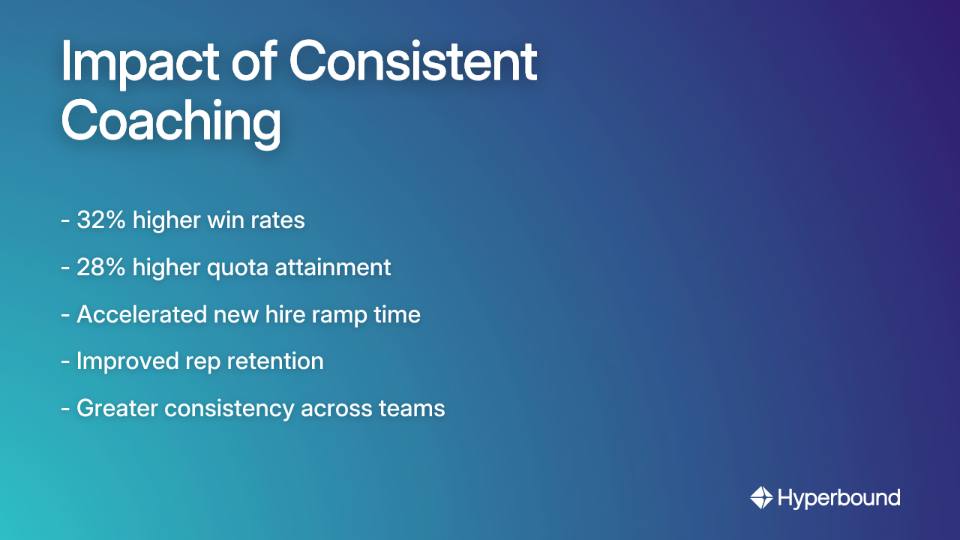
Insights are useless without action. A modern coaching program is essential for turning analysis into behavior change and revenue growth. The impact is significant: organizations with consistent coaching see 32% higher win rates and 28% higher quota attainment, according to research from Korn Ferry.
Here's how to build a program that works for every segment:
Hyperbound's AI Sales Roleplays allow you to turn the winning behaviors you've identified into hyper-realistic practice scenarios. This provides a safe, repeatable environment for reps to build skills without risking live deals.
For New Hires: Create roleplays that simulate common objections and discovery scenarios, allowing them to practice dozens of times before speaking to real prospects. This dramatically reduces ramp time and builds confidence.
For Tenured Reps: Develop scenarios that force them to use new sales methodologies or competitive talk tracks, helping them break old habits and adopt new strategies without resistance.
For All Reps: Hyperbound's AI Coaching provides instant, personalized feedback after every roleplay and real call. It highlights where they deviated from the playbook and offers suggestions for improvement, enabling continuous self-improvement without waiting for a 1:1 with a manager.
Use the AI-surfaced examples of top-performing calls as a "game tape" library. Share clips of excellent discovery questions or objection handling in team meetings to foster collaborative learning.
The AI can identify specific moments like "great value positioning" or "effective competitive differentiation" to create a searchable library of best practices from your own team's conversations.
Instead of generic coaching, focus on one specific skill for a few weeks (e.g., a "Discovery Call Sprint"). Use AI scorecards to track progress on that specific competency.
For example, if analysis shows your mid-performers aren't asking enough questions about business impact, create a two-week sprint focused solely on improving that skill. The targeted focus drives faster behavior change than trying to improve everything at once.
Use analytics dashboards to track individual and team progress on the skills you're coaching. This allows you to measure the ROI of your coaching initiatives and refine your strategy over time based on what's working.
The Analysis: Using Hyperbound's AI Real Call Scoring, a B2B software company discovered their top performers spent an average of 18% more time on business impact questions during discovery calls compared to the rest of the team. They also identified that top performers responded to pricing objections by asking for clarification about the specific concern rather than immediately offering discounts or justifications.
The Action Plan: The sales enablement team created an AI Sales Roleplay in Hyperbound that simulated a discovery call with a prospect who was vague about their challenges. The AI buyer was programmed to respond favorably when reps asked specific business impact questions, and to raise pricing objections that required clarification.
The Result: After requiring all reps to complete the roleplay scenario at least five times, the team saw a 22% increase in deal size and a 15% improvement in discovery-to-demo conversion rates within the following quarter. Mid-level performers showed the most significant improvement, narrowing the gap between themselves and the top performers.
Stop analyzing your sales team with a broad brush. Start by segmenting your reps, using a data-driven framework to analyze their unique performance patterns, leveraging AI to identify the DNA of a winning deal, and using those insights to power a scalable, personalized AI coaching program.
This targeted approach not only lifts the performance of new and tenured reps but also creates a culture of continuous improvement, turning sales coaching from a manager-led chore into an integrated part of your team's workflow.
Ready to stop guessing what makes your top reps successful? See how Hyperbound can help you analyze, replicate, and scale winning behaviors across your entire sales team.
Sales performance analysis is the process of using data to evaluate the effectiveness of your sales team, strategies, and processes. It involves gathering data from sources like your CRM and call recordings, defining key performance indicators (KPIs), identifying patterns, and using those insights to create targeted action plans. The goal is to move beyond surface-level metrics and understand the specific behaviors and activities that drive revenue.
Segmenting sales reps into groups like New Hires, Tenured Reps, and Top Performers is crucial because each group faces unique challenges and requires different coaching strategies. A one-size-fits-all approach to coaching is ineffective. Analyzing them separately allows you to identify specific friction points and opportunities for targeted improvement across your entire team.
Coaching should be tailored to each segment's needs: focus on foundational skills and confidence-building for new hires, introduce new strategies and technologies for tenured reps, and reverse-engineer the successful behaviors of top performers to scale them. For new hires, use AI roleplays to practice core scenarios. For tenured reps, use data to show the effectiveness of new methods. For top performers, analyze their calls with AI to create a "game tape" library of best practices for the rest of the team.
AI can analyze thousands of sales calls instantly, identifying statistically significant patterns and behaviors that are impossible for a human manager to detect manually. While a manager can review a handful of calls, AI tools can process every single conversation to pinpoint the exact talk tracks and objection handling techniques that correlate with winning deals. This removes subjective bias and provides a data-driven blueprint of what truly drives success.
The first step is to establish a clear framework by gathering and integrating your sales data from all sources, such as your CRM and call platforms. Once you have clean, integrated data, you must define the Key Performance Indicators (KPIs) that align with your business goals. These initial steps provide the foundation for uncovering the insights needed to build targeted and effective coaching initiatives.
The success of a sales coaching program is measured by tracking improvements in both leading and lagging indicators, such as behavior change and revenue growth. Use AI scorecards to track progress on specific competencies (e.g., asking more discovery questions) and correlate this behavioral data with business outcomes like higher conversion rates, shorter sales cycles, and increased quota attainment. This allows you to measure the direct ROI of your coaching efforts.










Use Cases
Legal